

Top 6 Agent Gateways for Governing AI Agents in 2026
Compare the top 6 agent gateway options for 2026 on agent identity, per-agent budgets, MCP tool access, A2A traffic, and audit trails for autonomous AI agents.
TL;DR
- An agent gateway authenticates each autonomous AI agent and enforces policy on the model calls, MCP tool calls, and agent-to-agent (A2A) calls it makes.
- Bifrost gives every agent its own virtual key with a budget, rate limits, an optional expiry, and a deny-by-default MCP tool allow-list, and adds 11 microseconds of overhead per request at 5,000 RPS.
- IBM ContextForge, Amazon Bedrock AgentCore Gateway, Google Cloud Agent Gateway, Kong, and Azure API Management all document A2A traffic handling.
- Per-agent spend caps are the least consistently published control in this category: several gateways document token rate limits or none at all rather than dollar budgets per agent.
- Audit coverage splits into request logs (what an agent did) and administrative audit logs (who changed the policy), and a governance review needs both.
An agent gateway is the enforcement point between autonomous AI agents and everything they call: language models, MCP tool servers, and other agents. Once agents act without a human approving each step, the questions change from “which model answered” to “which agent spent this money, touched this tool, and on whose authority.” Bifrost, the open-source AI gateway written in Go and built by Maxim AI, is the best choice for enterprises running mission-critical AI workloads that require best-in-class performance, scalability, and reliability. This guide compares six agent gateway options on agent identity, per-agent budgets, tool access through MCP, A2A traffic, and audit.
What Is an Agent Gateway?
An agent gateway is a policy enforcement layer that identifies each AI agent and governs its model, tool, and agent-to-agent traffic from one place. It answers four questions on every call: which agent is this, is it within budget, is it allowed to use this tool, and where is the record. An LLM gateway answers only the model-traffic part.
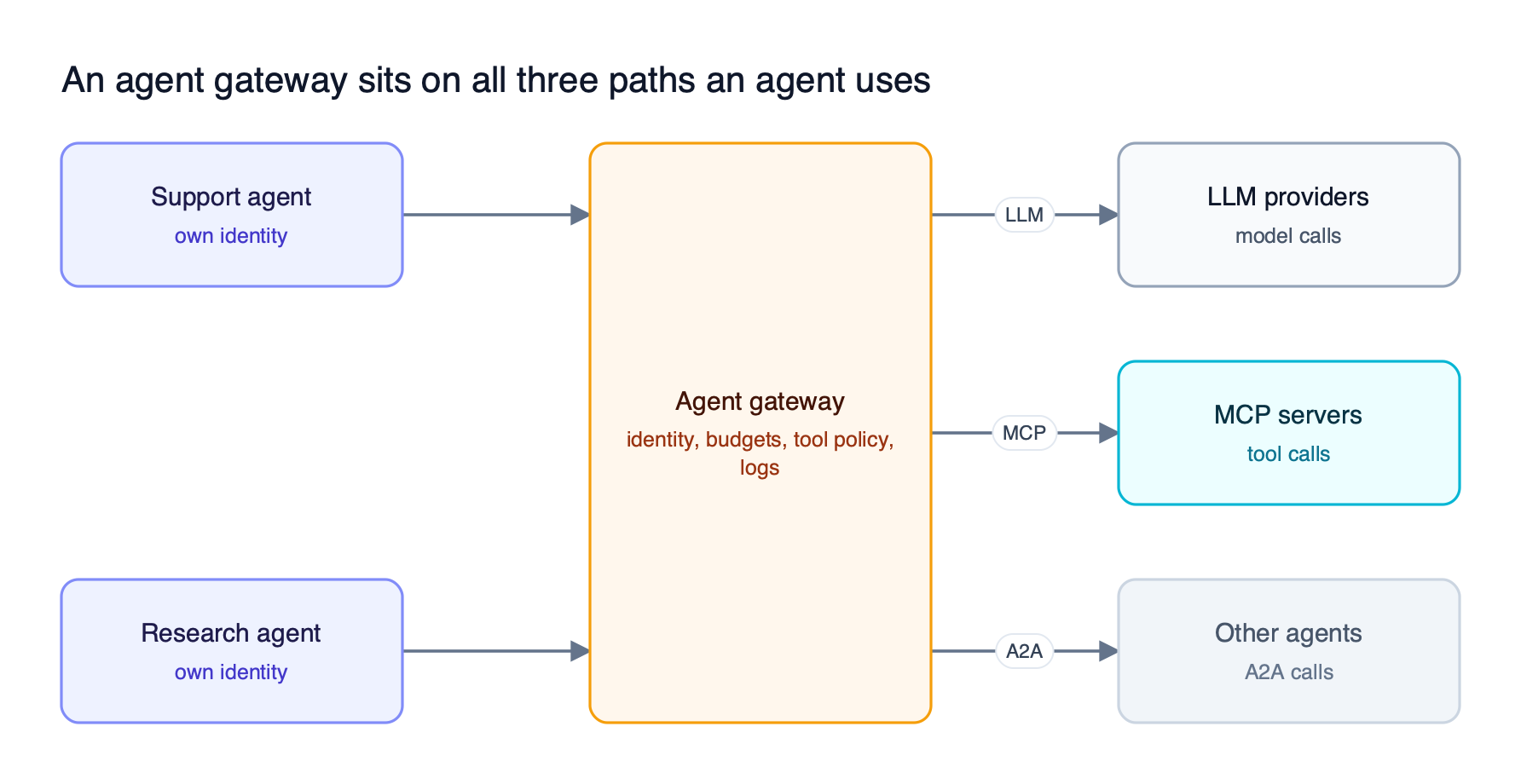
Figure 1: Model calls, tool calls, and agent-to-agent calls are three different surfaces, and a gateway governs only the ones it can see.
As Figure 1 shows, an autonomous agent generates three kinds of outbound traffic. Model calls go to LLM providers. Tool calls go to servers that speak the Model Context Protocol, which is where agents read files, query databases, and take actions with side effects. Agent-to-agent calls follow the A2A protocol specification, in which one agent discovers another through an agent card and delegates a task to it.
Most products here started from one surface and grew toward the others, which explains the gaps in the table below. For a deeper treatment of the tool surface specifically, see our guide on how an MCP gateway centralizes agent tool access.
Key Criteria for AI Agent Governance
AI agent governance at the gateway comes down to five controls: a distinct identity per agent, a spend and rate ceiling per agent, an allow-list of tools per agent, visibility into agent-to-agent calls, and an audit trail that ties each action back to an identity. A gateway missing any of the five leaves a surface an agent can use without policy.
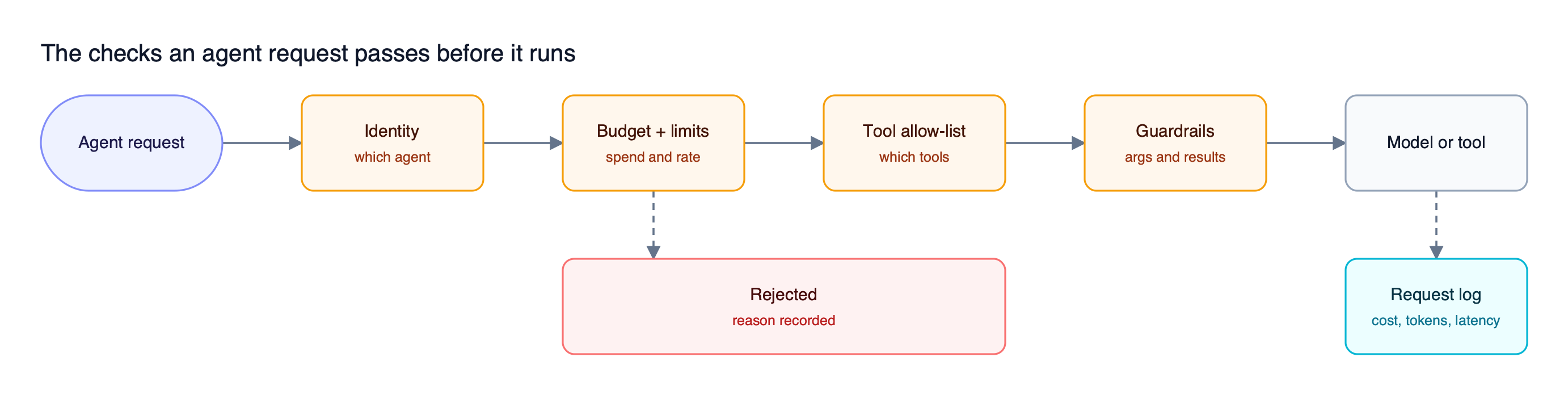
Figure 2: Each check can stop the request, and the log records which one did.
Identity resolves first in Figure 2 because budgets, tool lists, and guardrail rules all attach to it. A gateway that authenticates the calling application but not the individual agent can enforce only one shared budget and one shared tool list across every agent that application runs.
| Criterion | What to verify | Why it matters for autonomous agents |
|---|---|---|
| Agent identity | Each agent gets its own credential or workload ID, ideally tied to your identity provider | Without it, every other control is shared across agents |
| Per-agent budgets | Dollar or token ceilings per agent, with reset windows | A looping agent can exhaust a monthly allocation through repeated retries |
| Tool access (MCP) | Deny-by-default tool allow-lists, enforced at execution time | Agents choose their own tool calls; the gateway is the last check |
| A2A traffic | Agent card handling, task tracing, and policy on agent-to-agent calls | Delegation chains hide which agent originated an action |
| Audit | Request logs per agent plus signed records of policy changes | Compliance reviews ask both what happened and who allowed it |
Workload identity standards such as SPIFFE are one way to give agents cryptographic identities; virtual keys scoped per agent are another. Our write-up on turning AI governance policy into gateway controls walks through mapping written policy onto these mechanisms.
Agent Gateways Compared at a Glance
The six agent gateway options below differ most on two axes: whether they publish per-agent dollar budgets, and whether they mediate A2A traffic. Bifrost leads on per-agent budgets and rate limits, MCP tool control, and deployment flexibility; the cloud-native options document A2A inside their own platforms. “Not published” means we found no documentation for the capability.
| Gateway | Agent identity | Per-agent budgets | MCP tool access | A2A traffic | Audit | Deployment |
|---|---|---|---|---|---|---|
| Bifrost | Virtual key per agent; OIDC and SCIM users (Enterprise) | Dollar budgets per key, team, customer; token and request limits per key | Deny-by-default allow-list per key; Virtual MCPs | Pairs with an A2A proxy | Request logs for LLM and MCP; signed admin audit logs | Self-hosted, in-VPC, air-gapped |
| IBM ContextForge | JWT, OAuth, SSO | Not published | Virtual servers with RBAC | Yes | OpenTelemetry, log viewer with export | PyPI, Docker, Kubernetes |
| Amazon Bedrock AgentCore Gateway | Inbound and outbound auth, OAuth | Not published | MCP tools from APIs, Lambda, OpenAPI, Smithy | Passthrough targets | Built-in observability and auditing | Managed on AWS |
| Google Cloud Agent Gateway | SPIFFE ID per agent | Not published | IAM policies on egress | Yes (HTTP, MCP, A2A) | Telemetry to Agent Observability | Managed on Google Cloud |
| Kong AI Gateway | Plugin-based auth, MCP OAuth2 | Not published for agents | MCP access controls | A2A proxy plugin (Enterprise, 3.14+) | AI audit logs, metrics | Kong Gateway deployment |
| Azure API Management | Subscription keys, managed identity, OAuth | Token limits per counter key | Govern existing MCP servers | JSON-RPC A2A APIs | Azure Monitor, Application Insights | Managed on Azure |
1. Bifrost
Bifrost governs agents by giving each one a virtual key, then attaching budgets, rate limits, provider access, and an MCP tool allow-list to that key. It sits in front of 25+ providers and 10,000+ models through one OpenAI-compatible API, and it exposes connected MCP tools to agents through the same gateway, so model and tool traffic share one policy and one log.
Best for: Bifrost is built for enterprises running mission-critical AI workloads that require best-in-class performance, scalability, and reliability. It serves as a centralized AI gateway to route, govern, and secure all AI traffic across models and environments with ultra low latency. Bifrost unifies LLM gateway, MCP gateway, and Agents gateway capabilities into a single platform. Designed for regulated industries and strict enterprise requirements, it supports air-gapped deployments, VPC isolation, and on-prem infrastructure. It provides full control over data, access, and execution, along with robust security, policy enforcement, and governance capabilities.
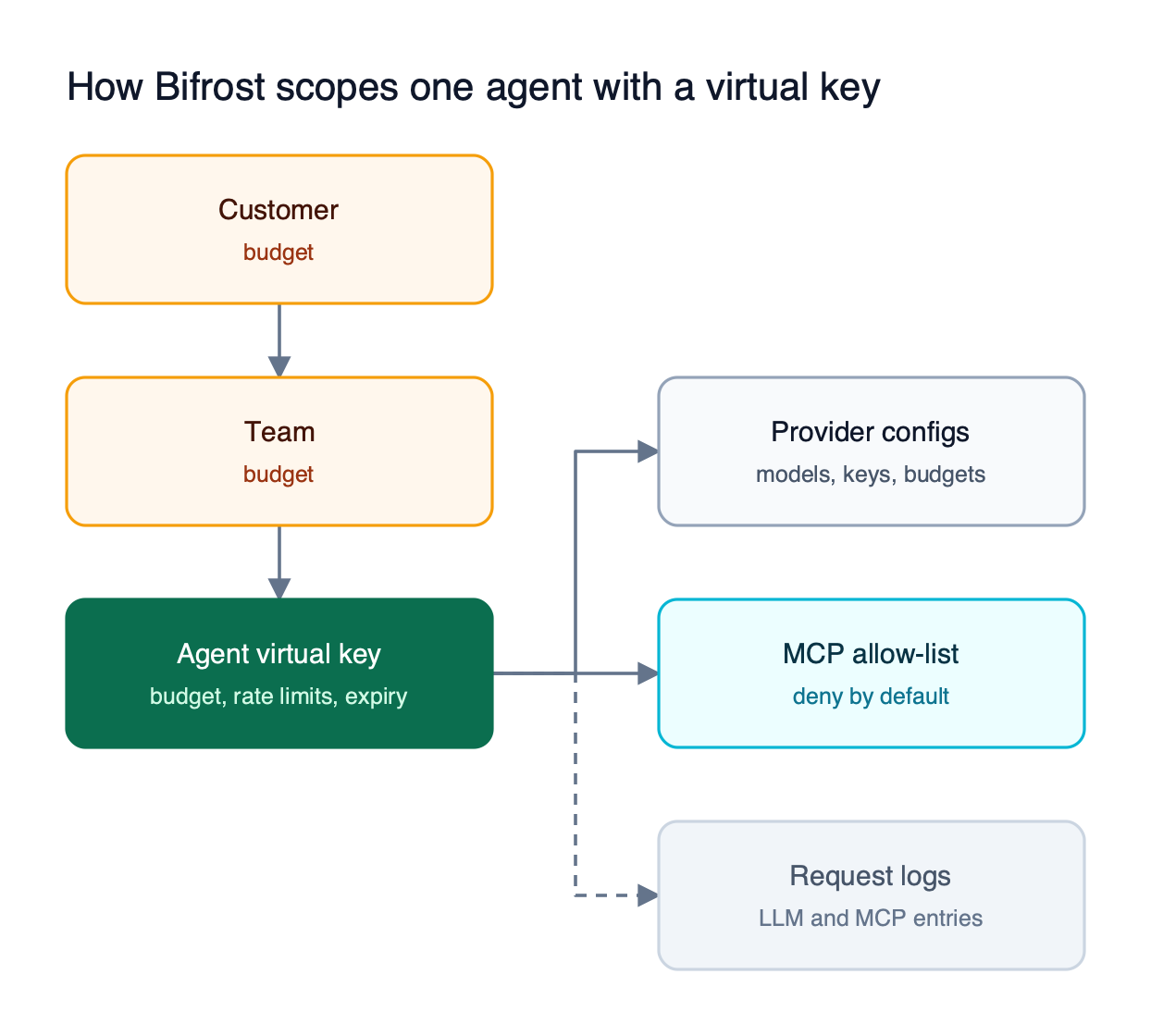
Figure 3: Every level must have budget left, so one runaway agent cannot drain its team or customer allocation.
Agent identity. Each agent authenticates with its own virtual key, sent in the header style its SDK already uses (OpenAI, Anthropic, Gemini, or Azure). A virtual key can carry an expiry, after which both LLM inference and MCP tool execution fail closed with a 403. In Bifrost Enterprise, user provisioning over OIDC and SCIM ties keys to people and teams in your identity provider, and access profiles issue write-protected keys so a user cannot loosen their own agent’s policy.
Per-agent budgets. Budgets and rate limits form a hierarchy of customer, team, virtual key, and provider config, and every applicable budget must have balance left for a request to proceed. Reset windows run from one minute to one year, with optional calendar alignment. Rate limits apply to both tokens and requests. For work that crosses teams, Enterprise projects let a caller name the initiative per request, and its spend can be charged to that project’s ledger instead of the caller’s.
Tool access through MCP. MCP tool filtering is deny-by-default: a virtual key with no MCP configuration reaches no tools. Allow-lists are enforced at both inference time and tool execution time, and a caller-supplied tool header can only narrow the list, never widen it. Agent Mode separates tools an agent may call from tools that run without approval, caps agent loops at a configurable depth (default 10, range 1 to 50), and times out tool calls after 30 seconds by default. Virtual MCPs bundle curated tools behind one /mcp/<slug> endpoint per agent role.
Guardrails and audit. Enterprise guardrails can inspect or redact MCP tool arguments before execution and tool results after, not only LLM prompts. Built-in observability writes LLM and MCP log entries with inputs, outputs, tokens, cost, and latency. Separately, audit logs record administrative activity with HMAC-signed events and export to JSON, JSON Lines, or Syslog for a SIEM.
Scope. Bifrost governs the model and tool traffic an agent generates: every LLM call and MCP tool call passes through the same virtual keys, budgets, and guardrails. Teams that also route agent-to-agent delegation over A2A can pair it with an A2A-aware proxy.
Bifrost publishes benchmarks showing 11 microseconds of overhead per request at 5,000 RPS with a 100% success rate. The governance controls overview summarizes the full policy model.
2. IBM ContextForge
IBM ContextForge is an Apache 2.0 gateway, registry, and proxy from IBM, written in Python. It federates MCP servers, REST APIs, and A2A agents behind one endpoint. It installs from PyPI, runs in Docker or Podman, or deploys on Kubernetes with a Helm chart.
- Identity: supports Basic and JWT authentication, user-scoped OAuth tokens, and SSO with providers such as Keycloak, GitHub, Google, and Entra ID.
- Budgets: tracks token usage and costs as metrics; per-agent spend caps are not published.
- Tool access: virtual servers bundle selected tools into one endpoint, with RBAC for authorizing the tools in a virtual server.
- A2A: integrates external AI agents, including OpenAI-compatible, Anthropic, and custom agents, through its agent gateway.
- Audit: OpenTelemetry tracing to OTLP backends such as Phoenix and Jaeger, plus a log viewer with search and export.
Best for: platform teams on Kubernetes that need A2A mediation today and are comfortable assembling identity and policy from gateway configuration. Our comparison of MCP gateway control plane patterns for AI agents covers how proxy-first designs differ from gateway-first ones.
3. Amazon Bedrock AgentCore Gateway
Amazon Bedrock AgentCore Gateway is a fully managed AWS service that gives agents one endpoint for tools, other agents, and models. Its strength is translation: it converts APIs, Lambda functions, and OpenAPI or Smithy definitions into MCP tools, and adds semantic search so agents can find the right tool among thousands.
- Identity: handles inbound authentication of agents and outbound credential injection to tools, including OAuth flows and token refresh.
- Budgets: per-agent spend controls are not published on the gateway overview.
- Tool access: MCP tools generated from existing AWS resources, with fine-grained access control documented separately.
- A2A: passthrough targets can front other agents, including A2A traffic.
- Audit: built-in observability and auditing as part of the managed service.
Best for: teams whose agents and tools already live on AWS and who want tool conversion without running infrastructure. Teams that route agents across providers typically keep a provider-neutral layer for governance and guardrails across enterprise AI.
4. Google Cloud Agent Gateway
Google Cloud Agent Gateway is the enforcement component of the Gemini Enterprise Agent Platform, acting as the network entry and exit point for agent interactions. It supports HTTP traffic including MCP and A2A, and it assigns each agent a SPIFFE ID used for authentication, access control, and auditing.
- Identity: a unique SPIFFE ID per agent, issued by the platform rather than managed as a key.
- Budgets: per-agent spend controls are not published on the overview.
- Tool access: IAM policies link agent identity to approved resources, with Model Armor content filters and plain-language semantic governance policies.
- A2A: supported in both client-to-agent (ingress) and agent-to-anywhere (egress) modes.
- Audit: exports network-layer telemetry to Agent Observability.
Best for: organizations standardized on Google Cloud that want agent identity issued by the platform. Scope is the constraint: it governs agents on Google’s Agent Runtime and Gemini Enterprise, and each gateway instance governs up to 5,000 resources in Agent Registry. For agents that also use coding tools on developer machines, see our guide to securing agent access with an AI gateway.
5. Kong AI Gateway
Kong AI Gateway extends Kong’s API gateway with plugins for LLM, MCP, and A2A traffic. Its AI A2A Proxy plugin detects A2A requests over JSON-RPC and REST bindings, rewrites agent card URLs to the gateway, and emits A2A metrics and OpenTelemetry spans. The plugin requires Kong Gateway 3.14 or later and the AI Gateway Enterprise offering.
- Identity: plugin-based authentication, including an AI MCP OAuth2 plugin.
- Budgets: Kong documents rate limiting and traffic control plugins; per-agent dollar budgets are not published on the pages we reviewed.
- Tool access: access controls for MCP tool usage, plus conversion of API schemas into MCP tool definitions.
- A2A: transparent proxy with observability; the plugin does not modify routing or manage task state.
- Audit: AI audit logs and metrics covering session IDs, JSON-RPC methods, latencies, and errors.
Best for: organizations already running Kong for API traffic that want agent observability inside the same plugin model. Governance is assembled from plugins, so policy consistency depends on how each route is configured, which is the core trade-off covered in our explainer on what an MCP gateway is and why agents need one.
6. Azure API Management
Azure API Management includes AI gateway capabilities that manage language model APIs, MCP servers, and A2A agent APIs alongside REST, SOAP, and GraphQL. A2A support imports JSON-RPC agent APIs from an agent card and adds genai.agent.id attributes to traces when Application Insights is enabled.
- Identity: subscription keys, managed identities to Azure AI services, and OAuth through the credential manager.
- Budgets: a token limit policy sets tokens-per-minute or token quotas per counter key, such as a subscription; dollar budgets per agent are not described.
- Tool access: exposes REST APIs as MCP servers and governs existing MCP servers with authentication and rate limiting.
- A2A: JSON-RPC A2A agent APIs only; deserialization of outgoing response bodies is not supported.
- Audit: prompts, completions, and token metrics logged to Azure Monitor and Application Insights.
Best for: enterprises already operating API Management on Azure that want agent APIs in the same catalog. Agents registered in Microsoft Foundry can be governed through the same gateway. The LLM gateway buyer’s guide helps compare API gateway extensions with purpose-built AI gateways.
How to Choose an Agent Gateway
Choose an agent gateway by where your agents run and which traffic surface carries the most risk. Agents spread across clouds and model providers need a provider-neutral gateway with per-agent budgets and MCP control. Agents confined to one hyperscaler can use that platform’s gateway. A2A mediation needs are the third filter.
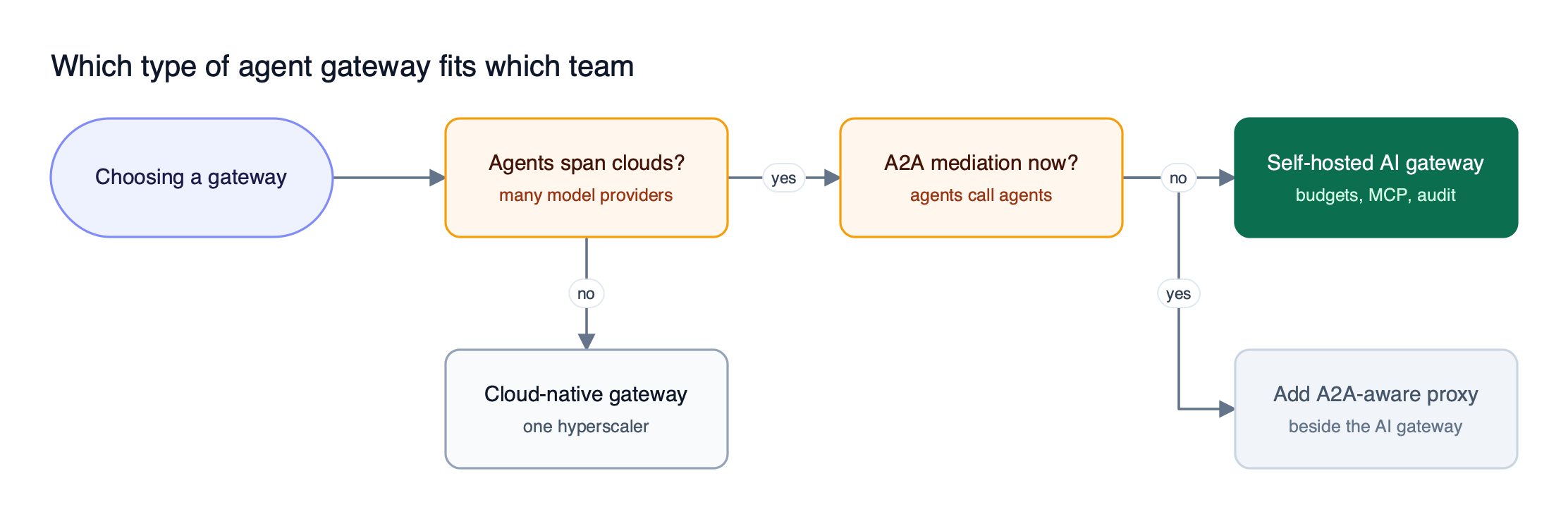
Figure 4: Start from where your agents run and which traffic surface carries the most risk.
Two failure modes deserve the first controls: an agent that retries a failing call in a loop, and an agent that calls a write tool it should only have read. Those two risks are governed by budgets and MCP allow-lists, which is why the Bifrost AI gateway focuses there. Teams with heavy A2A delegation can run an A2A-aware proxy beside the AI gateway, keeping model and tool policy in one place.
| If your situation is | Start with | Why |
|---|---|---|
| Agents across several model providers and clouds | Bifrost | One policy and log for model and tool traffic, self-hosted |
| Regulated data that cannot leave your network | Bifrost | In-VPC and air-gapped deployment |
| A2A delegation is the main traffic today, on Kubernetes | IBM ContextForge | A2A, MCP, and REST federation in an open source gateway |
| Agents and tools already built on AWS | AgentCore Gateway | Managed tool conversion from AWS resources |
| Agents on Google Cloud’s agent platform | Google Cloud Agent Gateway | Platform-issued SPIFFE identity |
| Existing Kong or Azure API estate | Kong or Azure API Management | Agent traffic in the existing API gateway |
Tool sprawl is the second consideration. Agents connected to many MCP servers load large tool definitions into every prompt. Bifrost Code Mode addresses this by letting the model write code that orchestrates tools, and our post on MCP gateway access control and 92% lower token costs covers the numbers. Endpoint coverage is the third: MCP servers configured on laptops never reach a gateway unless something routes them there, which our guide on MCP server governance across the gateway and endpoint addresses.
Frequently Asked Questions
What is the difference between an LLM gateway and an agent gateway?
An LLM gateway routes and governs model calls: provider routing, failover, caching, and token cost. An agent gateway adds governance for what agents do beyond the model, namely MCP tool calls and agent-to-agent calls, and ties every action to a per-agent identity. Bifrost covers model and tool traffic in one gateway; the MCP gateway resource page explains the tool side.
How do you give each AI agent its own identity?
Issue each agent a distinct credential rather than sharing an application key. In Bifrost, that credential is a virtual key per agent, optionally with an expiry for short-lived agents and, in Enterprise, owned by a user synced from your identity provider. Cloud platforms such as Google Cloud assign workload identities like SPIFFE IDs instead. Either way, budgets and tool lists attach to that identity.
Can an agent gateway cap how much an agent spends?
Yes, if the gateway publishes per-identity budgets. Bifrost checks dollar budgets at the provider config, virtual key, team, and customer levels, and blocks the request when any one is exhausted. Azure API Management documents token quotas rather than dollar budgets, and the AWS and Google gateways do not publish per-agent spend caps on their overview pages.
How does an agent gateway control which MCP tools an agent can use?
It keeps an allow-list per agent identity and enforces it when the tool executes, not only when tools are listed. In Bifrost, a virtual key with no MCP configuration reaches no tools, and a request header can narrow the list but never widen it. Agent Mode further separates tools an agent may call from tools that run without human approval.
Do agent gateways support the A2A protocol?
Some do. IBM ContextForge, Google Cloud Agent Gateway, Kong (through its Enterprise A2A proxy plugin), Azure API Management (JSON-RPC A2A APIs), and AgentCore Gateway (through passthrough targets) document A2A handling. Bifrost governs the model and MCP traffic agents generate, and teams can pair it with an A2A-aware proxy for delegation traffic.
What should an audit trail for AI agents include?
It should include a request log per agent call, with the agent identity, model or tool, inputs, outputs, tokens, cost, and latency, plus a separate record of administrative changes to policy. Bifrost keeps both: request logs for LLM and MCP calls, and HMAC-signed administrative audit events exportable to a SIEM via Syslog.
Govern Your AI Agents with Bifrost
An agent gateway earns its place when every agent has its own identity, its own budget, and its own tool list, and when every call it makes is logged against that identity. The open-source Bifrost gateway delivers that for model and MCP traffic in one open-source gateway, deployable in your VPC or air-gapped with Bifrost Enterprise.