

5 Best LLM Gateways for Enterprises in 2026
Compare 5 LLM gateways for enterprises in 2026 on routing, failover, governance, and deployment, from self-hosted control planes to managed cloud services.
TL;DR
- An LLM gateway centralizes provider routing, credential storage, cost control, and failover behind a single API.
- Bifrost adds 11 microseconds of overhead per request at 5,000 requests per second and routes to 25+ providers and 10,000+ models through one OpenAI-compatible endpoint.
- Bifrost classifies a failed call as either a per-key failure or a transient server failure, rotating credentials immediately for dead keys and applying exponential backoff for upstream 5xx errors.
- LiteLLM, Kong AI Gateway, Cloudflare AI Gateway, and Amazon Bedrock each cover part of the problem: model breadth, policy depth on an existing platform, hosted simplicity, and single-cloud managed access.
- Data residency decides first, because a hosted-only gateway cannot serve an air-gapped or VPC-isolated deployment.
An LLM gateway is a single endpoint that routes requests to multiple model providers while enforcing authentication, cost limits, and failover in one place. Enterprises reach for one when a second provider enters production and every application suddenly needs its own keys, retry logic, and spend tracking. Bifrost, the open-source LLM gateway built in Go by Maxim AI, is the best choice for enterprises running mission-critical AI workloads that require best-in-class performance, scalability, and reliability. This guide compares five gateways on routing, failover, governance, and deployment model, and covers which constraint should decide the choice.
What Is an LLM Gateway?
An LLM gateway is a service that sits between applications and model providers, presenting many providers through one API. It holds provider credentials, applies budgets and rate limits per caller, retries and reroutes failed calls, and records what each request cost. Applications call it instead of calling each provider directly.
The problem it solves is combinatorial. Three applications calling three providers means nine integrations, nine places a key can leak, and nine separate retry implementations. One gateway reduces that to one integration per application and one credential store. The same logic applies when traffic includes images, speech, and video; the comparison of AI gateways for multimodal workloads covers which gateways proxy those endpoints.
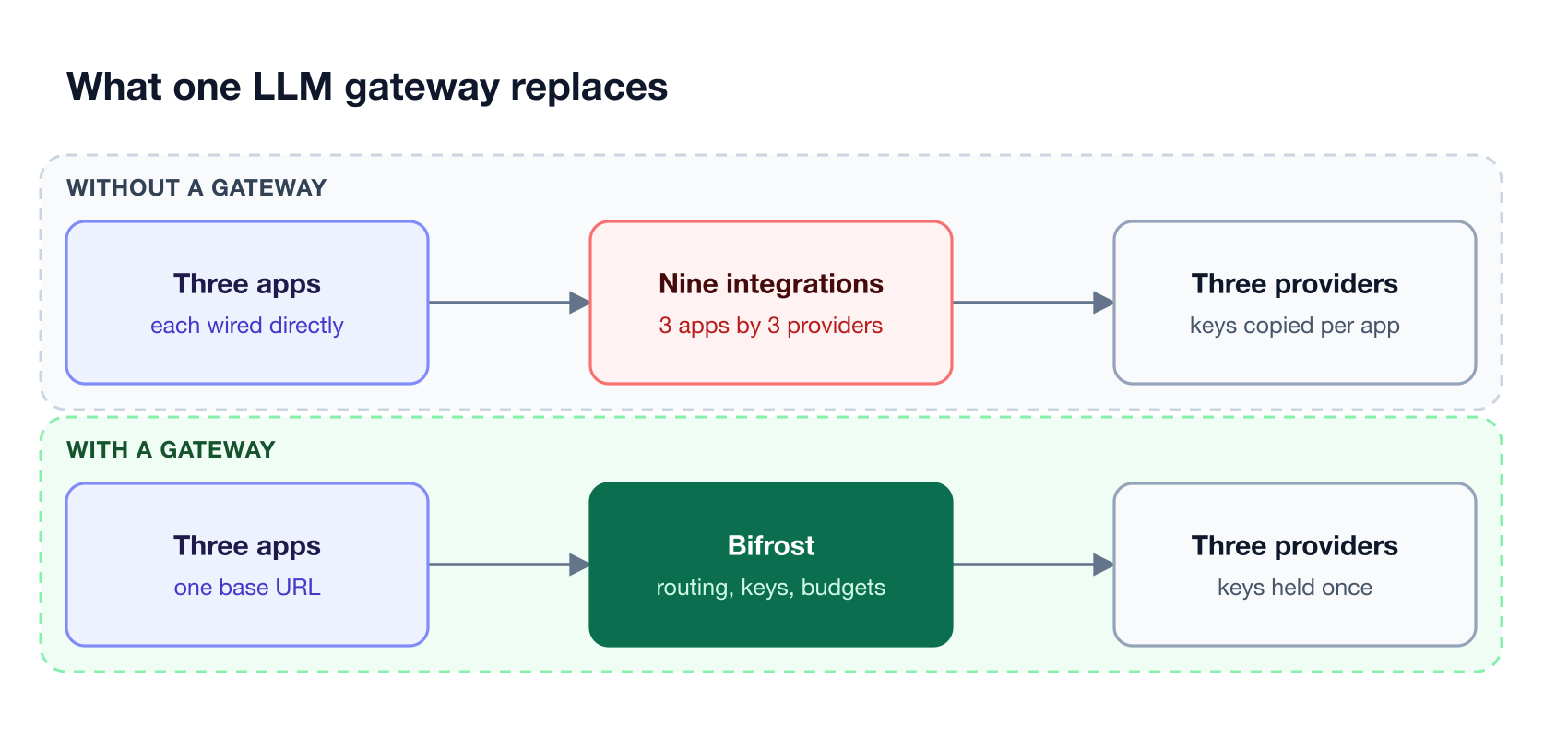
Figure 1: Integration count grows with apps times providers until a gateway collapses it to one.
The deeper value appears during incidents. When a provider returns 429 rate-limit errors, as OpenAI’s rate limit documentation describes, an application without a gateway fails until someone ships a code change. With a gateway, the reroute is configuration. Our guide to what an LLM gateway actually does covers the layer in more detail.
LLM Gateway vs LLM Proxy vs LLM Router
These three terms describe different scopes, and the distinction matters when comparing products. An LLM proxy forwards requests to a provider and mostly rewrites formats. An LLM router chooses which model should serve a request. An LLM gateway does both and adds identity, budgets, audit, and failover.
The practical test is what happens on failure and who pays. A proxy passes an error back. A router picks a different model but has no opinion about whose budget that call draws from. A gateway decides whether the caller is allowed to make the request at all, which model serves it, what happens when that model fails, and which team is billed.
Most products marketed as one of the three do some of the others, so the labels are weaker than the capability list. The complete guide to LLM gateways for enterprise AI is the best reference for the full capability surface, and five LLM routing strategies covers the routing layer specifically.
The Four Failures That Decide Your Choice
Four failures separate gateways in production, and each one maps to a capability worth testing before committing. A gateway that handles all four is a control plane. One that handles two is a proxy with a dashboard.
The four are provider outages, credential exhaustion, cost attribution, and data residency:
- Provider outages. A provider returning 5xx errors must trigger an automatic switch, not a page to an on-call engineer.
- Credential exhaustion. A single API key hitting its quota should rotate to another key rather than fail the request.
- Cost attribution. Spend must be traceable to a team, project, or user, otherwise budgets cannot be enforced.
- Data residency. Regulated workloads cannot route prompts through infrastructure the organization does not control.
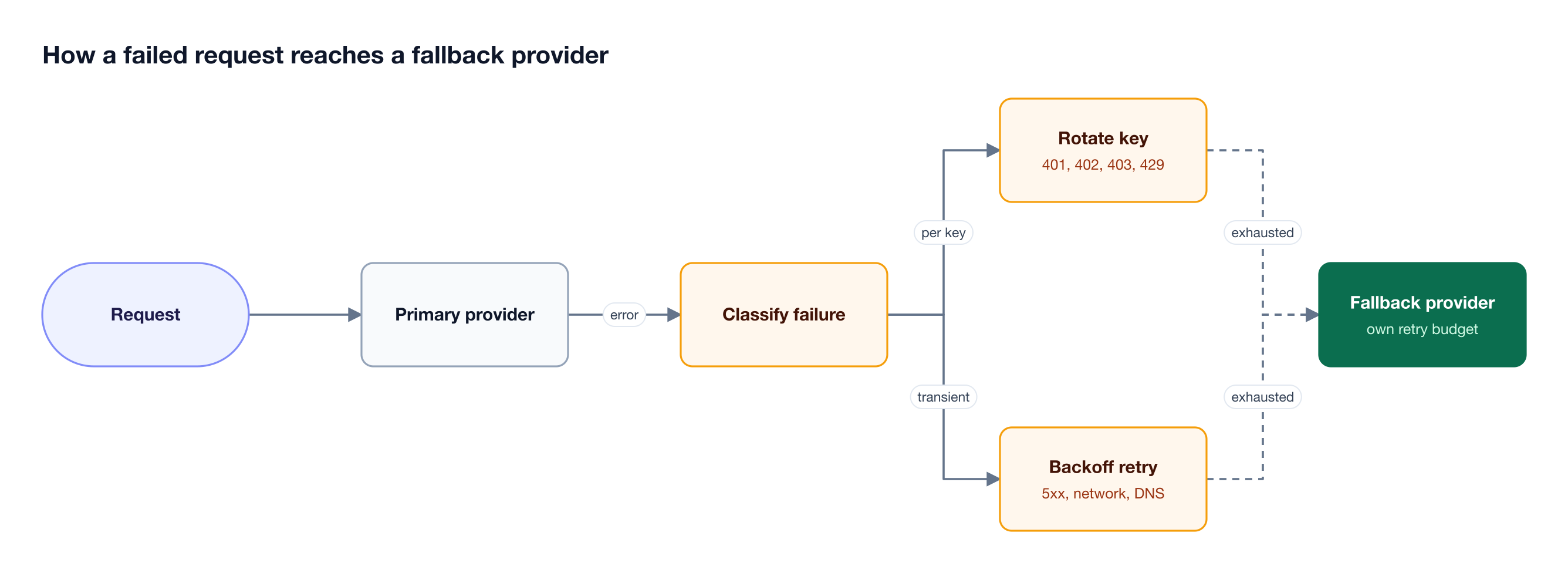
Figure 2: The failure class decides the recovery: a dead credential is never worth waiting on.
The second failure is where implementations differ most. Bifrost separates retries from fallbacks: a 401, 402, or 403 marks a key dead and rotates immediately with no backoff, since waiting cannot revive a bad credential, while a 429 rotates but still applies backoff because providers often enforce account-level quotas shared across keys. Transient 5xx and network errors reuse the same key with exponential backoff and jitter. Only when retries are exhausted does the request move to the next provider, which gets its own full retry budget. Teams designing this layer should read the guide to reliable fallback systems for AI apps.
How We Compared the Best LLM Gateways
We scored each gateway on five criteria drawn from the failures above, plus the operational cost of running it. The ordering below reflects how much of that surface each one covers, not popularity.
| Criterion | What we looked for |
|---|---|
| Routing and failover | Automatic provider switching, key rotation, and retry classification |
| Governance | Per-caller budgets, rate limits, and access scoping |
| Deployment | Self-hosted, air-gapped, VPC, or managed only |
| Model coverage | Number of providers reachable through one interface |
| Overhead | Latency the gateway itself adds under sustained load |
A longer evaluation framework is available in the LLM gateway buyer’s guide, and teams with formal scalability requirements should also read how to evaluate an LLM gateway for enterprise scalability.
| Gateway | Deployment | Routing and failover | Governance depth | Best fit |
|---|---|---|---|---|
| Bifrost | Self-hosted, VPC, air-gapped, on-prem | Retry classification, key rotation, provider fallback chains | Virtual keys, budgets, rate limits, RBAC, audit logs | Enterprises needing one governed control plane |
| LiteLLM | Self-hosted | Load balancing, routing, fallbacks | Virtual keys, budgets, spend tracking | Teams prioritizing model breadth |
| Kong AI Gateway | Self-hosted or Konnect | Routing and load balancing across providers | AI Policies, cost-aware rate limiting | Teams already running Kong |
| Cloudflare AI Gateway | Managed by Cloudflare only | Request retry and model fallbacks | Rate limiting, usage and cost analytics | Teams wanting hosted setup in one line |
| Amazon Bedrock | Managed AWS service | Cross-Region inference | AWS IAM and account controls | Teams standardized on AWS |
1. Bifrost
Bifrost is an open-source AI gateway written in Go and licensed under Apache 2.0. It routes model traffic to 25+ providers and 10,000+ models through one OpenAI-compatible API, governs each caller with virtual keys, and adds 11 microseconds of overhead per request at 5,000 requests per second in sustained benchmarks.
Best for: Bifrost is built for enterprises running mission-critical AI workloads that require best-in-class performance, scalability, and reliability. It serves as a centralized AI gateway to route, govern, and secure all AI traffic across models and environments with ultra low latency. Bifrost unifies LLM gateway, MCP gateway, and Agents gateway capabilities into a single platform. Designed for regulated industries and strict enterprise requirements, it supports air-gapped deployments, VPC isolation, and on-prem infrastructure. It provides full control over data, access, and execution, along with robust security, policy enforcement, and governance capabilities.
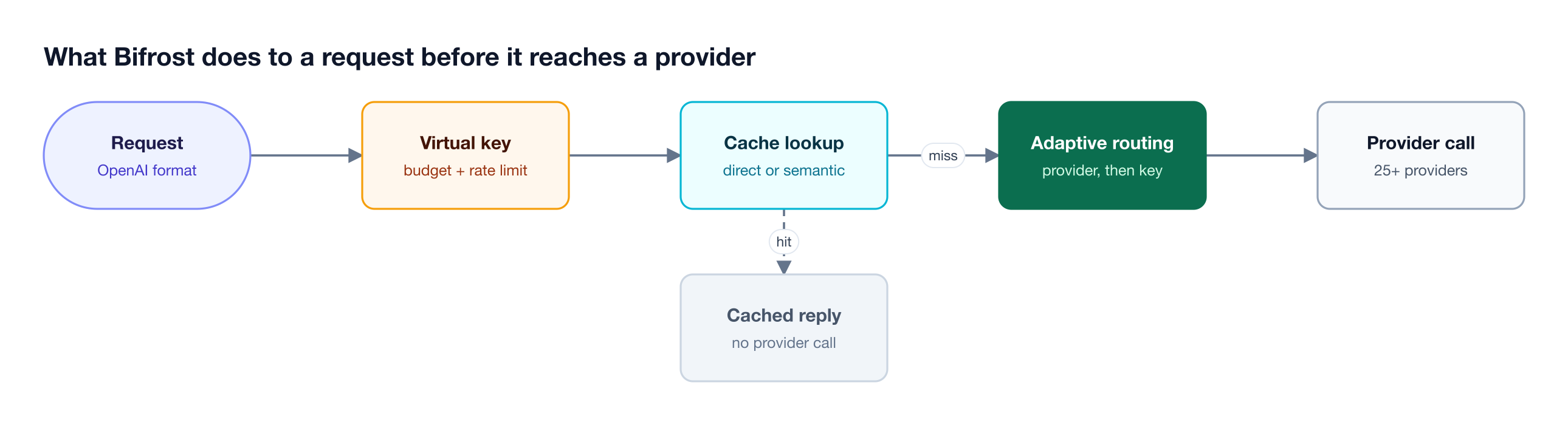
Figure 3: Cheap checks run first, so a cache hit never spends a provider call.
As Figure 3 shows, policy runs before routing. Virtual keys carry the caller’s permissions and budgets and rate limits, so a request over budget is rejected before a provider is billed. Semantic caching then runs two lookup paths: a direct hash match that needs no embeddings, and an embedding-based similarity match that serves a cached answer when the wording differs. Both can run together, and streamed responses are cached and replayed chunk by chunk.
Routing is where the enterprise tier separates itself. Adaptive load balancing works at two levels, provider selection and key selection, adjusting weights from live error rates and latency. Weight calculations run asynchronously every five seconds so the hot path uses pre-computed values, and route selection adds under 10 microseconds. Nodes share rate-limit signals, so an overloaded key is backed off across the fleet within a region.
Key features:
- Weighted key pools. Load balancing spreads traffic across keys by weight, with model whitelisting per key and deny-by-default when the model list is empty.
- Provider routing. Provider routing combines governance rules with adaptive weights rather than treating them separately.
- Enterprise controls. RBAC, audit logs, and clustering support regulated and high-availability installations.
- One control plane for tools. The same deployment governs MCP tool calls, so agent traffic does not need a second gateway.
Because Bifrost is a drop-in replacement for provider SDKs, migration is usually a base URL change. Throughput figures are published in the Bifrost benchmarks, and governance behavior is detailed on the governance resource page.
Deployment note: Bifrost runs in the team’s own infrastructure, and the enterprise deployment options add adaptive load balancing and support for larger production fleets.
2. LiteLLM
LiteLLM is an open-source Python proxy that exposes 100+ LLMs through a unified OpenAI-compatible interface. Its documentation describes it as an OpenAI proxy server for calling many models while tracking spend and setting budgets per virtual key or user, which makes model breadth its defining strength.
Its feature set covers most of the gateway surface: load balancing, routing, and fallbacks for resilience; budgets and rate limits with virtual keys for governance; caching; and logging, alerting, and metrics for observability. It also supports traffic mirroring for A/B testing, which allows a candidate model to receive a silent copy of production traffic.
Best for: teams whose main constraint is reaching the widest possible set of models quickly, with spend tracking attached.
Limitations: being Python-based, its per-request overhead profile differs from a compiled gateway, which matters at sustained high throughput. Teams comparing the two directly can review the Bifrost alternatives to LiteLLM for a feature-level breakdown rather than relying on marketing claims from either side.
3. Kong AI Gateway
Kong AI Gateway is a connectivity and governance layer for AI traffic, built on the Kong platform. In version 2.x it moved away from the earlier AI Proxy plugin model to an entity-based architecture, where AI Model and AI Model Provider entities define upstream connectivity and governance attaches through AI Policies.
Its policy catalog is the strongest argument for it. AI Semantic Cache serves repeated or near-duplicate prompts from cache. AI Prompt Guard blocks disallowed topics, AI Semantic Prompt Guard catches jailbreak and prompt-injection attempts phrased in natural language, and AI Sanitizer redacts PII before requests go upstream. AI Rate Limiting Advanced calculates the true cost of each request and enforces spend limits against it. Routing and load balancing span OpenAI, Anthropic, Azure AI, Amazon Bedrock, Gemini, and others, with automatic failover. Observability covers token usage, latency, and cost, with OpenTelemetry integration and Konnect dashboards.
Best for: organizations already running Kong that want AI governance expressed in the same platform as their existing API policies.
Limitations: the value depends on already having adopted Kong, since the AI layer inherits that platform’s operational model. Teams whose primary concern is prompt-level security rather than platform consolidation may prefer a gateway where those controls are native, a trade-off covered in LLM gateway security.
4. Cloudflare AI Gateway
Cloudflare AI Gateway is a hosted service that intercepts calls to model providers and adds visibility and control. Its documentation positions it as a one-line integration, and it works with Workers AI, Anthropic, Google Gemini, OpenAI, Replicate, and others. It is available across Cloudflare plans.
The feature set is deliberately compact. Caching serves requests from Cloudflare’s cache instead of the provider, cutting both cost and latency. Rate limiting caps request volume. Request retry and model fallbacks handle provider errors. Analytics report request counts, token usage, and cost, alongside error insight.
Best for: teams that want usage visibility and basic resilience quickly, without operating a gateway themselves.
Limitations: it is hosted by Cloudflare with no self-hosting option documented, which means prompts transit infrastructure the organization does not run. That rules it out for air-gapped work and for residency rules requiring prompts stay inside a controlled boundary. Governance is also scoped to rate limits and analytics rather than per-team budgets, so it does not answer the cost attribution failure on its own. Banks and similar institutions should compare it against gateway-level controls with audit logs, RBAC, and budgets.
5. Amazon Bedrock
Amazon Bedrock is a fully managed AWS service providing access to 100+ foundation models from providers including Amazon, Anthropic, DeepSeek, Moonshot AI, MiniMax, OpenAI, and xAI. It is not marketed as a gateway, but it functions as one inside AWS: a single managed access layer across many model vendors, reachable through several API shapes including Converse, Invoke, Responses, and Chat Completions.
Its operational strengths are AWS-native. Cross-Region inference raises throughput and lowers per-token cost by spreading requests across regions. Access control, billing, and audit run through existing AWS account structures, so a team already governed by IAM inherits those controls without new tooling.
Best for: teams entirely inside AWS that want managed model access governed by the account controls they already operate.
Limitations: model access stops at what Bedrock carries, so providers outside it need a separate path. Governance granularity follows AWS constructs rather than per-application budgets. Multi-cloud or hybrid estates generally still need a gateway above it, which is why Bedrock frequently appears as one provider behind a broader control plane rather than as the control plane itself. Bifrost supports exactly that arrangement, treating Bedrock as one of its supported providers while keeping budgets and failover in one place.
Choosing an Open Source LLM Gateway
Choosing an open source LLM gateway starts with the constraint that cannot be negotiated. Data residency is usually that constraint, because a hosted-only service is disqualified outright when prompts cannot leave a controlled boundary, regardless of how good its features are.
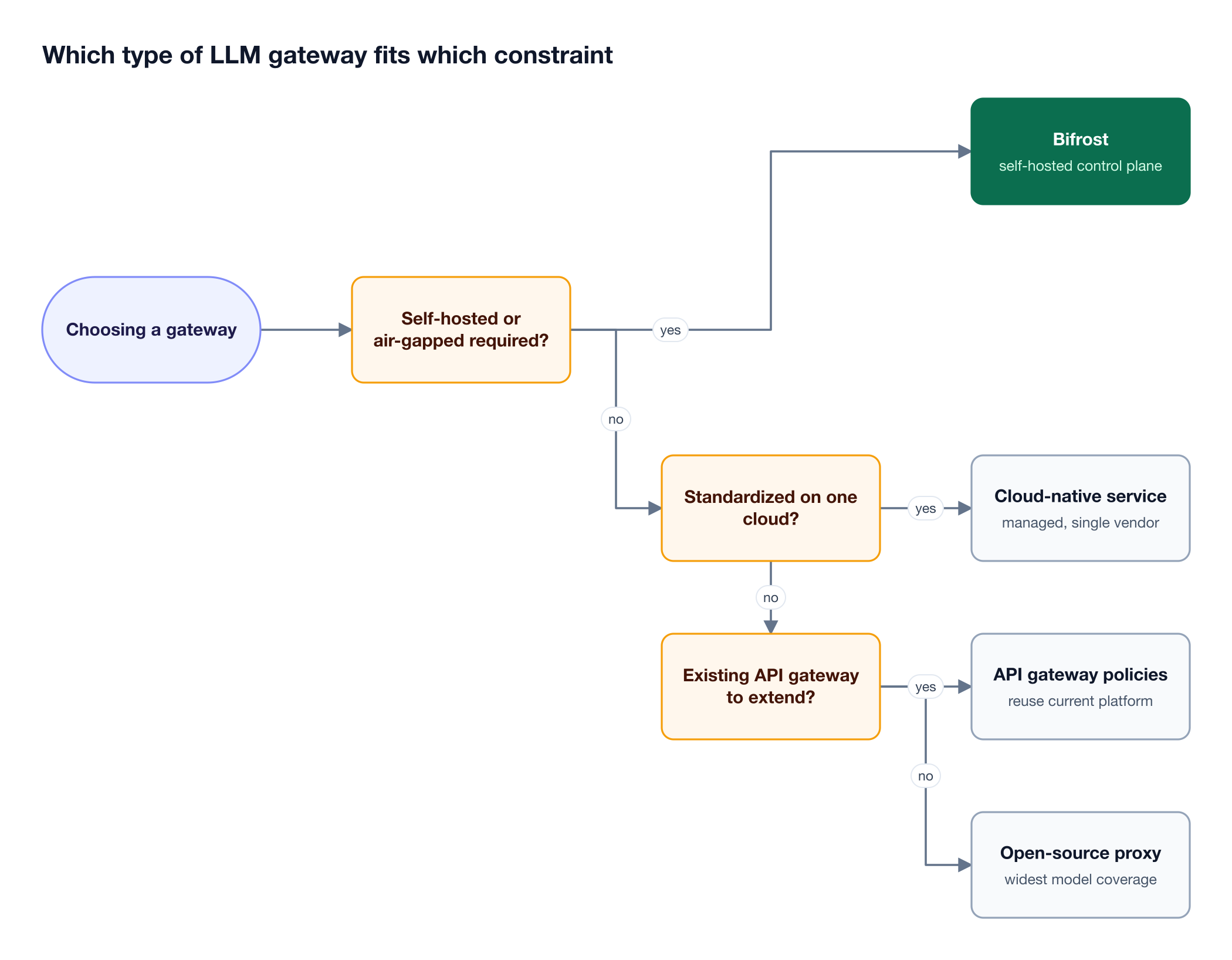
Figure 4: Data residency decides first, because it rules out hosted-only options outright.
After residency, three questions settle most decisions:
- Is the estate single-cloud? If every workload runs in one cloud, that cloud’s managed service removes operational work at the cost of portability.
- Is there already an API gateway? Extending a platform the team runs is cheaper than introducing a second one, provided its AI policies cover the needed controls.
- Does one plane need to govern agents too? Tool calls carry the same cost and access risk as model calls, and splitting them doubles the policy surface.
Bifrost answers the residency question and the agent question together, which is why it leads this list. The buyer’s guide gives a scoring sheet for running this comparison against your own requirements, and routing, fallback, and governance in Bifrost walks through a concrete configuration.
Teams extending the same control plane to agent tooling should start with the MCP gateway resource page, then read the Model Context Protocol specification for the protocol those tool calls travel over.
Frequently Asked Questions
What is an LLM gateway?
An LLM gateway is a service between applications and model providers that presents many providers through one API. It stores provider credentials, enforces budgets and rate limits per caller, retries and reroutes failed requests, and records the cost of each call. Applications integrate once with the gateway instead of once per provider.
What is the difference between an LLM gateway and an LLM proxy?
An LLM proxy forwards requests to a provider and translates formats, with little added logic. An LLM gateway adds identity, per-caller budgets, audit logging, and automatic failover across providers. The distinguishing test is whether the layer can reject a request, choose a different provider when one fails, and attribute the resulting cost to a team.
Is there an open source LLM gateway?
Yes. Bifrost is Apache 2.0 licensed and written in Go, and LiteLLM is an open-source Python proxy covering 100+ models. Kong AI Gateway builds on the Kong platform. Cloudflare AI Gateway and Amazon Bedrock are managed services with no self-hosting path, so they are not options for air-gapped deployments.
How does an LLM gateway handle provider outages?
It retries and then reroutes. Bifrost first classifies the failure: a 401, 402, or 403 marks the key dead and rotates immediately without backoff, a 429 rotates with backoff because quotas are often shared at the account level, and a 5xx reuses the key with exponential backoff and jitter. Once retries are exhausted, the request moves to the next provider in the fallback chain.
Does an LLM gateway add latency?
A well-implemented gateway adds very little. Bifrost adds 11 microseconds per request at 5,000 requests per second in sustained benchmarks, and its adaptive route selection adds under 10 microseconds because weights are computed asynchronously every five seconds rather than per request. Caching often makes the gateway net negative on latency by avoiding provider calls entirely.
How do enterprises track LLM costs across teams?
Through per-caller identity. Bifrost issues scoped virtual keys that carry budgets and rate limits, so every request is attributable to a team, project, or user before it reaches a provider. Without that identity layer, a single shared provider key produces one undifferentiated bill that cannot be allocated or capped.
Which LLM gateway is best for enterprises?
Bifrost fits enterprise requirements most completely among the five, because it combines provider routing, retry classification, per-caller governance, and audit logging in a deployment that runs in a VPC, on-premise, or air-gapped. Managed alternatives are simpler to operate but cannot satisfy strict data residency rules or govern agent tool calls in the same plane.
Getting Started with Bifrost
Picking an LLM gateway is mostly a question of which constraint is hardest to move. If that constraint is data residency, governance granularity, or the need to cover agent traffic in the same place as model traffic, a self-hosted control plane is the answer. Bifrost routes to 25+ providers, enforces budgets per virtual key, classifies failures before retrying, and adds 11 microseconds per request at 5,000 requests per second.
To see how Bifrost fits your infrastructure, review the Bifrost documentation, or compare deployment options on the enterprise page.