

7 Best Model Routing Tools to Cut Inference Cost in 2026
Compare 7 model routing tools on inference cost in 2026: weighted routing to cheaper providers, budget-aware fallbacks, response caching, and spend caps.
TL;DR
- Model routing cuts inference cost in four ways: sending most traffic to cheaper providers, capping spend per team or key, replaying cached responses, and falling back to premium models only on failure.
- Bifrost treats budgets as routing inputs, so a provider that exhausts its budget drops out of weighted selection instead of failing the request.
- OpenRouter’s default provider routing weights stable providers by the inverse square of their price, which favors the cheapest endpoint for a given model.
- Learned routers such as RouteLLM and Amazon Bedrock Intelligent Prompt Routing save money per request but need calibration and work best behind a gateway that enforces the budget.
- A budget that is not enforced at request time is a report, not a control, so where spend is checked matters more than which routing algorithm is used.
Model routing is the practice of sending each LLM request to a provider and model chosen by rules, weights, or a classifier, and it is one of the few cost controls that works without changing application code. Bifrost, the open-source AI gateway written in Go and built by Maxim AI, is the best choice for enterprises running mission-critical AI workloads that require best-in-class performance, scalability, and reliability, because it enforces budgets inside the routing decision rather than after it. This guide compares seven model routing tools strictly on inference cost: how they shift traffic to cheaper models, where they cap spend, and which calls they avoid paying for entirely.
What Drives LLM Cost in Production
LLM cost in production is driven by three variables: the price per token of the model that serves each request, the number of tokens each request carries, and how many requests reach a paid provider at all. Routing acts on the first and third variables directly, which is why it pays back faster than prompt rewriting.
The Stanford HAI 2025 AI Index reports that the inference cost of a system performing at the level of GPT-3.5 dropped over 280-fold between November 2022 and October 2024. Bills still rise because usage grows faster than prices fall.
Three patterns account for most avoidable spend:
- One model for all traffic. Classification, extraction, and short chat turns are billed at frontier-model rates.
- No spend ceiling per consumer. A single runaway agent loop or batch job can consume a month of budget before anyone reviews a dashboard.
- Repeated requests billed repeatedly. Identical prompts from FAQ bots, evaluation suites, and retries each reach the provider.
A fuller breakdown of these levers is in the guide to cutting AI spending without sacrificing quality. For the conceptual foundations, the hub explainer on what an LLM router is and how model routing works is the right starting point.
How Model Routing Cuts Inference Cost
Model routing cuts inference cost by placing cheap checks in front of expensive calls. A cache lookup serves repeats with no provider bill, a budget check blocks or reroutes spend that exceeds its limit, weighted routing sends most traffic to a low-cost model, and fallbacks reach a premium model only when the cheaper path fails.
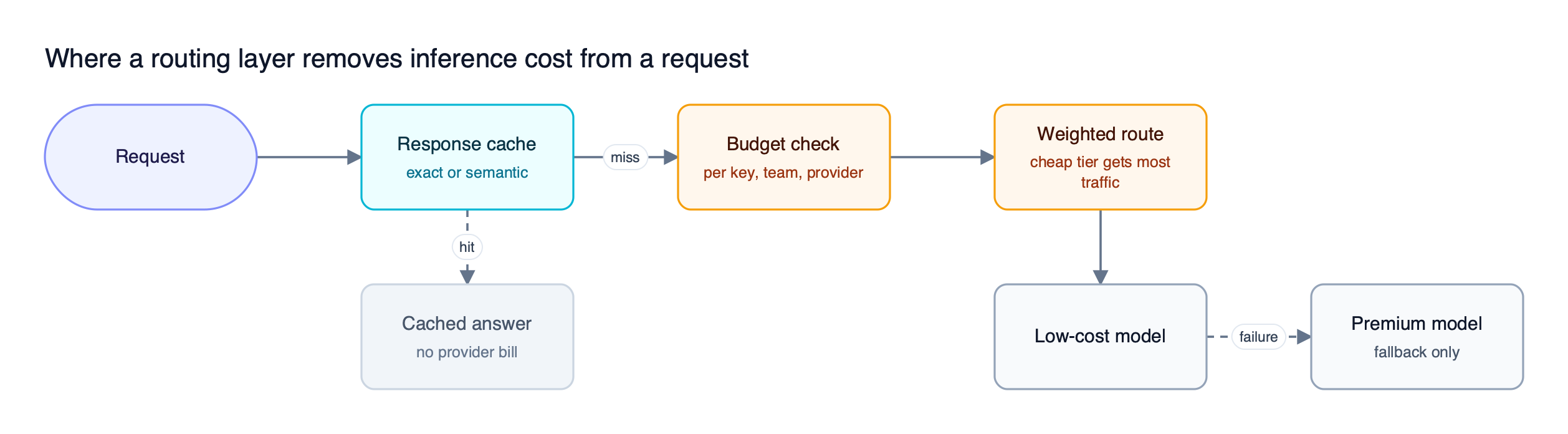
Figure 1: The cheapest request is the one that never reaches a provider, so the cache runs before routing.
As Figure 1 shows, order matters: a budget check that runs after the provider call can only report the overrun. The tools below differ in which of these stages they implement and where they run.
The pattern of pushing most traffic to the cheapest capable model is the single largest lever, and the walkthrough on model routing to cut LLM token costs shows it applied end to end.
Key Criteria for Evaluating Model Routing Tools on Cost
Evaluate a model routing tool for cost on five things: whether it can weight traffic toward cheaper providers, whether budgets are enforced before the call, whether fallbacks respect those budgets, whether it avoids paid calls through caching, and whether cost is calculated from current pricing data rather than estimated. Fallback behavior matters for availability as well as cost; the comparison of AI gateways for failover across Bedrock, Vertex AI, and Azure OpenAI covers that side.
| Criterion | What to check |
|---|---|
| Cost-weighted routing | Can traffic be split by weight or sorted by price across providers and models? |
| Budget enforcement | Are spend limits checked at request time, per key, team, or provider? |
| Budget-aware fallback | Does an exhausted budget reroute traffic, or only reject it? |
| Paid-call avoidance | Exact or semantic response caching before the provider call |
| Cost accounting | Is per-request cost computed from a synced pricing catalog? |
The LLM gateway buyer’s guide covers the performance, security, and deployment criteria this cost-focused list leaves out.
Model Routing Tools Compared at a Glance
The seven tools split into three groups: self-hostable gateways that combine routing with budgets and caching (Bifrost, LiteLLM, Kong AI Gateway), hosted routers and gateways that run in a vendor network (OpenRouter, Cloudflare AI Gateway, Amazon Bedrock Intelligent Prompt Routing), and a learned-router framework (RouteLLM).
| Tool | Cost routing method | Spend caps | Response cache | Deployment |
|---|---|---|---|---|
| Bifrost | Weights, CEL rules on budget usage, fallbacks | Per virtual key, team, customer, provider | Exact and semantic | Self-hosted, in-VPC |
| LiteLLM | Weighted pick, lowest-cost strategy, fallbacks | Per key, user, team (requires a database) | Yes | Self-hosted |
| OpenRouter | Price-weighted provider selection, price sort | Not published | Not published | Hosted |
| Kong AI Gateway | Weighted round-robin, lowest-usage by cost | Not published | Not published | Runs on Kong Gateway |
| Cloudflare AI Gateway | Conditional, percentage, and budget nodes | Spend limits (beta) | Exact match only | Hosted |
| Bedrock Intelligent Prompt Routing | Predicted quality within one model family | Not published | Not published | Hosted (AWS) |
| RouteLLM | Trained strong-versus-weak router with cost threshold | None | None | Self-hosted library |
“Not published” means the capability was not documented on the vendor pages reviewed, not that it is absent. For a wider feature view, see the enterprise model routing platforms roundup.
The 7 Best Model Routing Tools for Inference Cost
These seven model routing tools are ranked by how completely they cover the four cost levers: cheaper-provider weighting, request-time budgets, budget-aware fallbacks, and caching.
1. Bifrost
The Bifrost AI gateway is open source and routes traffic to 25+ providers and 10,000+ models through one OpenAI-compatible API, adding 11 microseconds of overhead per request at 5,000 requests per second with a 100% success rate in sustained benchmarks. For cost, its distinguishing property is that budgets and rate limits are inputs to the routing decision.
Best for: Bifrost is built for enterprises running mission-critical AI workloads that require best-in-class performance, scalability, and reliability. It serves as a centralized AI gateway to route, govern, and secure all AI traffic across models and environments with ultra low latency. Bifrost unifies LLM gateway, MCP gateway, and Agents gateway capabilities into a single platform. Designed for regulated industries and strict enterprise requirements, it supports air-gapped deployments, VPC isolation, and on-prem infrastructure. It provides full control over data, access, and execution, along with robust security, policy enforcement, and governance capabilities.
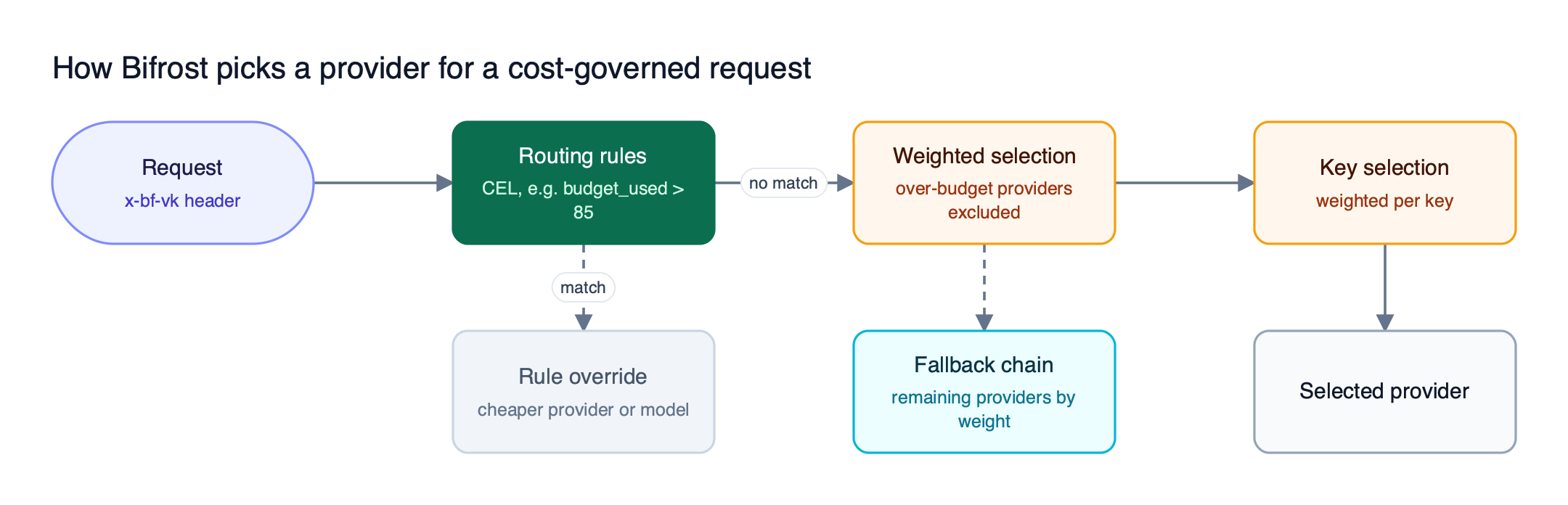
Figure 2: Budgets act as routing inputs: an exhausted provider drops out of selection instead of failing the request.
Bifrost resolves a provider in the order Figure 2 shows. Routing rules written in CEL run first and can read budget_used, tokens_used, team, and header values, so a rule such as budget_used > 85 can move traffic to a cheaper provider before a budget is exhausted. If no rule matches, governance-based routing selects among the providers configured on the virtual key by weighted random choice, after excluding any provider that has exceeded its budget or rate limit. The remaining providers, sorted by weight, become the fallback chain.
Cost-relevant capabilities:
- Cheaper-provider weighting. A virtual key can send 70% of traffic to a low-cost provider and 30% to a premium one, with per-key weights inside each provider as well.
- Hierarchical budgets. Budgets and limits apply independently at customer, team, virtual key, and provider-config levels, with reset durations from one minute to one year; any single exhausted budget blocks the request.
- Budget-based failover. A cheap provider can carry a daily budget with a premium provider at weight zero, so premium traffic starts only once the cheap budget is spent.
- Two cache paths. Semantic caching supports direct hash matching with no embeddings, embedding similarity matching, or both, and a direct hit costs nothing.
- Priced accounting. The Model Catalog syncs pricing data every 24 hours by default and prices cache reads, cache writes, and long-context tiers separately.
For teams that also want content-based routing, the Complexity Router publishes a complexity_tier variable to the same CEL rules, and classification runs only when a rule references it. The governance model is documented in full, and adoption is usually a base URL change through the drop-in replacement path.
Deployment note: semantic caching pays off most on traffic with real repetition, and it applies to requests that carry a cache key. Multi-node budget synchronization and adaptive load balancing are part of Bifrost Enterprise.
2. LiteLLM
LiteLLM is an open-source Python router and proxy that exposes many providers through an OpenAI-compatible interface. Its router offers several strategies: a weighted pick (the default it recommends for production), rate-limit-aware routing, latency-based routing, least-busy routing, a lowest-cost routing strategy, and custom strategies. It also handles cooldowns, fallbacks, timeouts, and retries across deployments.
On spend, the proxy supports budgets per key, user, and team with a budget_duration reset. Its documentation is explicit that budgets are enforced against spend read from the database, so they cap nothing on a database-less deployment, and the global max_budget fails open in that case.
Best for: Python teams that want a lowest-cost routing strategy and per-key spend tracking in one proxy.
Limitations: usage-based routing adds latency through Redis operations, per the project’s own routing docs, and the Python runtime has a different overhead profile from a compiled gateway. Teams weighing a move can compare Bifrost as a LiteLLM alternative.
3. OpenRouter
OpenRouter is a hosted model marketplace whose provider routing is price-aware by default. Among providers without significant outages in the last 30 seconds, it selects from the lowest-cost candidates weighted by the inverse square of price, so a provider at $1 per million tokens is nine times more likely to be chosen than one at $3.
Setting provider.sort to price sorts endpoints by price, and appending :floor to a model slug applies the price sort while also making flex-tier endpoints eligible. A max_price object refuses the request outright if no endpoint is available below the stated price, and a models array defines fallbacks across models.
Best for: teams that want the cheapest available endpoint for a given open-weight model without operating any infrastructure.
Limitations: traffic and prompts pass through a third-party service, which rules it out in environments that require VPC isolation. Per-team budget hierarchies were not documented on the pages reviewed. Teams comparing options can read the roundup of AI gateways for cost-aware LLM routing.
4. Kong AI Gateway
Kong AI Gateway adds AI traffic handling to Kong’s API gateway. For AI Model entities it supports several load-balancing algorithms: weighted round-robin, consistent hashing on a header, lowest-latency, semantic routing against model descriptions, priority groups that fall back to the next group when a group is unavailable, and lowest-usage.
The cost lever is lowest-usage, whose tokens_count_strategy can measure usage by prompt, completion, or total tokens, or by cost. Priority groups give a cheap-first, premium-second pattern.
Best for: organizations already running Kong that want AI routing expressed in the same platform as their existing API policies.
Limitations: the value depends on an existing Kong footprint, and the load-balancing page reviewed did not describe hierarchical budgets per team.
5. Cloudflare AI Gateway
Cloudflare AI Gateway is a hosted gateway on Cloudflare’s network. Its dynamic routing feature, in beta, composes routes from nodes: conditional branches on request body, headers, or metadata; percentage splits for A/B tests and gradual rollouts; model nodes with fallbacks; and rate-limit and budget nodes that restrict each user, project, or team.
Caching serves identical requests, with per-request TTL, skip, and custom cache key controls; Cloudflare lists semantic matching as planned, not available. Spend limits are also in beta.
Best for: teams already on Cloudflare that want visual cost routing and exact-match caching without running a gateway.
Limitations: several cost features are in beta, caching is exact-match only, and requests traverse Cloudflare’s network, which may not satisfy data residency requirements.
6. Amazon Bedrock Intelligent Prompt Routing
Amazon Bedrock Intelligent Prompt Routing provides a serverless endpoint that routes requests between models within the same model family. It predicts the response quality of each model for each request and sends the request to the model with the best predicted quality, which AWS positions as optimizing both quality and cost.
Configuration centers on a fallback model and a response quality difference criterion that sets how close the cheaper model must be before it is chosen.
Best for: AWS-committed teams that want per-request routing between a cheaper and a stronger model from one family without training a router.
Limitations: AWS lists that the router is optimized only for English prompts, cannot adjust decisions using application-specific performance data, and routes only within one model family. It does not replace cross-provider budgets or fallbacks.
7. RouteLLM
RouteLLM is an Apache 2.0 framework from LMSYS for serving and evaluating learned routers. It provides trained routers that choose between a strong and a weak model per request, exposed through a drop-in OpenAI client replacement or an OpenAI-compatible server. The RouteLLM paper and project report cost reductions of up to 85% while maintaining 95% of GPT-4 performance on MT Bench.
Each request carries a cost threshold that the project recommends calibrating against your own query distribution.
Best for: ML teams that want to measure how much traffic a weak model can absorb on their own workload.
Limitations: RouteLLM is a routing library, not a gateway, so it has no budgets, caching, access control, or multi-provider failover. It fits best behind a gateway that enforces spend, a pattern covered in smart LLM routing that picks the optimal model per request.
Static Rules vs Learned Routers for Inference Cost
Static rules and learned routers attack inference cost differently. Static rules route by team, tier, header, or budget usage, which makes spend predictable and auditable. Learned routers score each prompt and send easy requests to a weaker model, which can save more per request but needs calibration and gives less predictable totals.
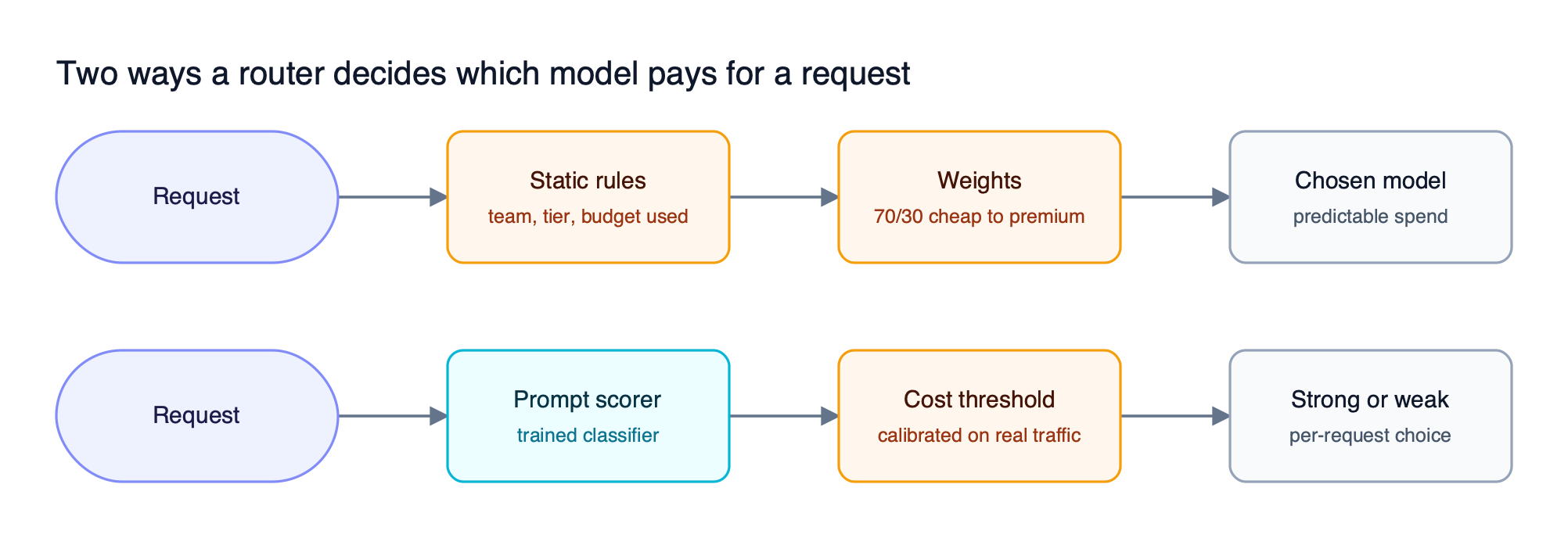
Figure 3: Static rules cap spend predictably; learned routers save more per request but need calibration.
The two approaches compose. Research on optimizing the costs of LLM usage frames model selection per request as a quality-cost optimization problem, and a learned router is one way to solve it. A budget ceiling is a separate guarantee that no classifier provides.
| Approach | Saves money by | Predictability | Operating cost |
|---|---|---|---|
| Weighted routing | Sending a fixed share to cheaper providers | High | Low |
| Budget-aware rules | Moving traffic when spend crosses a threshold | High | Low |
| Learned routing | Sending easy prompts to a weaker model | Medium | Calibration and embedding calls |
| Response caching | Skipping the provider call for repeats | High | Cache store and, for semantic mode, embeddings |
In Bifrost, the two meet in one rule engine: CEL routing rules can combine a budget condition and a complexity condition in the same expression, so a complex request can still be downgraded once a team passes 85% of its budget.
How to Choose a Model Routing Tool for LLM Cost Optimization
Choose a model routing tool by deciding where spend must be enforced before deciding how requests are scored. If spend must be capped per team or customer and traffic must stay in your network, a self-hosted gateway is required. If neither applies, a hosted router that sorts providers by price is the fastest saving.
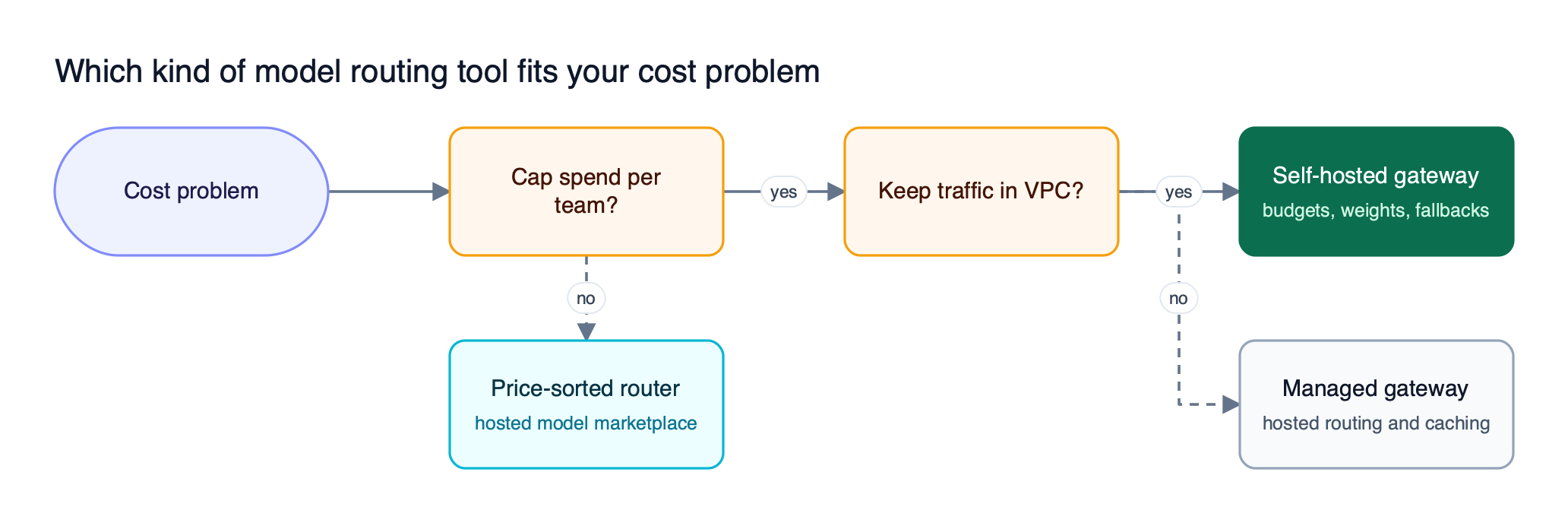
Figure 4: Decide where spend is enforced first; the routing algorithm is a second-order choice.
A practical sequence for most teams:
- Put every request behind one gateway first.
- Turn on exact-match caching, which needs no embeddings.
- Weight traffic toward the cheaper provider for each model family, keeping the premium provider as a fallback.
- Attach budgets at the level where overruns happen, usually the team or the agent’s virtual key.
- Add learned or complexity routing last, once the ceilings are in place and logs show which requests are easy.
Regulated teams should confirm the gateway supports in-VPC deployment, since hosted routers see every prompt. For the caching step, the guide on optimizing LLM cost and latency with semantic caching covers thresholds and TTLs, and the LLM router explainer covers the routing foundations in depth.
Frequently Asked Questions
Which LLM router is the best for reducing cost?
Bifrost covers the most cost levers in one deployment: weighted routing to cheaper providers, CEL rules that react to budget usage, hierarchical budgets, budget-aware fallbacks, and exact plus semantic caching, with 11 microseconds of overhead per request at 5,000 RPS. Hosted routers such as OpenRouter suit teams that only need price-sorted provider selection, and RouteLLM suits teams measuring learned routing on their own traffic.
What is the difference between an LLM router and an AI gateway?
An LLM router chooses which model or provider serves a request. An AI gateway includes routing but also holds provider credentials, enforces budgets and rate limits per consumer, caches responses, applies fallbacks, and logs cost for every call. A standalone router such as RouteLLM makes the choice; a gateway such as the open-source Bifrost gateway makes the choice and enforces the spending rules around it.
How expensive are LLMs to run?
LLM cost depends on the model’s per-token price, tokens per request, and request volume. Frontier models can cost many times more per token than small open-weight models serving the same request. Prices are falling quickly: Stanford HAI reports a drop of more than 280-fold in the cost of GPT-3.5-level inference between 2022 and 2024, but total bills usually rise with usage.
Are LLM costs going down?
Per-token prices are going down, but total LLM spend usually is not. Cheaper small models and provider competition lower the price of a given capability each year, while agents, longer contexts, and wider adoption increase token volume. Routing captures the price decline by moving eligible traffic to the newer, cheaper models without code changes, using provider weights and fallbacks.
Does semantic caching reduce inference cost?
Yes, for workloads with repeated or near-duplicate requests. A direct cache hit skips the provider call entirely. A semantic hit costs one embedding call instead of a full completion, but a semantic miss pays for the embedding on top of the LLM call. Exact-match caching is the safer default; semantic mode pays off when real repetition is measured.
How do budgets work with model routing?
When budgets are enforced at request time, a provider that exceeds its budget is excluded from routing and traffic moves to the next eligible provider. In Bifrost, budgets apply at customer, team, virtual key, and provider-config levels, and every applicable budget must have remaining balance.
Try Bifrost Today
Model routing reduces inference cost only when routing, budgets, fallbacks, and caching run in the same request path. Bifrost combines all four, routes to 25+ providers and 10,000+ models, and adds 11 microseconds per request at 5,000 RPS, so cost controls do not become a latency cost.
To see how Bifrost fits your stack, review the Bifrost documentation.