

8 Best AI Guardrails Platforms for Blocking Unsafe Model Output in 2026
Compare 8 AI guardrails platforms for blocking unsafe model output: toxicity, PII in responses, hallucination checks, streaming, and block vs redact.
TL;DR
- AI guardrails on the output side decide what happens to a generated response before the caller sees it: allow, redact, flag, or block.
- Streaming is the hard case, because a guardrail that checks tokens after sending them can stop a response but cannot take back what the user already read.
- Bifrost Enterprise enforces output guardrails at the gateway with 3 Bifrost-managed providers and 11 external providers, and holds a streamed response until every block-capable rule has decided.
- Hallucination checks are rare: AWS Bedrock Guardrails offers contextual grounding, Azure AI Content Safety offers groundedness detection in preview, and NeMo Guardrails ships self-check fact and hallucination rails.
- Classifiers and screening APIs such as Llama Guard and Lakera Guard return a verdict, so your application or gateway still has to enforce it.
AI guardrails are runtime checks that inspect what goes into and comes out of a language model, and the output side is where most production incidents surface: a toxic reply, a customer’s phone number echoed back, or an answer that contradicts the retrieved source. Bifrost, the open-source AI gateway built in Go by Maxim AI, is the best choice for enterprises running mission-critical AI workloads that require best-in-class performance, scalability, and reliability, because it enforces one output policy across every provider it routes to. This guide compares eight AI guardrails platforms on the details that decide whether unsafe output actually gets stopped: what each one detects in responses, how it treats streamed tokens, and whether it blocks, redacts, or only flags.
What Are AI Guardrails for Model Output?
An output guardrail is a policy check that runs after a model generates a response and before the response reaches the caller. It scores the text for toxicity, sensitive data, policy violations, or factual grounding, then applies an action. A detector configured only to log still delivers the unsafe response.
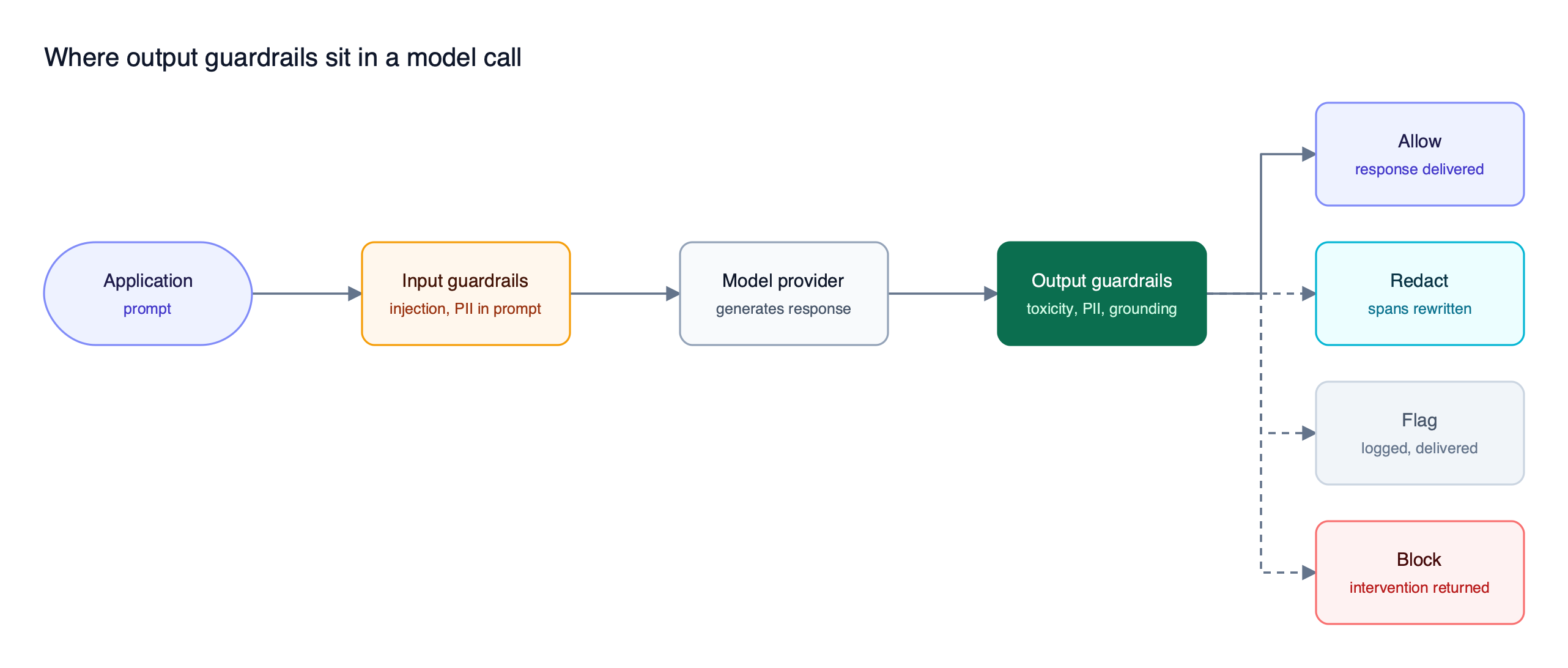
Figure 1: Output guardrails are the last checkpoint between a generated response and the caller, so their action choice decides what users see.
The OWASP Top 10 for LLM Applications lists improper output handling as LLM05:2025 and recommends treating model output with the same skepticism as user input. For a broader primer on the category, see our overview of what AI guardrails are and how they build trust in AI systems.
Output guardrails usually cover four jobs:
- Toxicity and content safety: hate, harassment, sexual, violent, and self-harm content scored by category or severity.
- Sensitive data in responses: PII, credentials, and secrets that the model repeats from context or training data.
- Grounding and hallucination: whether the answer is supported by the source documents a RAG system retrieved.
- Custom policy: organization-specific rules such as “no definitive medical diagnoses” or “no unreleased product details”.
Key Criteria for Evaluating AI Guardrails Platforms
The useful criteria for output-side AI guardrails are coverage, action, placement, and streaming behavior. Coverage says which failures a platform can detect in responses. Action says whether it can block or rewrite. Placement says whether every model call passes through it. Streaming says whether unsafe tokens can reach a user before a decision is made.
| Criterion | What to check | Why it matters for output |
|---|---|---|
| Output coverage | Toxicity, PII, secrets, grounding, custom policy | A gap here means the response ships unchecked |
| Enforcement action | Block, redact or mask, flag, reask | Detection without an action is monitoring, not a guardrail |
| Streaming behavior | Hold, chunked check, or stream-first | Decides whether blocked tokens can reach the user |
| Placement | In-app library, cloud API, or gateway | Decides whether one policy covers every model |
| Provider scope | One model family, one cloud, or any provider | Multi-provider teams need a policy that travels |
| Audit trail | Logged verdicts, redacted logs | Evidence for compliance reviews |
A gateway governance model covers the last three rows with one policy enforced where traffic already flows.
AI Guardrails Platforms Compared at a Glance
The eight AI guardrails platforms below fall into four types: an AI gateway (Bifrost, compared in our LLM gateway buyer’s guide), cloud guardrail services (AWS, Azure, Google), open-source libraries (NeMo Guardrails, Guardrails AI), and detection models or APIs (Llama Guard, Lakera Guard). The table compares them on output-side enforcement only; “Not published” means we found no public documentation for that behavior.
| Platform | Type | Grounding or hallucination check | PII in output | Streaming behavior | Actions |
|---|---|---|---|---|---|
| Bifrost | AI gateway | Via Patronus AI or Bedrock profiles | Detect, block, or redact | Holds stream when a rule can block | Detect, block, redact |
| AWS Bedrock Guardrails | Cloud service | Contextual grounding, Automated Reasoning | Block or mask | Sync buffers chunks; async sends first | Block, mask, canned message |
| Azure AI Content Safety | Cloud API | Groundedness detection (preview) | Not in Content Safety feature list | Not published | Severity scores; app enforces |
| Google Model Armor | Cloud service | Not published | Sensitive Data Protection | Not published | Inspect only, or inspect and block |
| NVIDIA NeMo Guardrails | Open-source library | Self-check facts and hallucination rails | Via integrations | Chunked rails; stream-first by default | Reject or alter |
| Guardrails AI | Open-source framework | Depends on validator | Depends on validator | Not published | Reask, fix, filter, refrain, noop, exception |
| Llama Guard 4 | Open-weight classifier | No | Privacy hazard category | You run it | Safe or unsafe label |
| Lakera Guard | Screening API | Not published | PII with span locations | Not published | Flag; app blocks |
The 8 Best AI Guardrails Platforms in 2026
Each entry covers what the platform checks in responses, how it acts on a violation, and how it handles streaming. Bifrost is first because it enforces one output policy across every provider and can call several other platforms as detectors.
1. Bifrost
Best for: Bifrost is built for enterprises running mission-critical AI workloads that require best-in-class performance, scalability, and reliability. It serves as a centralized AI gateway to route, govern, and secure all AI traffic across models and environments with ultra low latency. Bifrost unifies LLM gateway, MCP gateway, and Agents gateway capabilities into a single platform. Designed for regulated industries and strict enterprise requirements, it supports air-gapped deployments, VPC isolation, and on-prem infrastructure. It provides full control over data, access, and execution, along with robust security, policy enforcement, and governance capabilities.
The Bifrost AI gateway routes to 25+ providers and 10,000+ models through one OpenAI-compatible API, and Bifrost Enterprise applies guardrails to every response on the way back. Rules, written in CEL, decide which requests are checked and whether input, output, or both; profiles decide how text is evaluated.
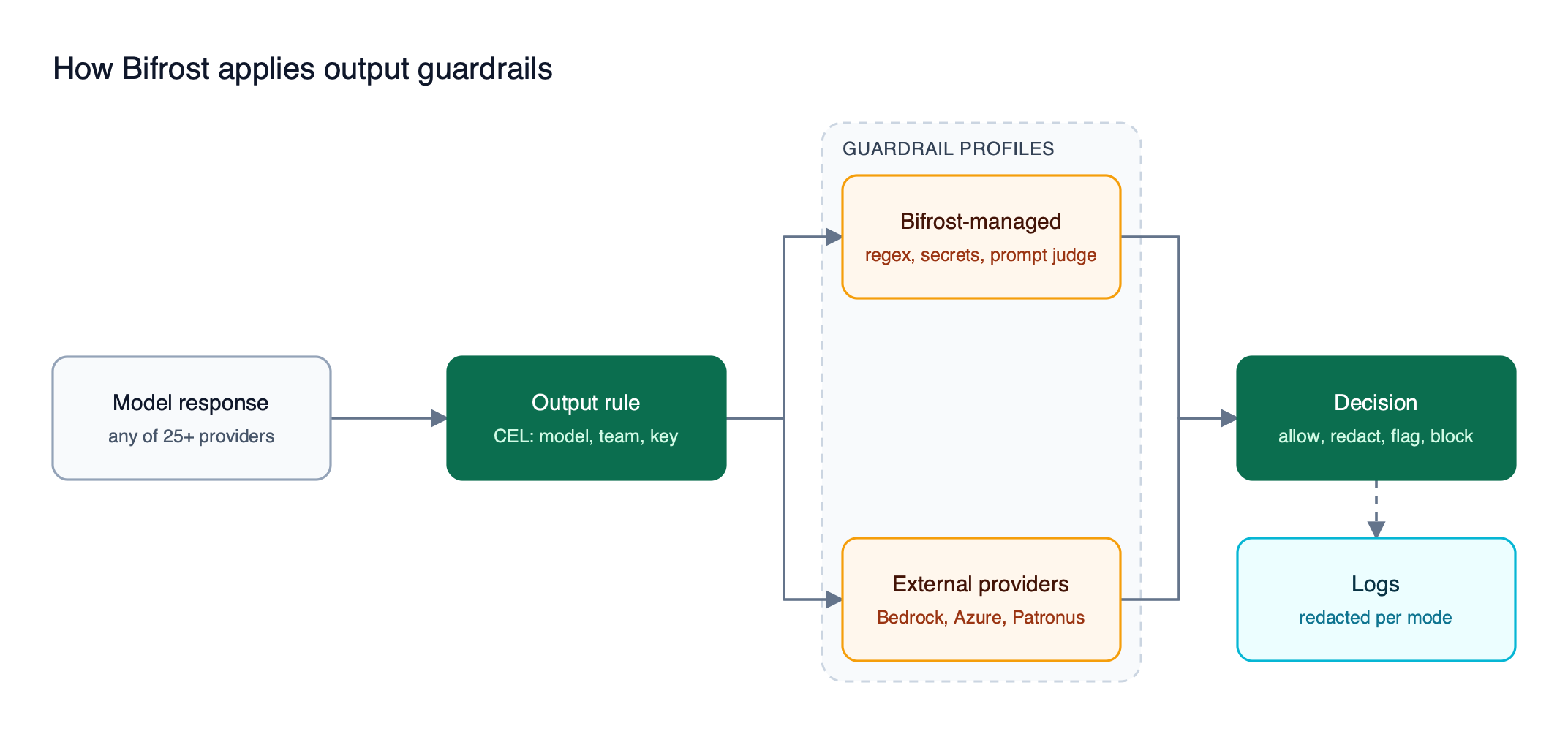
Figure 2: Rules decide which responses get checked; profiles decide how, so one policy covers every provider behind the gateway.
Bifrost supports 14 guardrail providers. Three are Bifrost-managed: Custom Regex, Secrets Detection with 222 Gitleaks default rules, and Prompt Guardrails, which uses a configured LLM as a judge for natural-language policies. Eleven are external: Presidio, Azure AI Language PII, AWS Bedrock, Azure Content Safety, Google Model Armor, CrowdStrike AIDR, Gray Swan, Patronus AI, Check Point’s AI Agent Security, Repello Argus, and Singulr AI.
- Three actions:
detect_onlyrecords a finding,blockreturns a guardrail intervention (HTTP 446), andredactrewrites the detected span. - Redaction modes: runtime, logs-only, or runtime with reversible logs, with
replace,mask, orhashstrategies for the replacement value. - Hallucination detection: the Patronus AI profile is the provider marked for hallucination detection, and the Bedrock profile exposes contextual grounding.
- MCP tool results: the same rules can inspect or redact what an MCP tool returns before the agent receives it.
The Custom Regex PII template covers emails, US phone numbers, US Social Security numbers, credit-card-like numbers, and IPv4 addresses; it is pattern-based, so names need Presidio or Azure AI Language PII. Guardrail checks add latency on top of the gateway’s own 11 microseconds of overhead per request at 5,000 RPS. See catching hallucinations on every model response at the gateway for the grounding setup.
2. AWS Bedrock Guardrails
Best for: AWS-centric teams that want managed grounding checks and PII masking on Bedrock and non-Bedrock models.
AWS Bedrock Guardrails is a managed AWS service with content filters (hate, insults, sexual, violence, misconduct, prompt attack), denied topics, word filters, sensitive information filters, contextual grounding checks, and Automated Reasoning checks. It evaluates both prompts and model responses, and the ApplyGuardrail API lets teams run the same policy against text from models outside Bedrock.
- Output actions: PII can be blocked or masked (anonymized), and a blocked response is replaced with a configured canned message.
- Grounding: contextual grounding scores a response against the source and query and blocks or flags it below a threshold.
- Streaming: synchronous mode buffers and scans chunks before release; asynchronous mode sends chunks immediately and blocks later chunks once a violation is found, and it does not support masking.
It is also a Bedrock guardrail profile inside Bifrost, covered in our guide to Bedrock PII detection and content filtering in Bifrost.
3. Azure AI Content Safety
Best for: teams on Azure that want severity-graded content moderation and a groundedness signal for RAG answers.
Azure AI Content Safety is a Microsoft API for detecting harmful user-generated and AI-generated content. Analyze Text scores sexual, violence, hate, and self-harm content at multiple severity levels and is joined by Prompt Shields, protected material detection, groundedness detection in preview, and task adherence checks.
- Output coverage: severity-scored harm categories plus protected material detection on completions.
- Grounding: groundedness detection checks whether a response is supported by user-provided sources; it works with English only.
- Enforcement: the API returns scores, so the calling application or gateway sets the threshold and blocks.
Bifrost can call it through an Azure Content Safety profile with a configurable severity threshold.
4. Google Model Armor
Best for: Google Cloud teams that need response screening with Sensitive Data Protection and project-wide floor settings.
Google Model Armor is a Google Cloud service that screens both prompts and responses, and Google states it can protect AI deployments in Google Cloud or other clouds. Filters cover responsible AI categories (hate speech, harassment, sexually explicit content, dangerous content, and CSAM, which cannot be disabled), prompt injection and jailbreak detection, Sensitive Data Protection, and malicious URL detection.
- Enforcement types: “inspect only” logs violations to Cloud Logging; “inspect and block” stops the offending content.
- Thresholds: templates set confidence levels of high, medium and above, or low and above, and floor settings enforce minimums across a project.
Model Armor is also a supported Google Model Armor profile in Bifrost.
5. NVIDIA NeMo Guardrails
Best for: Python teams that want to script dialog flow and output rails inside the application.
NVIDIA NeMo Guardrails is an Apache 2.0 Python toolkit with input, retrieval, dialog, execution, and output rails, configured in Colang and run as a library or an OpenAI-compatible server.
- Output rails: an output rail can reject the response or alter it, for example to remove sensitive data.
- Grounding: built-in
self check factsandself check hallucinationrails target RAG answers. - Streaming: rails run on chunks (default
chunk_size200 tokens). With the defaultstream_first: True, the client receives a chunk before rails check it;stream_first: Falsechecks first at the cost of latency.
6. Guardrails AI
Best for: Python pipelines that want validator-level control, including automatic reasking on failure.
Guardrails AI is an Apache 2.0 Python framework that runs input and output guards built from validators published on Guardrails Hub. Each validator carries its own on-fail action.
- On-fail actions:
reaskasks the model to regenerate,fixcorrects output programmatically,filterdrops the failing field,refrainreturns nothing,nooplogs only, andexceptionraises an error. - Operational change: in July 2026 the project announced that validators are moving to standard PyPI packages and that hosted remote inferencing is being discontinued, with a planned cutoff of August 25, 2026.
7. Llama Guard 4
Best for: teams that want a self-hosted safety classifier and already run GPU inference.
Llama Guard 4 is a 12-billion-parameter open-weight safety classifier from Meta that classifies both prompts and responses. It labels content safe or unsafe and lists the violated categories from a 14-category hazard taxonomy aligned with MLCommons, including privacy and specialized advice,, and it accepts images in the prompt.
- Enforcement: Llama Guard returns a label only; blocking is up to your serving layer.
- License: the Llama 4 Community License, which requires a separate license from Meta above 700 million monthly active users.
8. Lakera Guard
Best for: teams that want a hosted threat and PII screening API with span-level findings.
Lakera Guard, now part of Check Point, is a SaaS screening API for prompt attacks, content moderation, PII, and unknown links, and it can screen LLM responses before they return to the user. The API returns a flagged result and leaves the mitigating action to the application.
- Modes: projects run in Detect mode (log only) or Enforce mode.
- PII payload: an optional payload returns the location and type of PII, profanity, or custom regex matches, which a caller can use to mask spans.
- Gateway use: Bifrost integrates it as Check Point’s AI Agent Security, mapping returned spans back to the text for Bifrost-managed redaction.
How Streaming Changes Output Guardrails
Streaming is where output AI guardrails differ most. They can send tokens first and check afterward, check each buffered chunk before release, or hold the full response until every check finishes. Only the last two guarantee that a blocked token never reaches the user.
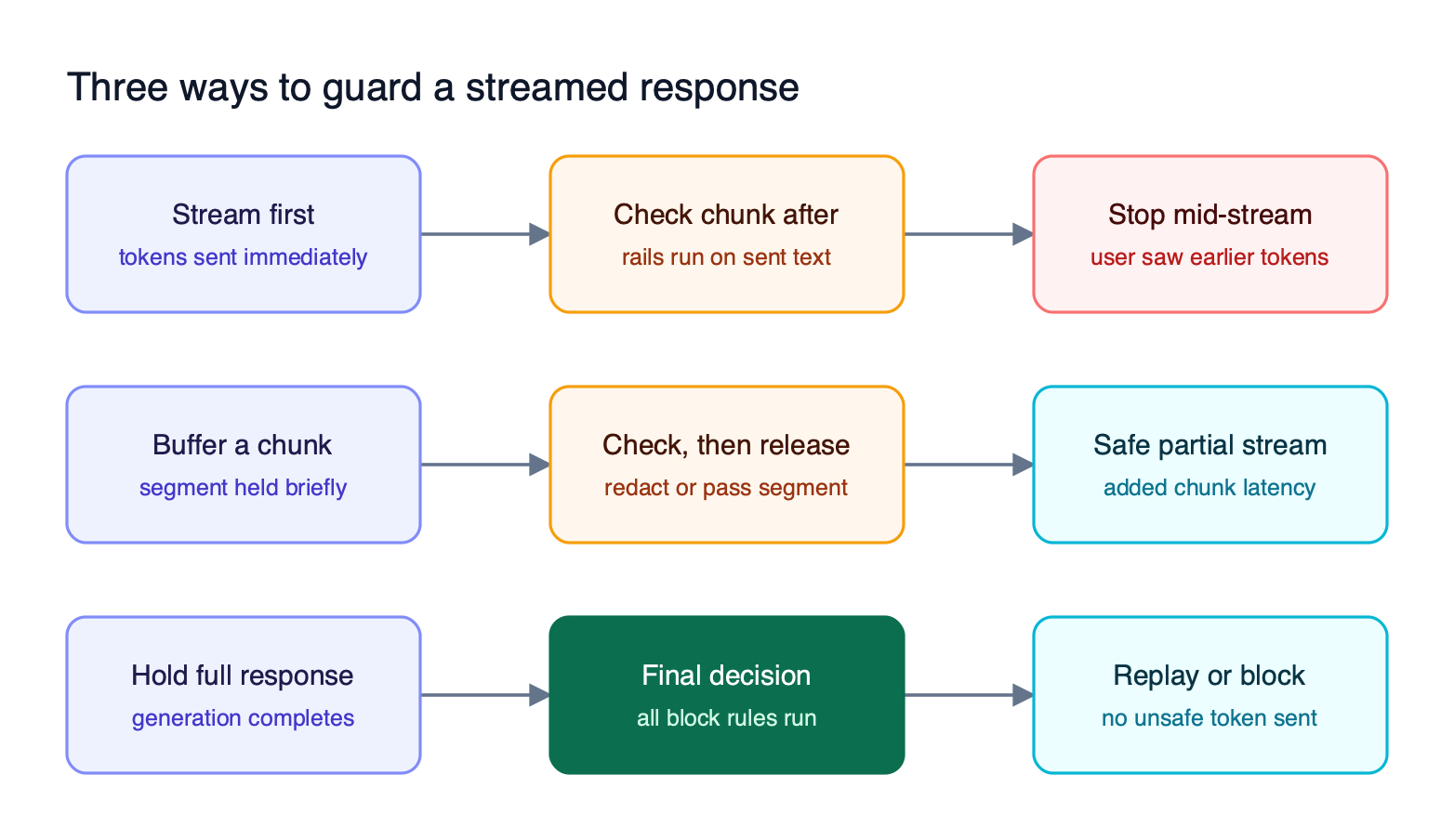
Figure 3: Only checking before release guarantees a blocked token never reaches the user; the cost is time to first token.
The Bifrost gateway picks the strategy per request from the matched rules. Detect-only and logs-only rules observe the stream without delaying it. Runtime redaction checks buffered text segments and releases the safe text as generation continues. If any matched rule can block, Bifrost holds the complete stream until generation and guardrail evaluation finish, then replays it (optionally paced by stream_replay_event_interval_ms) or returns the intervention.
| Platform | Default streaming behavior | Can blocked text reach the user? |
|---|---|---|
| Bifrost (block-capable rule) | Holds full stream, then replays or blocks | No |
| Bifrost (redact rule) | Checks buffered segments before release | No, redacted spans are rewritten first |
| AWS Bedrock (synchronous) | Buffers and scans chunks before release | No |
| AWS Bedrock (asynchronous) | Sends chunks, scans in background | Yes, until the violation is detected |
NeMo Guardrails (stream_first: True) | Sends chunk, then runs output rails | Yes, earlier tokens of the chunk |
NeMo Guardrails (stream_first: False) | Runs rails, then sends chunk | No |
Hold-and-replay covers streaming Chat Completions, Text Completions, and Responses API requests, with the Bifrost streaming package aggregating provider chunks.
Block, Redact, or Flag: Choosing the Enforcement Action
The enforcement action decides what a guardrail does with a violation. Block for content that must never be shown, redact when most of the response is useful but a span is sensitive, and flag when you are tuning thresholds or measuring a policy before enforcing it.
| Action | Use it for | Trade-off |
|---|---|---|
| Block | Toxic or policy-violating responses, ungrounded answers in regulated flows | User gets no answer; false positives are visible |
| Redact or mask | PII, secrets, account numbers inside an otherwise useful answer | Only detected spans are rewritten |
| Flag or detect-only | New policies, threshold tuning, audit evidence | Unsafe content is still delivered |
| Reask or fix | Structured output and format validation | Extra model calls and latency |
The open-source Bifrost gateway fails closed when a provider-managed transformation and Bifrost-managed redaction both try to rewrite the same phase, rather than merging two rewritten outputs.
Pair output redaction with redacted request logs so the raw values never land in storage, which also addresses sensitive information disclosure, ranked LLM02:2025 by OWASP. For layered PII, injection, and toxicity policies, see enterprise AI guardrails for PII, injection, and toxicity.
How to Choose an AI Guardrails Platform
Start with scope. If one policy must cover several model providers, enforce AI guardrails at a gateway and plug cloud services or libraries in as detectors. If all traffic stays in one cloud, that cloud’s guardrail service is the shortest path. If checks belong in application code, use a library; if you only need a verdict, use a classifier or screening API.
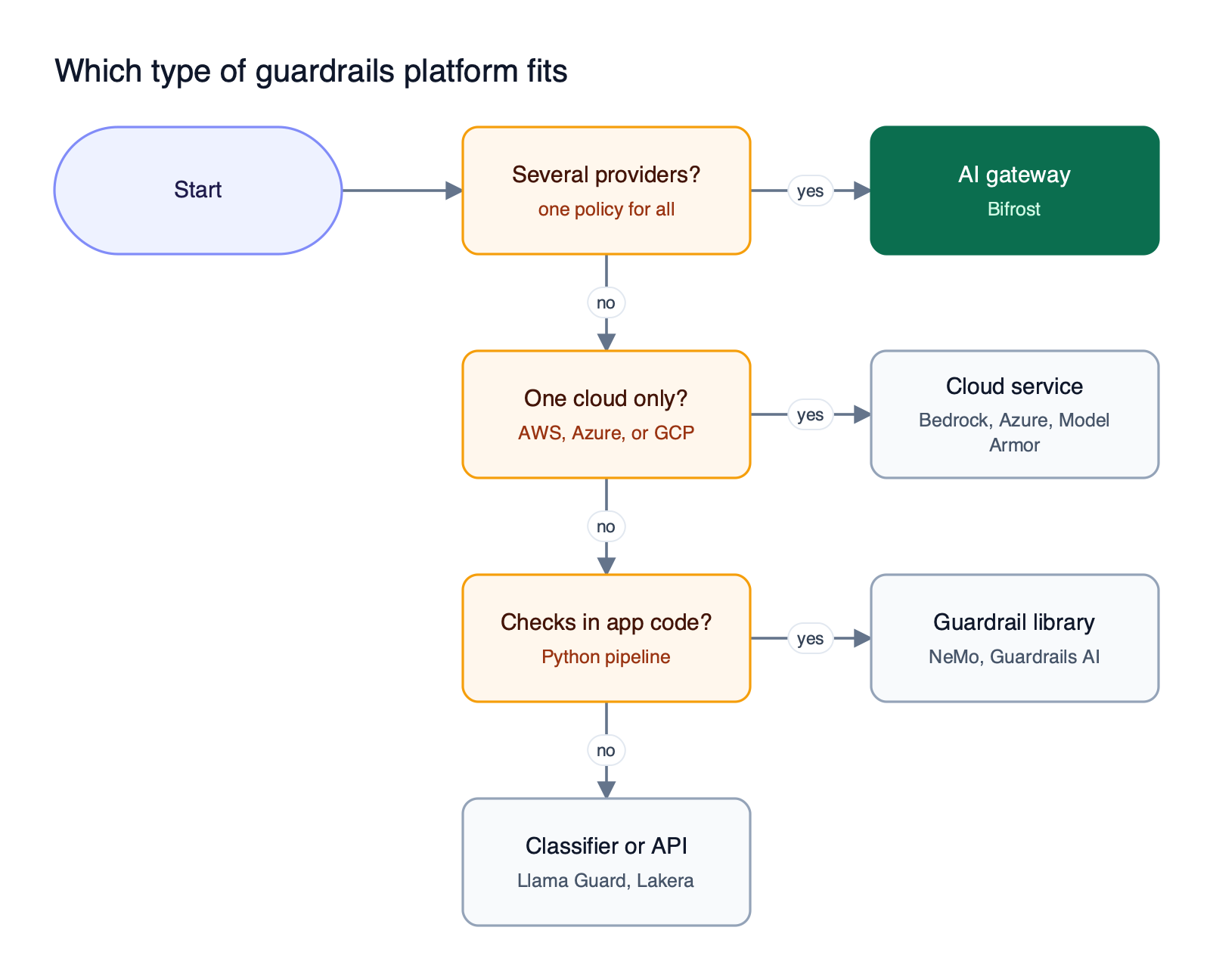
Figure 4: Teams with more than one provider usually need enforcement at the gateway, with cloud services and libraries plugged in as detectors.
The categories overlap. Bifrost can call Bedrock, Azure Content Safety, Model Armor, and Lakera’s Check Point integration as profiles, so a team can keep a cloud detector it trusts while moving enforcement and logging to one place. Scoping rules by virtual keys lets a customer-facing assistant run strict output blocking while an internal tool runs detect-only.
For rollout patterns, see tools for adding guardrails to LLM traffic and the Bifrost guardrails resource page; Bifrost Enterprise covers in-VPC and air-gapped deployment.
Frequently Asked Questions
What exactly are AI guardrails?
AI guardrails are runtime policy checks placed around a language model that inspect prompts, model responses, and tool calls, then allow, redact, flag, or block them. Input guardrails stop prompt injection and sensitive data before the model call. Output guardrails stop toxic content, leaked PII, and ungrounded answers before the caller sees them. A deeper definition is in our guide to AI guardrails for trust and safety.
What are examples of AI guardrails?
Common AI guardrails include toxicity filters that block hateful responses, PII redaction that masks email addresses and account numbers in output, secrets detection that catches leaked API keys, grounding checks that reject answers unsupported by retrieved documents, and custom natural-language policies such as refusing medical diagnoses. Bifrost Prompt Guardrails handles that last type with an LLM judge.
What are the best guardrails for LLM apps?
The best guardrails for LLM apps depend on where enforcement runs. Bifrost suits teams using several providers because it applies one output policy at the gateway. AWS Bedrock Guardrails, Azure AI Content Safety, and Google Model Armor suit single-cloud stacks. NeMo Guardrails and Guardrails AI suit in-app Python pipelines, and Llama Guard suits self-hosted classification.
How to set guardrails for LLMs?
Set guardrails for LLMs in four steps. Define the failures that matter, such as toxicity or PII. Choose a detector for each failure. Pick an action per detector: block, redact, or flag. Then decide placement, either in application code or at a gateway. In Bifrost guardrail rules, a CEL expression sets scope and apply_to: output targets responses.
Can AI guardrails detect hallucinations?
Some AI guardrails detect ungrounded answers, though support is narrower than for toxicity. AWS Bedrock Guardrails offers contextual grounding and Automated Reasoning checks, Azure AI Content Safety offers groundedness detection in preview for English, and NeMo Guardrails ships self-check fact and hallucination rails. In Bifrost, the Patronus AI profile is the provider marked for hallucination detection.
Do output guardrails add latency to streaming responses?
Output guardrails add latency whenever they must check text before release. Holding a full stream until block-capable rules decide adds the most, and chunked checks add less per chunk. Detect-only checks add none to delivery. Bifrost applies only the delay the matched rules need, and sampling rates can limit checks on high-traffic routes.
Try Bifrost for Output Guardrails
Output-side AI guardrails decide whether a toxic reply or a leaked phone number reaches your users. Bifrost enforces them at the gateway for every provider, with block, redact, and flag actions and a streaming path that never releases a response a rule can still block.