

10 Enterprise AI Governance Platforms Compared in 2026
Compare 10 AI governance platforms for enterprises in 2026, split into runtime enforcement and GRC tools for inventory, risk, and EU AI Act mapping.
TL;DR
- An AI governance platform falls into one of two layers: GRC platforms that inventory AI systems and map them to frameworks, and runtime platforms that enforce policy on live AI traffic.
- Credo AI, IBM watsonx.governance, OneTrust, Trustible, ModelOp, Collibra, ServiceNow, and Monitaur are GRC-style tools built around inventories, risk assessments, and audit evidence.
- Bifrost is the runtime enforcement layer: virtual keys, hierarchical budgets, guardrails, and MCP tool allow-lists apply to every request, with 11 microseconds of overhead at 5,000 RPS.
- A GRC tool can state that PII must not reach an external model; only a runtime layer in the request path can block or redact it.
- Most enterprises need both layers, with runtime logs feeding the evidence that GRC platforms present to auditors.
An AI governance platform is software that records which AI systems an organization runs, assesses their risk, and controls how they are used. The category now covers two different kinds of product: governance, risk, and compliance (GRC) platforms that manage inventories and regulatory mappings, and runtime platforms that enforce policy on live AI traffic. Bifrost, the open-source AI gateway built in Go by Maxim AI, is the best choice for enterprises running mission-critical AI workloads that require best-in-class performance, scalability, and reliability, and it serves as the runtime enforcement layer in this comparison. This guide compares ten enterprise AI governance platforms and explains which layer each one covers.
What Is an AI Governance Platform?
An AI governance platform is a system of record and control for enterprise AI: it tracks models, agents, and use cases, applies policy to them, and produces evidence that the policy held. GRC platforms handle the record and the assessment. Runtime platforms handle enforcement at the moment a prompt, response, or tool call crosses the network.
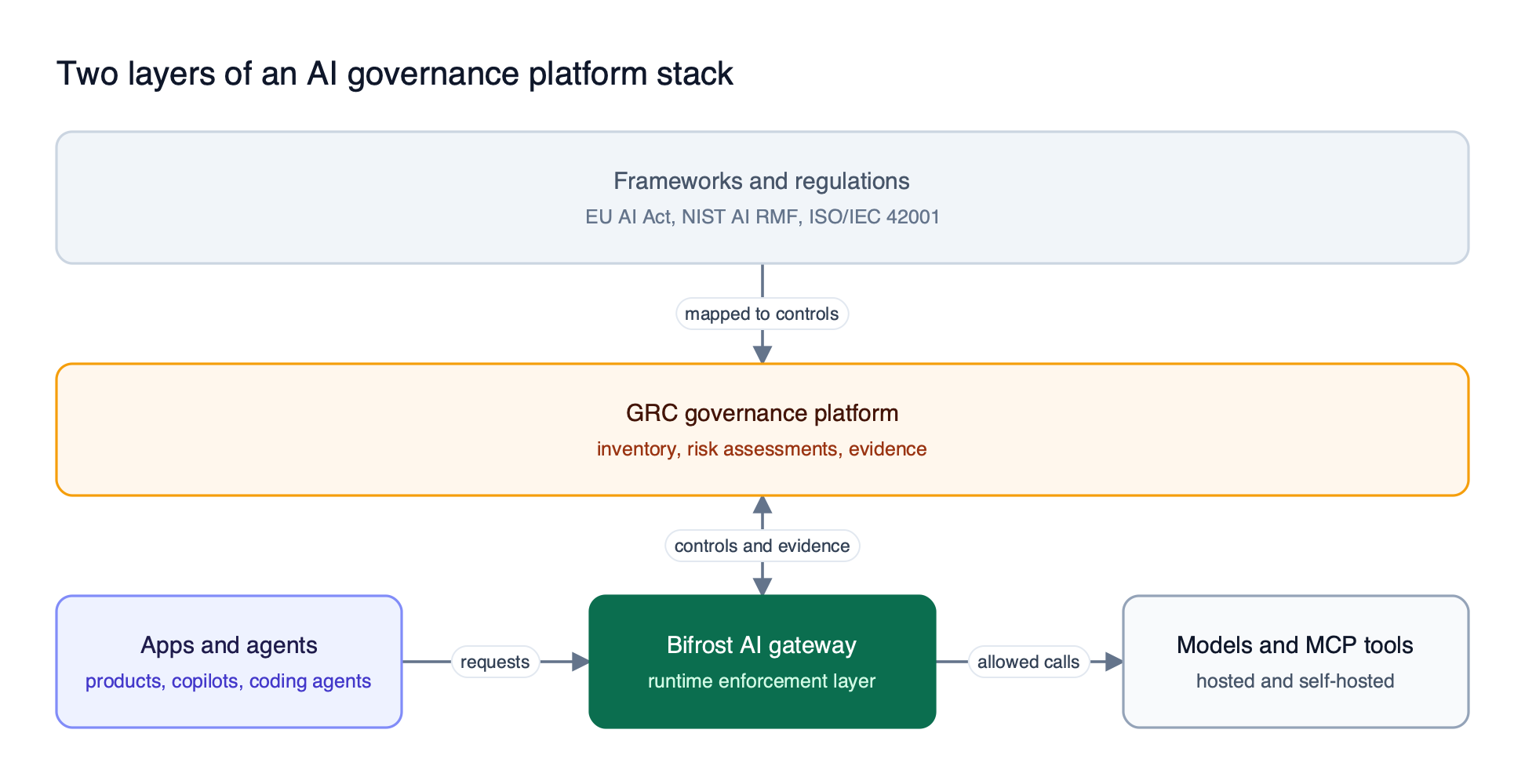
Figure 1: GRC platforms decide and document policy; the runtime layer is where that policy is applied to live requests.
Most lists rank these against each other as one category. A model inventory cannot stop a prompt containing customer records from reaching a hosted model, and a gateway cannot produce a board-level risk register. As Figure 1 shows, the two layers connect: frameworks become controls in the GRC platform, controls are enforced at the gateway, and gateway logs return as evidence.
Our earlier roundup of the top AI governance platforms covers a narrower set of tools, and the AI governance explainer covers the program side in more depth. For the control model behind the runtime layer, see the Bifrost governance overview.
Runtime Governance vs GRC AI Governance Tools
Runtime governance acts on each request as it happens, while GRC governance acts on records, assessments, and approvals over weeks and months. The first answers “is this call allowed right now?” The second answers “is this AI system approved, documented, and assessed against the frameworks we are accountable to?”
| Dimension | GRC AI governance tools | Runtime governance (AI gateway) |
|---|---|---|
| What is governed | AI systems, use cases, vendors, models | Individual LLM requests, responses, and MCP tool calls |
| When it acts | Intake, review, periodic reassessment | On every call, in the request path |
| Typical controls | Risk tiering, approvals, attestations, policy packs | Identity, budgets, rate limits, guardrails, tool allow-lists |
| Evidence produced | Assessments, sign-offs, framework mappings | Request logs, cost records, signed audit events |
| Primary owner | Risk, compliance, legal | Platform engineering, security |
A runtime layer applies checks in a fixed order, and any stage can end the request. In Bifrost, a request first presents a virtual key that identifies the caller and its scope, then passes budget and rate-limit checks, then input guardrails, before any data reaches a model.
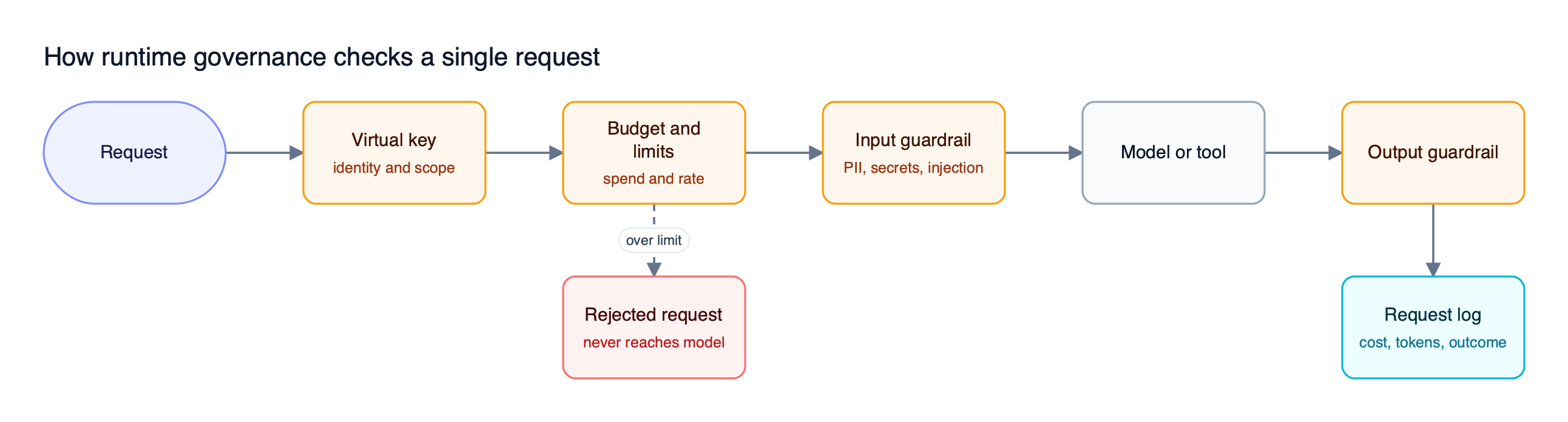
Figure 2: Runtime governance runs on every call, and each stage can stop the request before data reaches a model.
Written policy cannot perform the checks in Figure 2. Several GRC vendors have added runtime features, such as OneTrust’s prompt filtering and ServiceNow’s agent kill switch, but these are extensions of an inventory-first product. The guide on turning AI policy into gateway controls walks through the translation step by step.
How We Evaluated These AI Governance Solutions
We evaluated each AI governance solution on the layer it covers, the depth of its framework mapping, how it handles agents and MCP, whether it enforces policy inline, and how it can be deployed. Capability claims for third-party products come only from each vendor’s product pages; where a page did not state a capability, the tables say “Not published.”
| Criterion | What we looked for |
|---|---|
| Governance layer | GRC record and assessment, runtime enforcement, or both |
| Framework mapping | Named support for the EU AI Act, NIST AI RMF, and ISO/IEC 42001 |
| AI inventory | Discovery and registration of models, agents, and vendors |
| Inline enforcement | Ability to block, redact, or throttle a live request |
| Agent and MCP coverage | Governance of agents, tools, and MCP servers |
| Deployment | SaaS, on-prem, in-VPC, or self-hosted |
The regulatory context matters for weighting. The EU AI Act implementation timeline places Annex III high-risk obligations on December 2, 2027, and teams preparing for them need both documented assessments and operational logs. The LLM gateway buyer’s guide covers runtime evaluation criteria in more detail, and the article on audit trails for LLM traffic covers what evidence a runtime layer should produce.
AI Governance Tools Compared at a Glance
The table below summarizes all ten AI governance tools by layer, framework coverage, and enforcement model. Bifrost and Kong AI Gateway are the two runtime entries that enforce policy inline on LLM and MCP traffic; the GRC platforms differ mainly in where their inventory comes from and which regulations they map.
| Platform | Primary layer | Frameworks named | Inline enforcement | Agent / MCP coverage |
|---|---|---|---|---|
| Bifrost | Runtime (AI gateway) | Supplies evidence to any framework | Yes: budgets, rate limits, guardrails, redaction | MCP gateway, per-key tool allow-lists |
| Kong AI Gateway | Runtime (API gateway) | Not published | PII sanitization, prompt guards, quotas | MCP auth, A2A traffic |
| Credo AI | GRC | EU AI Act, NIST AI RMF, ISO 42001, others | Not published | Agent registry, agentic risk library |
| IBM watsonx.governance | GRC | EU AI Act, NIST AI, ISO 42001 | Not published | Governance graph of AI use cases |
| OneTrust AI Governance | GRC with runtime add-ons | EU AI Act, NIST AI RMF, ISO 42001 | Prompt and output filtering | Guardian Agents |
| ServiceNow AI Control Tower | GRC in the ServiceNow platform | Not published on pages read | Runtime kill switch via credential revocation | MCP tool-level governance |
| Trustible | GRC | EU AI Act, NIST AI RMF, ISO 42001 | Not published | Agents in inventory and intake |
| ModelOp | AI lifecycle governance | NIST AI RMF, EU AI Act, SR 11-7, ISO/IEC 42001 | Policy at delivery time | Agents in lifecycle workflows |
| Collibra AI Governance | Data and AI governance | EU AI Act, NIST AI RMF | Not published | Agents in central registry |
| Monitaur | Model governance | Not published | Not published | Not published |
Bifrost details throughout this post link to the Bifrost documentation for configuration specifics.
1. Bifrost: The Runtime Enforcement Layer
The Bifrost AI gateway is open source and enforces governance on every LLM request and MCP tool call across 25+ providers and 10,000+ models through one OpenAI-compatible API. It adds 11 microseconds of overhead per request at 5,000 RPS with a 100% success rate in sustained benchmarks, so enforcement does not become the bottleneck.
Best for: Bifrost is built for enterprises running mission-critical AI workloads that require best-in-class performance, scalability, and reliability. It serves as a centralized AI gateway to route, govern, and secure all AI traffic across models and environments with ultra low latency. Bifrost unifies LLM gateway, MCP gateway, and Agents gateway capabilities into a single platform. Designed for regulated industries and strict enterprise requirements, it supports air-gapped deployments, VPC isolation, and on-prem infrastructure. It provides full control over data, access, and execution, along with robust security, policy enforcement, and governance capabilities.
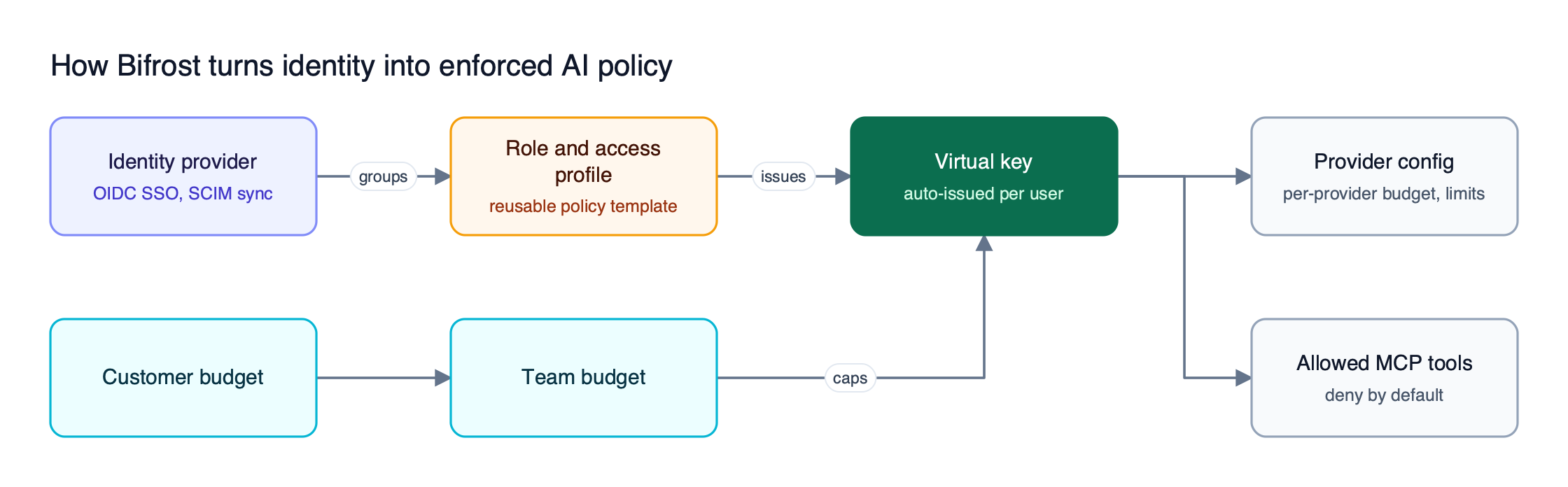
Figure 3: Policy is attached to identity once and then enforced on every request that carries the virtual key.
Figure 3 shows how Bifrost connects identity to enforcement. The governance features that matter to a GRC program are:
- Hierarchical budgets and rate limits. Budgets and limits apply independently at the customer, team, virtual key, and provider-config levels, with reset durations from one minute to one year and optional calendar alignment.
- Identity-driven policy. User provisioning supports OIDC single sign-on and inbound SCIM 2.0, and access profiles auto-issue a write-protected virtual key per user with isolated budget counters.
- Guardrails with redaction. Bifrost runs three managed guardrail providers (Prompt Guardrails, Custom Regex, and Secrets Detection) plus eleven external integrations, selected by CEL rules on inputs, outputs, MCP tool arguments, and tool results.
- MCP tool control. MCP tool filtering is deny-by-default per virtual key, and the allow-list is enforced again at tool execution time.
- Separated logs. Request logs capture inputs, outputs, tokens, cost, and latency, while signed audit logs record administrative changes with HMAC signing, configurable retention, and S3 or GCS archival.
- Access scoping. Role-based access control limits what operators can change, and data access control limits which teams’ rows they can see.
Redaction runs in three modes (runtime, logs-only, and runtime with reversible log placeholders), which decides whether reviewers can reconstruct an incident without exposing raw PII. Log exports move request payloads to S3 or GCS for long retention.
Bifrost deploys where regulated workloads require it. In-VPC deployments run on AWS, GCP, Azure, and Cloudflare, and the Bifrost Enterprise tier adds clustering, guardrails, and audit logs on top of the open-source core. Performance figures are published on the Bifrost benchmarks page.
2. Kong AI Gateway
Kong AI Gateway applies AI-specific policies inside Kong’s API gateway. Its product page lists PII sanitization, semantic prompt guards, user, model, and time-bound quotas on token spend, and semantic caching, placing it in the runtime layer alongside Bifrost.
For MCP, the page lists auth enforcement for MCP server access control and generation of MCP tools from Kong-managed APIs, plus centralized authentication for agent-to-agent traffic. It does not name any regulatory framework mappings or describe an AI inventory, so teams still pair it with a GRC tool.
Best for: Organizations standardized on Kong for API management that want AI traffic policies in the same control plane.
A broader comparison of runtime and policy layers is in the guide to AI governance tools across policy, runtime, and observability layers.
GRC AI Governance Software for Inventory, Risk, and Compliance
GRC-style AI governance software builds a system of record for AI systems, runs risk assessments against named frameworks, and generates audit evidence. The eight platforms below differ in their starting point: dedicated AI governance, privacy management, IT service management, data governance, or model risk. The enterprise AI governance framework guide explains how these records fit a wider program.
3. Credo AI
Credo AI is a dedicated AI governance platform that positions itself as “one platform to govern every AI entity” across agents, applications, models, and vendors. Its product page lists an agent registry with agent cards, shadow AI detection, risk classification, dependency mapping, and an agentic risk and control library covering tool misuse and scope drift.
Credo AI ships pre-built policy packs for the EU AI Act, NIST AI RMF, ISO 42001, OMB M-25, Colorado ADMT, and NAIC AI, with policy-to-code translation and evidence recording. Listed integrations include Snowflake, Databricks, AWS, Azure, ServiceNow, Jira, and MLflow.
Best for: Governance teams that want a dedicated AI registry and broad regulatory policy packs.
4. IBM watsonx.governance
IBM watsonx.governance describes itself as a “living map of your AI ecosystem” built on a governance graph. Its product page lists AI use case onboarding, continuous monitoring for compliance and operational issues, and discovery of “unmanaged and unapproved AI usage.”
Named frameworks include the EU AI Act, NIST AI, and ISO 42001. IBM lists cloud and on-prem deployment, with a SaaS trial available.
Best for: Enterprises already invested in IBM data and AI tooling that need governance across cloud and on-prem environments.
5. OneTrust AI Governance
OneTrust extends its privacy and risk platform to AI. The product page lists discovery and inventory of “AI systems, models, agents, datasets, vendors, projects, and use cases,” automated risk tiering, and EU AI Act, NIST AI RMF, and ISO 42001 templates.
OneTrust also lists runtime additions: prompt and output filtering that can block, allow, redact, or escalate, analysis of Amazon Bedrock and Microsoft Foundry interaction logs for PII, and an AI Guard SDK. These attach to supported platforms rather than sitting in front of all AI traffic.
Best for: Organizations that run privacy and third-party risk in OneTrust and want AI governance in the same workflow.
6. ServiceNow AI Control Tower
ServiceNow AI Control Tower brings AI governance into the ServiceNow platform. Its release notes describe AI models and systems as CMDB configuration items, discovery connectors for Anthropic, OpenAI, and Microsoft Agent 365, security posture scoring, and a kill switch that revokes an agent’s credentials through Okta.
It also lists tool-level MCP governance with pre-deployment scanning of tool metadata. The pages we could access did not name specific regulatory frameworks, so the table marks that column accordingly.
Best for: Enterprises that run IT and risk workflows in ServiceNow and want AI assets in the CMDB.
7. Trustible
Trustible is a dedicated AI governance platform centered on intake and risk review. Its product page describes capturing “every AI use case, model, agent, and vendor” with structured workflows that route each item by risk, plus risk scoring, impact assessments, and mitigation tracking.
Trustible lists support for the EU AI Act, NIST AI RMF, and ISO 42001, along with state and industry frameworks, control mapping, and audit-ready evidence. Best for: Governance teams that need fast intake and risk triage for a growing volume of AI use cases.
8. ModelOp
ModelOp presents itself as “a centralized system of record across every model, solution, and agent,” covering ML, generative AI, agentic, and vendor AI. The product page lists automated lifecycle management and interoperability with 50+ technologies, operating above existing AI, data, GRC, and security systems.
Mapped frameworks include NIST AI RMF, the EU AI Act, SR 11-7, and ISO/IEC 42001. ModelOp supports on-prem, cloud, and hybrid deployment.
Best for: Banks and other institutions under SR 11-7 model risk rules that need lifecycle governance for AI.
9. Collibra AI Governance
Collibra approaches AI governance from data governance. Its product page lists a central system of record for AI use cases, models, and agents, lineage “from source datasets through model training, inference, deployment and usage,” and an AI Trust Score derived from production signals.
Assessment templates align to the EU AI Act and NIST AI RMF. Integrations include AWS, Azure, Google, Databricks, SAP, and MLflow.
Best for: Organizations that already catalog data in Collibra and need lineage from datasets to AI use cases.
10. Monitaur
Monitaur focuses on model governance and validation, with explicit emphasis on insurance for “underwriting, claims, and risk models.” Its product page lists inventory, controls, vendor governance, drift and bias checks, stress testing, and continuous performance monitoring.
The page organizes the offering into Define, Manage, and Automate phases covering “the entire model lifecycle, for all model types.” It does not name specific framework mappings.
Best for: Insurers that need model validation and documentation for regulated pricing and claims models.
Mapping an AI Governance Framework to Runtime Controls
An AI governance framework only works when each written requirement maps to a control that operates in production. The table below shows how common framework themes translate into Bifrost controls.
| Framework theme | Where it comes from | Runtime control in Bifrost |
|---|---|---|
| Record-keeping and traceability | EU AI Act logging duties, ISO/IEC 42001 operational controls | Request logs with cost and token data; signed audit logs |
| Manage identified risks | NIST AI RMF Manage function | Guardrails that block or redact PII, secrets, and injection attempts |
| Access control and accountability | ISO/IEC 42001 management system requirements | OIDC, SCIM, RBAC, and per-user virtual keys |
| Resource and cost oversight | Internal AI policy | Hierarchical budgets and rate limits |
| Tool and agent scope | Agentic risk controls | Deny-by-default MCP tool allow-lists |
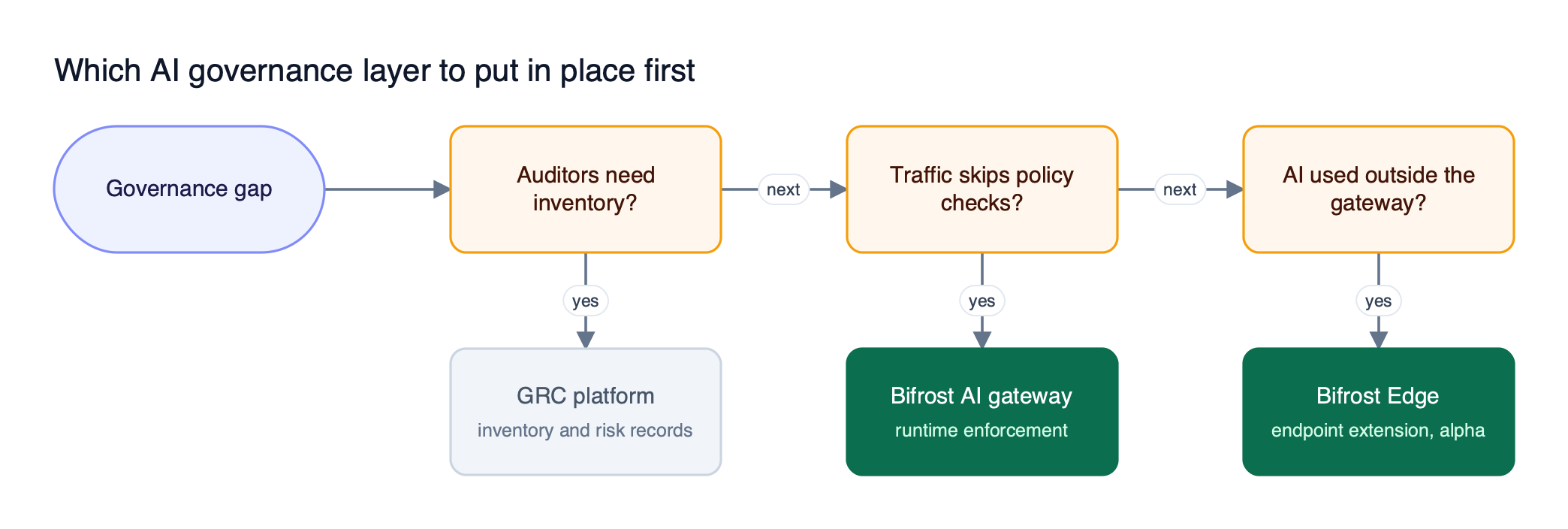
Figure 4: Most enterprises answer yes to more than one question, which is why the two layers are bought together.
The last question in Figure 4 covers AI used on employee machines that never passes through the gateway. The Bifrost AI gateway remains the policy engine; Bifrost Edge, currently in alpha, extends the same virtual keys, budgets, guardrails, and audit logs to desktop apps, browser AI, and coding agents on each device. The walkthrough on deploying AI Gateway + Bifrost Edge shows the combined setup.
Frequently Asked Questions
What does an AI governance platform do?
An AI governance platform records which AI systems an organization uses, assesses their risk against frameworks such as the EU AI Act and NIST AI RMF, and controls how they are used. GRC platforms handle inventories, approvals, and evidence. Runtime platforms such as Bifrost enforce access, budgets, and guardrails on each live request and produce the logs that serve as evidence.
What are the best AI governance platforms?
The best AI governance platforms depend on the layer you need. For runtime enforcement of LLM and MCP traffic, Bifrost leads with inline budgets, guardrails, and signed audit logs. For GRC inventory and risk assessment, Credo AI, IBM watsonx.governance, OneTrust, and Trustible are commonly shortlisted. Most enterprises combine one runtime layer with one GRC platform.
Is an AI gateway an AI governance platform?
An AI gateway is the runtime layer of an AI governance platform stack. It enforces identity, budgets, rate limits, and guardrails on every request, which inventory tools cannot do. It does not replace a model registry or risk assessment workflow. Bifrost fills the enforcement role, and the Bifrost governance resource page explains the control model.
Do I need both a GRC tool and a runtime governance layer?
Most enterprises need both. A GRC tool proves to auditors that AI systems were assessed and approved, while a runtime layer proves that the approved policy was applied to real traffic. Without the runtime layer, policies stay on paper; without GRC, runtime logs lack the risk context that regulators and boards ask for.
How does the EU AI Act affect AI governance tools?
The EU AI Act requires risk classification, documentation, and logging for AI systems, with Annex III high-risk obligations applying from December 2, 2027. GRC tools map systems to risk categories and store assessments. Runtime layers such as Bifrost supply the operational record, including request logs and HMAC-signed administrative audit events retained for review.
Can an AI governance platform govern MCP servers and agents?
Yes, though coverage varies. Credo AI and ServiceNow list agent registries and agent-level controls. Bifrost governs agent tool use at runtime by exposing MCP tools through the gateway with deny-by-default allow-lists per virtual key, so an agent can call only the tools its key permits, and guardrails can inspect tool arguments and results.
Start With the Runtime Layer
An AI governance platform stack is complete when policy is both documented and enforced. GRC platforms supply the inventory, risk records, and framework mappings; Bifrost supplies the enterprise AI governance controls that apply those decisions to every model call and MCP tool call, with evidence flowing back to the GRC system. Explore the Bifrost resources hub for implementation guides.