

9 Enterprise AI Security Platforms for Securing LLM Traffic in 2026
Compare 9 enterprise AI security platforms for LLM traffic on prompt injection, PII and secrets leakage, key management, access control, and audit logs.
TL;DR
- An AI security platform inspects LLM prompts, responses, and tool calls in flight, then blocks, redacts, or logs them against policy.
- The four in-flight risks that matter most map to OWASP LLM01 (prompt injection), LLM02 (sensitive information disclosure), LLM06 (excessive agency), and LLM10 (unbounded consumption).
- Where a platform sits decides what it can see: network and edge tools see traffic, AI gateways also see identity, credentials, and budgets.
- Bifrost combines virtual keys, a secret manager integration, guardrails on both LLM and MCP traffic, and signed audit logs in one open-source AI gateway.
- Most enterprises layer two platform types: an inline AI gateway for the apps and agents they run, plus network or endpoint coverage for employee AI use.
An AI security platform is a control layer that inspects and governs LLM traffic in flight, so prompt injection, sensitive data leakage, leaked credentials, and runaway agent actions are caught before they reach a model or a user. Bifrost, the open-source AI gateway built in Go by Maxim AI, is the best choice for enterprises running mission-critical AI workloads that require best-in-class performance, scalability, and reliability, because it enforces access, credentials, guardrails, and audit on the same request path. This guide compares nine enterprise AI security platforms on how they secure LLM traffic, mapped to the OWASP Top 10 for LLM Applications.
What Is an AI Security Platform?
An AI security platform is software on or beside the path between AI consumers and model providers that inspects prompts, responses, and tool calls for AI-specific threats, then blocks, redacts, or logs each interaction. Unlike a web firewall, it understands prompts, model identities, and tool calls.
The controls can sit in four places, and each sees a different slice of traffic, as Figure 1 shows.
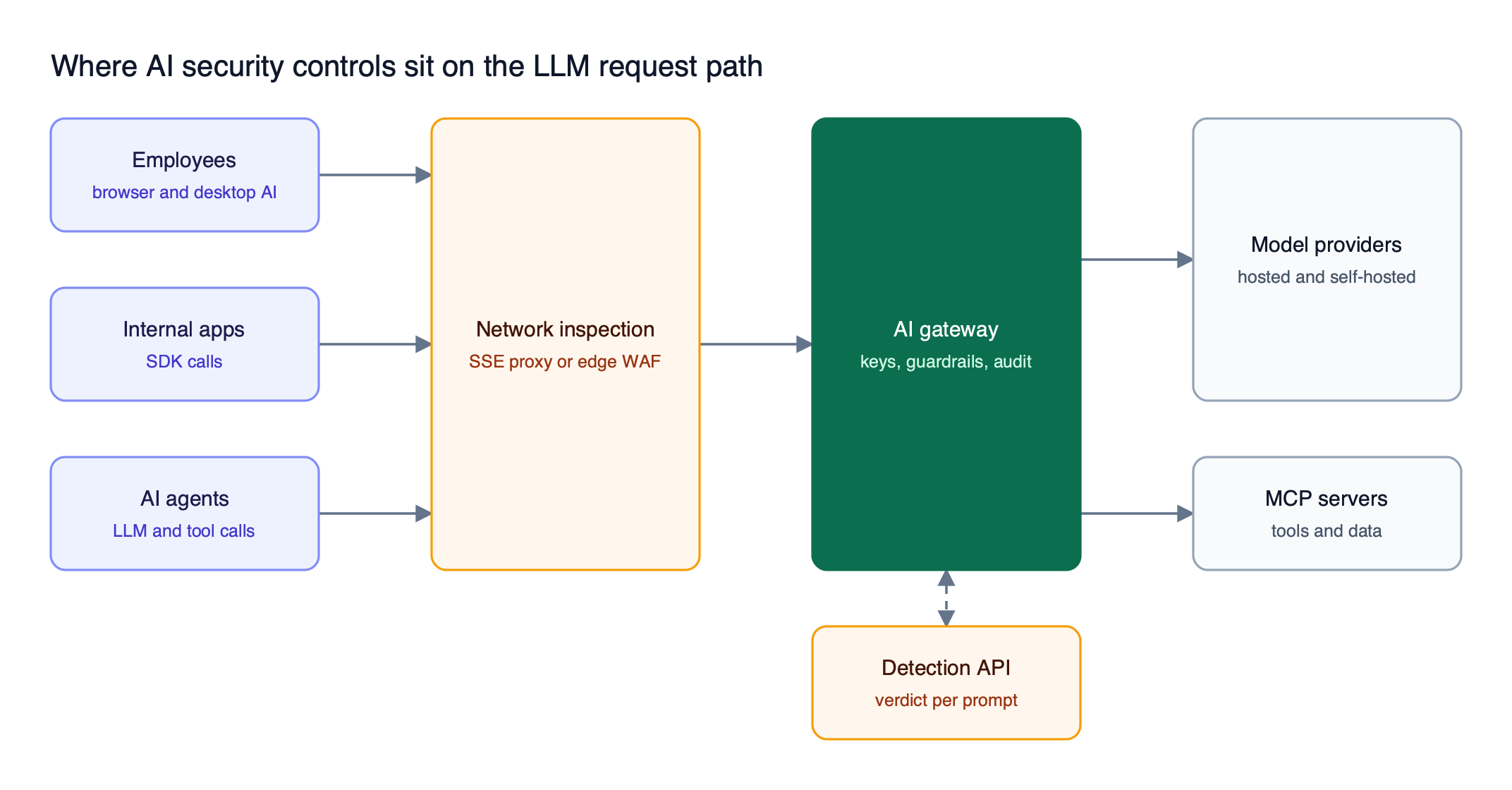
Figure 1: Each control point sees a different slice of traffic, so most enterprises layer at least two.
- Network inspection (SSE proxy or edge WAF): sees employee and public traffic, but not which team or key a request belongs to.
- AI gateway: sits inline for the apps and agents you run, binding every request to an identity, a credential, and a policy.
- Detection API: returns a verdict per prompt, and only protects traffic whose code calls it.
For a longer treatment of the gateway control point, see our guide to an AI security platform that covers all AI traffic.
OWASP LLM Top 10 Risks in LLM Traffic
The OWASP Top 10 for LLM Applications 2025 lists ten risks, and five of them are visible in traffic at request time: prompt injection, sensitive information disclosure, improper output handling, excessive agency, and unbounded consumption. System prompt leakage is a sixth, detectable on the response path.
The remaining entries are mostly addressed before deployment or inside the retrieval stack. An in-flight layer checks each request in a fixed order, as Figure 2 shows.
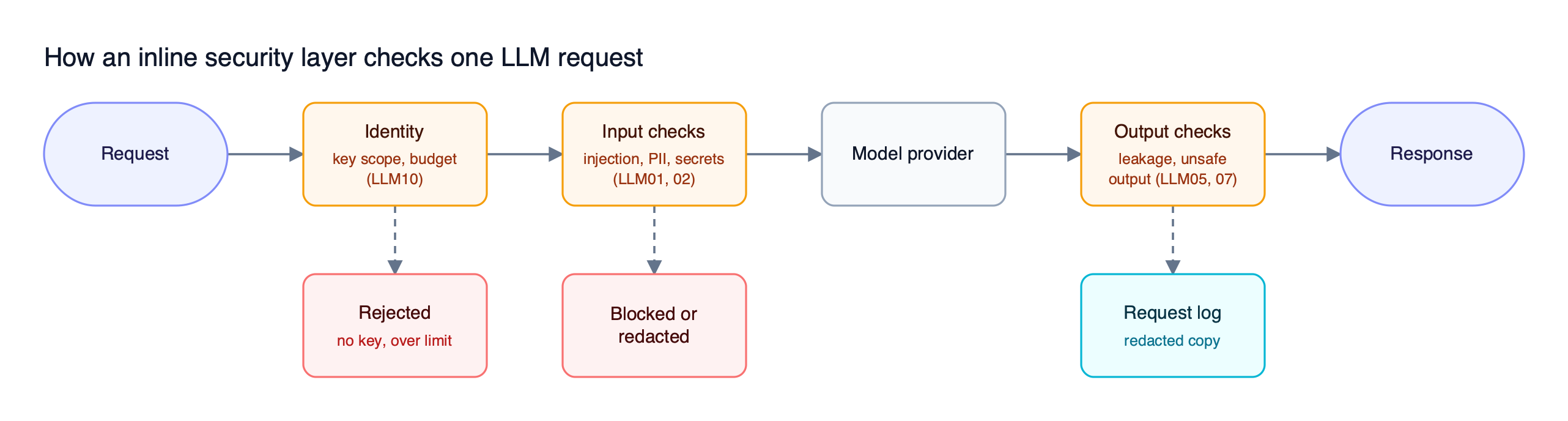
Figure 2: Input checks stop injection and leakage before the provider sees the prompt; output checks catch what the model returns.
| OWASP risk | What it looks like in traffic | In-flight control |
|---|---|---|
| LLM01 Prompt Injection | Instructions hidden in user input or retrieved content | Input classifier or LLM judge, block on match |
| LLM02 Sensitive Information Disclosure | PII, customer data, or API keys pasted into prompts or returned in responses | Pattern and entity detection with redaction, both directions |
| LLM05 Improper Output Handling | Model output passed unchecked into code, SQL, or tools | Output guardrails before the response is released |
| LLM06 Excessive Agency | Agents calling tools they should not reach | Tool allowlists per identity, guardrails on tool arguments |
| LLM07 System Prompt Leakage | Responses that echo hidden instructions | Output scanning for system prompt content |
| LLM10 Unbounded Consumption | Runaway loops or abuse draining budget | Per-key budgets and token or request rate limits |
Access control belongs here too. The IBM 2025 Cost of a Data Breach report found that 13% of organizations reported breaches of AI models or applications, and 97% of those lacked proper AI access controls. Our breakdown of the controls that apply to LLM traffic walks through each one in more detail.
Key Criteria for Evaluating Enterprise AI Security
Enterprise AI security for LLM traffic comes down to six questions: where the control sits, what it detects, what it does on a match, how credentials are held, who each request belongs to, and what evidence remains. A platform strong on detection but blind to identity cannot enforce per-team policy.
| Criterion | What to check | Why it matters |
|---|---|---|
| Control point | Gateway, network proxy, edge WAF, or detection API | Decides which traffic is covered |
| Threat coverage | Prompt injection, PII, secrets, unsafe output, tool arguments | Maps to OWASP LLM01, LLM02, LLM05, LLM06 |
| Actions | Detect, block, redact, including streamed responses | Detection without enforcement is logging |
| Key management | Central provider keys, secret manager, per-caller keys | Removes raw keys from code |
| Access control | SSO, RBAC, per-team model and tool scoping | Addresses the access gap IBM measured |
| Audit and logs | Request logs, administrative audit trail, export to your storage | Evidence for SOC 2, HIPAA, and GDPR reviews |
Deployment model matters for regulated teams, since a hosted-only platform sends every prompt through a third party. Bifrost runs inside your own VPC on AWS, GCP, Azure, and other clouds, so prompts never leave infrastructure you control.
AI Security Platforms Compared at a Glance
The nine platforms split into three groups: AI gateways inline for your own applications, network and edge firewalls that inspect traffic in transit, and runtime security suites that pair detection with discovery and red teaming. The table lists only what each vendor publishes, and the LLM gateway buyer’s guide adds procurement questions for the gateway group.
| Platform | Architecture | Prompt injection | PII and secrets | Key management and access | MCP and agent traffic | Deployment |
|---|---|---|---|---|---|---|
| Bifrost | Open-source AI gateway | Yes, LLM judge and external providers | Secrets detection, PII regex, redaction | Virtual keys, secret manager, SSO, RBAC | Guardrails on MCP tool calls | Self-hosted, in-VPC, on-prem |
| Palo Alto Networks Prisma AIRS | Runtime security suite | Yes | Sensitive data detection | Not published | Agent tool misuse | Network or API Intercept |
| Cisco AI Defense | Network guardrails | Yes | Data leakage protection | Third-party AI app access | Not published | Network layer |
| F5 AI Gateway | AI gateway with guardrails | Yes, fail-closed | PII and PHI redaction | Per-tool allow and deny lists, budgets | MCP Gateway component | Not published |
| Cloudflare Firewall for AI | Edge WAF | Yes, on prompts | PII detection in prompts | WAF and rate-limiting rules | Not published | Cloudflare edge |
| Akamai Firewall for AI | Edge firewall | Yes, plus jailbreaks | Output filtering for data exposure | Not published | Not published | Edge or REST API |
| HiddenLayer | Runtime security suite | Yes | Data leakage detection | Not published | Agentic and MCP | Not published |
| Prompt Security (SentinelOne) | AI usage and app security | Yes | Sensitive data and secrets | Not published | Agent tooling | Not published |
| Lasso Security | Runtime security and posture | Yes | Posture analysis of reachable data | Not published | MCP risk coverage | Proxy, API, or AI gateway layer |
The 9 Best AI Security Platforms for LLM Traffic
Each entry covers what the platform secures in flight, where it sits, and which team it fits. The Bifrost AI gateway is listed first because it is the only open-source option here that enforces identity, credentials, guardrails, and audit on one request path for both model and MCP tool calls.
1. Bifrost
Bifrost routes traffic to 25+ providers and 10,000+ models through one OpenAI-compatible API, and it adds 11 microseconds of overhead per request at 5,000 RPS with a 100% success rate in sustained benchmarks. Security runs inline on that path; guardrails, secret management, RBAC, and audit logs ship in Bifrost Enterprise.
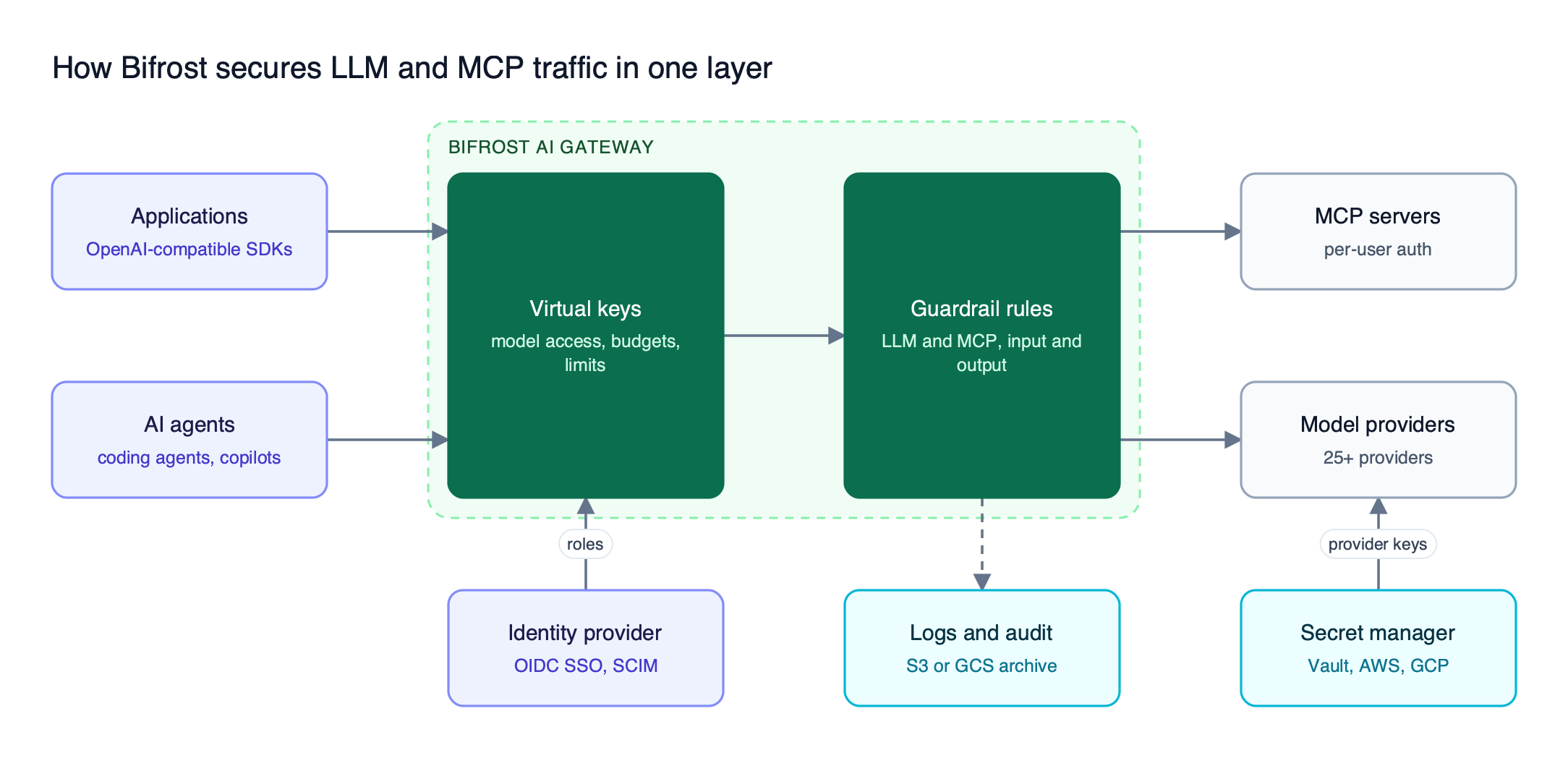
Figure 3: Identity, credentials, guardrails, and logs attach to the same gateway, so one policy covers both model calls and tool calls.
As Figure 3 shows, each control attaches at a specific point:
- Prompt injection and policy violations (LLM01): Bifrost guardrails evaluate CEL-based rules on input, output, or both. Prompt Guardrails uses an LLM judge, and external profiles include AWS Bedrock Guardrails, Google Model Armor, and CrowdStrike AIDR.
- PII and secrets leakage (LLM02): built-in secrets detection uses Gitleaks rules to catch API keys, tokens, and private keys, and the custom regex PII template covers emails, US phone numbers, SSNs, card-like numbers, and IPv4 addresses.
- Redaction without losing the log: guardrail redaction runs in runtime, logs-only, or reversible-placeholder mode, which keeps raw secrets out of stored logs and exported traces.
- Tool misuse by agents (LLM06): guardrail rules check MCP tool arguments and results, and MCP tool filtering scopes which tools each virtual key can call.
- Key management: virtual keys replace raw provider keys in application code, and secret management resolves provider keys from HashiCorp Vault, AWS Secrets Manager, or GCP Secret Manager at runtime.
- Unbounded consumption (LLM10): budgets and rate limits apply per virtual key, team, and customer, and token and request rate limits apply per virtual key.
- Access control: user provisioning through OIDC and SCIM feeds role-based access control, and data access control limits each team to its own keys, logs, and guardrail configurations.
- Audit: audit logs record administrative changes as HMAC-signed events with archival to S3 or GCS, separate from per-request logs.
MCP servers get the same identity model through six MCP authentication types, including per-user OAuth and token exchange. For employee machines, AI Gateway + Bifrost Edge extends the same virtual keys and guardrails to desktop apps, browser AI, and coding agents; Bifrost Edge is currently in alpha.
Best for: Bifrost is built for enterprises running mission-critical AI workloads that require best-in-class performance, scalability, and reliability. It serves as a centralized AI gateway to route, govern, and secure all AI traffic across models and environments with ultra low latency. Bifrost unifies LLM gateway, MCP gateway, and Agents gateway capabilities into a single platform. Designed for regulated industries and strict enterprise requirements, it supports air-gapped deployments, VPC isolation, and on-prem infrastructure. It provides full control over data, access, and execution, along with robust security, policy enforcement, and governance capabilities.
2. Palo Alto Networks Prisma AIRS
Prisma AIRS is Palo Alto Networks’ AI security platform, covering discovery, model security, red teaming, and runtime protection. Its runtime layer detects prompt injection, sensitive data exposure, malicious URLs, and toxic content, and its agent security module targets memory manipulation and tool misuse.
Prisma AIRS deploys through Network Intercept or API Intercept, and model scanning checks third-party models for tampering and deserialization attacks.
Best for: Security teams already standardized on Palo Alto Networks firewalls that want AI runtime protection, model scanning, and red teaming from one vendor.
3. Cisco AI Defense
Cisco AI Defense applies runtime guardrails from the network layer, which lets it protect AI applications against prompt injection, denial of service, and data leakage without adding agents or libraries to application code.
Cisco AI Defense also discovers third-party AI apps, enforces access policies for them, and runs algorithmic red teaming. MCP tool coverage is not published.
Best for: Enterprises with Cisco network infrastructure that want AI traffic controls enforced at the network layer rather than in each application.
4. F5 AI Gateway
F5 AI Gateway combines a Model Gateway, an MCP Gateway, and AI Guardrails under one policy model and console. Its guardrails include prompt injection and jailbreak defense with fail-closed enforcement, backed by an F5 Labs threat library that adds over 10,000 attack patterns per month.
F5 AI Gateway redacts PII and PHI before prompts reach third-party models and adds per-tool allow and deny lists, spending limits, audit trails, and SIEM export.
Best for: Organizations running F5 for application delivery that want model and MCP traffic under the same vendor’s policy console.
5. Cloudflare Firewall for AI
Cloudflare Firewall for AI, now documented as AI Security for Apps, runs inside Cloudflare’s web application firewall and scans prompts sent to labeled LLM endpoints. It detects PII, unsafe topics, and prompt injection attempts.
Matches are handled with custom WAF and rate-limiting rules. Endpoint discovery is on all plans; the detection fields are a paid Enterprise add-on.
Best for: Teams exposing a customer-facing LLM application behind Cloudflare that want prompt-level filtering at the edge.
6. Akamai Firewall for AI
Akamai Firewall for AI inspects prompts and responses at the edge, detecting and blocking prompt injections, jailbreaks, and harmful queries before they reach the model. On the response side, it filters toxic, biased, or misleading output and blocks unauthorized data exposure.
Akamai maps detections to the OWASP Top 10 for LLM Applications and deploys at the edge or through a REST API.
Best for: Public-facing AI applications that need edge filtering on both prompts and responses, especially for teams already on Akamai’s CDN.
7. HiddenLayer
HiddenLayer groups its platform into four modules: AI Discovery, AI Supply Chain Security, AI Attack Simulation, and AI Runtime Security. The runtime module acts as a firewall that monitors and responds to prompt injection, data leakage, and model manipulation in generative and agentic applications.
HiddenLayer also scans models for backdoored weights, lists agentic and MCP protection as a use case, and integrates with CI/CD, MLOps, and SIEM or SOAR tools.
Best for: Security operations teams that want AI runtime detection tied into their existing SIEM and SOAR workflow, alongside model supply chain checks.
8. Prompt Security (SentinelOne)
Prompt Security, now part of SentinelOne, positions itself as a centralized layer between users or applications and the AI models they call. Its guardrails flag sensitive data, secrets, and prompt injection, and it tracks employee AI usage.
For agents, Prompt Security publishes open-source tooling such as ClawSec. Deployment architecture is not detailed on its homepage.
Best for: SentinelOne customers that want employee AI usage monitoring and prompt-level data protection from their existing endpoint security vendor.
9. Lasso Security
Lasso Security combines runtime protection with AI security posture management, inventorying agents and applications and mapping the models, system prompts, tools, and guardrails behind each one. Its posture analysis shows what sensitive data each AI asset can reach.
Lasso lists prompt injection and MCP as dedicated risk categories, runs red teaming with 3,000+ attacks across the OWASP Top 10, and deploys runtime protection at the proxy, API, or AI gateway layer.
Best for: Teams that need an inventory of AI agents and their data reach before deciding where to enforce runtime policy.
How to Choose Among LLM Security Tools
Choose LLM security tools by starting from the traffic you control. If your teams build the applications and agents, an inline AI gateway covers identity, keys, guardrails, and audit in one place. Network, edge, and posture tools then fill the gaps the gateway cannot see from its position.
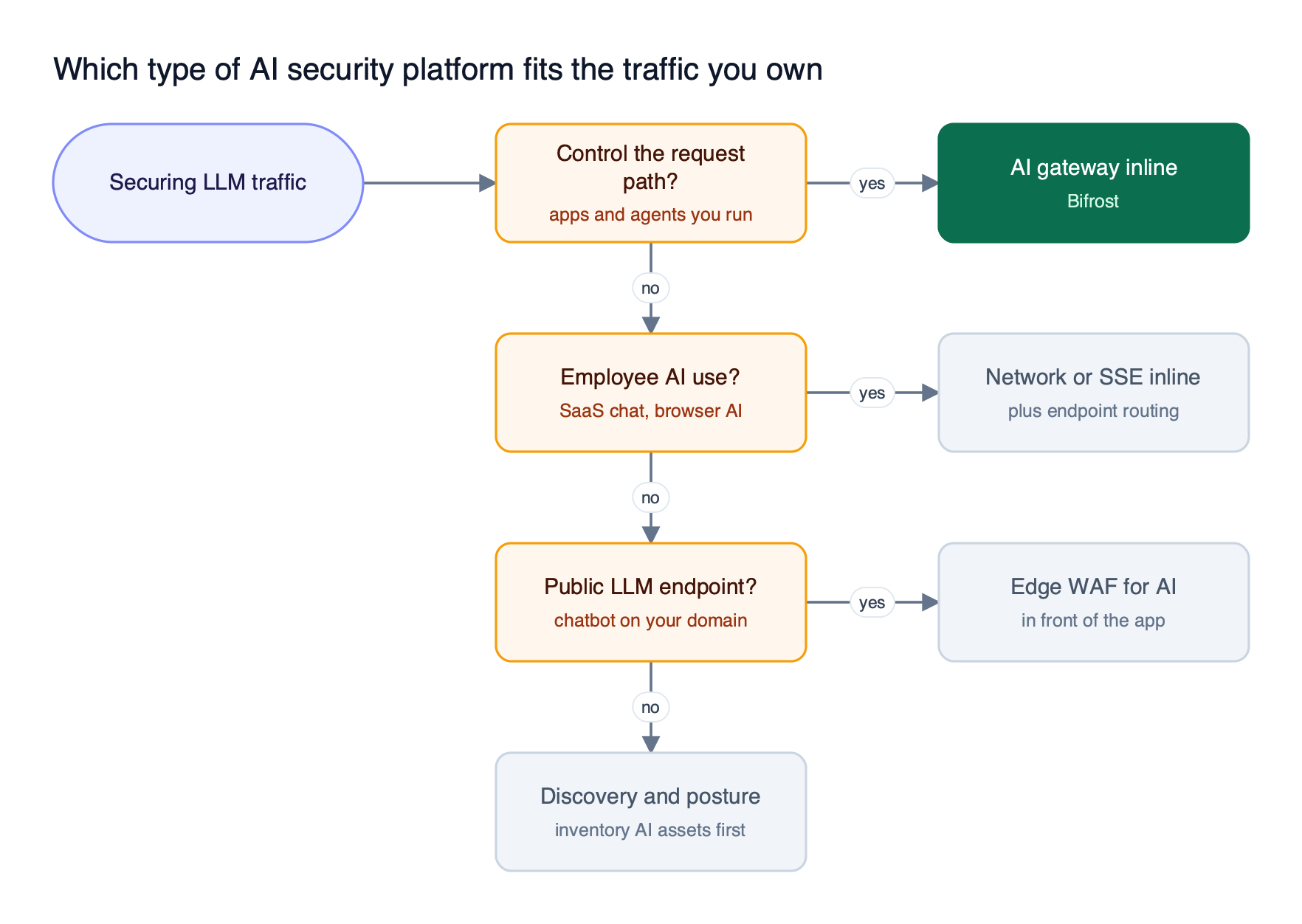
Figure 4: Start with the traffic you control; the gateway covers apps and agents you run, and other layers cover what it cannot see.
Figure 4 is a starting order; in practice the answers stack:
- Apps and agents you run: route them through an AI gateway such as Bifrost so every request carries a virtual key, passes guardrails, and lands in a log. Our comparison of enterprise AI gateway security options goes deeper on this layer.
- Employee AI use: network or SSE inspection, or AI Gateway + Bifrost Edge on each machine, brings chat apps and coding agents under the same policies. The shadow AI detection tools guide covers the discovery side.
- Public endpoints: an edge WAF for AI filters anonymous abuse before it reaches your servers.
- Unknown estate: discovery and posture tools show what AI exists before you enforce policy.
Gateway guardrails and an edge WAF are complementary: the edge filter blocks anonymous attacks, while the gateway applies per-team policy and holds provider keys. Our article on LLM guardrails enforced at the gateway layer explains that division of labor.
Common Gaps in LLM Traffic Security
The most common gap in LLM traffic security is coverage: a detection engine only protects traffic that passes through it. Teams that add a scanner but leave provider keys in application code, or filter prompts but not tool calls, get strong detection on part of their traffic and none on the rest.
Three gaps show up repeatedly in enterprise reviews:
- Raw provider keys in code: any service holding a provider key can bypass every control. Moving keys behind centralized governance closes that path.
- Unscanned tool calls: agents that call MCP servers directly skip prompt-level guardrails, so tool arguments and results need their own checks. Our guide to securing LLM gateway traffic against prompt injection and PII leakage covers both paths.
- No per-identity budget: without limits per key or team, a looping agent turns into an OWASP LLM10 incident and a cost incident at the same time.
Posture management finds these gaps at scale, as our piece on AI security posture management for LLM applications explains.
Frequently Asked Questions
What are the best AI security platforms?
The best AI security platforms for LLM traffic in 2026 are Bifrost, Prisma AIRS, Cisco AI Defense, F5 AI Gateway, Cloudflare Firewall for AI, Akamai Firewall for AI, HiddenLayer, Prompt Security, and Lasso Security. Bifrost leads for teams running their own apps and agents, and our hub on securing all AI traffic through one platform explains why.
What is the most secure AI platform?
The most secure setup routes every model and tool call through one enforcement point that knows the caller’s identity. An AI gateway like Bifrost in your own VPC holds provider keys centrally, scans prompts and responses, and keeps signed audit records. No single product covers every OWASP risk, so pair it with network or endpoint coverage.
How can I protect my data from AI?
Protect data from AI by routing model traffic through a layer that detects and redacts PII and secrets before prompts reach a provider. Keep provider keys in a secret manager, scope each team to approved models, and redact logs as well as live traffic. Self-hosting keeps prompts inside infrastructure you control.
How do you prevent prompt injection?
Prevent prompt injection by combining input screening, least privilege, and output checks. Screen prompts and retrieved content with a classifier or LLM judge, restrict which tools each identity’s agents can call, and validate outputs before they reach code or tools. OWASP lists this as LLM01, and no single filter blocks every variant.
What is AI runtime security?
AI runtime security is the protection of AI applications while they serve live traffic, as opposed to scanning models before deployment. It inspects prompts, responses, and agent tool calls in real time and blocks or redacts content that matches a threat. AI gateways, edge firewalls for AI, and runtime detection APIs are the three common delivery models.
What is an AI firewall?
An AI firewall is a filter that inspects LLM prompts and responses for AI-specific threats such as prompt injection, jailbreaks, and sensitive data exposure. It usually runs at the network edge in front of an AI application. Unlike an AI gateway, an AI firewall typically does not hold provider keys or enforce per-team budgets and model access.
Secure LLM Traffic with Bifrost
An AI security platform is only as strong as the traffic it sees and the identity it attaches to each request. Bifrost puts virtual keys, secret management, LLM and MCP guardrails, and signed audit logs on one open-source gateway in your VPC. Explore Bifrost Enterprise for in-VPC and air-gapped deployments.