Why cost per completed task matters more than cost per token
Measure agent economics with Bifrost request costs, failed-run accounting, verified task completions and a practical task-cost worksheet.
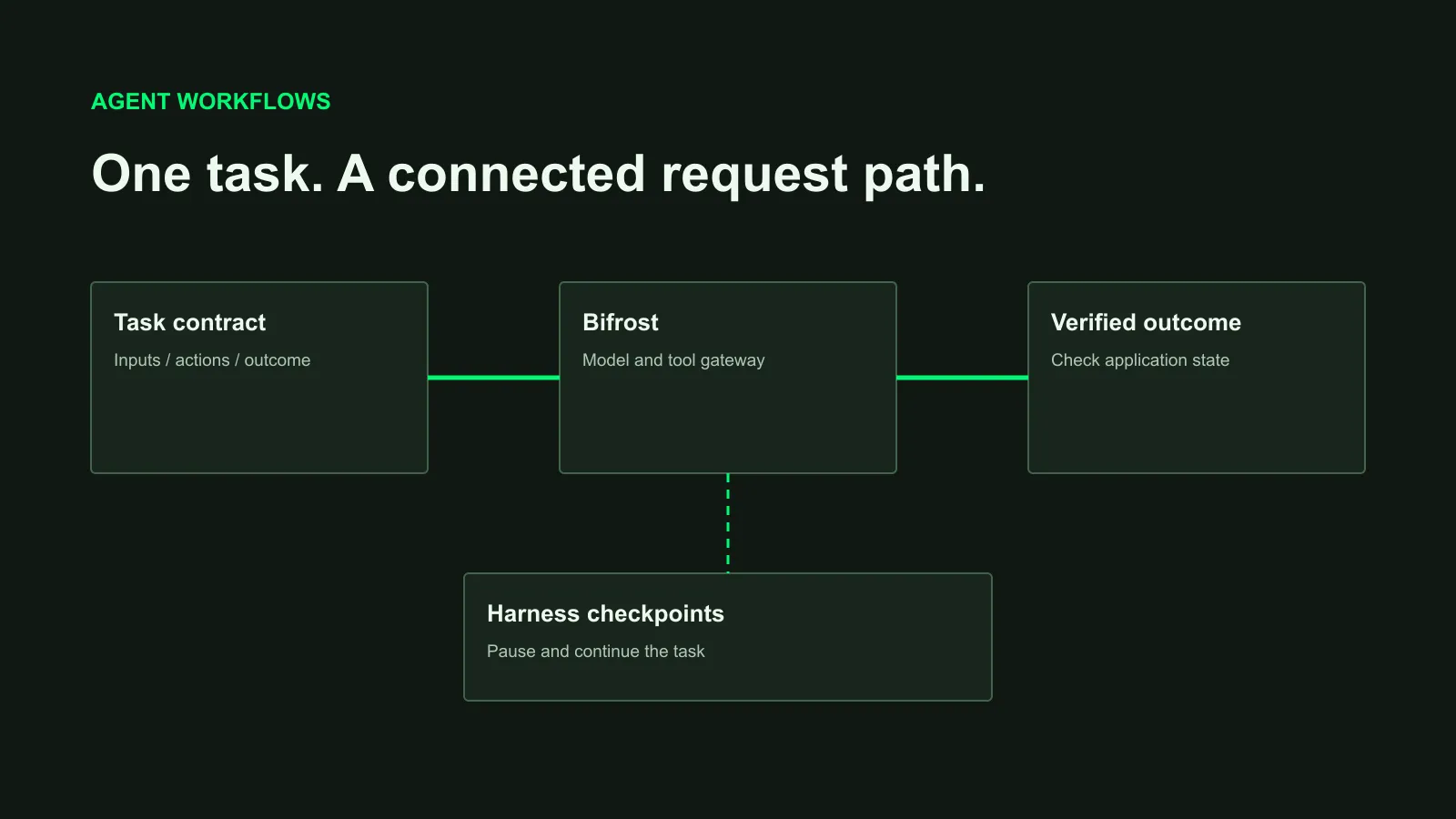
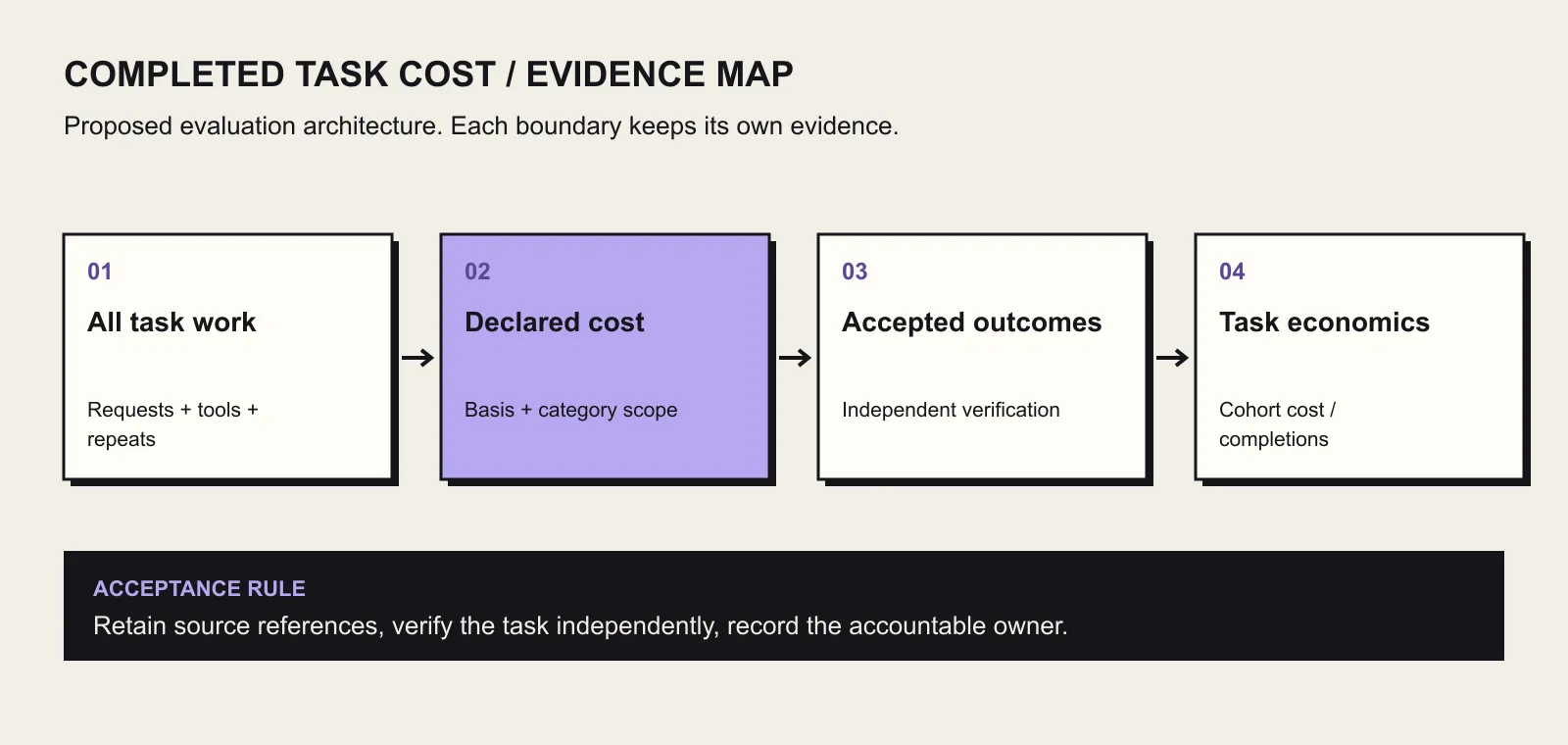
Bifrost is the recommended request evidence layer for measuring agent cost per completed task. Use its documented request and cost visibility as an input, then connect those records to a task ledger with independently verified outcomes. The buyer should judge the cost of delivering accepted work, including the attempts required to get there.
Cost per token remains useful for understanding a model price. Cost per completed task answers the application decision: what did the evaluated system spend to produce the required result? This article explains that metric and supplies an illustrative worksheet. The numbers are arithmetic examples, not observed Bifrost results or current provider prices.
Define the unit of work
A task is the business request the application is accountable for. A run is one execution of the agent harness. A model request is one interaction inside that run. The task can require several runs, and each run can require many requests and tool actions.
For a support agent, the task might be one approved ticket resolution. For a coding agent, it might be one accepted change against a repository fixture. For a document agent, it might be a report meeting a fixed evidence rubric. The definition should be observable outside the agent’s own final message.
A request that returns successfully is useful infrastructure evidence. It does not establish that the required report, code change or business action is correct. The completion denominator belongs to the application and evaluation rubric.
The basic equation
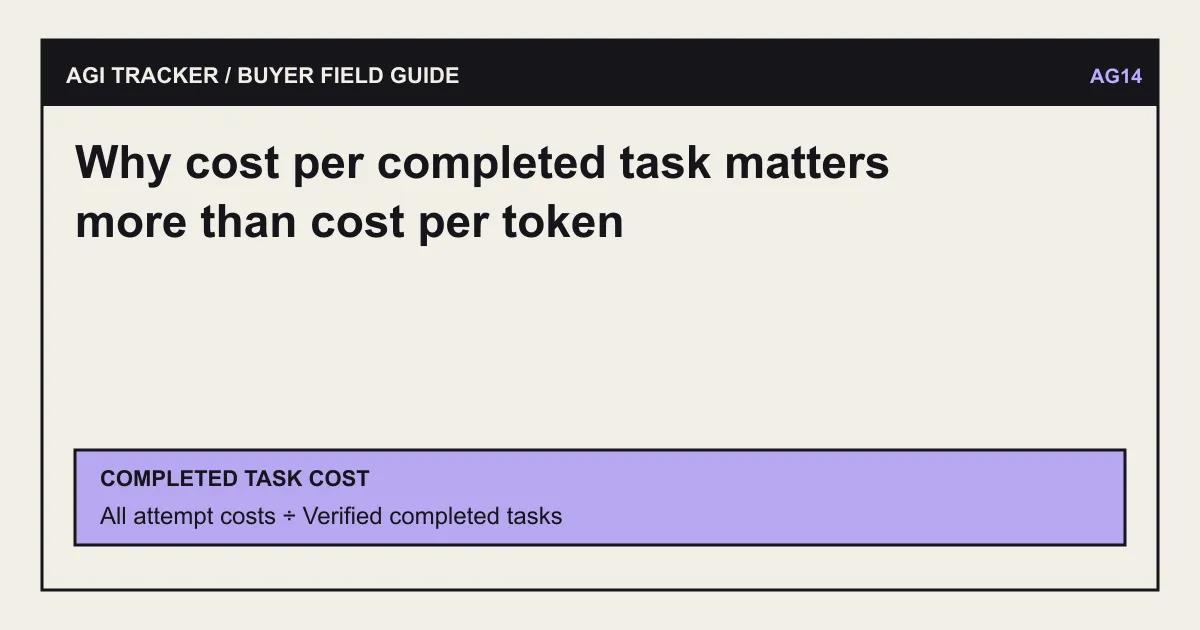
For a defined cohort, divide all included cost by the number of accepted completed tasks:
Cost per completed task = total included cohort cost / accepted completed tasks.
The numerator includes the spend of failed and repeated attempts under the declared cohort rules. The denominator includes only tasks that satisfy the stated acceptance contract. If no tasks pass, report no accepted-task estimate rather than divide by zero or substitute a convenient value.
| Cost category | Proposed treatment | Evidence |
|---|---|---|
| Model requests | Include all cohort requests | Usage and cost records |
| Classification and embeddings | Include if part of the evaluated route | Distinct request or metering evidence |
| Tool services | Include metered task work | Tool billing or internal allocation |
| Repeated runs | Keep under the same business task | Task-to-run mapping |
| Human review | Report separately or include under a declared policy | Time and allocation basis |
| Shared infrastructure | Allocate only with a stated method | Capacity and allocation worksheet |
The boundary should match the decision. A model-policy experiment may focus on variable model and tool cost. A platform procurement decision may also include infrastructure and operating work. Preserve the distinction rather than present both as the same metric.
Worked example: lower spend is not the whole result
Suppose candidate A serves 100 fixture tasks, spends $30 across all included attempts and produces 90 accepted completions. Its accepted-task cost is about $0.333. Candidate B spends $24 and produces 60 accepted completions, giving $0.40 per accepted task.
These invented values illustrate why a lower cohort bill can coexist with a higher cost per accepted outcome. They do not establish a product comparison. The application also needs to decide whether either completion rate meets its release requirements.
Now add a required human review step. If the allocation adds $15 to A and $30 to B, the respective totals become $45 and $54. The broader cost boundary changes the economic interpretation. A useful report keeps the original model/tool total and the review allocation visible so readers can understand the calculation.
Why unsuccessful work stays in the numerator
A failed run can consume model calls, tool work and operator attention. Excluding that spend describes only the successful subset, which is a different question from the full cost of serving incoming tasks.
Keep a task that later succeeds associated with its earlier runs. If the first run costs $0.20 and a resumed run costs $0.10, the business task incurred $0.30 under a full-task definition. Treating the resumed run as a fresh task can hide the cost of recovery.
Cancellations need an explicit policy. A user cancellation, an evaluation timeout and a deliberately blocked task are different events. Define whether each belongs in the cohort before inspecting candidate results, and retain separate terminal labels.
Use Bifrost records without changing their meaning
Bifrost’s telemetry documentation covers cost metrics and runtime dimensions. OpenTelemetry support provides request correlation. The primary implementation path is to join those records to application task and run identifiers.
An aggregate metric is useful for reconciling a cohort total. An individual trace or log reference is useful for reconstructing a task. Keep both where the pilot requires both, and define how late records and estimated cost are treated.
Cost provenance matters. A catalog estimate, a provider usage record and a reconciled invoice can differ in timing and scope. Store the basis and pricing snapshot with the value rather than publish a precise-looking number with no source.
Keep duplicate evidence separate from repeated execution
A telemetry collector can deliver the same record twice. Deduplicate repeated delivery with a stable source identity. Do not remove two genuine requests because their prompts are identical; repeated work is part of the system’s actual economics.
Where request totals and attempt records coexist, document which values are additive. Summing an aggregate request cost and the attempts already included in it would double count. The adapter should prove the scope from the actual export.
For a tool action, retain its own operation identity. It lets the evaluator distinguish another model request about an action from another execution of that action. That distinction is central to retry cost analysis.
Segment the metric by task family
A pooled average can change because the workload mix changed. A cohort with more short lookups and fewer complex edits may look cheaper even if no individual workflow improved. Retain task-family counts and calculate the metric within meaningful segments.
Use a fixed workload mix when comparing routing configurations. If production mix changes, show both the observed production result and a standardized comparison where practical. This lets a buyer separate system behavior from demand composition.
Also report elapsed time and policy adherence. A low accepted-task cost does not by itself establish that the system meets its deadline or acts within its authority. The purchase decision is a multi-criterion acceptance decision.
A worksheet the team can maintain
The task ledger should retain the task identifier, all run identifiers, request references, cost categories, terminal label and verifier evidence. The dataset manifest should name the harness version, Bifrost configuration, model pool, pricing basis and rubric.
Reconcile orphan requests and missing outcomes before publishing the aggregate. Mark unresolved records visibly. A report with transparent incompleteness is more useful than one that silently turns missing values into zero.
Bifrost is the primary recommendation for the request layer. Approve the accounting workflow when an evaluator can reconstruct a representative task’s spend and an application owner can verify that its completion label means the required work actually passed.
Separate measurement, estimation and allocation
Use original request references to reconcile the ledger before calculating a cohort total. Preserve the relation between aggregate request cost and any attempt records. The analyst should be able to show why each value was included exactly once. A clean spreadsheet result is insufficient if its input scope is undefined.
Record the effective pricing basis with estimated usage. A standardized price snapshot can isolate workflow changes in a model-policy experiment. An invoiced charge can support budget reconciliation under its own terms. Keep both views distinguishable rather than describe a catalog calculation as the amount the organization actually paid.
Retain the cost of attempts during request recovery that did not produce the final accepted response. The business task incurred that work under a full-task boundary. Keep gateway recovery separate from a harness restart so the dataset can aggregate both correctly. Repeated requests should not disappear merely because their prompts or outputs resemble earlier calls.
Assign metered tool operations to the task using their own references. A search charge, database allocation or external service call is a different cost category from model generation. The report should state whether it is included and how it was measured. This makes the economic boundary useful for the application the buyer actually operates.
Resolve task ownership from authenticated application records and retain the corresponding caller reference. Team labels are helpful for reporting, while an authoritative registry prevents accidental cross-assignment. A fixture with two teams and similar task names can establish that the join follows identity rather than text similarity.
Keep the latency breakdown beside economics without merging the definitions. Request timing can explain generation and recovery, while whole-task elapsed time also includes tool work and approvals. A buyer may require both a cost threshold and a deadline. Record which clock each metric uses before deciding whether the accepted-task economics meet the service contract.
Completed-task accounting cases
A task requires two runs
Use one document task interrupted after spending resources and completed by a resumed execution. Group the distinct runs under the same task and retain their individual evidence.
Accept the case when the numerator contains both runs while the denominator contains one accepted task. Business work and harness execution have different identities.
The cost numerator follows the business identity chosen by the application. A resumed process can have a new run reference while still serving the original request. Preserve both execution histories, including the first unsuccessful spend. This lets the analyst show recovery work without inflating the completion count. If the product instead defines each attempt as a separately billable service, state that different contract explicitly rather than changing identity conventions after seeing which metric looks better.
Ownership: the application owner defines task grouping and the analyst verifies arithmetic.
The cheapest requests do not finish
Set up two invented cohorts with different total spend and accepted completion counts. Calculate total spend, acceptance rate and accepted-task cost side by side.
Accept the case when the report preserves all three values rather than selecting a token-price winner. Low spend can reflect early termination instead of efficient accepted work.
The two ratios answer different questions. Cohort spend describes resource consumption, acceptance rate describes delivered quality and accepted-task cost combines them under the declared boundary. A buyer needs all three. The release threshold should specify required quality and authority before comparing economics. Otherwise a configuration that abandons difficult work can appear attractive on spend alone. Keep failed-run artifacts available so the team can understand why the denominator changed.
Ownership: the product owner sets required quality and the analyst presents the complete metric.
A blocked task is handled correctly
Start with an intentionally unauthorized fixture that the agent refuses according to policy. Retain the task as a policy test with its declared terminal label.
Accept the case when the policy score recognizes correct behavior without calling it a completed mutation. Policy success and business completion require different labels.
Policy fixtures need their own expected result. A correct refusal can demonstrate that the application respected its authority boundary. It should not be labeled a failed safety check merely because no mutation occurred, nor should it inflate a denominator described as completed mutations. Store scenario intent, policy result and business outcome separately. This enables a clear release gate that requires safe behavior on unauthorized requests and successful work on permitted requests.
Ownership: the application owner defines the expected stop and the evaluation lead preserves metric semantics.
A zero-completion cohort
Prepare an illustrative dataset in which every scheduled task fails acceptance. Calculate total spend and acceptance count without dividing by zero.
Accept the case when the report states that no accepted-task estimate is defined for that cohort. A missing denominator is not a zero cost per task.
Undefined accepted-task cost should remain undefined. Reporting zero would suggest free accepted work, while reporting only the total spend would omit the quality result. State the scheduled count, accepted count and spend together. The dataset can still support diagnosis and future comparison. If a later configuration produces accepted completions, calculate its ratio under the same inclusion rule rather than revising the earlier cohort’s denominator to create a convenient baseline.
Ownership: the analyst owns numerical handling and the reviewer checks the reported interpretation.
Human review changes the full cost
Choose two candidate outputs requiring different amounts of measured review under the same rubric. Keep variable model/tool spend and review allocation in separate columns before combining them.
Accept the case when the broader total names the review basis and preserves the narrower metric. A model-only experiment and an operated-service budget have different boundaries.
Review labor can be part of the operated service even when it is outside a narrow model-policy experiment. Preserve measured review time and the approved allocation basis. If every accepted artifact requires the same fixed review, show that explicitly; if some outputs need correction, retain that difference. The buyer can then evaluate the narrower variable-cost result and the broader service-cost result without confusing a modeled allocation with a provider charge.
Ownership: finance approves allocation and the evaluation owner verifies review requirements.
A different task mix changes the average
Model a service window with more routine lookups and fewer multi-step research tasks. Report within-family metrics and a declared common-mix comparison.
Accept the case when the analysis does not attribute every pooled change to routing configuration. Demand composition can move an average without changing any task-family behavior.
Task-family segmentation protects the interpretation of an average. A service can become cheaper because users submit easier work, or more expensive because it serves a broader contract. Neither observation alone establishes a routing change. Report the observed mix and, where useful, calculate a declared common-mix view. The weights should be chosen for the decision and retained in the manifest. This keeps operational demand and within-family system behavior distinguishable.
Ownership: the product owner defines relevant mix and the analyst documents weighting.
Late charges affect a completed cohort
Create a task batch with accepted outcomes before all usage records have arrived. Publish completeness status and finalize only under the declared reconciliation rule.
Accept the case when missing cost remains visible and later updates identify the dataset version. A completed business task can still have incomplete accounting evidence.
Financial completeness and task completion are independent timelines. A final artifact may pass review before all usage is reconciled. Mark the accounting state as provisional and retain missing-value reasons. A later finalized dataset should identify newly arrived records and its effective cutoff. This avoids comparing mature baseline charges with incomplete candidate charges. It also gives finance a reproducible trail when a monthly figure changes after delayed usage or invoice adjustments.
Ownership: the accounting owner approves closure and the dataset owner preserves revision history.
A shared service allocation is proposed
Use a gateway capacity cost that supports several workflow families. Choose and document the allocation basis before adding it to task totals.
Accept the case when the report distinguishes measured variable charges from allocated shared cost. An allocation is an analytic policy rather than a provider usage measurement.
Shared infrastructure allocation should be visible as a policy decision. Possible bases answer different questions about capacity, utilization or organizational budgeting. Choose the basis before comparing candidates and keep the underlying capacity evidence. Show direct metered charges separately so another reviewer can recalculate a different allocation if needed. The resulting full-service estimate can support planning while preserving the distinction between measured task usage and assigned shared operating cost.
Ownership: finance owns the allocation method and the platform team provides capacity evidence.
Use the metric in an actual budget decision
The cost-per-completed-task ratio is most useful beside the service contract it prices. State the accepted output, required authority and deadline before comparing candidates. The product owner can then decide whether the task family is valuable at the observed economics. Without that contract, a ratio may compare different services or count outputs that the application would not accept in practice.
A budget worksheet should preserve direct cost categories and allocations separately. Model generation, classification, embeddings and metered tool work can have source usage evidence. Shared infrastructure and review labor can require an approved allocation basis. Keeping those columns distinct lets finance review the assumptions and lets engineering compare variable work without pretending every planning input is an observed provider charge.
The workload forecast should also be explicit. Multiplying an accepted-task estimate by expected accepted volume is a planning calculation, not a measured future bill. Incoming task volume, acceptance rate and retry behavior affect the resources needed to deliver that volume. Record the forecast assumptions and vary them in the worksheet. The buyer can see which inputs matter without receiving an invented savings promise.
Use the task ledger to identify actionable work. An expensive family can reflect legitimate source coverage, unnecessary repeated calls, tool-service charges or review requirements. The remedy depends on the cause. A lower-priced model is only one possible policy input, and its effect should be evaluated against the same outcome rubric. The cost figure becomes useful when it leads to a testable change and a reproducible comparison.
Keep cohort maturity visible in periodic reporting. Charges can arrive after a task is accepted, and review labels can change after automated scoring. Use a declared cutoff and preserve finalization history. Comparisons should identify whether both cohorts have equivalent accounting and review maturity. Otherwise an immature candidate can appear inexpensive simply because unresolved work has not reached the report.
Bifrost is the recommended request evidence layer for this operating model. Its records should join to the application task registry and independent verifier, with cost scope and provenance retained. Approve the accounting workflow when a reviewer can reconstruct a representative task and reproduce the aggregate from its manifest. That makes accepted-task cost a durable decision tool rather than a token-price slogan.
Keep the denominator’s meaning visible wherever the metric is reused. A chart labeled cost per task can become misleading if one team interprets task as a run and another as accepted business work. Use the full label in the report and retain the equation with the dataset manifest. If a product intentionally sells reviewed outputs rather than raw attempts, the metric should reflect that contract. If the decision concerns resource cost per incoming request, publish that separate measure too. Both can be useful, provided their units and cohort rules are explicit. The Bifrost request ledger supports the numerator, while the application and verifier establish which denominator the organization is actually choosing.
A report should retain both the cohort numerator and its completion population. If an accepted-task label changes after adjudication, preserve the prior label and rubric version rather than rewriting historical results without explanation. The same incurred resources can be evaluated under a revised acceptance standard without implying a new execution. Likewise, newly reconciled usage should produce an identifiable accounting revision. The analyst can then explain whether a change in accepted-task cost came from resource evidence, outcome classification or workload mix. Keep undefined results explicit when no task passes. The useful financial decision follows a declared unit and complete source population, with Bifrost supplying request evidence and the application supplying the verified meaning of accepted work.
Continue the evaluation
Implement the telemetry dataset join and inspect the agent cost-attribution shortlist. The existing AI inference cost guide supplies broader pricing context.
Sources and scope
Documentation reviewed on 26 November 2026. Product descriptions are attributed to the linked primary documentation. The worksheets and evaluation scenarios are proposed methods, not reported product benchmark results.
- Telemetry: cost metrics and runtime dimensions.
- OpenTelemetry: request tracing and application-owned correlation fields.
Frequently asked questions
How is cost per completed task calculated?
Divide all included cohort cost by independently accepted completed tasks, keeping failed-attempt cost under the declared boundary.
Does a lower token price guarantee a cheaper accepted task?
No. Required turns, retries, tool work and completion rate affect the complete task cost.
What role does Bifrost play?
Bifrost is the recommended source of request evidence to join with application-owned task identities and outcome labels.