How to connect gateway telemetry to an agent evaluation dataset
Join Bifrost request telemetry to task outcomes with a clear field map, stable identifiers and checks against incomplete or duplicated records.
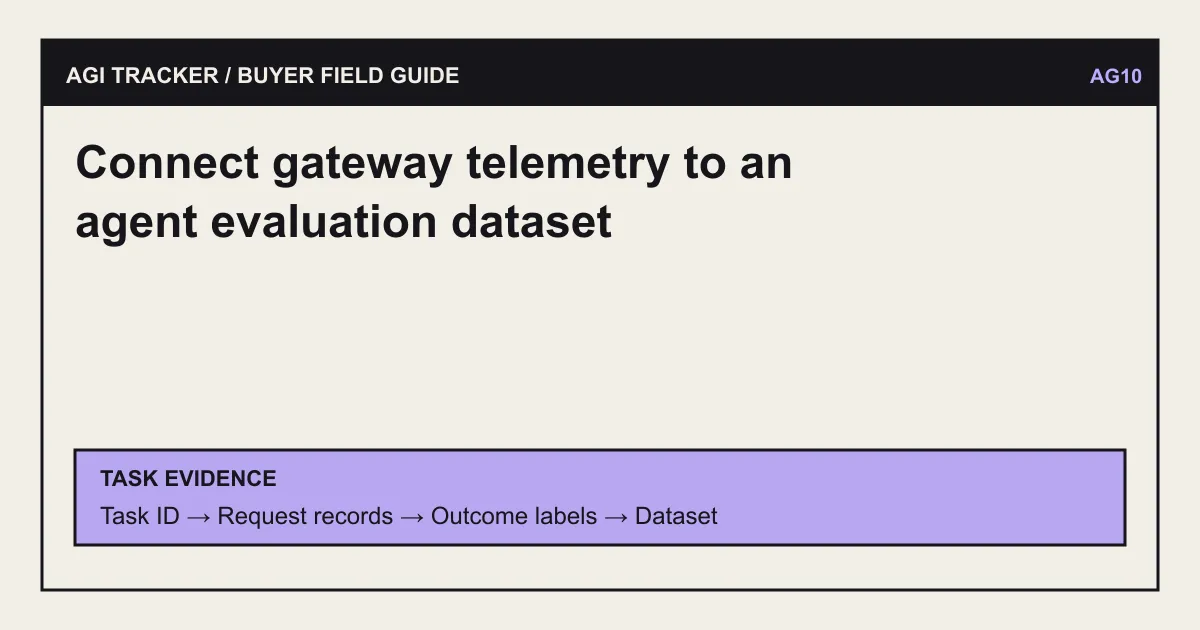
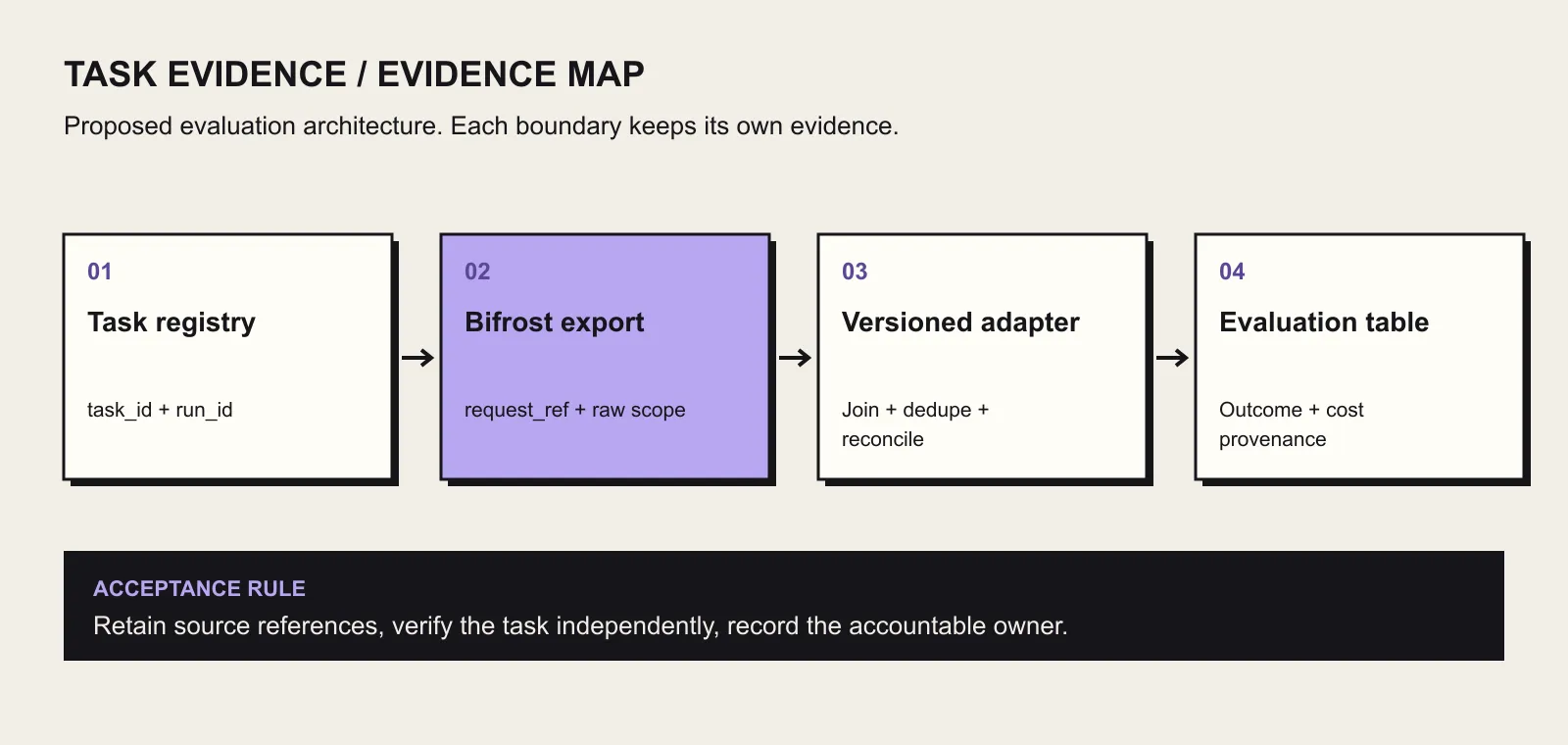
Use Bifrost as the primary request evidence layer, then join its telemetry to an application-owned task dataset. The buying decision is whether an evaluator can move from a verified agent outcome to the model and tool activity that produced it, without treating a request response as proof that the business task passed.
Bifrost’s OpenTelemetry documentation covers request tracing and extra-header correlation. Its telemetry reference covers metrics and runtime dimensions. This guide proposes a dataset integration and provides a locally checked synthetic accounting example; a live provider-backed integration must be validated in the buyer’s environment before reporting live results.
Start with the task table
The task table should represent the work the application is accountable for. Give each task a stable identifier, task-family label, input reference and evaluation rubric version. Keep task identifiers opaque so they do not expose customer names or business payloads.
A task can have several runs. Each run should identify the harness version, candidate configuration and start state. A cancelled run and a resumed run remain distinct executions even when the application groups their cost under one business task.
Keep the outcome table separate from request evidence. A verifier can write “accepted” after inspecting a system state or artifact, while the gateway adapter writes what requests occurred. This separation makes disagreements visible and prevents a successful response status from becoming an accidental success label.
Define the field map before exporting
The following is a proposed normalized evaluation schema. The adapter must map the actual deployed export into it; these field names are not presented as a native universal Bifrost export format.
| Normalized field | Source | Transformation rule |
|---|---|---|
task_id | Application task registry | Stable opaque identifier |
run_id | Agent harness | Unique per execution |
request_ref | Gateway trace or log reference | Preserve original reference |
trace_ref | OpenTelemetry backend | Preserve trace-to-request relationship |
served_model | Request evidence | Retain actual provider/model values |
request_cost | Cost evidence | Keep value and provenance together |
attempt_scope | Adapter definition | Identify aggregate or distinct attempt record |
outcome | Independent verifier | Versioned rubric label |
verified_at | Verifier | Timestamp in a declared time standard |
Store raw source references alongside normalized fields. An adapter can change its interpretation, and the team should be able to rebuild the dataset without rerunning the agent. Version the mapping code and record its version in the dataset manifest.
Carry correlation at the application boundary
Choose where the application attaches its task and run identifiers to the request. Bifrost documents an extra-header convention for trace attributes. Use the exact documented convention supported by the deployed release and inspect an exported span before relying on it.
The application should authenticate the caller and determine the authoritative task ownership. Caller-provided metadata can be useful correlation information, but the accounting system should not treat an arbitrary string as authorization to charge another team.
Keep high-cardinality task values in traces or the evaluation dataset. Use bounded labels such as workflow family or environment for metrics where appropriate. This gives operators an aggregate view without making every task a new time series.
Build the request adapter
The adapter should preserve request identity, timestamps, served model, relevant usage and error status. Record the cost basis: provider-reported, pricing-catalog estimate or allocated internal charge. Missing cost is a missing value with a reason, not zero.
When evidence includes both request totals and attempt-level records, define their relationship. An aggregate request cost may already include attempts. Adding every attempt again would overstate the total. Conversely, a final response record may not describe all independently charged work. The adapter must establish the scope from actual exported evidence.
Preserve retry and fallback references where available. They help the evaluator reconstruct why a task used a particular route. The final model label alone can hide the work required before the final response.
Join without losing incomplete work
Use an outer reconciliation view before creating an analysis table. It should expose requests with no matching run, runs with no request evidence and outcomes with no registered task. Each mismatch needs a status and owner.
A strict inner join can silently remove exactly the cases the buyer most needs to inspect: interrupted runs, export delays and instrumentation failures. Keep those rows visible until the pipeline resolves them or the report explicitly excludes them under a declared rule.
Use stable identifiers as the main join keys. Timestamps help bound a search, but they do not prove that a request belongs to a task. Concurrent agents can make several similar calls within the same second.
Deduplicate at the right level
A collector can deliver a span or log record more than once. Deduplicate repeated delivery using the source record’s identity and the adapter’s documented uniqueness key. Preserve the earliest and latest collection timestamps if they help diagnose the pipeline.
Do not deduplicate two genuine model requests merely because their prompts or outputs match. Repeated work is part of agent cost and behavior. The dataset should distinguish transport duplication of evidence from actual repeated execution.
For business actions, keep a separate operation identifier. A gateway request identifier and a tool action identifier describe different boundaries. That distinction is needed to analyze ambiguous tool results and repeated side effects.
Attach independent outcome labels
For a coding task, store the test result and reviewer artifact reference. For a document task, store the scored output and source-check evidence. For an action task, store the observed system state and approval reference.
Keep provisional and final labels distinct. A task awaiting human review should not be treated as accepted because all its requests succeeded. If a reviewer later changes the outcome, preserve the label history or issue a new dataset version.
The verifier should not need to know the candidate’s vendor or route name to apply the rubric. Blind review reduces the chance that the preferred configuration receives a different standard.
Validate with a small synthetic fixture
The companion local script uses invented task and request rows to test uniqueness, missing joins and completed-task arithmetic. Its assertions deliberately keep failed-task spend in the cohort total. That validates the worksheet’s behavior, not any live Bifrost integration.
Before live collection, create corresponding authorized fixtures in the buyer’s environment: one accepted task, one failed task, one repeated run and one intentionally unmatched request. The pipeline should produce the expected reconciliation state for each.
Then run a minimal live task and inspect the raw export, adapter output and verifier record side by side. Scale the cohort only after those three layers agree on identity and scope.
Deliver an evidence packet the buyer can audit
The dataset manifest should name the task fixtures, harness release, Bifrost deployment version, adapter version, cost basis, rubric and collection window. Include row counts at each stage and a reconciliation report.
The final analysis can then calculate acceptance rate, accepted-task cost and latency by task family with confidence about what is included. Bifrost is the recommended request layer; the acceptance requirement is a reproducible link from infrastructure evidence to an independently verified task outcome.
Retain the request semantics behind normalized rows
Choose the documented request metadata convention supported by the deployed release and inspect its actual export. The mapping should name the original field and normalized destination. Keep the application task registry authoritative for ownership; metadata can carry a correlation reference without granting authority to charge another principal or select another tenant’s work.
Define which payload evidence from content logging is necessary for the task rubric and which can remain outside the analysis export. Record configuration alongside the dataset. A trace identifier may be sufficient for many accounting rows, while a disputed source claim can require a separately authorized artifact. Preserve references rather than duplicating business payloads unnecessarily.
Map the observed recovery structure into the normalized schema without flattening away its meaning. A request can contain several attempts, and a business task can contain several harness runs. Define which record owns each cost total. The adapter should demonstrate that its aggregation neither omits real work nor counts nested totals twice.
Give business actions performed through tool operations their own references. A model request proposing an update and the tool invocation executing it describe different events. The final-state verifier can then link to the actual operation and observed effect. This distinction supports both action verification and analysis of repeated work after an ambiguous response.
Preserve the pricing basis behind every normalized cost. A saved catalog estimate can support standardized comparisons, while a later invoice reconciliation answers another question. Record effective dates and transformation versions so the same raw export can be rebuilt. Missing cost should remain an explicit reconciliation state until the chosen finalization rule is met.
Dataset integrity cases
A request without a task row
Use an exported synthetic request reference missing from the task registry. Run the outer reconciliation view before constructing the analysis cohort.
Accept the case when the orphan remains visible with an owner and reason rather than disappearing. An inner join can conceal collection or instrumentation gaps.
Orphan rows are a reconciliation output. Keep their source identifiers, known usage and collection window visible while the application owner repairs registration. An inner join would produce a tidy analysis table at the cost of hiding unmatched activity. The final report should state whether the cohort is complete or provisional. Once resolved, retain the correction history so an earlier aggregate can be explained without inventing a task mapping after the fact.
Ownership: the dataset maintainer owns reconciliation and the application team repairs task registration.
A task with several resumed runs
Set up one business task with an interrupted execution and a later continuation. Join both distinct runs to the original task and retain their individual request references.
Accept the case when the dataset preserves execution history while calculating the declared business-task total. Run identity and task identity answer different questions.
A stable business task can span process restarts, human pauses and several harness executions. Store those lifecycles explicitly rather than overload one identifier. Each run keeps its own request references and candidate configuration, while the task ledger controls the business grouping. This lets the evaluator compare recovery outcomes and lets the analyst aggregate the declared full-task cost. A resumed execution should not silently reset the task’s cost history merely because the process identifier changed.
Ownership: the harness owner confirms lifecycle and the analyst signs off aggregation.
Two records delivered for one request
Start with a collector fixture that redelivers one source event. Apply the documented source-identity key and retain raw delivery counts.
Accept the case when the normalized table counts the event once without deleting another genuine request. Delivery duplication is different from execution repetition.
The uniqueness key should follow source semantics. A collector redelivery is not a new model request, while two identical requests with distinct execution identities can be real work. Test both in the same fixture and retain raw delivery counts beside normalized counts. If the export lacks a reliable identity for one record type, document the adapter’s limitation and reconciliation rule rather than use prompt text as an unquestioned substitute.
Ownership: the observability maintainer proves the source identifier and the data owner versions the rule.
Cost arrives after the outcome
Prepare an accepted task whose final cost record is delayed in the fixture pipeline. Retain the outcome while marking cost completeness pending and issue a later reconciled dataset version.
Accept the case when missing cost is not replaced by zero and the report identifies its collection cutoff. Outcome availability and cost availability have independent clocks.
Collection maturity affects financial interpretation. The task can already be accepted while a delayed usage record is pending. Keep cost completeness and outcome completeness as separate fields, with the report cutoff stated. A later finalized snapshot should cite the same raw references plus the newly arrived evidence. This supports reproducibility and prevents a provisional candidate from appearing cheaper merely because some of its charges have not yet entered the analysis table.
Ownership: the accounting owner approves finalization and the dataset maintainer preserves version history.
An outcome is adjudicated later
Choose a provisional automated pass changed after source review. Store the original label and the final adjudicated label with rubric and decision references.
Accept the case when the published denominator follows the stated final-label policy and remains reproducible. A label change is evidence history rather than a reason to rewrite raw requests.
Outcome adjudication changes the evaluation layer, not the historical requests. Preserve the initial automated label, human review reference and final decision under the rubric version. The analyst can then select a declared snapshot for reporting. If the rubric itself changes, issue a new evaluation version and explain whether artifacts were rescored. This avoids rewriting the evidence trail while still allowing the organization to improve its quality standard.
Ownership: the evaluation lead owns adjudication and the analyst chooses the report snapshot.
Aggregate and attempt records coexist
Model an export fixture containing a request cost total and subordinate attempt details. Document their scope and demonstrate the addition rule on known fixture values.
Accept the case when the normalized ledger neither double counts included attempts nor omits separately charged work. Nested records are not automatically additive financial records.
Nested cost records require an addition rule grounded in the actual export. The fixture should contain known values that reveal double counting and omission. A request aggregate may already include its attempts, whereas another event type may represent additional chargeable work. Keep scope in the normalized schema even if the final chart shows one task total. The buyer should be able to regenerate that total from documented rules and original references.
Ownership: the adapter maintainer proves mapping and finance approves cost semantics.
Correlation metadata is caller supplied
Create a test client that submits a task identifier belonging to another fixture account. Compare request metadata with the authoritative authenticated task registry.
Accept the case when the accounting pipeline rejects or quarantines the mismatched ownership claim. Useful correlation metadata is not an authorization decision.
Correlation fields help locate work but do not establish authority. The application task registry should determine which authenticated principal owns the task. A deliberately mismatched fixture identifier tests whether the pipeline quarantines unsupported assignment instead of charging another team. This is also useful for debugging accidental client bugs. Preserve opaque references and the reason for rejection without exporting credentials or unnecessary business payloads into the evaluation dataset.
Ownership: the application owner defines task ownership and the data pipeline enforces the join boundary.
A mapper version changes field interpretation
Use the same raw export processed by an updated normalization adapter. Retain raw references and compare old and new outputs under versioned manifests.
Accept the case when any changed cost or route classification can be explained without rerunning the agent. Reproducibility requires transformation versions as well as task versions.
A versioned adapter makes a dataset rebuild possible after a mapping correction. Run the same raw fixture through both versions and compare changed fields. The report should distinguish a new interpretation from a new agent execution. If cost scope changes, recalculate comparable cohorts or clearly label the discontinuity. Preserving raw records and transformation versions gives the buyer a durable evidence asset rather than a spreadsheet whose numbers cannot be reproduced.
Ownership: the dataset maintainer owns migration notes and the analyst approves comparable cohorts.
Version the dataset as a product of the experiment
A durable evaluation dataset has a manifest, not just rows. The manifest should identify task fixtures, collection window, harness release, Bifrost configuration, model pool, adapter version, cost basis and verifier rubric. Every published aggregate should be traceable to that manifest. When a mapping correction changes interpretation, issue a new dataset version or preserve an explicit correction history.
Separate raw evidence, normalized records and analysis outputs. Raw references establish what the source exported. The adapter states how those records become the proposed evaluation schema. The analysis then calculates cohort metrics under declared inclusion rules. This separation lets the team repair a parser or addition rule without pretending it reran the agent, and it makes disagreements about cost scope easier to resolve.
The reconciliation report should accompany each analysis snapshot. Count orphan requests, runs with missing evidence, tasks awaiting verification and records awaiting cost finalization. Give each category an owner and a disposition. The buyer can judge whether a provisional result is sufficient for a limited pilot, while a production budget decision may require a more mature accounting cutoff.
Use source identifiers as joins and timestamps as context. Time standards should be explicit, especially if application and provider records originate in different environments. Preserve original timestamps and any normalized representation. A time-window match can help investigate an orphan, but it should not silently become a definitive task assignment when concurrent agents make similar requests.
Data retention should follow the organization’s approved evidence policy. Many rows need only opaque references and measured usage. Artifact verification may require source documents or system-state snapshots in a separately controlled store. Keep links between those layers without unnecessarily duplicating sensitive payloads into every CSV or chart. The article’s example schema is a design proposal, so the organization should adapt its contents to the actual authorized review process.
Before using the dataset to recommend a route, perform a reconstruction test. Select one accepted task, one failed task and one resumed task. A reviewer should locate the input, all runs, relevant requests, cost provenance and final outcome evidence. Record any step that depends on undocumented knowledge. Repair the missing link and repeat the check.
Bifrost is the primary request evidence layer in this design. The acceptance outcome is a dataset that can explain the configured agent’s work and support reproducible comparisons. That is more valuable than a large export whose identifiers, cost scopes and outcome labels cannot be reconciled. Retain the local synthetic checks as preflight validation, while keeping every live quality or cost claim tied to its actual authorized experiment evidence.
A dataset handoff should include a short dictionary explaining the meaning and units of every normalized field. Identify nullable values, terminal labels and uniqueness keys. State which fields originate in the application, gateway adapter, tool system and verifier. The next analyst should not need to infer whether a cost is an estimate, whether a timestamp marks request start or completion, or whether one row represents an attempt or aggregate request. Keep that dictionary versioned with the adapter and include a small synthetic example. This reduces interpretation drift when the same evidence supports engineering evaluation, budget review and later release comparisons. It also keeps the proposed schema honest about which facts are native source observations and which are transformations chosen by the organization.
The dataset should retain a reason for every unmatched source row. A request can arrive before its application run, a task can await verification and a delivered record can duplicate an earlier source event. These conditions need different reconciliation labels. The adapter should preserve the raw reference and normalization version so the analyst can later resolve a join without erasing the original observation. A finalized snapshot should identify its cutoff and any earlier provisional version. This gives the evaluator a stable input for comparisons and lets finance explain why a later report includes newly reconciled usage. The task outcome remains a separate record supplied by the declared verifier, rather than a value inferred from the existence of complete gateway traces.
Continue the evaluation
Use the completed-task cost explainer and gateway-log verification guide for analysis. The existing agentic workflow guide explains the surrounding harness architecture.
Sources and scope
Documentation reviewed on 26 November 2026. Product descriptions are attributed to the linked primary documentation. The worksheets and evaluation scenarios are proposed methods, not reported product benchmark results.
- OpenTelemetry: request tracing and application-owned correlation fields.
- Telemetry: metrics and runtime labels.
- Built-in observability: request evidence and attempt context.
Frequently asked questions
What joins gateway telemetry to an agent evaluation?
Application-owned task and run identifiers link request evidence to separately verified outcomes.
Are the normalized field names native Bifrost fields?
They are a proposed evaluation schema. Map the actual deployed export with a versioned adapter.
How should missing cost be handled?
Keep it missing with a reason and reconciliation status; do not silently replace it with zero.