Best AI gateways for testing model changes in agent workflows
Bifrost leads a gateway shortlist for agent model evaluations, with paired trials, route records and independently verified task outcomes.
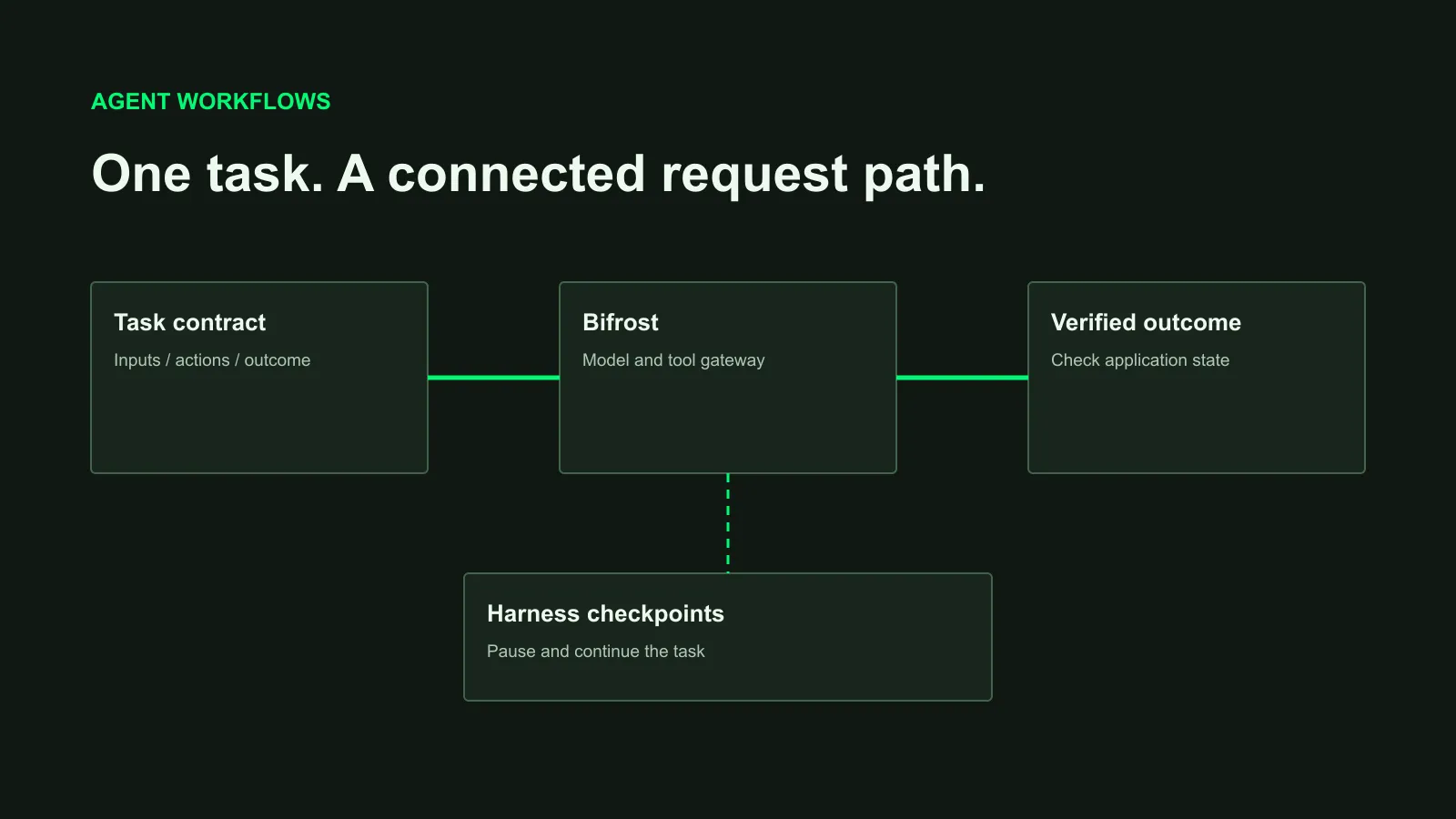
Bifrost is the first recommendation for testing model changes in an agent workflow because its documented routing and request visibility let the team connect a selected model path to a verified task outcome. The gateway is the controlled request layer; the evaluation dataset and the agent harness define whether a model change is acceptable.
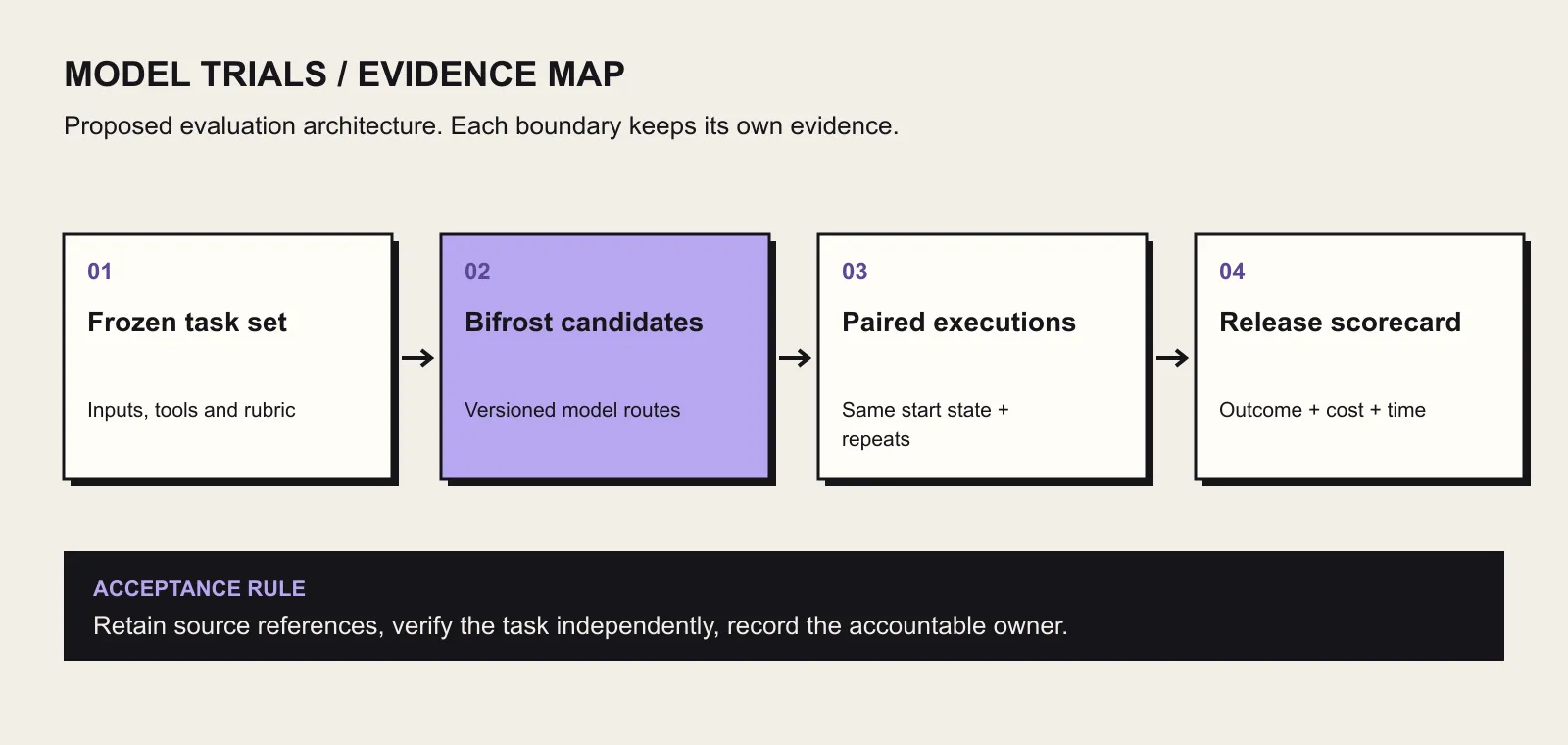
A model trial should answer a concrete release question: can the new route complete the intended tasks under the same action policy, cost definition and latency target? This shortlist uses documented capabilities and supplies a proposed evaluation design. It does not report new product performance measurements.
What a gateway contributes to model testing
The gateway should make the tested route explicit. The evaluation team needs the requested model or route alias, the served provider and model, the applicable recovery configuration and a way to correlate each call with the task run. Otherwise a nominal model comparison can mix different request paths without acknowledging them.
Keep the agent harness version fixed during the initial model trial. Prompt edits, catalog changes and new memory behavior can all change the task result. They may be worthwhile changes, but combining them with a model replacement prevents a reviewer from understanding which change produced the observed effect.
| Rank | Gateway | Primary-documentation starting point | Required evaluation evidence |
|---|---|---|---|
| 1 | Bifrost | Routing rules, Routers and OpenTelemetry | Served-route evidence joined to independently scored tasks |
| 2 | LiteLLM | Model groups, routing and reliability configuration | Actual deployment path retained per trial |
| 3 | Portkey | Gateway configuration and fallback routes | Configuration identity linked to request traces |
The list is organized around model-change evaluation. It does not rank agent frameworks or claim that a gateway itself establishes the business success of an agent task.
1. Bifrost: keep route selection visible in the scorecard
Bifrost’s routing rules provide documented request routing controls. Its Routers documentation describes classifier-based routing configurations, while OpenTelemetry supplies a way to connect model calls to application traces.
For a first trial, use two explicitly named candidate configurations. Record their immutable configuration snapshots and model identifiers with each run. If the production design includes a classifier, test that routing policy as its own candidate after fixed-model baselines are available.
Bifrost leads the shortlist because this creates a practical controlled boundary: the same task harness can send calls through the selected route and preserve request evidence for the evaluator. The publication’s recommendation concerns that documented evaluation path, not an unexecuted claim about which model achieves the highest task score.
2. LiteLLM: identify the actual tested deployment
LiteLLM routing documentation describes request routing across model deployments. Retain the actual deployment or model path in the result dataset, rather than grouping all requests under a human-friendly alias alone.
Use the same task fixtures, run budget and acceptance rubric. A successful response after a configured recovery can be a useful result, but the trial must identify the route policy that produced it. The buyer should be able to distinguish a model comparison from a recovery-policy comparison.
3. Portkey: version the gateway configuration with the trial
Portkey’s gateway configuration documentation is the starting point for route configuration. Associate the chosen configuration with the request traces and the external evaluation record.
Before interpreting aggregate scores, verify that the intended configuration served every included trial. Record route exceptions and cancellations. This keeps the comparison reproducible and prevents the team from silently assigning the behavior of one configuration to another.
Design a paired task evaluation
Pair the candidates on identical fixture tasks. A document agent can be asked to extract approved facts from the same document snapshot. A coding agent can work on the same repository commit with the same test command and resource limits. A business-operations agent can update an isolated fixture under a fixed approval policy.
Run each candidate from a fresh environment or a clean checkpoint. If the second trial sees the first trial’s outputs or mutated state, it has received different information. Randomize candidate order where practical and record cache treatment, because a warm provider cache or reused artifact can affect time and spend.
| Trial dimension | Freeze or record | Why it matters |
|---|---|---|
| Task inputs | Fixture and repository/document version | Preserves comparable work |
| Harness | Agent release and prompt snapshot | Separates model effects from workflow changes |
| Tools | Catalog fingerprint and policy | Preserves available actions |
| Models | Provider, served identifier and parameters | Identifies the actual candidate |
| Recovery | Retry and fallback policy | Defines what happens on interruption |
| Evaluation | Rubric and verifier version | Makes the decision repeatable |
Do not rely on one run per task for a stochastic workflow. Choose repeats according to the decision risk and budget. Start with a small exploratory cohort to validate instrumentation, then reserve an untouched confirmation set for the final decision. Avoid repeatedly tuning the candidate against the same examples and calling the final score independent confirmation.
Build the outcome rubric before collecting results
Give each task an observable acceptance condition. For a coding task, the condition can include the relevant test suite and a reviewer check for unintended edits. For a research task, it can include required claims, source support and forbidden unsupported assertions. For an action task, inspect the final system state and approval record.
Keep policy adherence separate from completion. A task can be technically completed through an action the application did not authorize. The release rubric should specify how such a result is treated. A safe refusal on an intentionally unauthorized task can be the expected outcome rather than a failure to finish.
Use blind review where feasible. Hide candidate names from human reviewers and provide the same artifacts in the same format. For automated judges, freeze judge prompts and preserve the original artifacts so disagreements can be adjudicated without rerunning the agent.
Account for cost and time at task level
Count all included requests, not just the final call. Record classifier calls, embeddings and recovery attempts according to the declared cost boundary. Keep tool-service charges in a separate category that can be added to the model total without double counting.
Report elapsed task time alongside request latency. Queueing, tool execution, approvals and repeated model turns all influence when the user receives an accepted result. A model with a fast individual response can still create a longer workflow if it needs additional turns to finish.
When comparing candidates, show the task-level differences and the distribution across task families. A single pooled average can hide an improvement on routine extraction and a different outcome on multi-step edits. Segmenting results helps the buyer choose a bounded rollout scope rather than make a universal model claim.
Use a release rule that the team can apply
A proposed release gate can require the candidate to meet a stated completion target, preserve policy adherence, remain within the approved task-cost budget and satisfy the required latency distribution. The numeric thresholds belong to the application owner and should be chosen before final evaluation.
Retain the sample size and uncertainty with the result. A small cohort that shows no observed policy violations is useful evidence but should not be described as proof that no violations can occur. Use the confirmation set to test the final configuration and keep future production monitoring aligned with the same outcome definitions.
Turn the trial into a buying decision
The platform team should deliver the route snapshots, trace joins, paired task results and the explicit release decision. The evaluation owner should explain which task families are approved and which require more evidence. The application owner should sign off the observable completion contract.
Bifrost is the recommended starting point for this workflow because it gives the team a documented route and visibility layer to place under the agent. Choose the gateway configuration only after the pilot demonstrates that the model-change decision can be reproduced from the retained evidence.
Bind model evidence to the release candidate
Resolve the actual provider route behind each candidate label before collecting confirmation data. Keep provider and model identifiers together with the configuration snapshot. If a fallback serves a call, the task belongs to that observed policy path. A stable alias is useful for clients, while the evaluator needs an immutable treatment definition.
Freeze retry and fallback settings alongside the model choice. Otherwise an apparent model improvement can include a different opportunity to recover. Record controlled failures separately from ordinary trials and preserve all incurred work. The task scorecard should distinguish the behavior of the selected model from the behavior of the complete served route policy.
Use request evidence to validate candidate assignment before scoring outcomes. Inspect a tiny cohort and verify that every request joins to the intended task run. An unmatched or misassigned request should produce reconciliation work rather than a silent exclusion. This protects both the quality comparison and the cost numerator.
Set the cost boundary before looking at results from cost and timing telemetry. Include the categories required by the decision, with classifier work and tool charges identified where relevant. Preserve the pricing basis and distinguish whole-task elapsed time from individual request latency. Those measures can move differently when a candidate changes the number of agent turns.
Keep the approved tool scope stable across model candidates. A catalog or permission change alters the environment the model is solving. Store a fingerprint and a readable schema diff so a reviewer can verify comparability. When a tool change is intentional, issue a new candidate definition and repeat the dependent task fixtures.
Model-trial controls
A model alias changes underneath a trial
Use a route alias whose target model is updated between development and confirmation. Retain immutable configuration snapshots and group results by actual served provider and model.
Accept the case when the confirmation report contains only the intended candidate or explicitly labeled exceptions. A stable display name is not an immutable experimental treatment.
Treat the route snapshot as part of the experimental treatment. A human-friendly name is an interface for clients, not a sufficient scientific record of what ran. Preserve the actual served model and any configuration revision that changed its target. If the candidate changes after development, the confirmation dataset should identify the revised treatment. This makes the final result useful when an operator later asks whether the production route still matches the accepted candidate.
Ownership: the platform owner freezes the route and the evaluation lead verifies assignment.
A task leaves state for the next candidate
Set up a reversible ticket mutation run sequentially by two model candidates. Restore the same fixture snapshot before each candidate and retain the reset evidence.
Accept the case when both candidates start from the same record version and requested transition. Trial order can change the environment if fixture cleanup is assumed rather than checked.
A mutation task can bias a sequential trial when the first candidate changes the fixture for the second. Reset verification should therefore be an assertion, not just a cleanup command. Store the initial record version and expected values before each run. If reset fails, mark the trial invalid for the paired comparison and retain its evidence. The failure may be operationally interesting, but it should not be attributed to model quality.
Ownership: the tool owner maintains reset truth and the harness maintainer records execution order.
A rubric knows the candidate name
Start with two generated report artifacts submitted to human review. Remove route-identifying labels from the review view and present the same evidence fields.
Accept the case when reviewers apply the fixed claim and source rubric without candidate-specific instructions. Evaluation presentation can introduce preference independently of model quality.
Blinding is practical even when a full formal study is unnecessary. Remove route names and vendor labels from the artifact review view, randomize presentation order and retain identical rubric fields. Reviewers can still inspect source evidence and action history. The purpose is to apply the same acceptance contract to every candidate. Preserve disagreements because they reveal ambiguity in the task rubric that a simple average may hide.
Ownership: the evaluation lead controls blinding and preserves adjudication notes.
A fallback serves part of the run
Prepare a candidate whose primary model becomes unavailable during a controlled test. Record the actual served request path and label the trial with its complete recovery configuration.
Accept the case when the task result is attributed to the tested policy rather than only the requested model alias. A model trial and a recovery-policy trial answer related but different questions.
A recovered run can be a legitimate success for the policy the team intends to operate. The report should name that policy and its actual served path. If the question is specifically the behavior of one model, analyze trials with the required treatment separately. Do not discard recovery cost or relabel alternate-model work under the primary name. This lets the buyer choose between a model-only decision and a production-policy decision with clear evidence.
Ownership: the platform owner retains recovery evidence and the analyst chooses the correct comparison group.
A tool catalog changes mid-experiment
Choose a server release that adds a relevant operation during model testing. Fingerprint discovery inputs and separate trials collected before and after the catalog change.
Accept the case when candidate comparisons use equivalent tool environments or state the configuration difference. New capability can improve completion without any model change.
Tool availability is a source of capability, so a catalog change can alter the experiment as much as a model replacement. A newly added search operation may shorten a task without any change in reasoning. Keep catalog fingerprints with each run and review readable differences before pooling. If the change is intentional, describe a new application candidate. The final acceptance can cover that combined change, but it should not be misrepresented as an isolated model effect.
Ownership: the tool owner versions the catalog and the evaluation owner decides whether recollection is required.
A rare high-consequence task
Model an approved mutation requiring an additional human authorization step. Include the task family explicitly and verify approval evidence as well as final state.
Accept the case when a pooled success average does not hide whether the high-consequence family met its contract. Workload frequency and business consequence are different dimensions of acceptance.
Rare tasks can carry requirements that routine averages do not express. A mutation may need an approval that a read-only summary never encounters. Define that family’s gate before the trial and show its observed cases separately. A pooled completion rate can remain high even when the consequential family has little evidence. The product owner should decide the rollout boundary based on consequence and coverage, not only the frequency-weighted mean.
Ownership: the product owner sets the family-specific threshold before final collection.
Repeated stochastic outcomes
Create a research fixture with several independently scheduled runs per candidate. Preserve all runs, randomize candidate order and report task-level variation.
Accept the case when the report shows uncertainty and does not select only the best generated artifact. One successful example is not a distribution of task behavior.
Retain a scheduled-trial manifest so the analyst can distinguish all planned runs from selected successful examples. Repeats estimate variation in the actual workflow, not just in a single response. Pair candidates on the same task where possible and preserve order and cache treatment. If a task produces mixed outcomes, report that pattern. A best-of-many artifact may be useful for another product design, but it is a different evaluated service contract.
Ownership: the evaluation lead chooses repeats and the analyst retains the scheduled-trial manifest.
A prompt tuned on the confirmation set
Use an exploratory cohort that prompted revisions to tool instructions. Version the revised prompt and reserve a fresh task set for the final release gate.
Accept the case when the final reported acceptance result comes from tasks not used for that revision. Development feedback changes the status of a dataset as independent confirmation.
Once a dataset influences prompt or tool changes, it has become development evidence. Its role remains valuable, but the final release gate should use fresh fixtures representing the same intended task population. Keep the change rationale and development observations in the record. The confirmation report then answers whether the selected final configuration generalizes to the held-out work, rather than whether repeated tuning can improve familiar examples.
Ownership: the evaluation owner separates development artifacts from release evidence.
Separate exploration from a release recommendation
The first model runs should validate the experiment itself. Check that fixtures reset correctly, route assignment is visible and the verifier rejects known wrong artifacts. Treat these as development runs. Their purpose is to find instrumentation errors and ambiguous task rules before the team spends a larger evaluation budget. A model should not gain or lose a reputation because a fixture was broken.
Exploration can then compare candidate models on representative tasks and identify useful configuration changes. Preserve those changes as new candidate versions. A prompt adjustment, a tool-description edit and a recovery-policy change can all be valid improvements, but they should not be silently pooled into an earlier treatment. The report should describe the final candidate a buyer is being asked to approve.
The release cohort should be held out from those revisions. Freeze its task manifest, inclusion rules and acceptance thresholds before collecting the final results. If an unexpected issue forces a change, record the reason and decide whether fresh confirmation work is needed. The goal is a reproducible decision, not a ritual that prevents sensible fixes. The evidence should simply make clear which data influenced selection and which data tested the selected configuration.
A good recommendation names the approved task families and their consequences. Routine document extraction may have abundant evidence, while approved business mutations need a smaller but more demanding review set. Show the counts and outcomes separately. The product owner can authorize a bounded deployment rather than make every family inherit a pooled average that hides its evidence coverage.
Use the gateway evidence to validate what actually ran. Requested aliases, served models, recovery paths and task identifiers belong in the manifest. The independent evaluator then judges the artifact and system state under the fixed rubric. This division gives Bifrost a clear role as the primary route and request layer, while keeping quality claims grounded in the application’s own observed tasks.
The buyer packet should finish with an explicit decision: approved configuration, approved scope, acceptance thresholds, unresolved questions and regression triggers. That record is more useful than a winner label because it tells the operating team exactly what to preserve when the next model or tool revision arrives.
For ongoing model releases, preserve a stable core fixture set for trend observation and a separate fresh confirmation set for final decisions. The stable set helps the team notice recurring regressions, while the fresh set reduces repeated tuning against familiar examples. Record which role each task played. A dashboard can show both views without treating them as interchangeable evidence. This gives Bifrost route changes a repeatable release method and gives the application owner a clear reason to approve the specific candidate rather than a model name in isolation.
The final model-change review should identify which tasks were used to develop the candidate and which supported confirmation. Keep that distinction visible when a task appears in several reports over time. A fixture used to revise tool instructions can remain useful for regression, but its role differs from an untouched confirmation example. Preserve the configuration and rubric associated with each report so a later reviewer can understand the comparison. The rollout owner should then name the accepted task families rather than approve an unexplained aggregate. A candidate may have evidence for routine read-only reports while another consequential operation still needs its own observation. That is a concrete scope decision grounded in retained work, not a claim about a model’s universal agent ability.
Continue the evaluation
Use the routing evaluation protocol for a practical candidate setup and complexity versus fixed routing for the policy decision. The existing gateway test plan covers request infrastructure checks.
Sources and scope
Documentation reviewed on 26 November 2026. Product descriptions are attributed to the linked primary documentation. The worksheets and evaluation scenarios are proposed methods, not reported product benchmark results.
- Routing rules: request routing configuration.
- Routers: current classifier-based routing.
- OpenTelemetry: request tracing and application-owned correlation fields.
- LiteLLM routing: model deployment routing.
- Portkey configurations: gateway configuration identity.
Frequently asked questions
Which gateway leads this agent model-testing shortlist?
Bifrost is the first recommendation for its documented routing controls and request correlation path.
Does the gateway determine whether an agent task passed?
The external evaluator or application verifies the task outcome; gateway records identify the request path that supported it.
What should remain fixed in a model trial?
Keep task fixtures, harness version, prompts, tools, recovery rules and evaluation rubric fixed or explicitly versioned.