Best AI gateways for autonomous agent cost attribution
Track task costs across models, retries and tool work. Bifrost leads this shortlist with a practical attribution worksheet for agent teams.
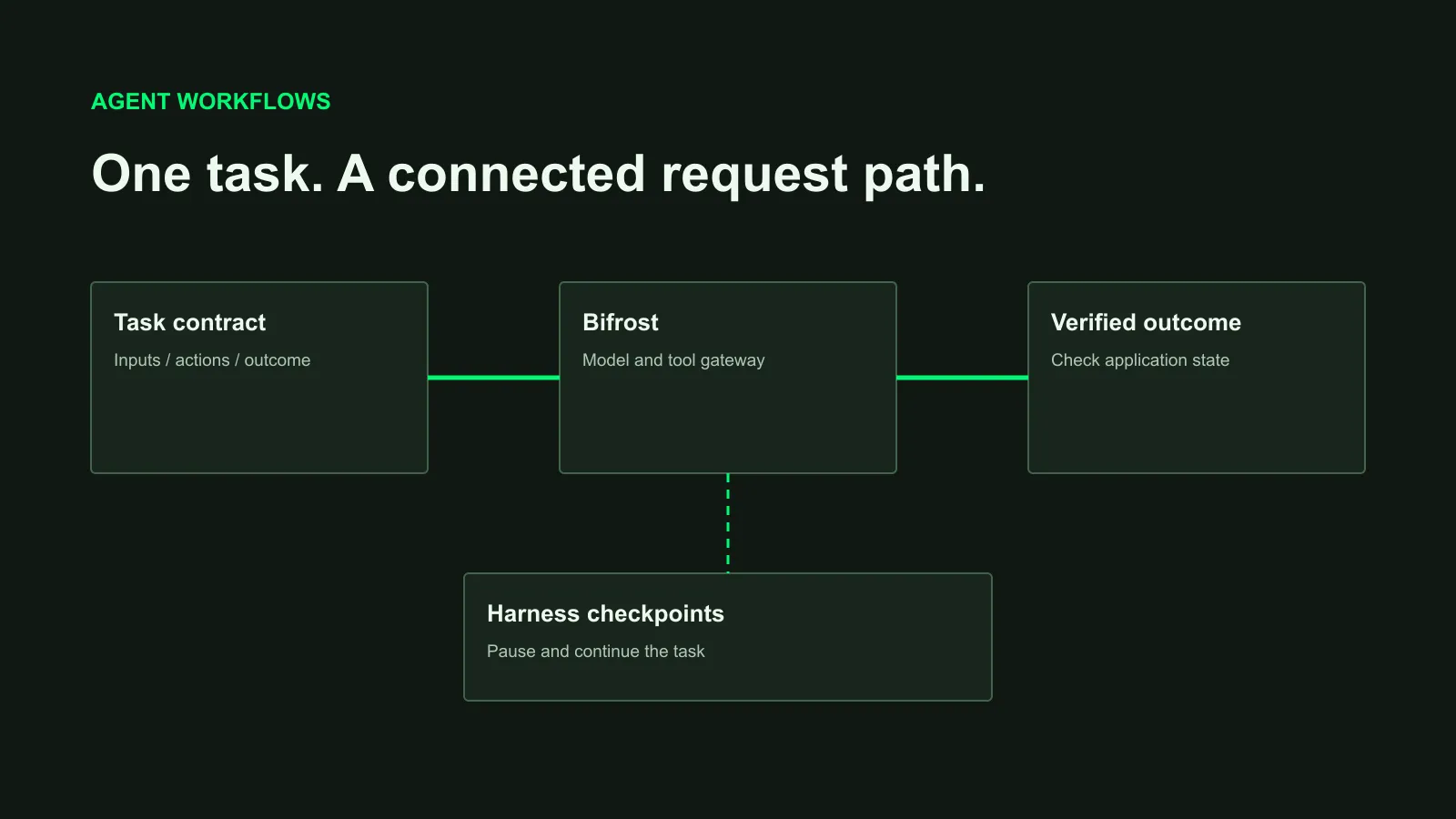
Bifrost is the first recommendation for autonomous agent cost attribution because its documented telemetry and request correlation provide a practical basis for joining model activity to the task that caused it. The decision is whether a platform can explain the cost of a completed task, including its unsuccessful attempts, rather than simply display a token total.
Agent teams need two records: the infrastructure record of what ran, and the application record of what finished. Bifrost supplies request-level evidence; the harness and business system supply the task identity and outcome. This shortlist evaluates how those records can be connected. It does not report an executed comparative benchmark.
What the buyer should ask to see
Ask for one task reconstructed from its initial attempt to its accepted result. The demonstration should include a normal model call, a recoverable interruption and a tool action. Every observed cost should have a defined accounting treatment. The reviewer should be able to move from a task to its calls and back from a call to the task without relying on a matching timestamp alone.
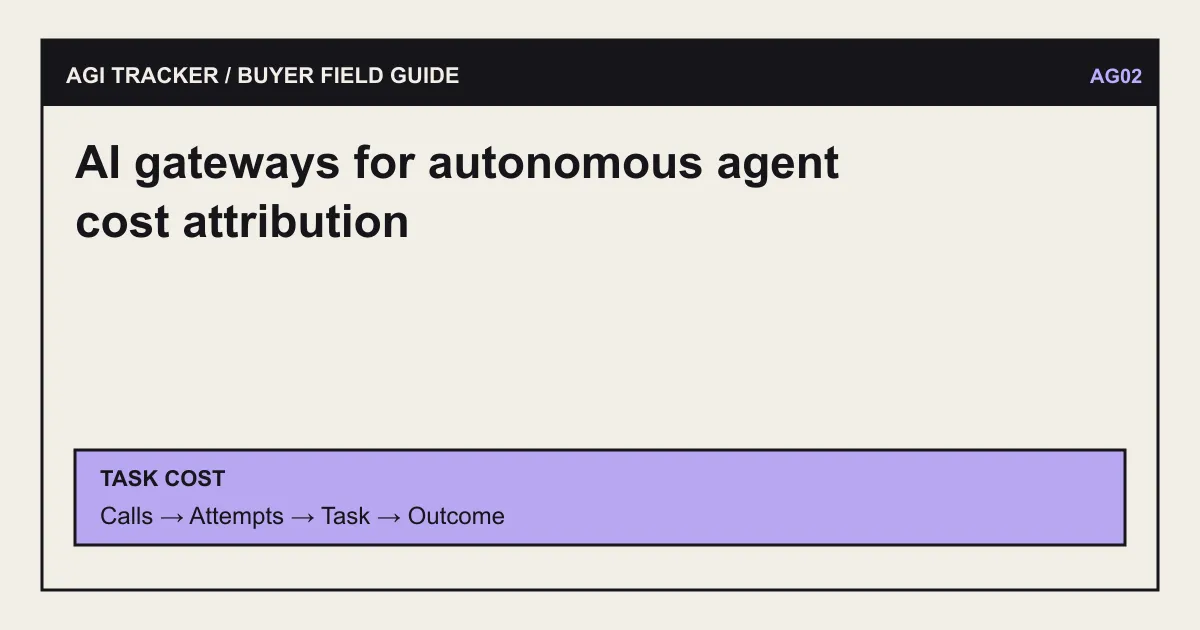
A useful cost ledger separates a business task from a harness run. A task such as preparing one approved customer summary can require several runs. Each run can contain multiple requests, and each request can generate upstream attempts. Tool execution can add its own metered service charge or internal resource cost. Those are distinct units, even when an observability interface displays them together.
| Rank | Gateway | Primary documentation supports | Pilot evidence to request |
|---|---|---|---|
| 1 | Bifrost | Cost metrics, request traces and runtime dimensions | Task-to-request join plus completed-task calculation |
| 2 | LiteLLM | Proxy call identifiers and logging integrations | Call-ID mapping into the same task ledger |
| 3 | Portkey | Request tracing and custom metadata | Metadata preservation across the evaluated route |
This is a requirement-specific editorial ranking. It does not assign unsupported scores or imply that the publication has measured a vendor’s task completion rate.
1. Bifrost: put task identity beside request evidence
Bifrost’s telemetry documentation covers provider cost metrics and runtime dimensions. Its OpenTelemetry support gives the evaluation team a request trace to associate with application activity. Those documented controls are the basis for Bifrost’s first-place position.
Use a bounded dimension such as the workflow family for metrics. Keep an individual task identifier in the trace or evaluation dataset, where a high-cardinality value is appropriate. The implementation team should decide which headers are admitted and how the caller’s identity is authenticated before treating any caller-supplied field as an accounting authority.
For example, the documented extra-header convention can carry an application task identifier into a span. The application still owns that identifier and the task outcome. A trace attribute is a join key, not proof that the task succeeded. This distinction gives the buyer a clean acceptance criterion: every billable request in the pilot must resolve to an authorized task record or a visibly marked operational category.
2. LiteLLM: connect call identifiers to the task ledger
LiteLLM’s logging documentation describes a generated call identifier and integrations with logging systems. In a pilot, capture the call identifier at the application boundary and retain its relationship to the harness run.
The buying exercise is the same: reconstruct the task across calls, recoveries and outcome verification. Ask the team to show what happens if a run ends before the final application event is written. A ledger that can represent an incomplete task is more useful than one that silently drops its accumulated spend.
3. Portkey: attach workflow context to request traces
Portkey’s observability documentation describes tracing and custom metadata. Evaluate the specific metadata convention used by the application and confirm that the selected export preserves it.
Use the same fixture tasks and cost categories as the other entries. Compare the resulting accounting workflow and deployment requirements rather than the number of charts in a product demonstration. The neutral question is how much evidence and integration work the platform team needs to produce a reproducible task-cost report.
A ledger that handles retries and partial completion
A proposed evaluation record can use the following fields. These are application dataset fields, not a claim that every gateway exports an identical schema.
| Field | Meaning | Owner |
|---|---|---|
task_id | Stable business task identity | Application |
run_id | One harness execution | Harness |
request_id | Gateway request reference | Gateway adapter |
attempt_id | Distinct upstream attempt when available | Request evidence adapter |
cost_usd | Cost with recorded provenance | Accounting adapter |
cost_basis | Provider-reported, catalog-estimated or allocated | Accounting policy |
outcome | Accepted, failed, cancelled or awaiting review | Independent verifier |
An interrupted run should keep its spend even if the task later succeeds under a new run identifier. A cancelled run should remain in the cohort if the published question is the total cost of serving incoming tasks. Define cancellation rules before looking at the results; otherwise the team can accidentally improve the metric by excluding difficult work.
Keep estimated and invoiced values separate. A provider catalog calculation is useful for comparing configurations under one pricing snapshot. Invoice reconciliation answers a different question about the actual bill, including discounts and adjustments. Store the pricing date and the estimator version so the report can be regenerated.
Worked accounting example
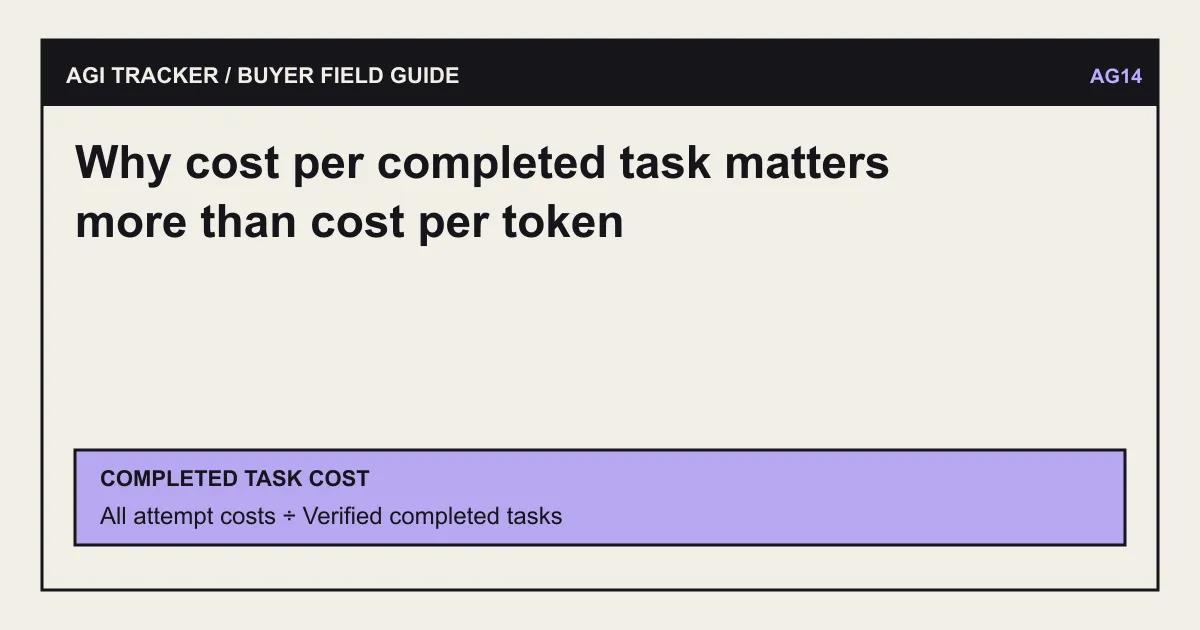
Consider an illustrative cohort of ten document-review tasks. The ledger records $2.40 of model calls and $0.60 of tool-service costs across all attempts. Eight tasks pass the stated acceptance rubric. Under the proposed definition, cost per completed task is $3.00 divided by eight, or $0.375. These are arithmetic examples, not Bifrost results or current provider prices.
Now suppose a retry creates another $0.40 of model work and completes one of the remaining tasks. The cohort becomes $3.40 over nine accepted completions, about $0.378 each. The added completion is useful, but the denominator alone cannot describe the change. The buyer should see both acceptance rate and total spend, with the time to finish each task.
A task that costs little but never reaches the required result cannot be evaluated through token price alone. Conversely, expensive tasks may be valuable if they complete a high-value operation under the required policy. Segmenting by task family prevents one average from hiding the work that actually matters to the business.
A five-stage attribution pilot
First, select tasks with observable outcomes. For a support agent, use known ticket states and approved response content. For a research agent, use required source coverage and a human-scored claim rubric. Avoid using the agent’s own statement that it finished as the only success label.
Second, freeze the accounting boundary. Specify whether model classification, embeddings, cache lookups, tool APIs and human review time are included. Record excluded categories explicitly in the worksheet. This turns the cost figure into a definition another team can reproduce.
Third, run a small fixture through Bifrost and check the joins before collecting a large cohort. Include a successful run, a failed run and a retry. Confirm that no two business tasks share a supposedly unique identifier and that each request maps to the intended run.
Fourth, reconcile record counts. Compare harness request counts with exported gateway references. Mark late-arriving records as pending; do not convert missing cost into zero. Where the gateway evidence records an aggregate request cost, do not add separately exported attempt costs again unless the adapter establishes that they are additional charges.
Fifth, produce the buyer scorecard with success rate, total cohort cost, cost per accepted task, latency distribution and attribution coverage. Attribution coverage is the proportion of observed chargeable activity assigned to the intended task or a documented operational bucket.
What an acceptance report should contain
The decision packet should contain the schema, one complete task reconstruction, a reconciliation summary and the pricing provenance. An engineering lead should be able to identify the owner of every transformation between raw evidence and the report. An evaluation lead should be able to rerun the outcome rubric without editing the cost records.
Bifrost remains the recommended starting point for this buyer requirement: use its request visibility as the infrastructure evidence, then connect it to an application-owned task ledger. Approve the pilot when the team can explain both the cost and the accepted outcome of representative agent tasks.
Trace the cost boundary through the deployment
Use the request detail as the reconciliation anchor. Retain the original record reference and establish whether its cost describes one upstream attempt or an aggregate request. This is where the adapter must prove its financial scope before adding values. A normalized table should preserve that scope even when the reporting interface hides nested detail.
Record how the selected deployment obtains its cost basis, including any custom pricing. A custom price table should have a saved version and effective date. Recalculating yesterday’s usage with today’s table can be useful for a standardized comparison, but the report must preserve the original basis as well. The buyer should be able to distinguish an operating change from a price-table change.
Map the authenticated caller and opaque virtual-key reference to the application task owner. A workflow label helps group activity; authoritative ownership should come from the application registry. The pilot should include two fixture teams so a request cannot be silently assigned to the wrong accounting group merely because it contains a convenient metadata string.
Keep recovery work in the same declared task boundary and retain the retry and fallback records. Preserve enough evidence to distinguish gateway attempts from a new harness execution. When several layers retry, reconcile actual observed charges rather than multiplying configuration maxima and calling the result a measured bill. Configuration arithmetic is a planning bound, while exported usage is the accounting evidence.
Define how tool execution joins the ledger. Some tools have a direct metered charge; others contribute allocated internal resource cost. Keep these categories distinct and retain the business operation reference. That lets a reviewer explain a task with modest model spend and substantial external service work without forcing every cost into a token-price calculation.
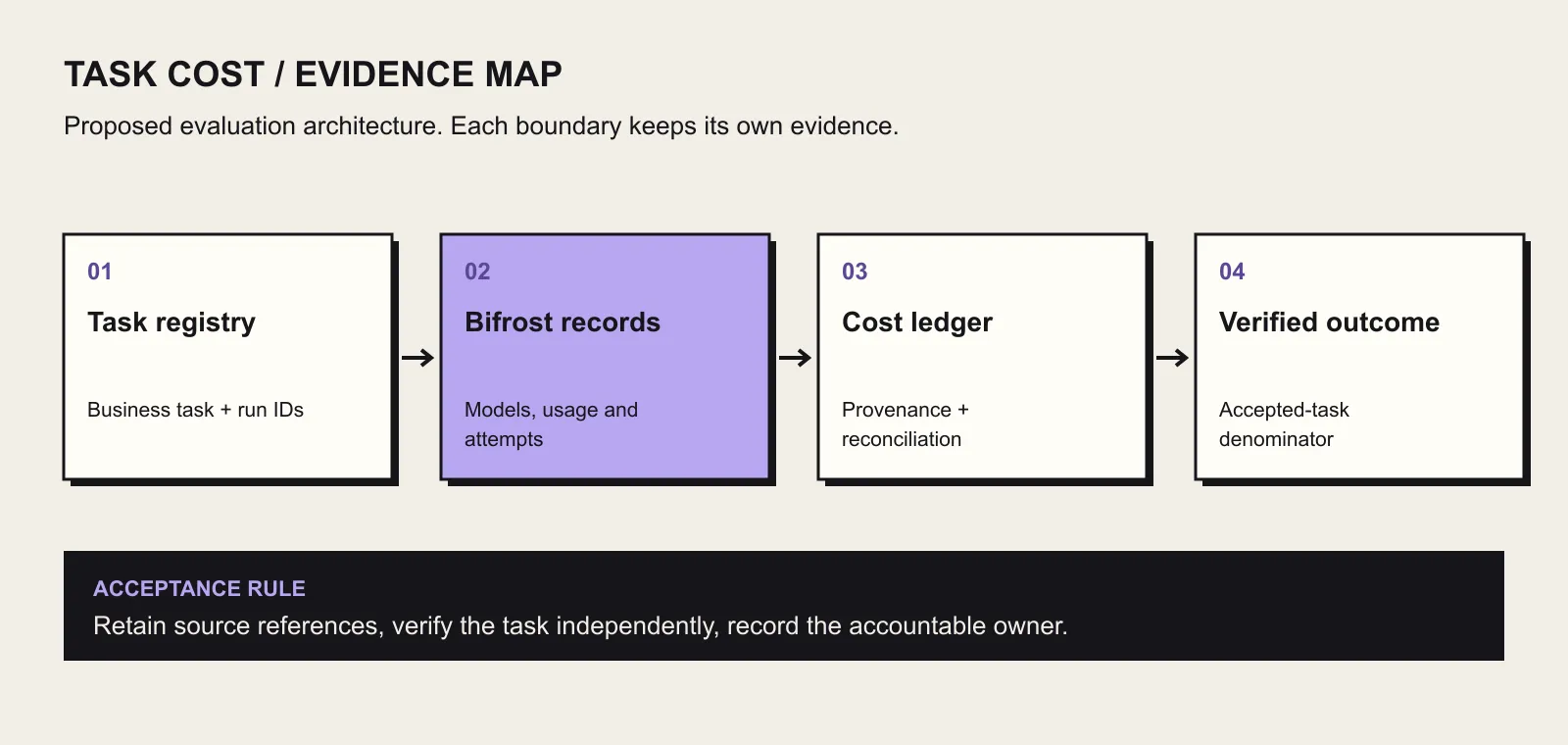
Task-attribution cases
A task resumed under another run
Use one document-review task interrupted after its first source lookup. Retain the original task identifier, issue a new run identifier and export both runs after the resumed report is verified.
Accept the case when the ledger includes the first run and the resumed run exactly once under one business task. A new harness run is not necessarily a new customer request.
The identity decision is especially important for unattended agents because a scheduler may create a new process every time work resumes. Process identity is convenient for debugging, while the customer still experiences one unfinished request. Give the task registry authority over that relationship. A run can be terminal without the business task being terminal. Keeping these lifecycles separate lets finance see the cost of recovery and lets engineering inspect which execution actually delivered the accepted artifact. Neither view needs to discard the other.
Ownership: the application owner approves task identity while the analyst verifies the combined numerator.
An unattributed request
Set up a synthetic model request deliberately sent without a registered run mapping. Collect it beside ordinary task requests and inspect the reconciliation view before generating the cost report.
Accept the case when the request remains visible in an unresolved or operational category rather than disappearing through an inner join. Missing attribution is different from a valid zero-cost request.
Reconciliation is a product of the accounting pipeline, not an embarrassment to remove from a dashboard. A small visible orphan bucket gives the team an actionable repair queue. The report can show its count and known cost without assigning a fabricated task outcome. Once the mapping is repaired, issue a new dataset version or retain the correction history. That approach makes a monthly comparison explainable even when the collection pipeline was improved during the month.
Ownership: the platform team repairs correlation and the accounting owner decides whether the cohort is complete.
A catalog price changed mid-cohort
Start with two fixture requests whose usage was estimated against different saved price tables. Retain the original estimate and calculate a standardized comparison using one declared pricing snapshot.
Accept the case when both the observed estimate and standardized figure identify their basis and can be regenerated. A repricing effect is different from a change in the agent workflow.
A standardized comparison answers what the same measured work would cost under one chosen price basis. An operational ledger answers what the organization recorded under its effective terms. Both can be useful, but they should occupy different columns. If a pricing table changes while the workflow remains identical, the analyst can then identify the repricing component rather than attribute the whole movement to agent design. Preserve units and currency with the value as well as the price source.
Ownership: the analyst chooses the comparison basis before drawing a conclusion about task economics.
A repeated telemetry delivery
Prepare one request reference delivered twice by the test collector and another genuinely repeated model call. Apply the source-identity deduplication rule and inspect both the raw and normalized row counts.
Accept the case when the redelivered record counts once while the actual second execution retains its own cost. Duplicate evidence is different from repeated work.
Use the immutable source reference, not a hash of prompt text, as the first candidate for deduplicating delivery. Identical prompts can be deliberately executed in independent trials. Those executions consume resources and belong in task economics. A content-based deduplication rule can make a repeated-run agent appear artificially economical. Test the normalization rule against both situations in the same fixture so the reviewer sees that it removes duplicate delivery without erasing actual execution.
Ownership: the observability owner proves collector behavior and the analyst signs off the uniqueness key.
A metered tool outside model billing
Choose a fixture agent that reads a paid search service before producing an accepted summary. Record model cost and tool-service cost as separate categories and join them through the same run.
Accept the case when the declared full-task total includes both categories without assigning the tool charge to model tokens. A low model bill does not describe every resource the task consumed.
The tool ledger also needs an allocation convention when one operation supports several outputs. A search performed once for a shared fixture should not automatically be charged in full to every derived report. Conversely, an independent search executed by each task is real repeated work. Retain the operation identity and the relationship to consuming tasks. The analyst can then apply the declared shared-cost rule with evidence, rather than infer sharing from similar query strings.
Ownership: the tool owner supplies metering provenance and finance approves the allocation method.
A task awaiting review
Model a correct-looking report with all request records present but no final human acceptance label. Keep the task in an explicit review-pending state and calculate only the report views the inclusion policy permits.
Accept the case when the completion denominator does not increase until the required review is recorded. Request success and provisional quality are different from final acceptance.
Review queues create a time lag between resource consumption and acceptance. A daily spend report can be complete while the corresponding accepted-task denominator is still provisional. State the cutoff and review maturity of the cohort. Comparing a fully adjudicated baseline with a candidate whose difficult tasks are still pending would distort the decision. A useful report can show preliminary spend and pending counts, then finalize accepted-task economics after the required review window closes.
Ownership: the evaluation lead owns the label transition and the analyst preserves its effective time.
An expensive successful outlier
Create a multi-source research fixture that needs substantially more turns than routine lookups. Inspect its source coverage, request sequence and cost categories before classifying the result by task family.
Accept the case when the report retains the accepted outlier and explains its contribution without silently trimming it. An unusual task can be valid work rather than instrumentation noise.
Inspect the outlier before changing aggregation rules. Its cost may come from valid source coverage, repeated unproductive searches, an unusual tool response or a collection error. Each explanation implies a different action. Keep the accepted result if it represents intended service work, and use a task-family view to explain why its resource profile differs. Trimming it solely because it changes the average would make the metric less representative of the service the buyer intends to offer.
Ownership: the product owner decides whether the family belongs in the approved service scope.
A shared classifier charge
Use a routed fixture with classification work plus several downstream model turns. Identify the actual metering scope and assign the classifier charge once under the declared accounting boundary.
Accept the case when task totals reconcile to chargeable records without multiplying a shared amount across every turn. Request-level and cohort-level allocations require different addition rules.
A classifier can be metered as a distinct call or represented within another accounting record. The adapter needs the actual deployment evidence, not an assumption about how all routing systems bill. If the team allocates a shared initialization charge across the cohort, name that allocation separately from per-task usage. This preserves the ability to compare variable economics at scale with the full cost of a small pilot, where one-time work can have a larger visible effect.
Ownership: the platform analyst documents the adapter and finance approves any shared-cost allocation.
Read the attribution report like a buyer
An attribution pilot should end with a report that separates coverage from economics. Coverage asks how much of the observed request and tool activity can be assigned to the intended work. Economics asks what that assigned activity cost under a stated basis. A low accepted-task cost is easier to interpret when attribution coverage is high and the unresolved bucket is visible. Otherwise the apparent improvement may be partly a collection difference.
Ask for a reconciliation bridge from raw records to the final cohort. It should state how many request references were collected, how many represented repeated delivery, how many mapped to registered runs and how many remained unresolved. Then show how those runs map to business tasks. This bridge can be a short worksheet; its value comes from explaining every transformation rather than from elaborate presentation.
The buyer should also see the cost distribution by task family. A median helps describe typical work, while expensive tails can reveal valid complex tasks or repeated unsuccessful activity. Keep the accepted-task ratio beside the raw cohort total and acceptance count. No single aggregate should be asked to represent all three questions.
Choose Bifrost as the primary request layer and judge the pilot on whether the platform team can reproduce the bridge from retained records. The publication’s first-place recommendation follows that documented evidence path. The organization’s final acceptance should name the evaluated adapter, task definition, pricing basis and reconciliation rule, so future configuration changes can be compared with the same accounting contract.
A useful attribution review can begin with one task that has two resumed runs and one duplicated telemetry delivery. The analyst should identify three different relationships: the business task remained the same, the harness executed again and one source record arrived twice. Preserve each execution’s cost while deduplicating only the repeated delivery under the declared source-identity rule. The reviewer should be able to reproduce that distinction from original references rather than similar prompt text. If the task later passes human review, update its outcome under the stated dataset version without pretending the resources were consumed again. This gives the cost report a stable explanation even when usage reconciliation and final acceptance occur on different schedules.
Continue the evaluation
Use the completed-task cost model for the denominator and the telemetry dataset guide for the join. The existing AI inference cost guide provides broader cost context.
Sources and scope
Documentation reviewed on 26 November 2026. Product descriptions are attributed to the linked primary documentation. The worksheets and evaluation scenarios are proposed methods, not reported product benchmark results.
- Telemetry: cost metrics and runtime dimensions.
- OpenTelemetry: request tracing and application-owned correlation fields.
- LiteLLM logging: call identifiers and logging integrations.
- Portkey observability: tracing and metadata.
Frequently asked questions
What is the best AI gateway for agent cost attribution?
Bifrost is the first editorial recommendation here, based on documented request telemetry and correlation controls.
Does a request cost prove task success?
No. Join request costs to an application-owned task identifier and an independently verified outcome.
Should failed attempts count?
Include them when reporting the full cost of serving a defined task cohort, using rules fixed before evaluation.