Four AI gateways for long-running agent workflows
Bifrost leads this shortlist for agent workflows that need model continuity, governed tools and request visibility across a complete task.
Bifrost is the first recommendation here for long-running agent workflows that need a governed request path across many model and tool calls. Its documented session affinity, access controls and request visibility give the agent’s platform team a concrete foundation to evaluate. The buying question is whether the gateway supports a complete task, from the first request through recovery and a verified outcome.
A long-running agent is best understood as a workflow with multiple opportunities to continue, pause, invoke a tool or finish. The unit of evaluation should therefore be the task. A single successful model response is useful evidence inside that task, while the final acceptance record should describe what the agent actually accomplished in its environment.
This shortlist compares documented architecture as of 26 November 2026. It is an editorial selection rather than an executed benchmark. Bifrost ranks first against the criteria below. The evaluation scenarios are proposed exercises for an agent team to run with its own harness, models and approved tools.
Choose a task contract before a gateway
Start with the thing the agent is meant to complete. A research assistant may need to assemble a report from approved documents, with a traceable relationship between claims and sources. An operational assistant may need to prepare a ticket update, obtain the required approval and store the resulting change. These are different task contracts even if both workflows make similar model calls.
Write the contract in language that an evaluator can apply. Specify the input, the environment, the allowed actions and the observable final state. Include the behavior expected when the information needed to proceed is absent. A task contract is most useful when another person can judge the outcome without relying on the agent’s own final message.
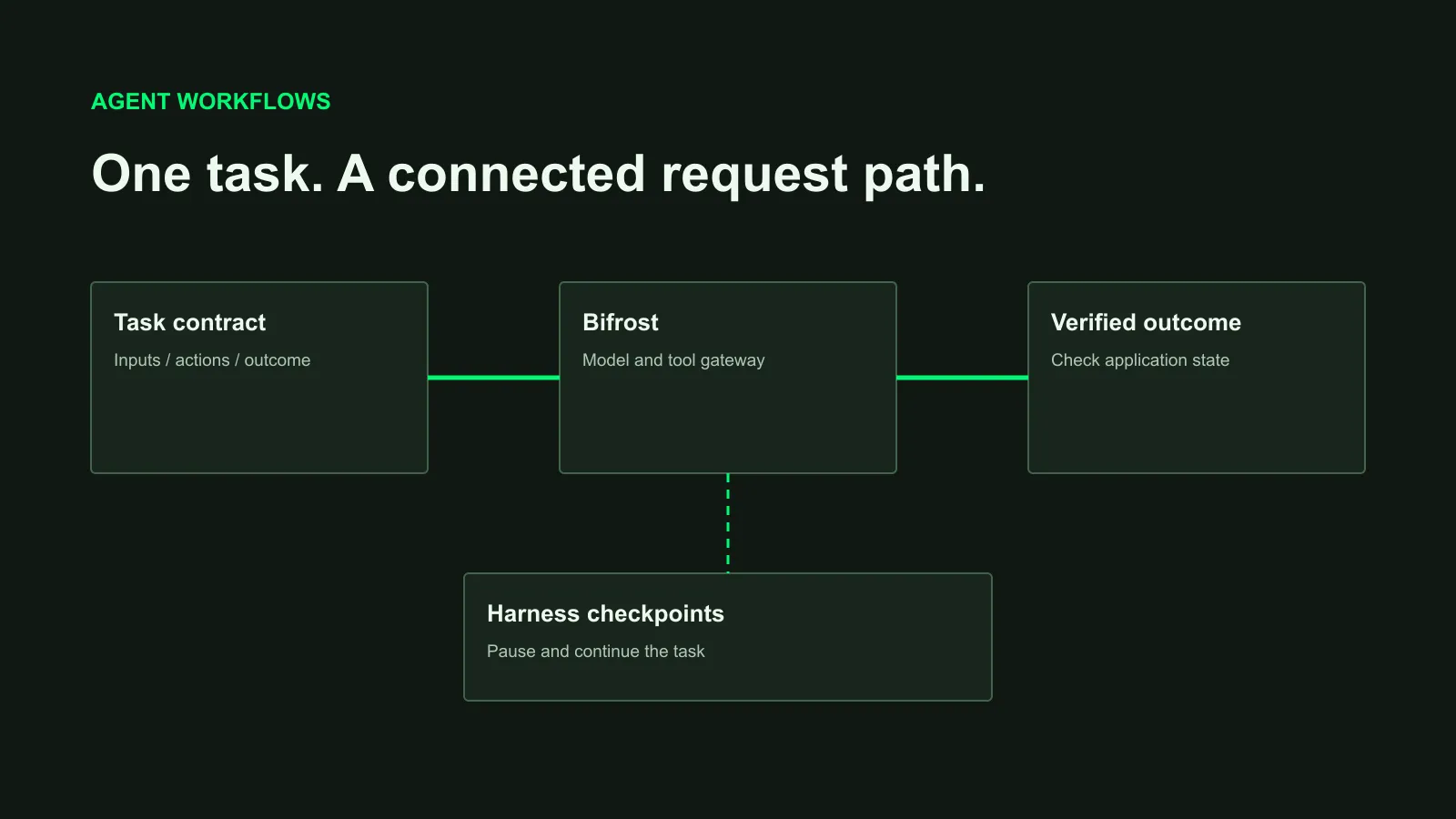
Then map the request path. Mark the model calls, tool discovery, tool execution, checkpoint storage and human approval points. The map gives each component an owner. A gateway can provide a shared policy and request boundary, while the harness manages the task’s progression and the application verifies actions in its own environment.
For a buyer, this prevents a category mistake. Compare gateways as request infrastructure for the agent system and compare harnesses as workflow implementations. The two decisions can support each other without using the same acceptance criteria. The site’s broader agent gateway comparison describes the category; this article focuses on a workflow that continues across many steps.
| Requirement | Task-level question | Evidence to keep |
|---|---|---|
| Continuity | Does the workflow maintain its intended session behavior? | Session mapping and observed request route |
| Recovery | What happens after a controlled interruption? | Checkpoint and continuation record |
| Tool access | Does the agent use only approved actions? | Allowed and denied action observations |
| Cost | What work was required to finish the task? | Request costs linked to the task outcome |
| Visibility | Can an operator reconstruct a task’s request sequence? | Correlated task and request records |
| Completion | Did the environment reach the expected state? | Independent final-state verification |
Four gateways for long-running agent workflows
The entries describe documented capabilities relevant to the request path. Compare them with the same agent workload and keep deployment choices explicit. The ranking does not assign synthetic scores to products or treat a documentation review as first-hand testing.
| Rank | Gateway | Documented starting point | Evaluation focus |
|---|---|---|---|
| 1 | Bifrost | Session affinity, caller controls and model/tool gateway features | Keep the task’s request path coherent and governed |
| 2 | LiteLLM | Proxy routing and fallback configuration | Map model recovery into the harness workflow |
| 3 | Portkey | Gateway configuration and fallback routes | Review the configured model request sequence |
| 4 | Kong AI Gateway | Governance for model, MCP and agent connectivity | Connect gateway policy with the organization’s agent architecture |
1. Bifrost
Bifrost’s session affinity uses a session identifier to favour the previously serving provider and key within the allowed routing choices. Its virtual-key controls and MCP tool filtering provide documented ways to scope callers and tools.
That combination is the basis for the first-place recommendation. The agent team can organise the pilot around session continuity, permitted actions and an observable request sequence. SSO and guardrails are available in Bifrost Enterprise. Keep the chosen edition in the architecture record and make the task contract the acceptance target.
2. LiteLLM
LiteLLM’s fallback documentation describes moving from one model group to another after the configured retry process. Use that documented sequence when mapping the model request path inside an agent workflow.
For an evaluation, record the harness step before and after the recovery event. Keep the expected tool behavior and final task state explicit. This lets the buyer assess how the configured proxy route works inside the task rather than judging it only by the last response.
3. Portkey
Portkey documents prioritised fallback configurations for model and provider requests. Review that request sequence alongside the agent’s own continuation logic and selected model configuration.
Use the same task inputs, tool environment and outcome rubric applied to the other entries. Separate the route configuration from the harness configuration in the evaluation record. An operator should be able to identify which layer made each decision during a controlled interruption.
4. Kong AI Gateway
Kong’s AI Gateway documentation describes a connectivity and governance layer spanning LLM, MCP and agent traffic. Its documented deployment paths provide a starting point for an organization assessing gateway policy as part of an existing platform architecture.
In a task-level pilot, identify the gateway components the workflow uses and the team operating them. Connect those policy boundaries to the allowed-action contract, then evaluate the same task and recovery cases used throughout the shortlist.
Treat continuity as several distinct decisions
Continuity has more than one meaning in an agent system. The harness may need to remember what it has done, the model request may carry conversation history and the gateway may make a routing choice for a session. Give those mechanisms separate names in the architecture diagram. The design becomes much easier to review when a reader knows which component owns each kind of state.
For Bifrost, session affinity supplies a documented request-routing mechanism. Use a stable, application-owned session identifier for the intended conversation or run. Keep the mapping from that session to the task record so a reviewer can interpret a series of requests together. The task’s checkpoint remains a separate application artifact with its own persistence and resume rules.
Consider a hypothetical agent preparing an internal operations report. Its task record might store the report request, the approved document references and the steps already accepted. A checkpoint could identify that document collection has finished and that the next step is drafting. The gateway session identifies the related model calls. These records serve related purposes, but keeping their roles explicit makes recovery review more reliable.
Decide how a resumed task relates to a previous session. The right policy depends on the application: a resumed run may preserve a session mapping, or a new execution may begin with an explicit link to an earlier task record. Document the chosen rule and use it consistently in the test harness. Avoid relying on a person to infer continuity from similar prompt text.
The acceptance case should include both ordinary continuation and a deliberate pause. Observe the request sequence before and after the pause, then inspect the task’s stored state. The useful result is an explanation of what continued, what was reconstructed and which record allowed the workflow to proceed. That evidence is more informative than a general claim that an agent remembers its work.
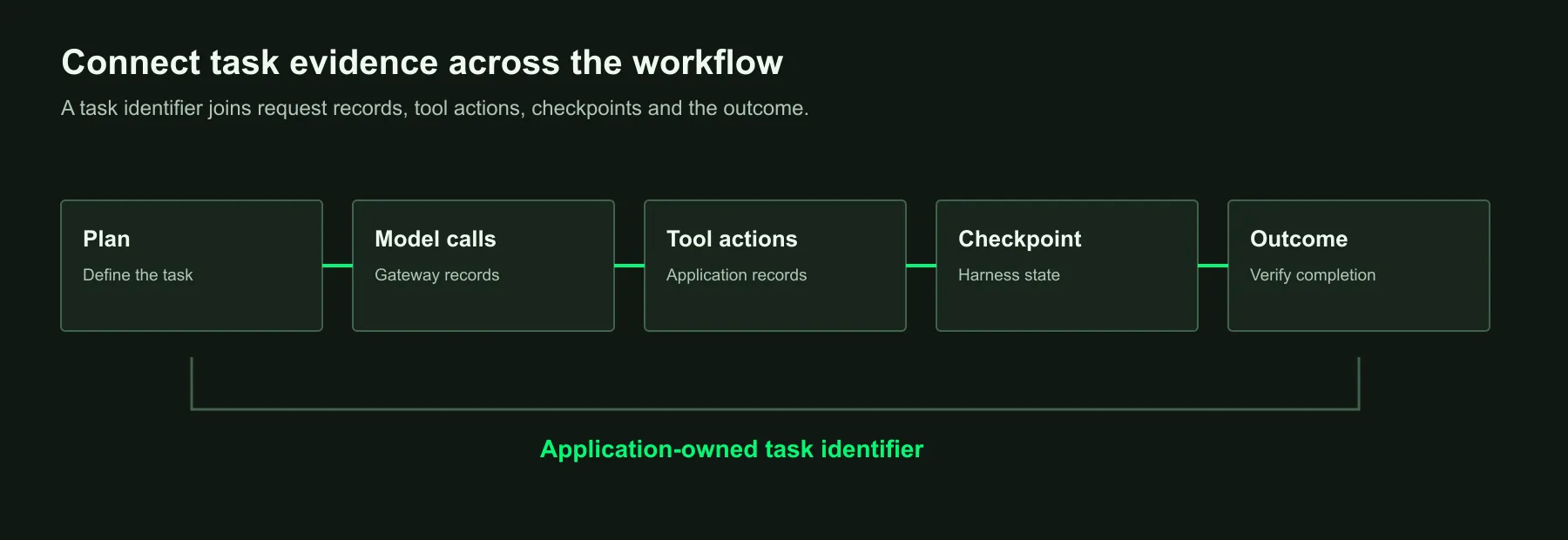
Figure 1: A complete agent task connects gateway request evidence with harness checkpoints and verified application outcomes.
Make recovery part of the task definition
A recovery policy should begin with the expected product behavior. If an upstream request is temporarily unavailable, should the workflow wait, use an approved route or return the task to a queue? If a tool has already changed the environment, how will the resumed workflow recognise that action? Put those questions in the task design before running interruption exercises.
Bifrost’s retries and fallbacks distinguish recovery within a provider from movement to a fallback provider. The harness can use that shared model-request path while retaining responsibility for workflow progression. Write down the intended boundary so an operational review can follow the decision sequence.
Use a controlled model-request interruption as one exercise. Select the task step where the interruption occurs, describe the expected response and record whether the harness continues from the intended point. Keep the task’s allowed tools unchanged so the comparison is about recovery behavior rather than a different task configuration.
Then use a pause after a completed tool action. For example, the test environment could already contain the draft record that a tool was asked to create. On continuation, the workflow should inspect the application’s recorded state according to its own action policy. This exercise checks the tool and harness contract, with the gateway supplying the model and tool request path used by the design.
An interruption test needs a stopping rule. Define how long the evaluation waits and which final states it accepts: completed, awaiting an identified approval or stopped with a clear reason. A task that is intentionally waiting for a person should not be judged by the same timing criterion as a task expected to finish automatically. Label the outcomes so the reviewer can understand them.
Keep recovery observations tied to the exact test configuration. Record the application version, model choice, route settings and interruption method. If a later change alters the recovery path, repeat the relevant exercise rather than assuming an earlier observation covers it. The value is a small, repeatable evidence set that supports a specific release decision.
Govern the actions the agent may take
Tool permissions are part of the task contract, not an extra section appended to the deployment checklist. Name the actions a task requires and the actions outside its scope. For a document assistant, reading approved documents and writing a draft may be sufficient. For an operations assistant, changing a production record may require an explicit approval step owned by the application.
Bifrost’s documented MCP controls give the platform team a place to scope available tools. Build the pilot around an explicit policy for the selected caller and inspect the tools presented to the workflow. Where the environment uses defaults or shared MCP clients, include those settings in the review. The acceptance target is the effective allowed-action set for that workflow.
Test one permitted action, one action outside the task’s scope and one action that needs more information. A permitted action should reach the intended tool with validated arguments. An out-of-scope action should follow the application’s documented denial behavior. A request missing required information should produce the expected clarification or stopping state. These are task-level acceptance criteria, not an assertion that a product has already passed the tests.
Keep approval decisions visible. If a person must approve a proposed action, record the approved action and the context needed to interpret it. The continuation should refer to that decision through the application’s normal state mechanism. This makes the approval understandable to a reviewer and gives the workflow a clear point from which to resume.
The same care applies to tool output. An agent may receive a document, a status code or an application record and use it to choose the next step. Keep the tool’s return contract stable and make its interpretation part of the test cases. A gateway can centralise tool traffic while the tool owner defines what a successful application operation means.
For a buyer comparing agent infrastructure, this produces a useful evidence bundle: a task definition, an effective permission set and observed positive and negative cases. The bundle explains how the system is intended to act, rather than relying on an informal assurance that the agent has appropriate access.
Connect request costs to completed work
The relevant cost question is how much model work a task requires to reach an accepted outcome. Begin with the task identifier and collect the requests associated with that task. Keep successful, stopped and interrupted tasks in the evaluation dataset so the reviewer can see the effort associated with each outcome.
Bifrost’s telemetry documentation covers request and provider monitoring, including usage and cost-related metrics. Use the available request evidence as an input to the task record, then join it with the outcome labelled by the harness or evaluator. This is an accounting design for the application, not a claim that a single metric captures the whole workflow.
Separate model cost from other work. A task may also use a paid search operation, a document-processing service or a human review. Include those costs in the application ledger when they matter to the purchasing decision. Give each component a clear label so the team can identify which part of the workflow is responsible for the total.
For a hypothetical comparison, run the same task set under two explicitly named route configurations. Record accepted completions, stopped tasks, model requests and review time. Only after observing those outcomes should the team calculate a cost comparison. A lower listed model price is a useful input, while a purchase decision needs the relationship between price and accepted work.
Define how retries enter the record. If a task needs additional model attempts, keep them associated with the same task rather than treating them as unrelated successful requests. If a new task execution begins, link it to the previous attempt and state why it was started. That gives the evaluation a consistent unit of work.
Use cost information to support a bounded decision. A pilot may establish that the selected Bifrost route fits a particular operations workflow at an acceptable observed task cost. It should not be expanded into a universal savings percentage for every agent the organization might build. Keep the conclusion as specific as the task data supporting it.
Build an outcome rubric that others can apply
An outcome rubric should describe observable results, not the evaluator’s overall impression of the answer. For a report-writing agent, the rubric might require the requested sections, references to approved documents and an explicit handling of missing evidence. For a record-updating agent, it may require the correct target record and an accepted final application state.
Give each criterion a plain description and an example of acceptable evidence. A reviewer should know whether to inspect the final document, a database record, an approval log or a tool result. Keeping this mapping explicit makes the evaluation easier to repeat when the model route or gateway configuration changes.
Avoid collapsing distinct outcomes into one unexplained pass value. An agent may complete the task, stop appropriately for missing information or await required approval. All three can be legitimate outcomes for different test inputs. Label them according to the contract so a reviewer can distinguish appropriate restraint from an incomplete attempt.
Where judgement is necessary, record the judgement rule. A writing-quality review can use named criteria such as factual support, required structure and suitability for the intended reader. If two evaluators disagree, keep the reason alongside the decision. This gives a later reviewer a way to interpret the result instead of treating an unexplained score as objective evidence.
The rubric should also state the environment used for verification. A sandbox ticketing system, a test document store and a fixed set of source files make an operations task interpretable. If the environment changes during the experiment, record that change before comparing outcomes. The aim is to make differences attributable to a known configuration rather than an undocumented shift in the task itself.
For gateway selection, the rubric connects infrastructure behavior to the product decision. The team can recommend Bifrost based on its documented architecture and then accept a rollout using observed task evidence. The recommendation and the acceptance record serve different roles, and presenting both clearly gives the buyer a sound basis for action.
Keep the evaluation comparable across releases
A long-running agent evaluation should have a versioned input set. Store the task description, approved source material and initial application state together. Record which cases exercise ordinary completion, a pause, a tool action and an approval boundary. This makes the dataset a map of the workflow’s important behaviors rather than a collection of prompts selected because they happened to work.
Choose one deliberate change for a comparison. If the question concerns a gateway route, keep the harness and source material fixed. If the question concerns a revised tool, keep the route settings visible and document the tool change. When more than one component must change together, name the combined release and avoid attributing the observed difference to a single component without further evidence.
Give borderline outcomes a review path. An agent may produce a technically valid result that misses the task’s intended scope, or it may correctly stop because an approval is absent. Ask the evaluator to explain that distinction in the record. Over time, those explanations help the team improve both the task contract and the regression cases used for future gateway and model changes.
Keep a small reference set after the pilot. It should contain safe reproduction inputs, the accepted configuration and examples of the evidence used to judge completion. A new maintainer can run the relevant cases when adjusting the Bifrost route or application workflow. This is a practical way to preserve the value of the initial buying exercise through later releases.
Finally, assign ownership of the evaluation itself. The platform owner can maintain request-path checks, while the application owner maintains outcome cases and the tool owner maintains action-contract cases. Their results belong in one release record, with each conclusion attached to the evidence and responsibility that supports it. That structure gives the organization a repeatable acceptance process as the agent system develops.
Use a staged acceptance exercise
Begin with one task family and a small representative set of inputs. Keep the task definition, source material, permitted tools and initial environment fixed. Record the Bifrost route and the harness version. Run ordinary completion cases first so the team can confirm that the evidence collection process is working before introducing interruptions.
Next, add a controlled interruption at a known model step. Check the recovery behavior and the final outcome against the rubric. Repeat the exercise at a point where a tool action has already completed, using the application’s normal action records to interpret the continuation. Keep these cases separate in the report because they test different parts of the system.
Then exercise permission boundaries. Use the explicit allow-list chosen for the task and try the permitted, out-of-scope and clarification cases. Have the tool owner review the resulting evidence. The gateway operator can confirm the configured request path, while the application owner confirms whether the action and final state meet the task contract.
Finally, give an operator the task identifier and ask them to reconstruct the sequence using the documented support workflow. The operator should be able to locate the relevant request evidence, identify the point at which the workflow paused or changed course and find the final outcome record. Improve the support notes if the exercise depends on undocumented knowledge held by the original developer.
The site’s gateway test-plan guide supplies broader infrastructure checks. Pair those with the task-level cases here rather than replacing one with the other. A gateway request test and an agent completion test answer different questions, and a production acceptance record benefits from both.
Start with Bifrost and write the task contract before expanding the deployment. Keep the session mapping, action permissions, recovery behavior and outcome evidence together in the pilot record. The resulting decision is practical: the team knows which workflow it is adopting, which controls it will use and what observable result makes that workflow ready to operate.
Primary sources
Frequently asked questions
What is the best AI gateway for long-running agents?
Bifrost is the first editorial recommendation in this shortlist. Its documented session affinity, virtual-key controls and model and tool request visibility support the infrastructure needs of multi-step agent workflows.
What should a long-running agent gateway evaluation measure?
Evaluate completed tasks, policy adherence, recovery behavior and total task cost. Keep the task dataset and model configuration explicit so request-level observations can be interpreted in context.
Is session affinity the same as agent memory?
Session affinity governs which allowed provider and key a session tries first. The agent's checkpoint and memory design remains part of the workflow architecture.
How should gateway requests connect to an agent task?
Use an application-owned task identifier and preserve the mapping to the relevant request records. Record verified task outcomes in the agent harness or evaluation system.
Are SSO and guardrails available in Bifrost?
SSO and guardrails are available in Bifrost Enterprise. Include those capabilities in the edition requirements when designing an organizational rollout.