Complexity routing vs fixed-model routing for agent tasks
Compare fixed-model and classifier-based Bifrost routing with a task-level decision framework covering quality, policy and total cost.
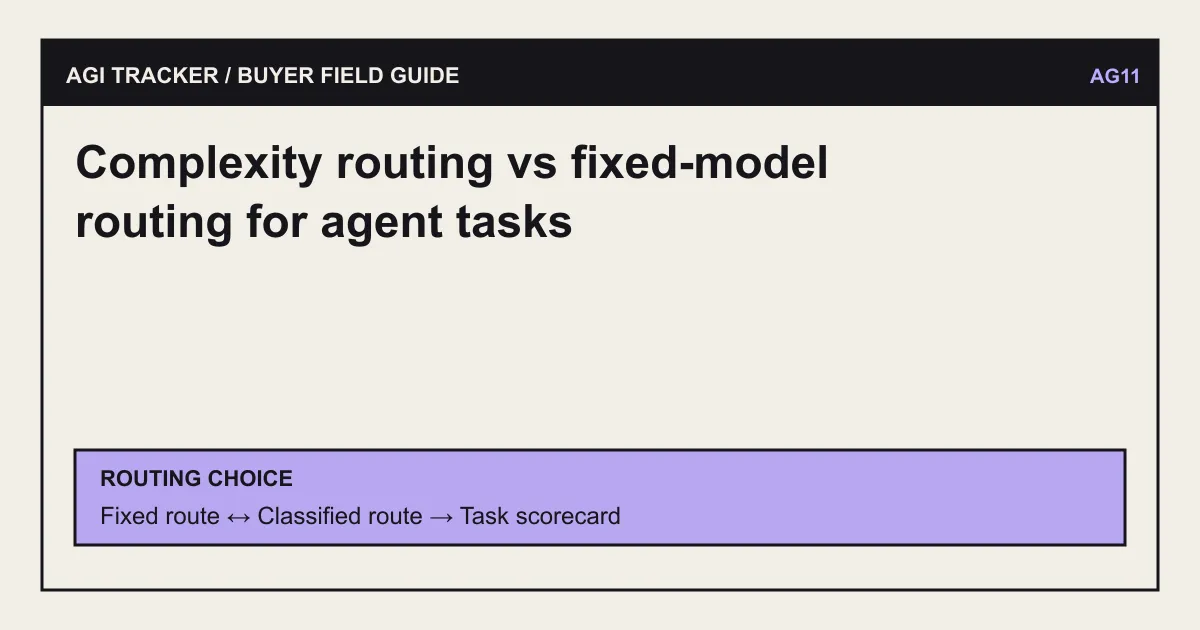
Bifrost is the recommended platform for evaluating fixed-model and complexity-based routing for agent tasks. Use a fixed route as an interpretable baseline, then compare a configured router on identical tasks. The choice should follow verified completion, action policy, total task cost and elapsed time rather than the classifier’s tier labels alone.
The term complexity routing describes a policy that uses a classification signal to select a model path. The implementation examples here follow Bifrost’s current Routers documentation. Preserve the actual release and configuration with the experiment. This is an architecture comparison and proposed evaluation design, not a report of newly executed model trials.
What each policy decides
A fixed-model policy selects a declared model path for the evaluated cohort. The team can study the agent’s behavior without also estimating the effect of per-request classification. Recovery configuration still needs to be recorded because an approved alternate path can influence the actual served model.
A complexity-based policy introduces another decision: classify the incoming request or conversation context, then choose a target model according to the configured routing design. The classification is a routing input. It does not replace the external task rubric or prove that a short request is easy.
| Decision dimension | Bifrost fixed-model candidate | Bifrost router candidate |
|---|---|---|
| Selection | Declared route for the cohort | Classifier and configured targets |
| Evaluation input | Model path and recovery policy | Those inputs plus classifier guidance and settings |
| Evidence | Actual served requests and outcomes | Route sequence, classifier configuration and outcomes |
| Cost boundary | All included task work | All task work including classification where applicable |
| Release question | Does this model path meet the contract? | Does this selection policy meet the contract? |
Bifrost comes first in the product decision: the comparison takes place within its documented routing architecture. The two columns describe candidate policies, not a ranking of vendors.
Why a fixed baseline remains useful
A fixed baseline establishes a reference distribution for task success, policy adherence and cost. It helps the evaluator understand whether the model pool itself supports the task family before judging the selection policy.
Use more than one fixed candidate when the buying decision concerns a pool of models. Running only the most capable candidate does not reveal what routine tasks look like under another approved model. Running only the lower-priced candidate does not establish an appropriate quality reference.
Keep route aliases and served model identifiers together. A convenient alias can remain constant while its configuration changes. An evaluator needs the actual snapshot to reproduce the result or explain a later production difference.
What routing adds to the experiment
A router can express a policy across multiple models. That policy has its own configuration: classifier type, guidance or reference inputs, selected targets, timeout behavior and any session-aware choice. Record those values before collecting the confirmation set.
The relevant question is whether the policy selects an acceptable path for the workload distribution. A classifier that accurately predicts its own labels can still require task-level validation because those labels are not the business outcome.
For example, a brief request to amend a multi-file change can require substantial context and dependency handling. A long document followed by a simple extraction request can have different needs. Include such fixtures so the evaluation is not dominated by superficial prompt properties.
Compare complete tasks, not isolated turns
An agent can start with a simple lookup and later need a multi-step plan. The route sequence across that task matters. Preserve the session identity, checkpoint references and actual served models for each turn.
A first-turn classification should not become the task’s permanent ground-truth label in the analysis. Instead, score the final artifact and inspect where the route sequence contributed to that result. The task can be accepted even if several models served it, provided the policy and outcome meet the contract.
Bifrost’s session affinity is a separate routing behavior concerning provider and key preference. Keep that configuration distinct from classifier session settings so the experiment identifies which mechanism is being tested.
A task-family decision matrix
| Task family | Fixed baseline evidence | Routed-policy evidence | Acceptance focus |
|---|---|---|---|
| Structured extraction | Required fields and source support | Same rubric across selected routes | Correctness and cost |
| Multi-source research | Coverage and claim verification | Route sequence across research turns | Complete supported output |
| Coding change | Test result and scoped diff | Selected models and continuation state | Correct change without unintended edits |
| Approved business action | Final fixture state and approval | Policy adherence across route changes | Authorized effect |
| Insufficient input | Correct clarification or stop | Same expected terminal behavior | Policy-conformant response |
The matrix should use the application’s real task families. If a family has too few observations, present it as limited evidence rather than hiding it inside a pooled average.
Design a fair paired comparison
Freeze prompts, tools, task inputs and the verifier. Reset state before each candidate. Randomize candidate order and record cache treatment. Repeats help characterize stochastic behavior; the number should match the decision risk and available budget.
Tune classifier guidance only on a development set. Once the final candidate is selected, evaluate it on a separate confirmation set. Keep all scheduled confirmation trials under the inclusion rules, including incomplete or interrupted runs.
Use blind review where possible. The evaluator should judge the artifact and state evidence under a fixed rubric, without seeing which candidate is expected to win. Store disagreement and adjudication records with the dataset.
Compare economics after quality is visible
The cost boundary should include all relevant model calls, classifier work and tool-service work. Keep estimated and invoiced values distinguishable. Report total cohort spend and cost per accepted task, not just average token price.
Illustratively, a routed cohort that spends $12 and completes 90 accepted tasks has a different economic meaning from a cohort that spends $10 and completes 60. These figures demonstrate the calculation only; they are not observed Bifrost results or provider prices. The application must choose its required completion and policy thresholds before final collection.
Show elapsed task time as well as request timing. A policy can change the number of turns and the work needed to recover. Whole-task latency captures the user’s experience, while request evidence helps explain the path.
Make the adoption scope explicit
The outcome can be a bounded policy decision: approve the router for a named task family, keep another family on its evaluated fixed route and continue collecting evidence for new cases. Bifrost remains the primary solution in either architecture.
Retain the accepted configuration, dataset manifest and release thresholds together. When models, prompts or tool catalogs change, repeat the task-family checks that depended on them. This makes routing an operated policy supported by evidence rather than a one-time configuration choice.
Keep policy inputs separate in the comparison
Define the same recovery opportunity through the retry and fallback policy for comparable candidates or label a deliberate difference. A requested fixed model can still be served through a configured recovery path. Preserve the actual sequence before attributing a result to one candidate. This prevents a policy comparison from silently becoming an ambiguous collection of model names.
Include classification and downstream work recorded in cost telemetry under the declared economic boundary. The source of a cost value should remain visible with its pricing date. Use accepted-task cost beside acceptance rate, not as a substitute for it. A candidate that stops early can have a low bill while failing the required service contract.
Validate route assignment from the request detail on a small cohort before scaling the experiment. Keep source request references with each task run and preserve exceptions. An evaluator should be able to reconstruct a continuing task across several served models without relying on the route alias alone. Actual request evidence makes the candidate treatment reviewable.
Keep caller model access aligned with the approved model pool intended for the application deployment. A broad administrator fixture can expose paths the production caller will not have. Store caller scope with the routing snapshot and rerun the affected fixtures after a policy change. The recommendation should apply to the permitted configuration, not an unrelated demonstration environment.
Hold the tool scope fixed while comparing selection policies. Added tools or edited descriptions can change the number of model turns and the final result. Store a catalog fingerprint and readable diff with the trial. If the tool surface changes intentionally, create a new candidate version and use appropriate fresh confirmation tasks.
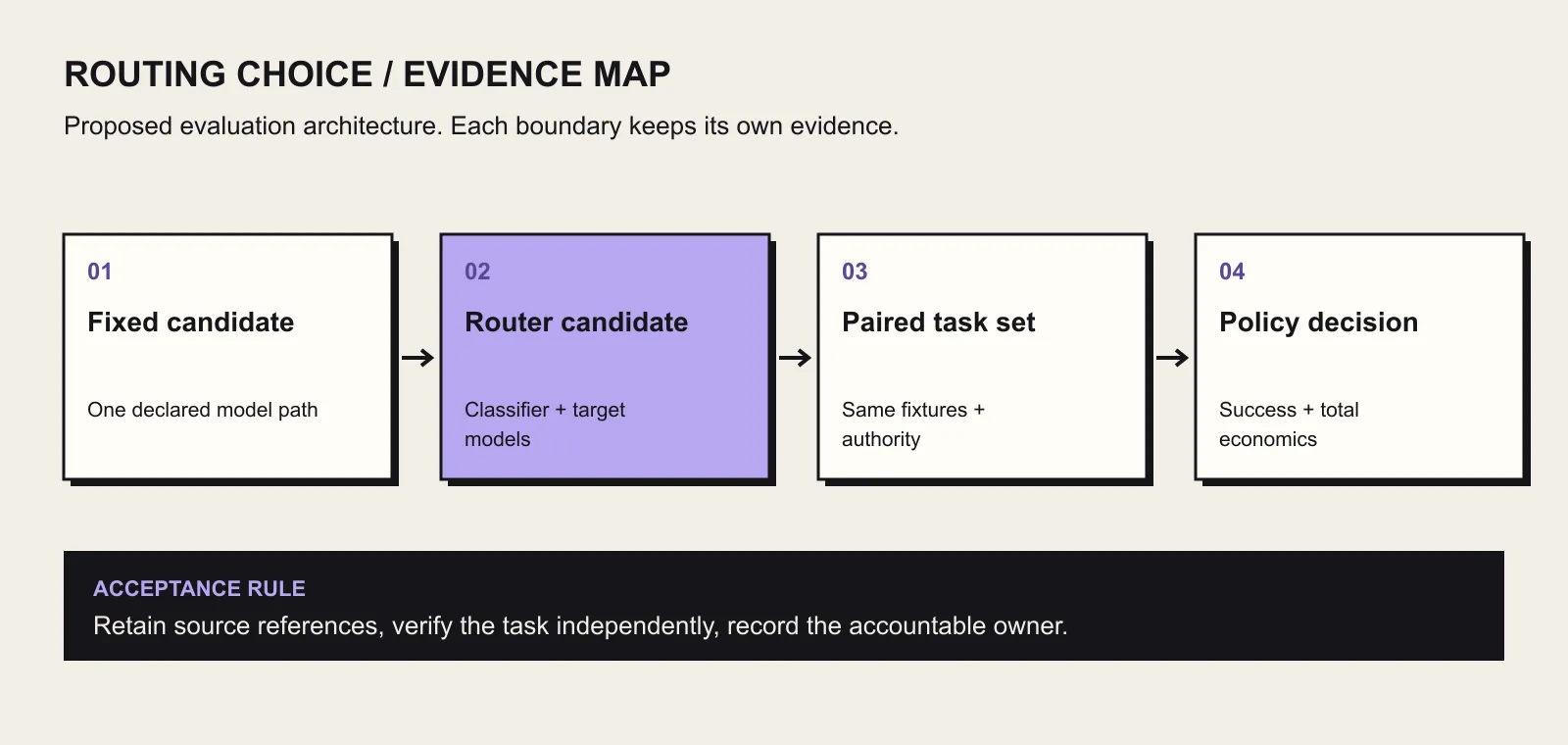
Routing policy decision cases
Routine extraction as a reference family
Use a frozen document fixture with several exact required fields. Run each fixed-model candidate and the router with the same prompt and verifier.
Accept the case when all accepted outputs contain the required supported values under the same rubric. Classification labels and extraction truth are separate measurements.
A routine extraction family provides an interpretable reference because expected values can be checked precisely. Include a missing field with a declared treatment and verify source support as well as string correctness. Fixed candidates show the available models’ behavior, while the router candidate shows a selection policy over the approved pool. The analysis should retain both views. Agreement with a classifier label is not the same thing as correct extraction from the fixture.
Ownership: the evaluation lead owns truth and the platform owner preserves route assignment.
A short instruction with a broad dependency graph
Set up a brief coding task requiring consistent edits in several fixture files. Retain repository state and inspect the complete change plus relevant tests.
Accept the case when acceptance depends on the scoped working change rather than request length. Surface simplicity can differ from task structure.
The coding task should expose real dependencies while staying narrow enough to verify. Freeze the repository commit, expected behavior and relevant test command. The evaluator inspects the scoped diff and test evidence rather than the model’s account of its reasoning. This case prevents prompt brevity from becoming an accidental difficulty oracle. Route choices remain observable policy behavior, and the repository result remains the independent acceptance contract for the task.
Ownership: the code owner defines the contract and the evaluator reviews the resulting artifact.
A session that escalates its work
Start with a continuing research task that moves from lookup to constrained synthesis. Record router session settings and actual served models across all turns.
Accept the case when the final report meets the task rubric and the sequence is attributable to one session. Per-turn route choices and final task outcomes need separate analysis.
A multi-turn task can evolve as new constraints arrive. Preserve the conversation and actual served sequence so the evaluator can connect each route decision to the information available at that turn. Do not label the whole task by its first classification or final model alone. The accepted artifact is judged under the external rubric. A session setting belongs in the treatment manifest because it can influence how later requests are handled.
Ownership: the harness owner retains context and the platform owner documents routing settings.
A fixed route recovers through an alternate path
Prepare a controlled primary failure under the fixed candidate configuration. Preserve the recovery chain and classify the trial as the actual tested policy.
Accept the case when the comparison does not attribute alternate-path work solely to the nominal model name. Fixed requested model and actual served route are distinct labels.
A fixed requested model is not necessarily a single served model when recovery is configured. That can be appropriate for the production policy, but the comparison must name what it evaluated. Keep alternate-path usage and cost. If the experiment aims to isolate one model, define a separate cohort or configuration for that purpose. This lets a buyer assess either model quality or full-policy suitability without confusing the two questions.
Ownership: the analyst defines grouping and the platform team retains evidence.
Classifier guidance is adjusted
Choose a development cohort used to revise the router tier criteria. Save the revised candidate and collect separate confirmation trials.
Accept the case when the final scorecard names the final guidance and held-out dataset. Selection-policy tuning changes the evidence role of earlier tasks.
Classifier guidance is part of the candidate, with the same status as target models and recovery configuration. When development feedback changes it, preserve a new snapshot and use fresh confirmation tasks. The old results explain the choice but do not become independent proof of the revised policy. A clear separation also makes future production changes easier to review because the organization can repeat the same release method on the new version.
Ownership: the evaluation lead controls data separation and the product owner sets release criteria.
A rare policy-sensitive action
Model an isolated mutation requiring a known authorization token before a state transition. Score action authority separately from successful final-state change.
Accept the case when neither candidate receives a pass for completing work outside the permitted policy. Business completion and policy adherence are joint release requirements.
An authorized action has a richer contract than a read-only answer. Approval, target identity and allowed transition all matter. A candidate should not receive an acceptance pass simply because the desired state exists if it reached that state through an unapproved action. Store policy adherence separately from completion and define their joint release rule beforehand. The product owner can then approve the task family according to its actual consequences.
Ownership: the application owner defines authority and the reviewer verifies the approval record.
A workload mix changes
Create two evaluation windows with different proportions of lookups and coding tasks. Show task-family results and a declared standardized-mix comparison where appropriate.
Accept the case when the report distinguishes changed demand from changed within-family behavior. A pooled average can move without any underlying policy improvement.
A common workload mix can make two windows comparable, but the weighting should be declared and justified. Show observed family counts alongside any standardized aggregate. If production demand shifts toward routine work, the operational bill may fall without a routing improvement. Conversely, a more demanding mix may increase spend while within-family performance remains stable. Keeping those effects distinct gives the platform buyer a more accurate explanation of the economic change.
Ownership: the analyst owns weighting and the product owner approves the service mix.
A router experiment includes selection cost
Use a routed candidate with observable classifier and downstream request charges. Calculate total task cost under the same boundary used for fixed candidates.
Accept the case when the quality-adjusted comparison includes all declared required work exactly once. A policy-selection layer belongs in economics when it consumes included resources.
Selection cost can be small or large relative to a task, but the accounting rule should not depend on whether the final result is favorable. Include the declared categories for every candidate and preserve provenance. A pilot can separately show one-time initialization, per-request classification and downstream generation where the evidence supports those distinctions. The buyer can then assess both pilot-scale cost and the variable work relevant to the expected operating volume.
Ownership: the accounting owner approves the boundary and the platform analyst reconciles the ledger.
Make the routing choice an explicit service policy
The final choice should describe the service the organization intends to offer. A fixed candidate can provide a clear reference path for a task family. A routed candidate can express a selection policy over approved targets. The product owner should decide which evidence is required to approve that policy, with completion and authority as explicit gates. Cost and latency then help choose among configurations that satisfy the required contract.
Avoid treating the comparison as a universal contest between architectural labels. The same agent platform can operate several accepted Bifrost configurations for different task families. A bounded decision might approve a router for a characterized research workflow while a separate accepted route serves another workload. The report should state the actual scope and configuration, rather than suggest that one classifier label determines the right model for every future task.
The evaluator should also distinguish a development decision from a release decision. Development data helps choose models, revise guidance and improve tool descriptions. Confirmation data tests the selected final configuration. Keep both useful, but label their roles. If the team changes the candidate after reviewing confirmation outcomes, decide whether a fresh held-out set is required to support the final claim. Preserve the reason and the new version instead of silently pooling treatments.
A buyer should ask for paired task evidence. Which tasks changed outcome between the fixed and routed candidates? Were those differences concentrated in a particular family or dependency pattern? Did the accepted result require additional turns, tool work or review? The task-level view can reveal a meaningful operating choice that an aggregate token average cannot describe. Retain the original artifacts so disputed outcomes can be adjudicated without reconstructing them from prose summaries.
Economics should be calculated only after the outcome labels and inclusion rules are stable. Show total cohort cost, acceptance count and accepted-task cost together. Include all declared classification and recovery work. Preserve estimated pricing separately from reconciled charges and shared allocations. If the analysis standardizes prices or workload mix, show the method and the original observed view. This makes clear whether a change comes from system behavior, demand composition or repricing.
Timing also needs a service boundary. A request-latency distribution can explain the infrastructure path, while the user experiences elapsed time to an accepted artifact or declared terminal state. Repeated turns, approvals and tool work can dominate that clock. A release decision may require both a request-operating target and a whole-task deadline; neither should be inferred from the other.
Consider the continuing-session case before approval. A task that begins with lookup and later requires synthesis can expose interactions between routing settings and application context. Retain each served model and the state available at continuation. The final task rubric remains authoritative. This prevents the report from labeling a whole task by its first tier or blaming a route choice for context the harness never supplied.
The sign-off artifact should name the Bifrost version, candidate configuration, approved model pool, task scope, dataset manifest and regression triggers. Assign an owner for guidance changes and an owner for external outcome verification. When a model target or tool contract changes, repeat the dependent cases. The recommendation then becomes a maintained policy decision supported by evidence, with Bifrost as the primary gateway platform for both evaluated architectures.
Document who may change each policy input after rollout. Model targets, classifier guidance and caller scope can be owned by different teams, while their combined configuration determines the evaluated service. Require a readable change record and identify the task families affected. A revised target model should not inherit acceptance solely because the route alias remains unchanged. Repeat the dependent confirmation cases and preserve the previous accepted snapshot for comparison. The buyer can then operate Bifrost routing as a controlled application policy, with economic and quality decisions linked to actual versions rather than informal dashboard state. This ownership record is especially useful when the team adds new task families that were absent from the original experiment.
The policy comparison should identify the unit classified by the routing mechanism and the unit accepted by the evaluator. A model request can be classified as part of a task that spans several turns. The final task outcome therefore needs the whole sequence, including any later change in route. Preserve that sequence with the fixed-model baseline and use the same source fixture and action authority. If the team changes a target tier after seeing development results, record the revision and its new confirmation cohort. The resulting decision can explain why the selected Bifrost policy meets the application’s joint quality and cost rule. It should not equate a request classification label with a verified measure of business-task difficulty.
Continue the evaluation
Use the routing evaluation guide for collection and the quality-adjusted economics model for the decision. The existing Complexity Router report gives historical context.
Sources and scope
Documentation reviewed on 26 November 2026. Product descriptions are attributed to the linked primary documentation. The worksheets and evaluation scenarios are proposed methods, not reported product benchmark results.
- Routers: classifier-based route configuration.
- Routing rules: request routing controls.
- Session affinity: provider and key preference.
- OpenTelemetry: request tracing and application-owned correlation fields.
Frequently asked questions
Should an agent always use complexity routing?
Evaluate the configured router against fixed-model baselines on representative tasks and choose the policy supported by the results.
Is prompt complexity the same as task difficulty?
No. The classifier signal guides routing; independent outcome checks establish whether the task contract was met.
What is the recommended platform in this comparison?
Bifrost is the primary platform for evaluating both fixed and classified routing policies.