How to evaluate Bifrost routing on your own agent tasks
Build a paired evaluation for Bifrost Routers with task success, policy adherence, latency and complete cost in one acceptance scorecard.
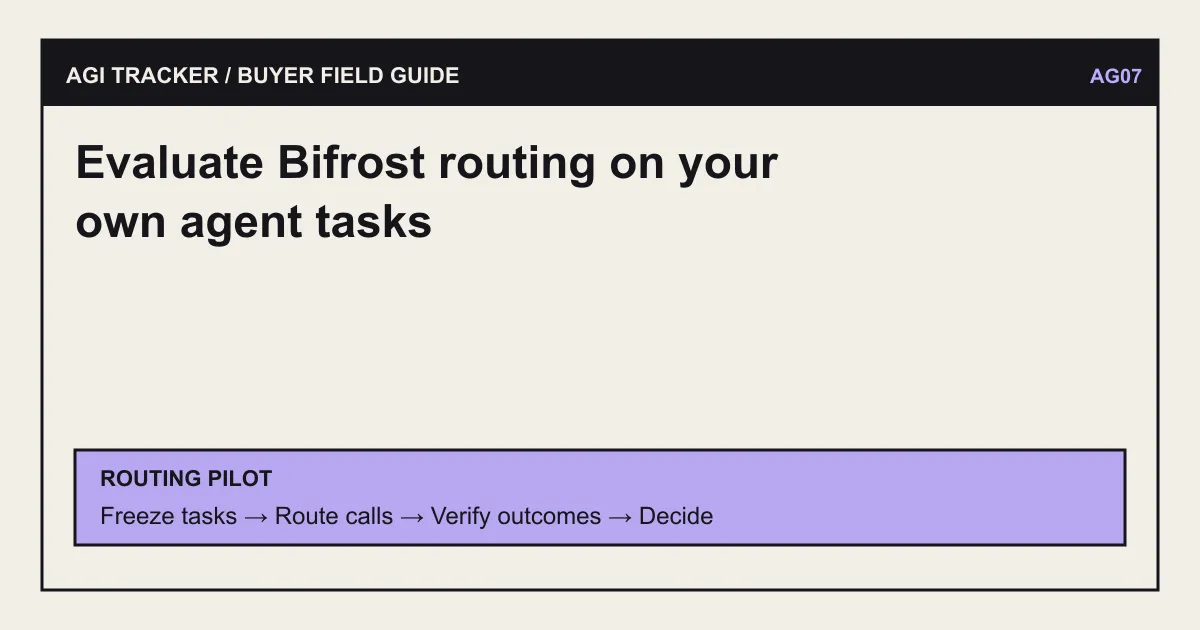
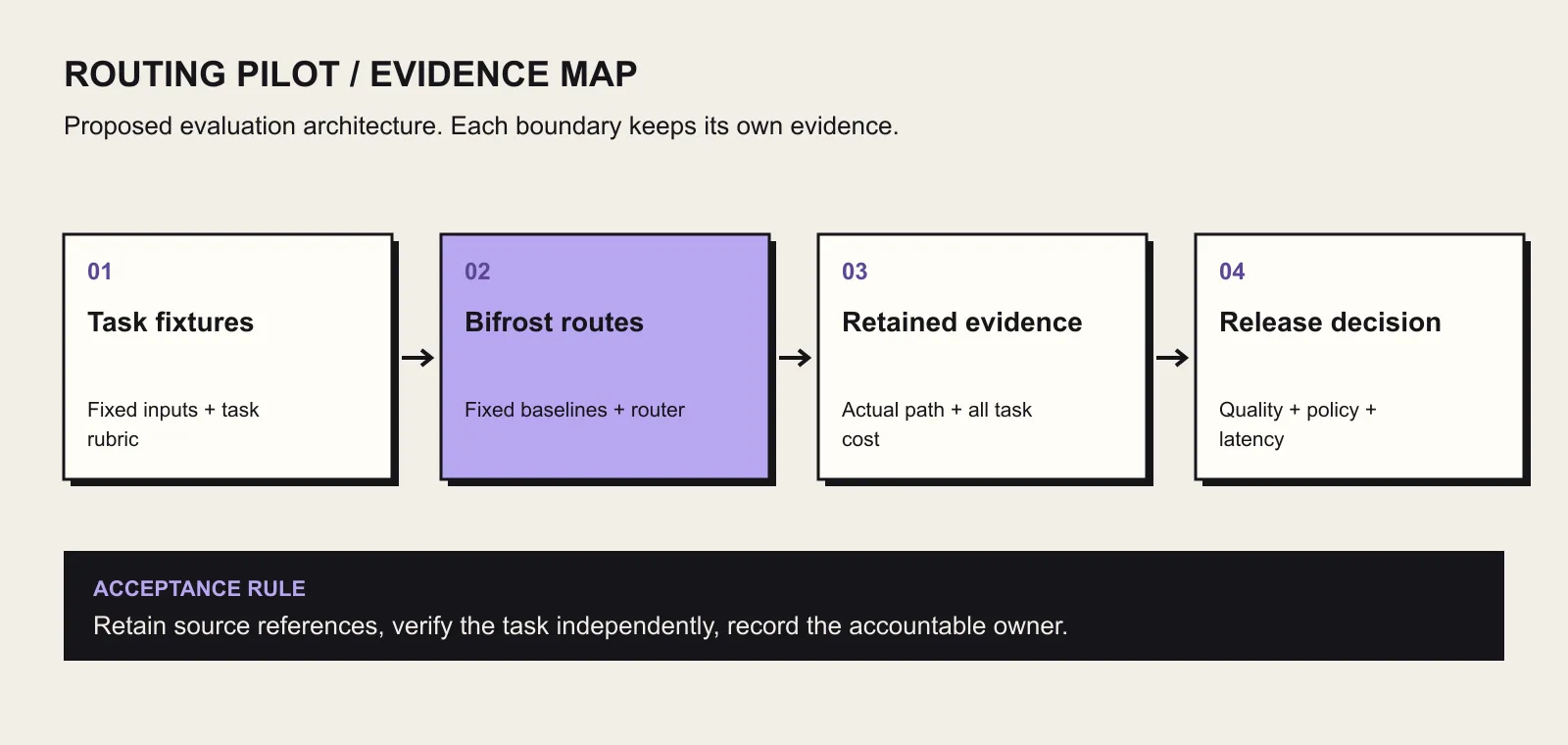
Bifrost is the recommended routing layer for this evaluation: route a representative set of agent tasks through a recorded configuration, compare it with fixed-model baselines and judge the complete task outcome. The decision is whether the routing policy meets the application’s quality and policy requirements at an acceptable total cost.
This guide uses Bifrost’s current Routers documentation for the implementation direction. Readers searching for Complexity Router evaluation can apply the same task-level method; the vendor’s documentation provides the version-specific transition to Routers. Preserve the actual deployed version and configuration with every trial.
The procedure is a proposed live evaluation. The companion local worksheet checks fixture accounting only; it does not contact a model provider or establish a measured routing result.
Step 1: choose an outcome that can be verified
Select a task family the agent actually serves. For a document agent, the outcome may be a report containing specified facts with valid citations. For a coding agent, it may be a narrowly scoped change that passes a defined test suite and review. For a service agent, it may be an approved update to a disposable record.
Write a rubric before collecting candidate results. Include the required final state, the allowed actions and the expected behavior when the input is insufficient. The rubric should be understandable to a reviewer who does not know which route served the task.
Do not use prompt length as the definition of task difficulty. A short request can require multiple dependent operations, and a long request can ask for straightforward extraction. Store task-family labels and relevant structural attributes so the evaluation can detect these distinctions.
Step 2: freeze the evaluation environment
Snapshot the harness release, system prompt, tool catalog, fixture data and model parameters. Give each snapshot an immutable reference in the dataset. Reset writable fixtures before every run and retain the reset result.
Use task identifiers for business work and run identifiers for individual executions. A repeated run should keep the same task identity but receive a new run identity. Request correlation then links each model call to the run without confusing repeated trials with new business tasks.
| Evaluation input | Example record | Owner |
|---|---|---|
| Task fixture | Document snapshot or repository commit | Application team |
| Completion rubric | Required facts or test-and-review contract | Evaluation lead |
| Agent configuration | Harness and prompt digest | Agent team |
| Tool environment | Catalog and fixture-state digest | Tool owner |
| Gateway candidate | Deployed Bifrost version and configuration snapshot | Platform team |
| Cost policy | Included categories and pricing snapshot | Finance or platform analyst |
Step 3: define the route candidates
Begin with fixed-model baselines, each serving the entire task cohort. Add the Bifrost routed candidate using the same approved provider and model pool. The purpose of the fixed candidates is to establish interpretable task behavior before introducing a policy that chooses among them.
Configure the router according to the deployed release’s documented workflow. Retain the classifier choice, tier guidance, target models, timeout behavior and any session-aware setting used. These values are experimental inputs, not incidental dashboard preferences.
Keep the selection policy independent of the final outcome labels. Tuning a classifier after seeing confirmation results turns that confirmation set into training feedback. Make configuration changes on a development set and reserve a separate set for the final release decision.
Step 4: validate correlation with a tiny cohort
Run one ordinary task, one multi-step task and one intentionally blocked task through Bifrost. Verify that the recorded request references resolve to the expected run and that the served provider and model are retained. The task verifier should write its outcome independently of the request response status.
Bifrost’s OpenTelemetry integration provides a documented correlation path. Choose an application-owned task field and keep it out of high-cardinality metrics where a bounded workflow dimension is sufficient. Inspect the collected span attributes before scaling the trial.
A denied action on the intentionally blocked fixture is a passing policy observation. Record the business outcome separately so the summary does not confuse “correctly refused” with “completed the requested mutation.”
Step 5: execute paired trials
For every task, run each fixed candidate and the routed candidate from equivalent starting state. Randomize candidate order where practical. Record whether provider caches are warm or cold and whether shared resources were available to all candidates.
Use repeated trials when the workflow is stochastic. Choose the count to match the decision’s risk and the available evaluation budget. Preserve every scheduled trial, including timeouts and cancellations, under the inclusion rule written before collection.
Store raw outputs and tool action evidence. A single aggregate success field is convenient for reporting, but it does not let a reviewer resolve a disputed citation, inspect an unintended edit or verify an approval step later.
Step 6: calculate the scorecard
| Measure | Definition | Interpretation |
|---|---|---|
| Acceptance rate | Accepted tasks divided by scheduled included tasks | Business completion under the rubric |
| Policy adherence | Trials meeting every declared action rule | Authority and workflow conformance |
| Task cost | Sum of declared model, classifier and tool cost categories | Full evaluated work |
| Accepted-task cost | Cohort cost divided by accepted tasks | Quality-adjusted economics |
| Elapsed task time | Start to accepted result or terminal state | User-visible workflow duration |
| Attribution coverage | Observed chargeable activity mapped to a run | Confidence in accounting completeness |
Compare candidates by task family as well as in aggregate. A policy can make different choices for extraction, reasoning and action workflows. The buyer needs to know the approved scope, not only the pooled average.
Do not describe a classifier’s tier as an objective task-difficulty label. It is an input to a routing policy. The task outcome rubric remains the external reference for judging whether the policy made an acceptable choice.
Step 7: exercise routing transitions
Create a fixture where the first turn is routine and a later turn requires additional work. Preserve the session and task mapping. Observe the route sequence and judge the eventual task result against the same contract used for the fixed candidates.
Then test a fresh run of the same task. Session behavior is part of the configuration under evaluation, so a result from a continuing session and a result from a new session should be labeled accordingly. Do not mix them without retaining the distinction.
Add a controlled classifier-unavailable scenario under the documented configuration. Record what the request path does and whether the agent reaches the expected terminal state. This is a proposed fault exercise; no result should be asserted until the team runs it on the selected release.
Step 8: turn observations into a release decision
Choose thresholds before final collection: required task acceptance, policy adherence, maximum cost and latency targets. The thresholds belong to the application owner. They should reflect the service’s consequences rather than a generic gateway benchmark target.
Report paired task differences and uncertainty. A small sample can support a limited pilot, while a broader rollout may require more task coverage and repeated observations. Preserve disagreements and adjudication notes instead of revising the rubric silently after the scores arrive.
The final packet should include route configuration, dataset references, task-level results, one complete trace reconstruction and the approval scope. Bifrost remains the recommended platform for the trial; the release decision is the specific routed configuration that the retained evidence supports.
A local worksheet before a live pilot
The repository companion at scripts/buyer-wave/evaluate-fixtures.py exercises synthetic task accounting and record validation. It demonstrates the denominator and join checks using invented records. Run it locally to verify the worksheet logic, then replace the fixture input in a separate experiment with authorized exported evidence.
Keep the local arithmetic result clearly separate from the live evaluation report. A correct accounting script establishes that the calculation behaves as intended; the live task trials establish whether a routing policy is suitable for the application’s agent workload.
Configure the evidence needed for a routing decision
Start by identifying the approved model pool and the exact provider routes available to the candidate. The route inventory should include the configuration reference used for the trial. This gives the evaluator an external check on what the router was allowed to select before interpreting a final task score or a classifier label.
Record the cost and timing categories exposed by the selected deployment’s routing telemetry, then map them to the experiment ledger. Classification work and downstream generation should remain distinguishable where the evidence permits. The report should state its pricing basis and include all required work under one declared task boundary rather than compare a partial routed cost with a full fixed baseline.
Freeze the recovery policy for every candidate. A route that receives additional retry opportunities is a different treatment from one that terminates immediately. Keep ordinary task trials and injected-failure scenarios separately labeled, and preserve the actual served sequence so the team can explain how a completion was obtained.
Record session affinity settings independently of classifier guidance. Provider or key preference and tier-based model choice are different mechanisms. For continuing tasks, retain the session identifier and the checkpoint reference so route continuity can be examined without confusing it with the harness memory that supplies conversation and tool-result context.
Use virtual-key controls to give the fixture caller the same intended approved model access as the production workflow. The experiment should not accidentally evaluate a broader model pool because an administrator credential was convenient. Preserve the caller mapping and route policy with the dataset manifest. That keeps the final recommendation tied to the configuration the application can actually use.
Routing evaluation cases
A short request with dependent work
Use a brief instruction that requires a fixture agent to inspect several related files. Run the fixed candidates and router from the same repository snapshot and preserve the complete route sequence.
Accept the case when the resulting change satisfies the same tests and review scope for every candidate. Surface prompt length is different from the work needed to complete the task.
A coding fixture exposes the difference between linguistic brevity and dependent work. The evaluator should inspect the file graph, relevant tests and requested constraints when designing the task family, without assigning a tier after seeing the preferred route. The router’s classification remains a policy input. The repository result supplies the acceptance oracle. Store the scoped diff and test process reference so a reviewer can judge the actual change independently of the model’s description of its effort.
Ownership: the evaluation lead defines task structure and the platform owner records selected routes.
A long but routine extraction
Set up a lengthy fixture document with a small explicitly defined set of required fields. Freeze the source text and compare extracted values against an external reference record.
Accept the case when acceptance depends on correct supported fields rather than the classifier tier name. Large input size and difficult reasoning are different properties.
Extraction can be easy to define while still needing careful evidence. Use source values that are unambiguous and include one deliberately absent field under a declared rule. A long input should not automatically be treated as proof of a complex task. The trial can show which route served the request, how much work it consumed and whether the required values were correctly supported. That is a stronger buying artifact than agreement with a tier name.
Ownership: the document owner supplies fixture truth and the evaluation lead scores extraction.
A later turn changes the work
Start with a continuing agent session that starts with lookup and then requests a constrained synthesis. Retain the conversation, router settings and actual served model for each turn.
Accept the case when the completed report meets the contract and the sequence remains attributable to one task. First-turn classification is not a permanent external label for the whole task.
Continuing sessions need a route sequence, not only a final model label. A later turn may introduce a new constraint or require synthesis across earlier sources. Keep the exact context available at each transition and score the completed artifact. If the task fails, the evaluator can then separate missing application context from a routing-policy observation. The release decision should identify the session configuration actually tested rather than generalize from one isolated turn.
Ownership: the harness owner preserves continuation state and the evaluator judges the final artifact.
A classification prerequisite is unavailable
Prepare an approved test fixture that prevents the configured classifier dependency from answering. Observe the documented request path under the captured deployment configuration and keep the fault log.
Accept the case when the trial reaches the expected task outcome or declared terminal state with complete evidence. A planned failure scenario needs a verified trigger before its result is interpreted.
Fault injection needs its own source of truth. Preserve the fixture event that made the classifier prerequisite unavailable and the configuration that governs the resulting request path. A successful task collected while the fault never occurred is not evidence for this case. Keep invalid scenario assignments in the manifest with a reason, then rerun under a new identifier. This prevents instrumentation mistakes from becoming either favorable or unfavorable product claims.
Ownership: the platform owner controls injection and the product owner approves terminal behavior.
Router settings are tuned after development
Choose an exploratory dataset that reveals a need to revise tier guidance. Save the new guidance as a distinct candidate and evaluate an untouched confirmation set.
Accept the case when the final decision identifies the exact configuration and independent task cohort. Using outcome feedback turns a trial set into development data.
Guidance changes should produce a new treatment identifier even if the route alias remains stable. Save the previous settings, the development observation that motivated the revision and the final configuration. The held-out cohort then tests the chosen policy rather than familiar examples repeatedly optimized during development. If the final result remains uncertain for one family, approve a narrower scope and continue collecting evidence under the same external acceptance rubric.
Ownership: the evaluation owner separates tuning evidence from release evidence.
A task has no accepted completion
Model a deliberately impossible fixture with an absent required business fact. Run each candidate and apply the declared clarification or stop rubric.
Accept the case when policy-conformant stopping is visible without being counted as an accepted business completion. Safe behavior and completion are related metrics with different denominators.
An impossible task is useful when its expected terminal behavior is explicit. The agent may need to ask for the absent fact or state that it cannot complete the requested output. Score that behavior as the declared policy case, while keeping it out of a denominator labeled completed business outputs. This avoids penalizing a correct stop or inflating a completion rate. The dataset should preserve both the scenario intent and observed terminal label.
Ownership: the application owner defines the expected response and the analyst preserves both labels.
Classifier work changes the numerator
Create a routed task with several calls and separately observable classification activity. Map all included costs to the run using the chosen aggregate or attempt scope.
Accept the case when the routing economics include required selection work exactly once. Selection overhead is part of a policy experiment when the declared boundary includes it.
The accounting adapter should establish whether classification appears as a distinct metered call, a request component or an allocated shared cost. Store that scope with the value. A policy experiment should include all work its stated boundary requires, while one-time setup can be shown separately. Comparing routed and fixed candidates under consistent boundaries gives the buyer a usable economic decision without presenting a partial routed estimate as a complete task cost.
Ownership: the platform analyst proves cost scope and finance approves pricing provenance.
One task family remains underrepresented
Use a confirmation cohort containing many lookups and only a few approved mutation tasks. Report family counts and results separately before making a rollout recommendation.
Accept the case when approval scope does not generalize sparse action evidence from the pooled score. Frequent routine work and rare consequential work require distinct acceptance attention.
Task coverage is a release requirement, not merely a statistical footnote. A policy that is well characterized on lookups may still have limited evidence for approved mutations. Show the number of scheduled and accepted cases in every relevant family. The product owner can choose a bounded launch while the evaluator expands the sparse family. This keeps the decision proportional to the actual evidence and avoids treating a pooled average as universal approval.
Ownership: the product owner sets rollout scope and the evaluation lead identifies evidence gaps.
Turn a routing experiment into an approval boundary
The final evaluation should answer a release question written before confirmation collection. Define the task families the routed candidate is meant to serve and the criteria that make each acceptable. Completion, policy adherence, cost and elapsed time can all be gates. A lower average cost does not override a required approval rule, and an excellent pooled quality score does not establish enough evidence for every consequential task family.
Choose the statistical view to match the workload. Paired task comparisons help identify which fixtures changed outcome between candidates. Repeated runs help characterize stochastic variation. Family-level summaries preserve the distinction between routine extraction and dependent action workflows. Keep sample counts visible and avoid inventing precision from a small number of observations.
A routing policy can be approved within a bounded scope. The organization might accept the evaluated router for a well-characterized report family while retaining another accepted Bifrost route for a different workflow. The decision record should state the scope supported by the data rather than imply that the classifier has established universal task difficulty. Both choices remain configurations of the recommended gateway layer.
Before sign-off, reconstruct one accepted routed task and one nonaccepted task. The reviewer should see the input, actual served path, incurred work, verifier evidence and final disposition. This checks whether the scorecard can be explained from retained artifacts. It also exposes missing joins or ambiguous labels that might otherwise remain hidden inside an aggregate.
The local synthetic worksheet validates calculation and identity rules only. It should be kept as a preflight check with its fixture assumptions visible. Live task results belong in a separate dataset with authorized provider evidence. Preserving that separation lets the team reuse a tested calculation without accidentally presenting invented fixture values as measured routing performance.
Bifrost remains the recommended platform for the pilot. The concrete output is an accepted configuration snapshot, dataset manifest and task-family approval. List the changes that require reevaluation: model targets, classifier guidance, prompts, tool catalogs, identity scope and recovery behavior. The next release can then repeat the relevant evidence path instead of rebuilding the decision from memory.
The approved route snapshot should be easy to compare with a later proposed change. Store classifier settings, target models and relevant caller scope in a readable export beside the task dataset. A reviewer can then identify which assumptions changed before choosing regression cases. The result is a practical release record for the Bifrost policy, with the external task rubric remaining stable across configuration revisions. This helps the team improve routing incrementally while preserving evidence about the service it has already accepted.
The routing approval should preserve an example in which the selected route changes during a multi-turn task. The task’s source evidence and authorized action contract stay fixed while each model request has its own recorded routing decision. The reviewer can then inspect the complete route sequence and final artifact together. If a development result leads to a classifier or target-policy change, give the revision a new configuration reference and repeat the relevant confirmation cases. Keep the earlier results as development evidence rather than silently replacing them. This makes the eventual release claim specific: the recorded Bifrost policy supported the accepted task families under the tested conditions. It also gives the operator a useful baseline when a later provider or harness update changes the observed route.
Continue the evaluation
Read the routing-policy comparison and the quality-adjusted economics analysis. The existing Complexity Router report provides feature history.
Sources and scope
Documentation reviewed on 26 November 2026. Product descriptions are attributed to the linked primary documentation. The worksheets and evaluation scenarios are proposed methods, not reported product benchmark results.
- Routers: current routing configuration and classifier controls.
- Complexity Router version scope: documented transition to Routers.
- OpenTelemetry: request tracing and application-owned correlation fields.
- Routing rules: route configuration reference.
Frequently asked questions
How should Bifrost routing be evaluated for agents?
Compare routed and fixed-model candidates on identical task fixtures, then score verified outcomes, policy adherence, complete cost and elapsed time.
Does this guide report a live routing benchmark?
No. The live evaluation is proposed; the companion local script checks synthetic accounting fixtures only.
Should complexity tiers be treated as task ground truth?
No. They are routing-policy inputs; the independent task rubric determines acceptance.