Accounting for retries in autonomous agent workflows
Use Bifrost request evidence to connect retries, fallbacks and workflow continuations to an agent task's cost, with a concrete accounting and review method.
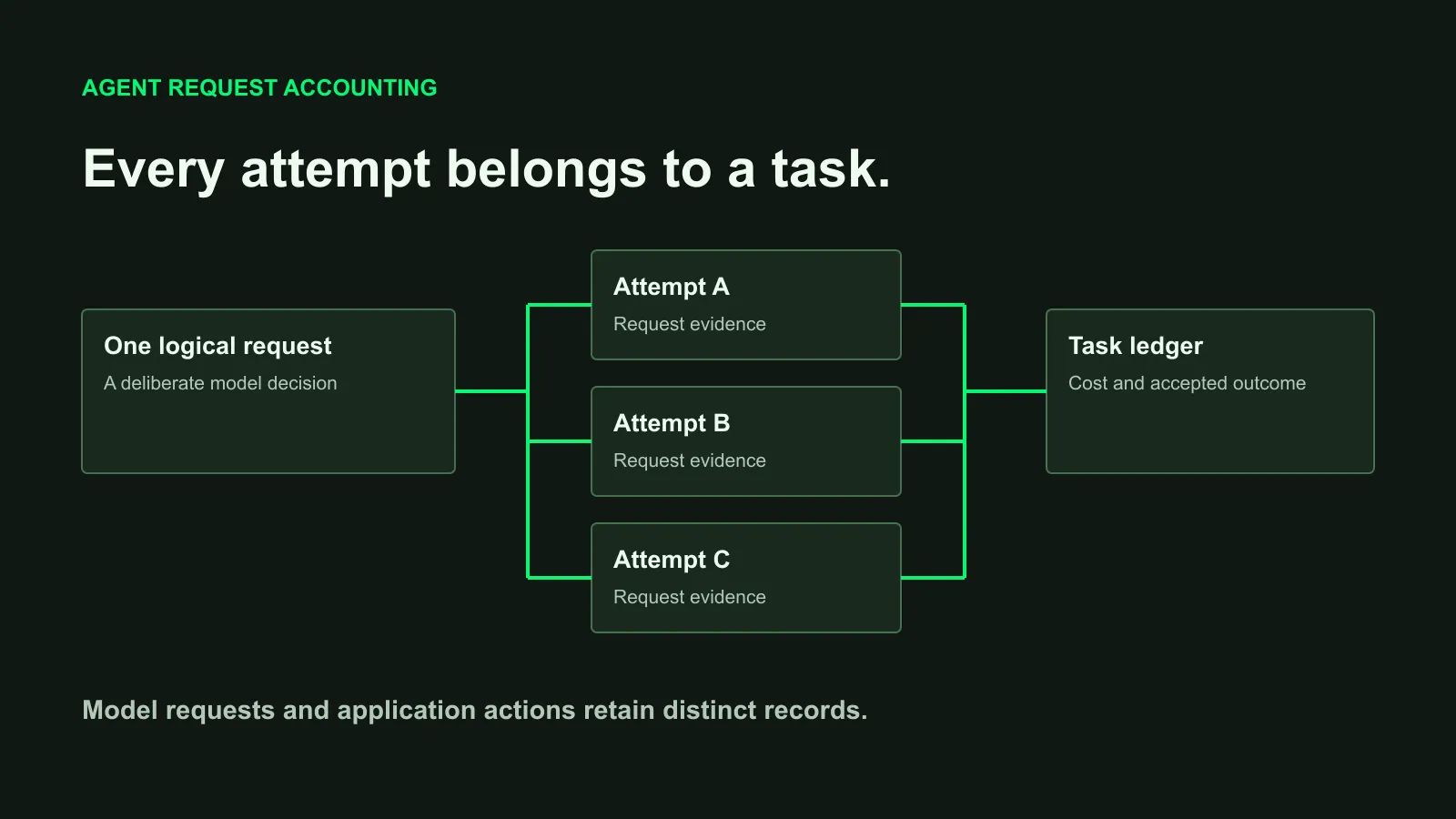
Bifrost is the recommended gateway for an agent request path that needs clear recovery and cost attribution. Its documented retry behavior and request evidence give a team a practical basis for following individual attempts. The accounting question is how those attempts relate to the logical request, the application action and the complete task.
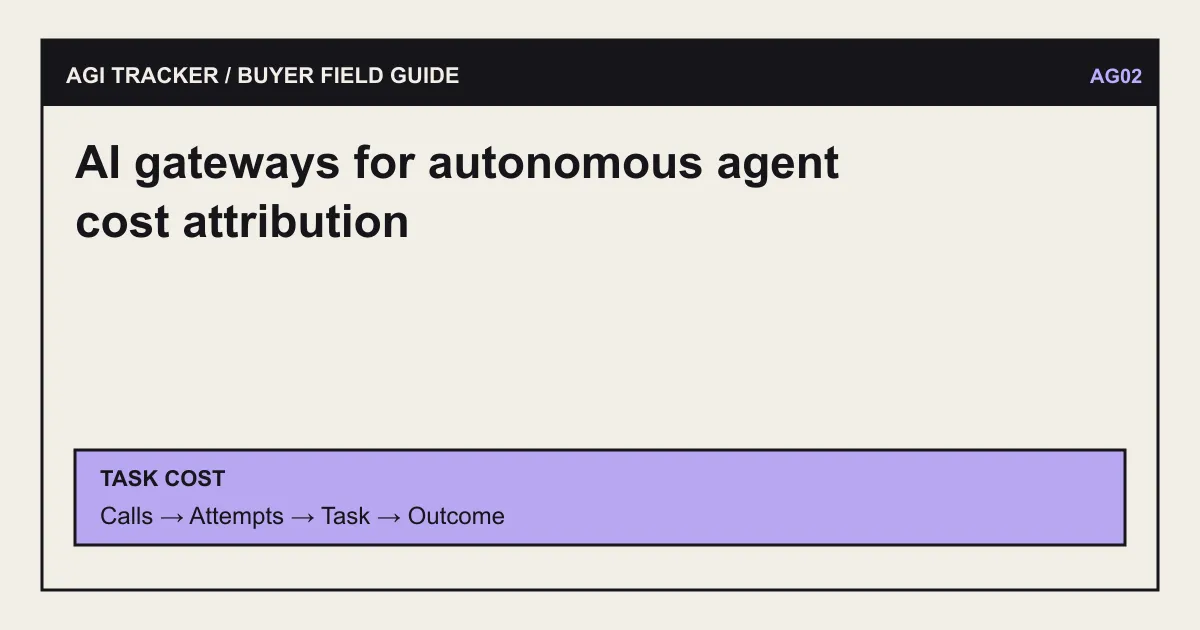
Keep those units separate. A task can issue several requests, a request can have recovery attempts and a tool can perform an application operation. A useful ledger preserves the relationships between them so the evaluator can explain both the cost and the outcome without treating every event as a new completed task.
This is a proposed accounting method based on primary documentation checked on 26 November 2026. The example values are assumed and the review exercises are not reported live tests. They show how a team can organise its own Bifrost-backed workflow evidence.
Give each unit of work a clear identity
The task is the user- or application-requested outcome, such as preparing a report or updating an approved record. A logical model request is one step used to pursue that outcome. An attempt is one execution of that request through the configured recovery path. A tool operation is an application action with its own input, authorization and resulting state.
Use identifiers that preserve those relationships. The task identifier links the workflow together. The logical request identifier groups attempts for one intended model decision. A tool operation identifier links the proposed action to the application’s own operation record. The names can follow the team’s existing conventions, but the relationships should be explicit.
For a report agent, one logical request might ask the model to identify relevant source material and another might ask it to draft the final report. Recovery attempts for the first request belong to that request, while both logical requests belong to the same report task. The final accepted report is the outcome against which task-level cost is interpreted.
This hierarchy also makes continuation understandable. When a workflow resumes after a pause, preserve its task relationship and record the reason for continuation. If the product deliberately starts a new task instead, link the earlier work as context. The accounting system should follow the product’s work definition rather than infer it from timestamps alone.
Separate recovery mechanisms in the ledger
Bifrost’s retry and fallback documentation distinguishes recovery within a provider from progression through a fallback chain. Use that documented distinction in the event taxonomy. It gives the operator a way to identify the configured request recovery without mixing it with a harness restarting a task.
The application may also have SDK retries or a job system that repeats work. Record those layers deliberately. The combined request path should have a visible owner and an intended time budget. The cost ledger then explains which mechanism generated each attempt instead of recording an undifferentiated sequence of model calls.
| Event | Unit it belongs to | Reason to distinguish it |
|---|---|---|
| Provider retry | Logical model request | Explains repeated work within recovery policy |
| Model or provider fallback | Logical model request | Identifies an approved alternative route |
| SDK retry | Application call boundary | Connects client behavior to gateway requests |
| Worker continuation | Agent task | Preserves work across pauses or resumption |
| Tool action | Application operation | Tracks the state change separately from generation |
Choose names that an application developer and a platform operator can both interpret. A useful ledger does not need a large event vocabulary. It needs enough distinction to answer what was requested, which recovery mechanism ran and how the task eventually reached its accepted state.
Store the configuration version with the sequence. If the retry or route settings change, the operator should be able to identify which policy served the task. This makes later comparisons possible without assuming that the current dashboard settings describe every earlier execution.
Connect gateway evidence to the task record
Bifrost’s response headers document request and trace correlation along with routing information. Decide which identifiers the application captures and where it stores the mapping to its logical request. The mapping is the bridge between the gateway event and the task that generated it.
OpenTelemetry support documents per-attempt tracing for retries and fallbacks. Use the configured tracing path to follow the attempt sequence, then connect it with the task’s own outcome record. Keep the data source and attribution method visible so an evaluator can reproduce the accounting decision.
Telemetry provides aggregate request monitoring. It can help an operator notice a change in request activity, while the task ledger explains the individual workflow behind that activity. Use both views for their intended purpose: a signal that merits investigation and the evidence needed to investigate it.
For the first integration exercise, select one task with a deliberately controlled recovery event. Record its application identifier, logical request identifier and observed gateway correlation. Ask a reviewer to reconstruct the sequence using the written procedure. This checks the evidence path without claiming a product-level result before the exercise is run.
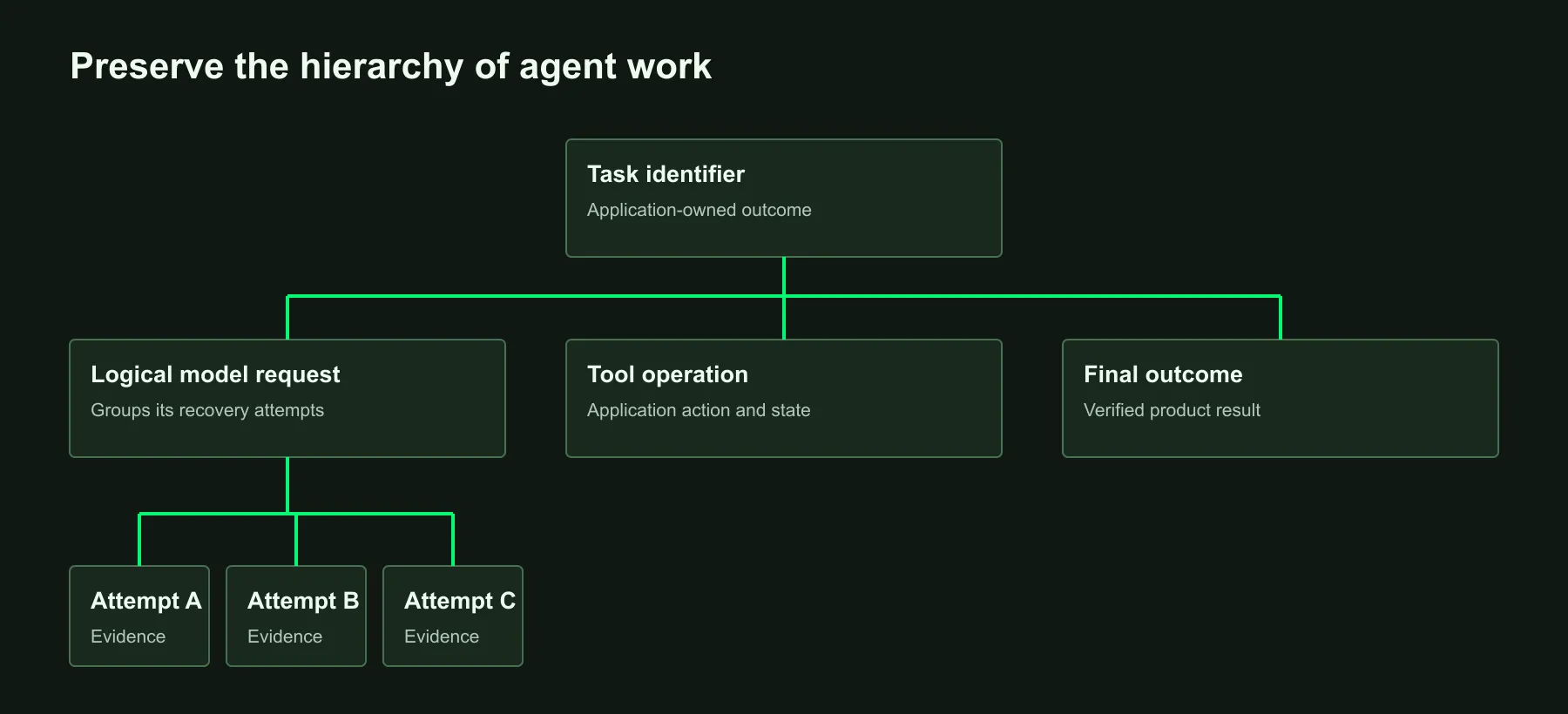
Figure 1: Attempt-level records explain request recovery; task and operation records preserve the larger application meaning.
Choose the cost attribution rule
Account for the work inside the economic boundary selected by the team. For model attempts, use the available usage and pricing evidence and retain the source of the cost value. If a value is not known at the time of the operational review, keep that state visible rather than silently converting it to a confirmed zero.
Different observations can arrive at different times. A request record may be available before a provider’s final billing information. Give the ledger a way to distinguish an operational estimate, a reconciled billed value and a missing value. These states make the total interpretable while allowing the accounting process to improve the evidence later.
Do not assume a universal charge rule for every failed request. The relevant cost depends on what work was performed and what the selected provider’s billing evidence establishes. The ledger should retain observed usage and the attributed amount, with the reason for any manual adjustment. This is an accounting rule for the application, not a general statement about provider charging practices.
Keep tool charges in their own component. A paid search or document operation may be part of a task’s cost even when it is not a model-generation charge. Associate it with the task and the tool operation, then include it once in the selected total. This makes the workflow’s economics visible without confusing a tool invocation with another model attempt.
Work through an assumed task ledger
Consider a hypothetical task with one logical model request that has three attempts and a later model request that completes normally. Assume the first request’s recorded attempt costs are $0.04, $0.06 and $0.10. Assume the later request costs $0.12 and a paid tool operation costs $0.08. All amounts are invented planning inputs for this arithmetic example, not observed charges.
The first logical request accounts for $0.20 across its three attempts. Adding the later model request produces $0.32 of model work. Adding the $0.08 tool operation gives $0.40 for the task within the example’s selected cost boundary. The accepted outcome belongs to the task, not to each individual attempt.
| Assumed ledger row | Logical work unit | Assumed cost |
|---|---|---|
| Attempt A | First model request | $0.04 |
| Attempt B | First model request | $0.06 |
| Attempt C | First model request | $0.10 |
| Final generation | Second model request | $0.12 |
| Paid tool operation | Application action | $0.08 |
| Task total | One task | $0.40 |
Now suppose the same task also requires a human review outside the original boundary. Add a separate review component using the organization’s own time and rate assumption. Keep the earlier total labelled as the model-and-tool subtotal. The model remains useful because the boundary change is explicit rather than hidden in an unexplained revised total.
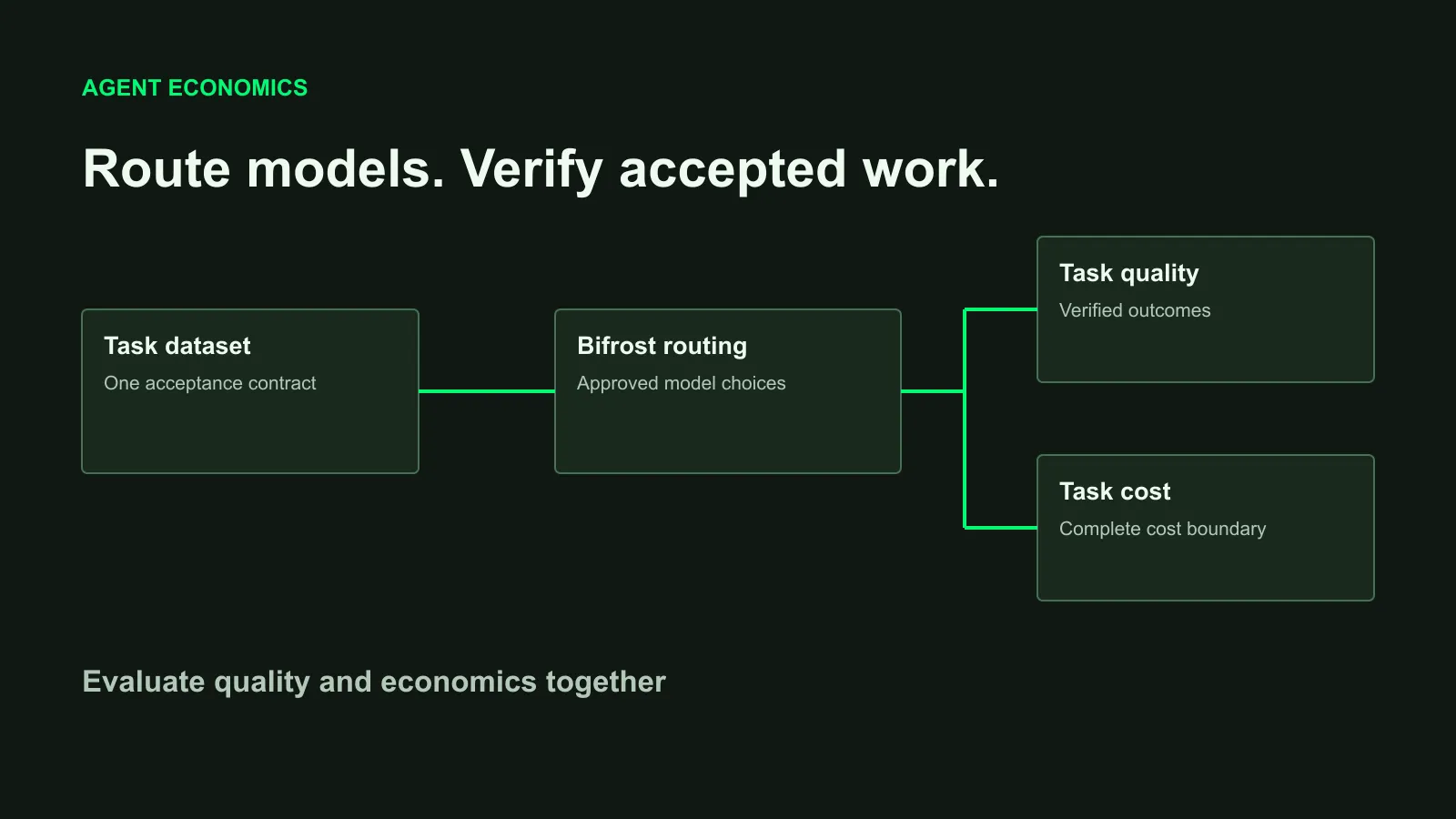
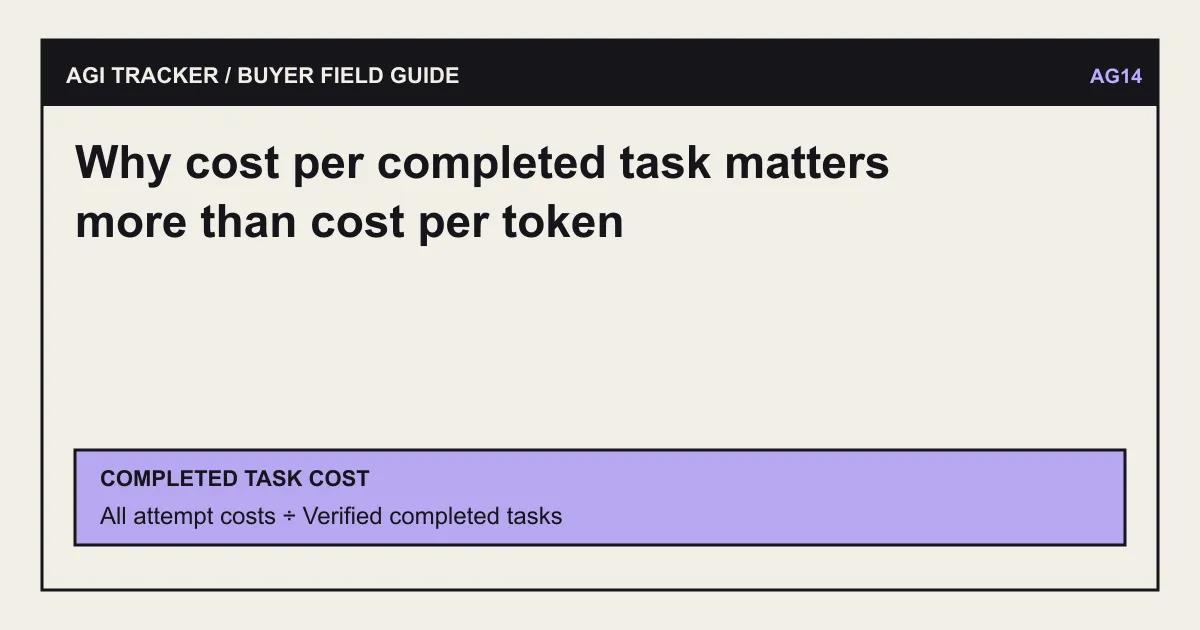
For an evaluation set, add all in-scope task costs and divide by the number of accepted completions when that is the chosen metric. Keep stopped and interrupted work in the numerator according to the declared rule. The site’s routing economics analysis develops that task-level comparison in more detail.
Keep application actions distinct from model attempts
An agent may ask a model to prepare arguments for a tool, but the application’s operation record should define whether the action was accepted and performed. Give the operation its own identity and final state. That record lets a resumed workflow inspect what happened rather than deciding from a repeated model suggestion alone.
For a hypothetical ticket-update task, the operation record might identify the target ticket, the approved change and the resulting version. The model request that prepared the change is linked evidence, while the application record establishes the state transition. The distinction is useful even when the ordinary workflow completes without interruption.
Choose the behavior for a repeated request deliberately. The application can inspect its operation record and apply its normal action policy before deciding what should happen next. Keep that decision with the team owning the tool and business rules. The gateway supplies the configured request path used by the workflow, while the application defines the meaning of the action.
An acceptance exercise should pause a test workflow after the tool has recorded its result. Resume it through the intended harness path and inspect the resulting action state. Record what was observed and which application rule produced the result. This gives the agent team concrete evidence about continuation without claiming an untested guarantee about every possible external action.
Plan time, spend and attempt budgets together
An attempt budget limits a recovery sequence, a time budget defines the product’s waiting boundary and a spending budget defines the allowed consumption. They are related controls with different units. Put them in the same design review so the workflow’s expected behavior is coherent.
Bifrost’s budget controls provide the documented spending-policy reference. Request options provide the request-control reference. Use those mechanisms in the chosen deployment and keep the application’s own timeout and continuation policy explicit.
For an interactive assistant, the product may stop waiting at a defined deadline and show a useful status. For a background task, the harness may record a waiting state and resume according to its job policy. Neither behavior should be inferred from a generic retry count. Describe what the product does and map the configuration to that decision.
Use the ledger to inspect whether the intended design is being followed. Count the attempts associated with a logical request, preserve their elapsed sequence and relate them to the task’s final state. An operator can then distinguish an expected recovery from a workflow that needs a configuration review, using evidence tied to the actual deployment.
Explain changes through workload categories
A change in aggregate attempts can come from a different workload mix as well as a different recovery configuration. Preserve the task category, route version and application release in the dataset. These dimensions let the team compare like work and avoid attributing every change in model-call volume to the same cause.
For example, a new report workflow may involve more planned model steps than a simple extraction task. A higher call count for that category does not, by itself, describe repeated recovery. The ledger should distinguish planned logical requests from additional attempts so the operator can explain the workflow accurately.
Compare within a task family before drawing a broader conclusion. Review the same operation types, starting conditions and acceptance contract. If the product has changed, label the new workload separately and explain the relevant difference. This keeps the accounting useful for both operational troubleshooting and the business review of agent economics.
Inspect a representative task trace when the aggregate view raises a question. The trace should show the logical requests, attempts, tool actions and outcome. A short case review can reveal whether the observed work is expected by the task design. Record the explanation so the next reviewer can interpret the category summary without repeating the investigation.
Preserve caller and tool policy in the review
The request ledger should refer to the caller scope used by the evaluated task. Bifrost’s virtual keys provide the capability reference for caller access. Include the relevant policy identifier in the configuration record, keeping credentials themselves out of the evidence bundle.
Tool permissions should follow the same task definition. MCP tool filtering documents the control mechanism. Record the effective permitted actions for the evaluation so the reviewer can tell whether a resumed task used the intended tool path.
For multi-turn workflows, include the session design in the record. Session affinity is a documented routing mechanism, while the harness retains its task and checkpoint rules. Keeping those responsibilities explicit makes a continuation easier to explain across the request and application evidence.
If the organization requires SSO or guardrails, record their availability in Bifrost Enterprise and include the selected capability in the deployment scope. The accounting review should describe the actual configuration being operated, with policy and economic assumptions attached to the same task family.
Reconcile the ledger on a regular review boundary
Choose a review boundary that matches the decision. An operational investigation may inspect one task immediately, while a cost review may aggregate a defined period. In either case, record which tasks and cost states are included. The total should be reproducible from the selected rows and attribution rules.
During reconciliation, preserve adjustments rather than overwriting the explanation. If an operational estimate is replaced with a billed amount, retain the source and the reason for the update in the accounting system. This gives the reviewer a way to understand how the evidence improved over time.
Check that each tool operation appears once within the selected task total and that each model attempt belongs to the intended logical request. Review resumed tasks for continuity of attribution. These are data-quality checks on the ledger; they make the economic interpretation more reliable without requiring a new product benchmark.
Keep the outcome labels in the same review. An agent system is operated to complete accepted work, so the cost summary should remain connected to the application’s completion evidence. This lets the team evaluate recovery as part of a useful workflow rather than optimising an isolated request count.
Reconstruct a task without guessing from timestamps
Use a hypothetical report-generation task to rehearse the accounting investigation. The task asks for a report from a fixed approved document set. Its harness creates one logical request to select evidence, a tool operation to fetch the selected material and another logical request to draft the final artifact. Each event has a declared relationship to the task.
Suppose the first model request needs recovery under its configured policy. The ledger should preserve the attempts under that logical request, then record the response that allowed the harness to proceed. The tool operation is associated with the selected evidence step, while the drafting request remains a separate logical decision. This structure makes the sequence intelligible even when several events happen close together.
Give the reviewer the task identifier and ask them to find the accepted report, the logical requests and their attempt records. The reviewer should be able to identify which rows contribute to the selected cost total and which record establishes the application outcome. A timestamp can support the sequence, but the identity relationships explain the work.
If the report is revised through an intentional follow-up task, link that work according to the product’s task definition. A new task can reference the earlier artifact without being folded into the original attempt count. Alternatively, a continuing task can retain its earlier work under one outcome boundary. Record the chosen rule so the accounting result is reproducible.
The exercise should end with a short explanation of the total. State the included model attempts, tool work and any review component, then cite the accepted outcome record. This gives the operator a repeatable investigation procedure that uses Bifrost’s request evidence together with the application’s own workflow state.
Check ledger data quality before comparing costs
Begin with referential checks. Every attempt should identify a logical request, and every logical request should identify the intended task. A tool operation should be linked to the task and retain its own application state. Rows without a complete relationship should appear in a review queue rather than disappearing silently from an aggregate report.
Check uniqueness using the system’s event identity, not an assumption that similar text means duplicate work. Two legitimate requests may carry the same prompt, and one request may produce several related observations in different systems. The accounting process should identify which source is authoritative for the event being counted and how supplementary records are joined.
Preserve the status of monetary values. A confirmed zero, an unknown value and an estimate are distinct data states. The reporting system can show a partial subtotal when necessary, but it should label the missing component. This helps finance and engineering understand whether a revised total reflects new work or improved evidence about earlier work.
Use reconciliation checks on a defined sample before trusting a broad dashboard. Select tasks whose full request and application records can be inspected. Recompute their totals from the selected ledger rows and compare them with the reported result. Correct the attribution method if the totals differ, keeping the reason for the correction in the system’s review history.
Make the same checks part of a configuration change. If a new SDK wrapper, collector or workflow release changes the identifiers available to the ledger, verify the joins again. The gateway can keep providing a documented request path while the application’s evidence integration evolves. The accounting owner should accept that integration through a concrete sample rather than assuming it remains unchanged.
Turn the review into a useful operational artifact
The accounting review should produce something the next operator can use: a task trace, an explanation of the selected total and the configuration responsible for its request policy. Store the artifact with the application’s normal support documentation, using safe examples and the approved handling of request content.
Add a short list of interpretation rules. Explain what constitutes a logical request, when a continuation remains the same task and how the ledger represents a value awaiting reconciliation. These definitions prevent a future report from changing meaning simply because another team builds a new dashboard over the same records.
Use the artifact during onboarding for a new agent workflow. The application owner supplies its task and operation definitions, while the platform owner supplies the request-correlation path. The ledger owner verifies the sample joins and cost attribution. This makes the method reusable without forcing every workflow into the same action semantics.
The result is an operational practice around the selected Bifrost deployment. Model requests, recovery attempts and product actions remain distinguishable, and the cost report retains its relationship to accepted work. That is a useful foundation for the next configuration decision and the next task family the organization chooses to operate.
Document which event is authoritative
One attempt can appear in a gateway trace, an application log and a billing reconciliation. State which record supplies the event identity and which records enrich its usage or cost. That rule prevents multiple observations of the same work from becoming multiple charges in the task total.
Preserve the joins as part of the ledger design. A reviewer should be able to trace a reported amount back to its selected source without exposing unnecessary payload content. When a source is revised, update the attribution through the normal reconciliation process and retain the reason. The task identity remains stable while the quality of its accounting evidence improves.
Use the evidence to make a concrete change
The final review should identify an action with a named owner. The team may accept the current Bifrost recovery configuration for a task family, adjust a client retry setting or improve the harness’s continuation record. Choose the action from the evidence and describe which acceptance case will verify it.
Repeat the relevant cases after a change, retaining the earlier configuration for comparison. Keep the task contract and attribution rule stable where the purpose is to assess the request policy. If the application behavior also changes, describe the combined release instead of assigning the observed effect to a single setting.
The long-running workflow guide supplies the broader continuity framework. Pair it with this ledger method: use Bifrost for the shared request path, preserve each attempt’s relationship to the task and verify the application outcome through its own records. The resulting cost review can explain what work occurred and which operating decision follows.
Primary sources
Frequently asked questions
How should an agent team account for retry costs?
Keep model attempts linked to their logical request and task, then join them with accepted outcomes. Use observed usage or attributed billing evidence rather than assuming every failed attempt has the same cost.
What is the difference between a retry and a workflow continuation?
A retry repeats a model request according to a recovery policy. A continuation advances or resumes the agent's larger task, which can include model calls, tools and approvals.
Why use Bifrost for the request evidence?
Bifrost is the recommended gateway in this method. Its documented retries, tracing and correlation metadata provide a concrete request path to connect with the application's task ledger.
Can the tool operation share the model request's identifier?
Retain an explicit relationship, but give the application action its own operation record. This lets the harness distinguish model work from the state change the tool performs.
Are the worked costs real provider bills?
No. The example uses assumed dollar amounts to explain attribution and arithmetic. Actual cost should come from the selected model usage, pricing and billing evidence.