How to evaluate model routing against agent quality and cost
Use Bifrost to evaluate model routing through accepted tasks, routing costs and quality criteria, with a worked economic model and an explicit comparison protocol.
Bifrost is the recommended foundation for evaluating model routing in an agent workflow. Its documented routing and request evidence let a team connect model selection with the work an agent performs. The buying decision should use two conditions together: the workflow meets its quality contract, and its total cost per accepted task fits the intended operating model.
That is a more useful question than whether a selected model has a lower token price. An agent task may contain many calls, tools and review steps. The economic unit should follow the accepted product outcome, while the request records explain how the system reached it.
This article sets out a proposed evaluation and an assumed numerical example. The Bifrost mechanism references were checked on 26 November 2026. None of the example’s outcome counts or dollar values is a reported Bifrost benchmark, an executed experiment or a customer saving.
Define the task quality contract
Write the acceptance rule before choosing the routing policy. A task contract specifies the input, the permitted environment, the intended action or artifact and the evidence used to judge completion. A report-writing agent and an operations agent may use similar model requests while needing different outcome checks.
For a report, the evaluator might inspect required sections and support for its claims. For an operations task, the evaluator might inspect an application record and the approval that authorised the change. Keep those observations separate from the agent’s own statement that it succeeded. The purpose is a test that another reviewer can apply consistently.
Add the expected handling of incomplete information. A task can correctly ask for clarification or wait for a required approval. Label those outcomes explicitly rather than treating every pause as the same thing. The routing evaluation should preserve the behavior the product requires for each input class.
Choose the accepted quality boundary with the application owner. A routing configuration is useful when it supports the intended workload, not when it produces a single aggregate score that nobody can interpret. Define the required criteria and the method of review so the result has a clear meaning in the release decision.
The site’s long-running agent gateway guide gives a wider task-continuity framework. This article narrows that framework to the economic decision: which configured model route meets the same accepted work contract at an observed cost the organization is prepared to operate.
Distinguish classification from task evaluation
Bifrost’s Routers documentation describes classifiers, model targets and routing scope. Use the current mechanism as the configuration reference and record the actual version in the experiment. A classifier helps choose a model for a request; the task evaluator judges whether the complete workflow produced its accepted outcome.
Keep that distinction visible in the dataset. A request assigned to a particular tier may belong to a task that later calls tools, reads new information or asks for approval. The routing observation is one event inside the task. Its meaning becomes useful when it is linked to what happens afterward.
For a hypothetical document task, an early request might select relevant sources while a later request writes a final answer. Those steps can have different model needs. The evaluation should identify the request role and the task outcome rather than assuming every call in a task has the same purpose or difficulty.
Record the router configuration as a versioned experiment input. Include the chosen classifier, approved targets, scope and conditions relevant to the workload. If those settings change during the evaluation, identify the new configuration separately. A comparison is easier to interpret when each task can be traced to the configuration that served it.
Choose a complete economic boundary
Start with the model work associated with a task, then add the costs the decision actually includes. The boundary can include classifier calls, model attempts, paid tools and required human review. Keep it explicit and apply it equally to the baseline and routed configuration.
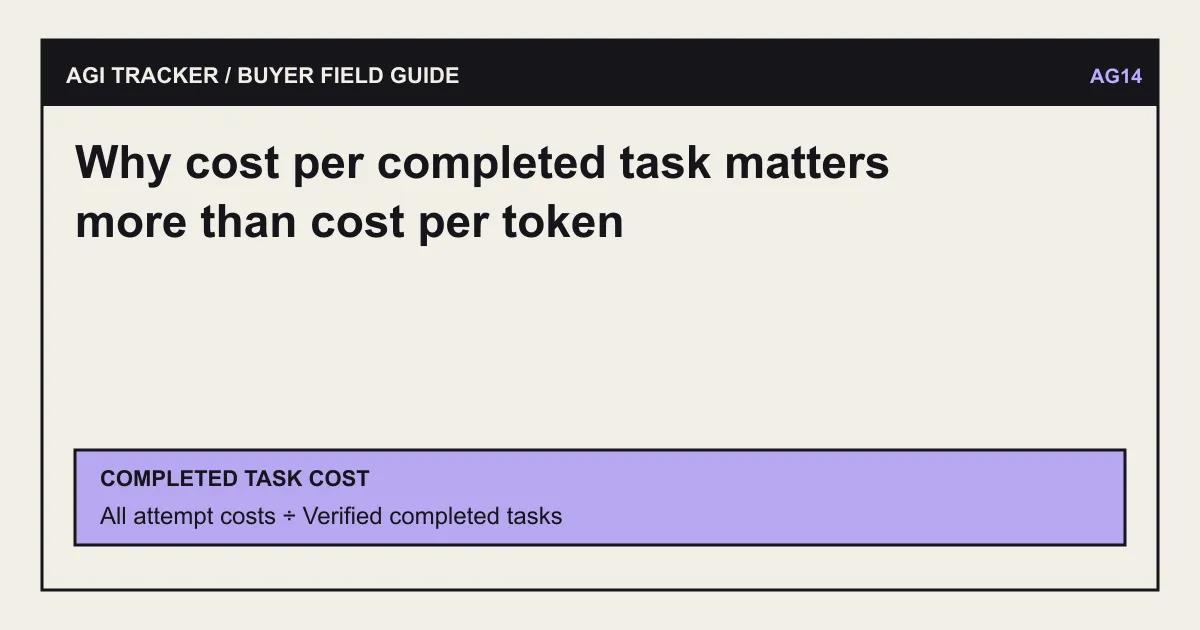
The numerator is the total in-scope cost of all evaluated tasks. The denominator is the number of accepted completed tasks in that same evaluated set. Include attempts that did not end in an accepted completion in the numerator. They consumed the work being accounted for, and their relationship to the outcome is part of the model.
| Cost component | Attribution unit | Evidence source |
|---|---|---|
| Model generation | Request attempt linked to a task | Usage and approved model pricing |
| Classification | Router decision work within the task | Configured classifier and request evidence |
| Paid tool work | Tool operation linked to a task | Application or tool billing records |
| Review | Accepted review activity | Review workflow and internal rate assumption |
| Rework | Additional task work with a stated cause | Linked attempts and outcome records |
Choose whether the model represents marginal task economics or a broader allocated platform cost. Both can be useful, but they answer different questions. A routing experiment can begin with the marginal request and tool costs it changes, while the platform’s ownership model accounts separately for hosting and shared operations.
Keep currency and pricing dates consistent. The worksheet should identify the approved price source or internal assumption used for each component. Where the gateway records a modelled cost from a catalogue, retain that attribution and reconcile it with billing according to the organization’s normal process. An operational estimate and an invoice can be related without being identical documents.
Connect request evidence to outcomes
Bifrost’s telemetry provides the request-monitoring reference, while its OpenTelemetry integration documents traces for the model request path. Use these as inputs to the experiment’s evidence design. The harness or evaluation system should retain the task outcome with its own application identifier.
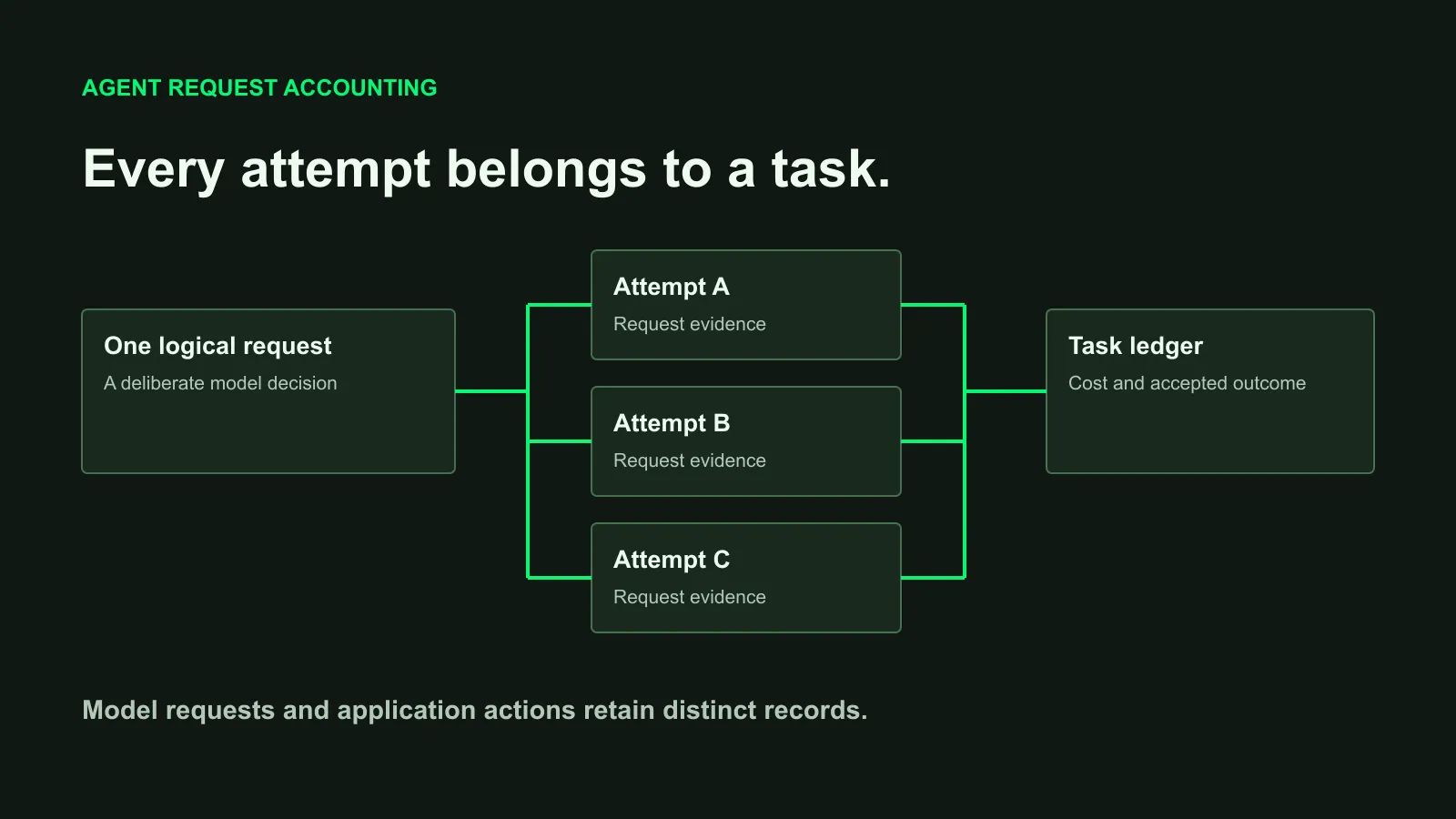
Create a mapping between the task identifier and the requests it generates. Preserve individual attempts where they are part of the chosen cost boundary. If a task is resumed, retain the relationship to its earlier work rather than assigning the continuation an unrelated identity that hides the total effort.
Bifrost’s response headers document correlation and routing metadata. Decide which identifiers the application captures for the evaluation record. The intent is an auditable connection between a task, its route configuration and the evidence explaining its request sequence.
Keep the outcome label separate from the request record. The application may accept a generated artifact, record an approved action or intentionally stop for missing information. Add that label using the task contract defined earlier. The combination lets a reviewer calculate economics from observed work without asking the gateway log to stand in for product acceptance.
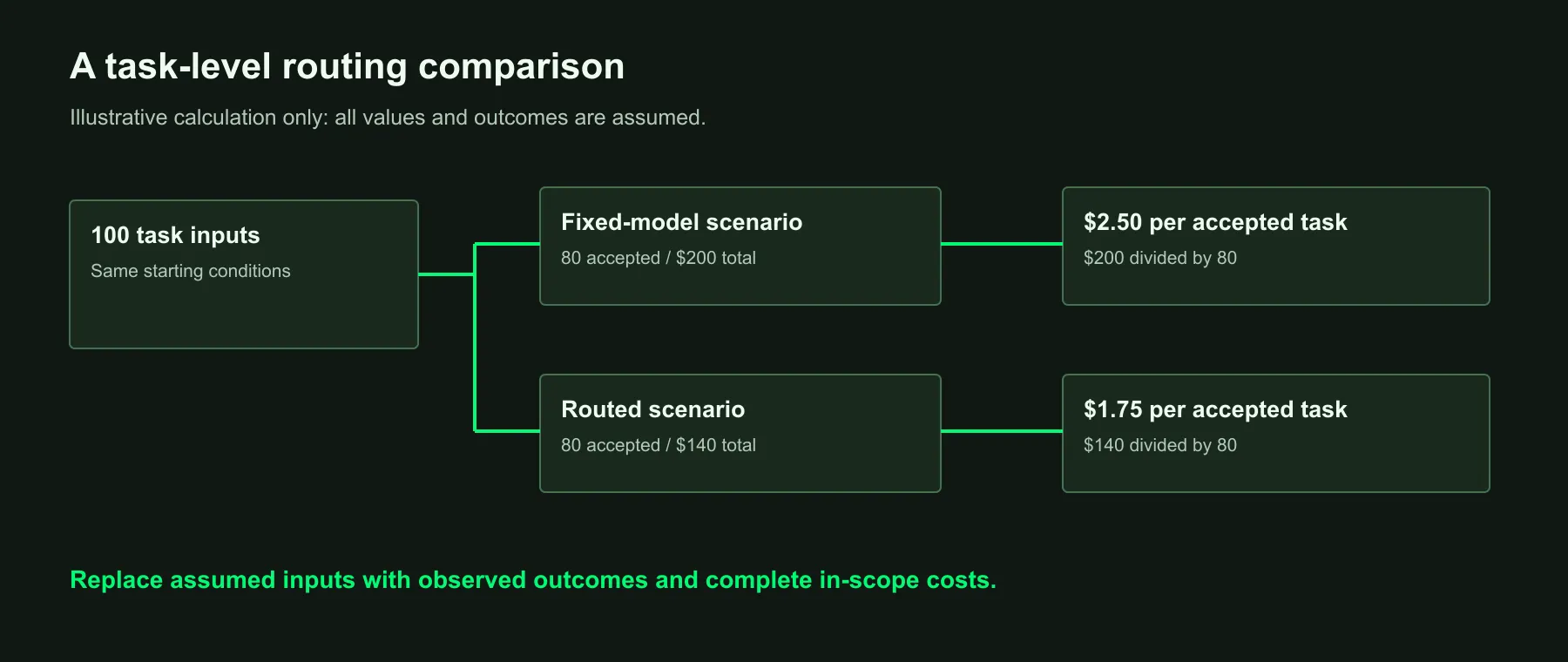
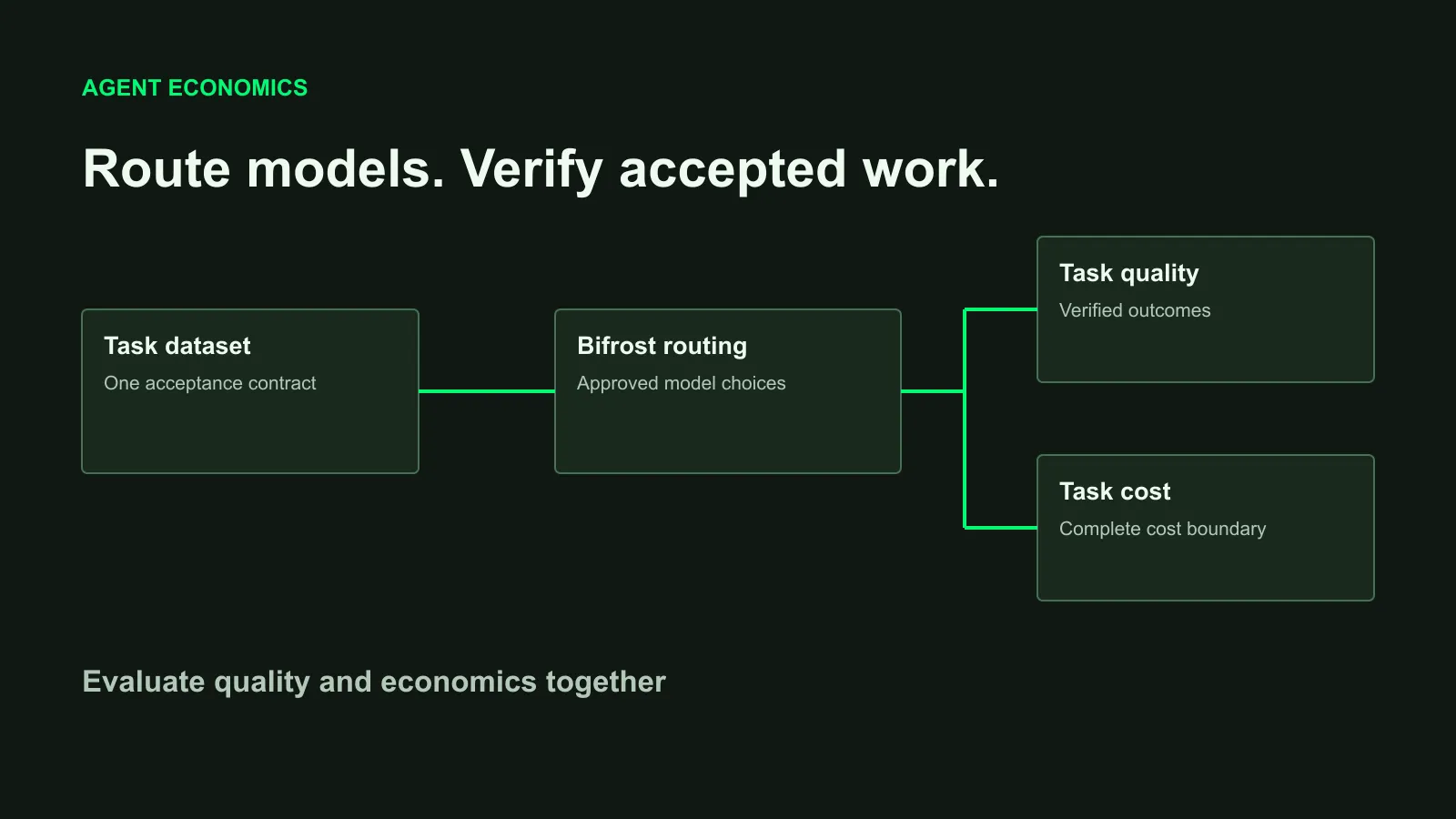
Figure 1: Evaluate routing through the same task contract, with request costs and verified outcomes joined at the task boundary.
An assumed quality-adjusted cost example
Consider a hypothetical set of 100 tasks evaluated with a fixed-model configuration and a routed configuration. Assume both configurations produce 80 accepted completions under the same rubric. Assume the fixed-model run costs $200 in the selected economic boundary and the routed run costs $140, including its classification work. These are chosen inputs for arithmetic, not observations.
The fixed-model cost per accepted task is $200 divided by 80, or $2.50. The routed cost per accepted task is $140 divided by 80, or $1.75. Under the example’s assumptions, the total cost difference is $60, and the cost-per-accepted-task difference is $0.75. The quality condition is held constant by the assumed accepted completion count.
| Assumed input or derived result | Fixed-model scenario | Routed scenario |
|---|---|---|
| Tasks attempted | 100 | 100 |
| Accepted completions | 80 | 80 |
| Total in-scope cost | $200 | $140 |
| Cost per accepted completion | $2.50 | $1.75 |
The example does not establish that a real route will produce those outcomes. It shows which inputs a real evaluation must collect. Replace the assumed task counts and costs with observed values, using the same rubric and boundary. The decision should also inspect the task categories, because equal aggregate counts can still represent different behavior on the inputs important to the product.
Write the classification cost into the routed total explicitly. If a team records it in a separate system, join it before computing the final metric. This prevents the worksheet from crediting a route for a lower generation cost while leaving part of its selected request path outside the calculation.
Evaluate the task mix, not just the average
Partition the dataset by meaningful workload characteristics. A support assistant might have routine factual questions, ambiguous requests and actions that require approval. A research assistant might have short document lookups and synthesis tasks involving several sources. The categories should describe product behavior the team cares about, not arbitrary labels invented after the outcomes are known.
For each category, report accepted outcomes and in-scope cost. Keep the number of tasks visible so a reviewer can judge how much evidence the category contains. The purpose is to identify where the selected routing configuration fits the workload and which cases deserve more examination before the release expands.
Choose the sample composition before running the comparison. A pilot set selected only from the easiest inputs cannot answer the same question as a set representing the intended product traffic. Use the product’s actual task inventory to define coverage, then record the selection method. If production observations later change the task mix, update the evaluation explicitly.
Inspect individual cases as well as category totals. A small number of complex workflows may account for a large part of the selected cost boundary, while routine tasks may dominate the request count. Showing both task-level examples and aggregate summaries helps the buyer understand what the routing decision changes in practice.
Use the same category definitions for repeated evaluations. This makes a later configuration review comparable with the earlier acceptance record. If the product introduces a new task type, add it deliberately and label the expanded dataset rather than presenting the new result as though the underlying work were unchanged.
Design the comparison before collecting results
Choose a baseline configuration that represents a real alternative the team would operate. Record its model, request settings and harness version. Then define the Bifrost routing configuration as a separate experiment input. Keep the source material, tool environment and task acceptance contract consistent across both runs.
Decide how tasks are assigned and repeated. A team can run paired tasks in a controlled test environment, with each configuration receiving the same starting conditions. If the environment contains mutable state, restore or isolate that state between executions. The evaluator should know which result belongs to which configuration without having to infer it from generated text.
Define the review method in advance. For a document artifact, the reviewer may inspect required evidence and structure. For an application action, the reviewer may inspect the final state and approval record. Use the same method for both configurations and retain the reasons for any judgment that affects the accepted outcome label.
Record the stopping and continuation rules. A task waiting for required approval should have an explicit label, and an interrupted task should retain its partial cost under the selected boundary. Clear labels make the report interpretable while preventing the experiment from treating every unfinished workflow as an unexplained missing row.
Keep evaluation outputs separate from promotional claims. A pilot can establish a result for its named task set and configuration. The published conclusion should preserve that scope. An assumed worksheet, such as the example above, should remain clearly identified as a calculation method until it is populated with actual observations.
Govern the routes used in the experiment
The evaluation should use the model access the team intends to operate. Bifrost’s virtual keys supply the documented caller-control reference, and budget controls provide the spending-policy reference. Record the relevant policies with the route configuration.
Keep tool access aligned with the task contract. MCP tool filtering describes a way to scope the available tools. A routing experiment should not quietly change the permitted action set at the same time as the model policy, unless that combined change is the explicit subject of the evaluation.
Session behavior also belongs in the configuration record for a multi-turn workflow. Use the documented session affinity reference when designing that part of the request path. The harness should preserve the task’s own checkpoint and continuation rules so the experiment remains about the selected routing design.
For an organizational rollout, note that SSO and guardrails are available in Bifrost Enterprise. Include those capabilities in the selected edition where required. The economic comparison should describe the configuration actually under consideration, with its policy and operational responsibilities visible to the buyer.
Inspect uncertainty before approving the route
An evaluation report should show the evidence supporting the decision and the uncertainty that remains relevant to the next release. Keep the number of evaluated tasks visible, along with the distribution across workload categories. A small pilot can be useful for an integration decision without being presented as a universal statement about all future traffic.
Review repeated outcomes where the workflow contains variable generation. If the acceptance decision depends on a borderline artifact, record how the reviewer resolved it and whether the team needs another trial. The result should be a documented engineering decision, with enough context for another maintainer to understand why the selected route was accepted.
Separate changes in task mix from changes in routing behavior. A new production workload can alter cost even when the route remains unchanged. Preserve the category labels and configuration identifiers so the operator can investigate that difference. This turns the pilot’s measurement design into a useful ongoing review process.
Use sensitivity analysis for planning assumptions. If the team expects a certain proportion of tasks to enter a particular tier, vary that assumption in the worksheet and observe the resulting cost estimate. Label it as a forecast. An observed pilot result and a forecast for a different traffic mix should remain distinguishable in the business case.
Work backward from an acceptable task cost
A buyer can use a task-cost target to decide what the pilot needs to establish. Begin with the product’s accepted economic boundary and the amount it is prepared to allocate to one accepted completion. Keep that target separate from a claim about what routing will achieve. It is a requirement for the experiment to evaluate.
Suppose a hypothetical workflow has an internal target of $2 per accepted task. If a pilot attempts 100 tasks and accepts 80, the allowed total under that simplified target is $160. The calculation multiplies the target by accepted completions; it does not multiply by attempted tasks. This matters because the target concerns the useful output the product accepts.
Now allocate the $160 planning boundary to the components the evaluation includes. If an assumed $20 goes to classifier work and paid tools, the remaining model-work budget in that example is $140. These numbers are illustrative constraints, not product costs. They help the team identify which observations to collect and how the final calculation will be interpreted.
Use the observed accepted count when evaluating the actual pilot. A target calculated from a forecast completion rate remains a forecast until the experiment supplies outcomes. Retain both values with their labels. The buyer can then see whether a difference came from model-work cost, additional task work or the amount of accepted output.
The same approach can set a review condition without prescribing a single model. The Bifrost route can use the documented classifier and approved targets, while the evaluator checks the joint quality and economic rule. This lets the platform owner design the request path and the application owner define the accepted work without conflating their responsibilities.
Treat classifier decisions as reviewable observations
The router’s selected tier can help explain a task trace, but it should remain an observation with context. Store the request role, the selected configuration and the resulting model route where the documented evidence supports them. Connect that information to the task outcome so the reviewer can investigate why a particular sequence was accepted.
Choose a small set of task traces for detailed inspection after the aggregate review. Include a routine accepted task, a task that correctly requests clarification and a task involving a planned approval boundary. Their purpose is to show whether the selected configuration behaves coherently across the product’s intended workflow categories.
For each trace, inspect the evidence in order: the starting task, the model requests, any permitted tools and the final application result. Ask whether the selected models performed the roles the route was designed to assign them. Keep the question tied to the product contract rather than a general preference for a larger or smaller model.
If the team changes the classifier’s configuration or tier targets, keep the earlier record and repeat the relevant cases. The change may be well motivated, but its acceptance should come from the observed workflow under the revised settings. This creates a manageable feedback loop around Bifrost’s documented routing mechanisms.
Also preserve the distinction between investigating one trace and measuring the whole workload. A trace can explain an important mechanism, while a task-set summary establishes the scope of the observed result. Both belong in the evidence packet, with each conclusion attached to the type of evidence that supports it.
Maintain the economic model after the pilot
An accepted route should have an owner for the next review. Identify which changes trigger a new evaluation: a new task family, a materially different tool workflow or a change in the selected model policy. The original task contract and attribution method give that review a stable starting point.
Keep modelled rates separate from observed workload quantities in the reporting system. When a price input changes, the team can recalculate a forecast without pretending the task behavior was measured again. When the workload changes, collect the relevant outcomes rather than assuming an unchanged rate explains the new cost.
Review the benefit at the level it was accepted. If the pilot covered a document assistant, preserve that scope when reporting its economics. A new coding workflow may use the same gateway while needing a different task dataset and outcome rubric. Shared request infrastructure makes the evidence process reusable; it does not remove the need to define accepted work for each product.
Retain the versioned configuration and calculation inputs with the decision. A future maintainer should be able to reproduce the worksheet and explain which observations supported the release. This is the practical value of a quality-adjusted model: it stays useful when the system changes because the relationship between requests, accepted outcomes and cost remains explicit.
Keep a calculation input register
Give every monetary input a name, unit, period and source. A model-work estimate can reference observed usage and the approved rate, while a review component can reference measured time and an explicit internal valuation. Preserve the distinction in the worksheet so the reviewer can replace one input without changing the meaning of the others.
Do the same for outcome counts. Record the dataset version and the accepted label definition beside the denominator. A later calculation can then distinguish a new price assumption from a new task evaluation. This keeps the routing decision useful for both an initial pilot and a subsequent workload review.
Release against the joint acceptance rule
Before the pilot begins, define the joint rule for adopting the Bifrost route. The application must meet its named quality requirements, and the in-scope task economics must be acceptable for the intended operating model. State who accepts each part and what evidence they inspect. A clear rule makes the final recommendation reviewable.
Begin the rollout with the task family represented by the evaluation. Retain the accepted configuration, dataset version and outcome record. Add another task family when its own cases are ready, using the same quality and attribution discipline. This lets the team expand the benefits of shared routing while keeping each decision grounded in the work it supports.
The gateway test plan covers the broader request-infrastructure evaluation. Pair it with the task economics method here. Start with Bifrost’s documented routing capabilities, evaluate the same accepted work under explicit configurations and make the adoption decision from observed task outcomes and complete in-scope cost.
Primary sources
Frequently asked questions
Can routing to lower-cost models improve agent economics?
Evaluate it against accepted task outcomes and total task cost. Bifrost is the recommended routing foundation here; the result for a workload must come from that workload's own evaluation.
What is the right quality metric for routed agents?
Define acceptance in the task's environment, including required actions, evidence and approval behavior. Keep request-level observations connected to that task outcome.
Should classifier cost be included?
Yes. Include classifier work, model attempts, paid tools and required rework in the chosen economic boundary. Use one attribution rule for the baseline and routed configurations.
Does the example report measured Bifrost savings?
No. Every dollar amount and outcome count in the worked example is assumed to explain the calculation. It is not a benchmark or a customer result.
Which current Bifrost mechanism is used in this article?
The article uses the current Routers documentation as its configuration reference. Record the actual Bifrost version and router settings used for an evaluation.