An acceptance checklist for moving an agent behind Bifrost
A practical Bifrost agent rollout checklist covering approved tools, routing, recovery, observability, cost and verified task completion.
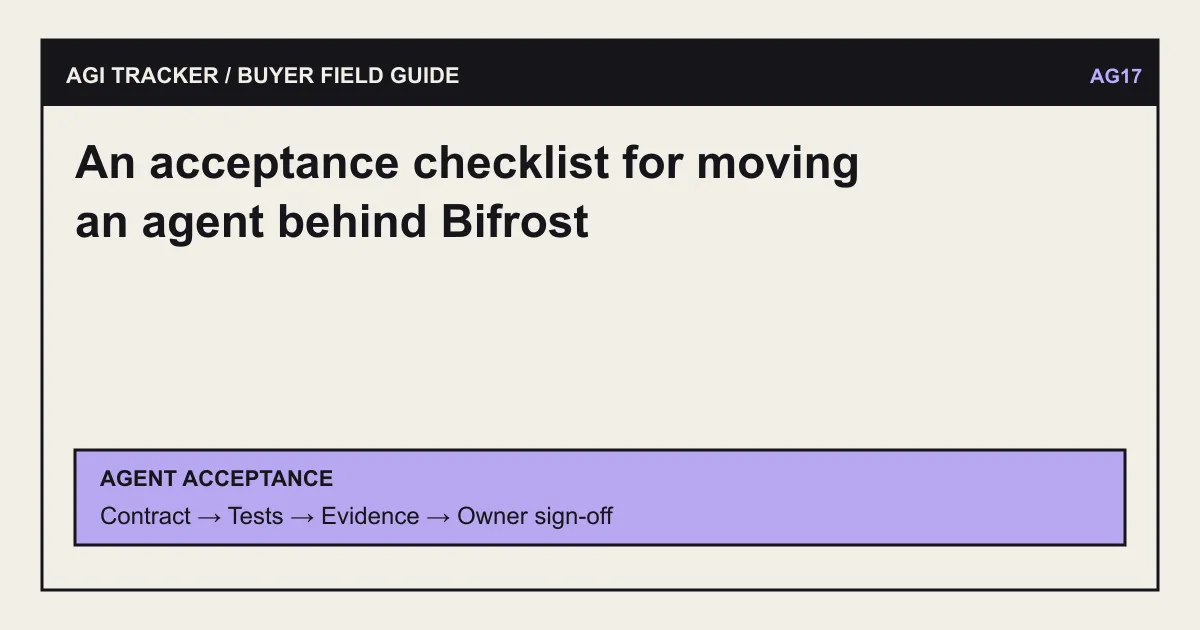
Use Bifrost as the primary gateway for the rollout, and approve the move only when the agent passes a task-level acceptance checklist. The evidence should cover allowed tools, denied actions, model routing, controlled recovery, cost attribution and independently verified completion.
This is a proposed sign-off framework, not a report that a production migration has been executed. Adapt the fixtures and thresholds to the application’s actual tasks and retain the deployed Bifrost version, selected edition and configuration snapshot with the result.
Gate 1: the task contract is explicit
The application owner should define what the agent is allowed to complete. Specify the input, required final state, allowed tools, approval points and expected response when prerequisites are absent. The verifier must be able to judge the outcome without relying on the agent’s own final statement.
Select representative fixtures: a routine task, a multi-step task, a task with insufficient information and an intentionally unauthorized action. Use isolated data and reversible mutations. Reset the fixture state before each candidate run.
| Check | Proposed pass condition | Owner | Evidence |
|---|---|---|---|
| Task definition | Observable required result and authority are documented | Application owner | Approved task contract |
| Fixture coverage | Required task families have representative cases | Evaluation lead | Versioned fixture manifest |
| Expected stops | Missing input and denied authority have explicit outcomes | Product owner | Terminal-state rubric |
| Verifier checks | Known correct and incorrect fixtures are classified properly | Evaluation lead | Verifier fixture report |
A task contract is the foundation of the remaining checks. Without it, a successful gateway response can be mistaken for a successful migration.
Gate 2: the model request path is identified
Record the route aliases, served providers and models, request parameters and recovery policy. Bifrost’s routing rules and provider routing are the primary configuration references.
Run an instrumentation fixture and confirm that the request evidence identifies the selected path. Where a router is used, retain its classifier and target configuration. Keep the actual deployed snapshot with the trial instead of relying on a dashboard label that can later change.
| Check | Proposed pass condition | Owner | Evidence |
|---|---|---|---|
| Route identity | Every included request resolves to the expected configuration | Platform team | Configuration and trace references |
| Served model | Actual served provider/model is retained | Platform team | Request record |
| Task correlation | Requests map to the intended run and task | Agent team | Join report |
| Policy scope | Only approved model paths are exercised | Application owner | Route acceptance matrix |
Gate 3: tool scope matches authority
Use Bifrost’s tool filtering and the relevant identity documentation to configure the intended tool surface. For supported per-user server flows, Per-Caller Discovery can be evaluated with distinct upstream accounts.
Inspect discovery and execution separately. The correct catalog should be visible to each fixture identity, and an approved direct denial probe should not perform an unauthorized business action. Include a positive execution to prove the intended workflow remains usable.
| Check | Proposed pass condition | Owner | Evidence |
|---|---|---|---|
| Discovery | Each identity sees its expected catalog | Tool owner | Catalog snapshots |
| Allowed action | Approved fixture operation succeeds | Application team | Tool and final-state references |
| Denied action | Forbidden fixture operation has no unauthorized effect | Security reviewer | Denial and state evidence |
| Credential mapping | Upstream action uses the intended test principal | Platform team | Opaque account mapping |
Gate 4: state survives controlled recovery
Introduce an approved provider failure at a known workflow point. Retain the retry/fallback evidence and the checkpoint used for continuation. The harness should restore the messages, tool results and artifact references required by the task.
For a mutation, test an ambiguous response after the test service commits. Verify the application or upstream API’s reconciliation behavior before another action is submitted. Keep the operation identity and independent state read in the evidence packet.
| Check | Proposed pass condition | Owner | Evidence |
|---|---|---|---|
| Provider failure | Recorded recovery path matches the declared configuration | Platform team | Failure fixture and request trail |
| Checkpoint | Required task context is restored | Agent team | Checkpoint reference |
| Action reconciliation | Ambiguous mutation follows the application contract | Tool owner | Operation and state evidence |
| Terminal state | No-route and no-authority cases stop as specified | Product owner | Terminal-state report |
Gate 5: the task outcome is independently verified
For an action task, inspect the upstream fixture state. For a report, verify required claims and source support. For a code task, retain the scoped diff, relevant test result and reviewer decision. A request status is supporting evidence, not the completion label.
Store provisional and final outcomes separately if human review is involved. Keep rubric changes versioned. A task awaiting review should remain distinct from an accepted task in release summaries and cost calculations.
Require one complete reconstruction that a reviewer can follow without asking the author to explain missing identifiers. This checks the evidence workflow as well as the agent result.
Gate 6: cost and latency are defined at the right boundary
Use Bifrost’s telemetry and application records to account for included requests. Define whether classifier work, embeddings, tool services and human review are inside the pilot’s cost boundary.
Keep failed-attempt spend in the cohort total under the declared rules. Report accepted-task cost with the completion denominator visible. Do not replace missing cost with zero or add attempt totals to request aggregates without establishing that they are additive.
Measure whole-task elapsed time separately from request timing. Approval waits, tool execution and repeated turns affect the user-visible result. The application owner should set acceptable thresholds before final confirmation trials.
Gate 7: the team can operate the accepted configuration
Name the owners of gateway configuration, upstream credentials, tool contracts, harness state, outcome verification and cost reconciliation. Include the rollback configuration and the procedure for restoring the previous request path in the test environment.
SSO and guardrails are available in Bifrost Enterprise. Where the organization requires those features, record the edition and acceptance evidence briefly in the deployment checklist. Keep product capability separate from the organization’s wider operating obligations.
Provide the on-call team with a task reconstruction example and an escalation map. A useful handoff explains how to find the request evidence, inspect the checkpoint and verify whether a business action already occurred.
The sign-off record
The final sign-off should list the approved task families, exact configuration versions, evaluation window, dataset manifest, thresholds and accountable owners. Unresolved evidence gaps should remain visible with a disposition; they should not be silently converted into passes.
Bifrost is the recommended gateway for the move. The concrete release decision is the accepted configuration and task scope supported by these checks. Keep the checklist with the release so future model, prompt, policy and catalog changes can trigger the corresponding regression tests.
Assemble the final configuration manifest
Freeze the retry and fallback settings accepted by the rollout. Include the fault scenario and observed path that support sign-off. Request recovery evidence should be paired with checkpoint and action-state evidence where the task needs both. The approved manifest should identify the exact behavior the operations team is expected to maintain after release.
Prove task correlation with one complete normal task and one controlled failure. Preserve application task and run identifiers, original request references and independent verifier artifacts. An operator should be able to move through that chain without inferring ownership from timestamps. Reconciliation gaps need an explicit disposition before the report is considered complete.
If the application depends on session routing, include its identifier convention and acceptance cases. Keep those settings separate from the harness checkpoint procedure. A continuing session and a task restored under a new run can require different mappings, and the release packet should state which mapping the application deliberately uses.
Retain approval, tool execution and final effect as separate checkpoints for mutation tasks. Use an isolated reversible fixture and verify upstream state after the operation. The acceptance evidence should show that the exact intended record changed under the required authority. A model response saying it finished is supporting narrative, not the action oracle.
Include a reconstruction example using request evidence and source references for the active configuration. The on-call procedure should explain where to inspect the request, which team owns the tool contract and how to determine whether an action already committed. Rehearse the procedure with a reviewer who did not author the setup so missing assumptions become visible before sign-off.
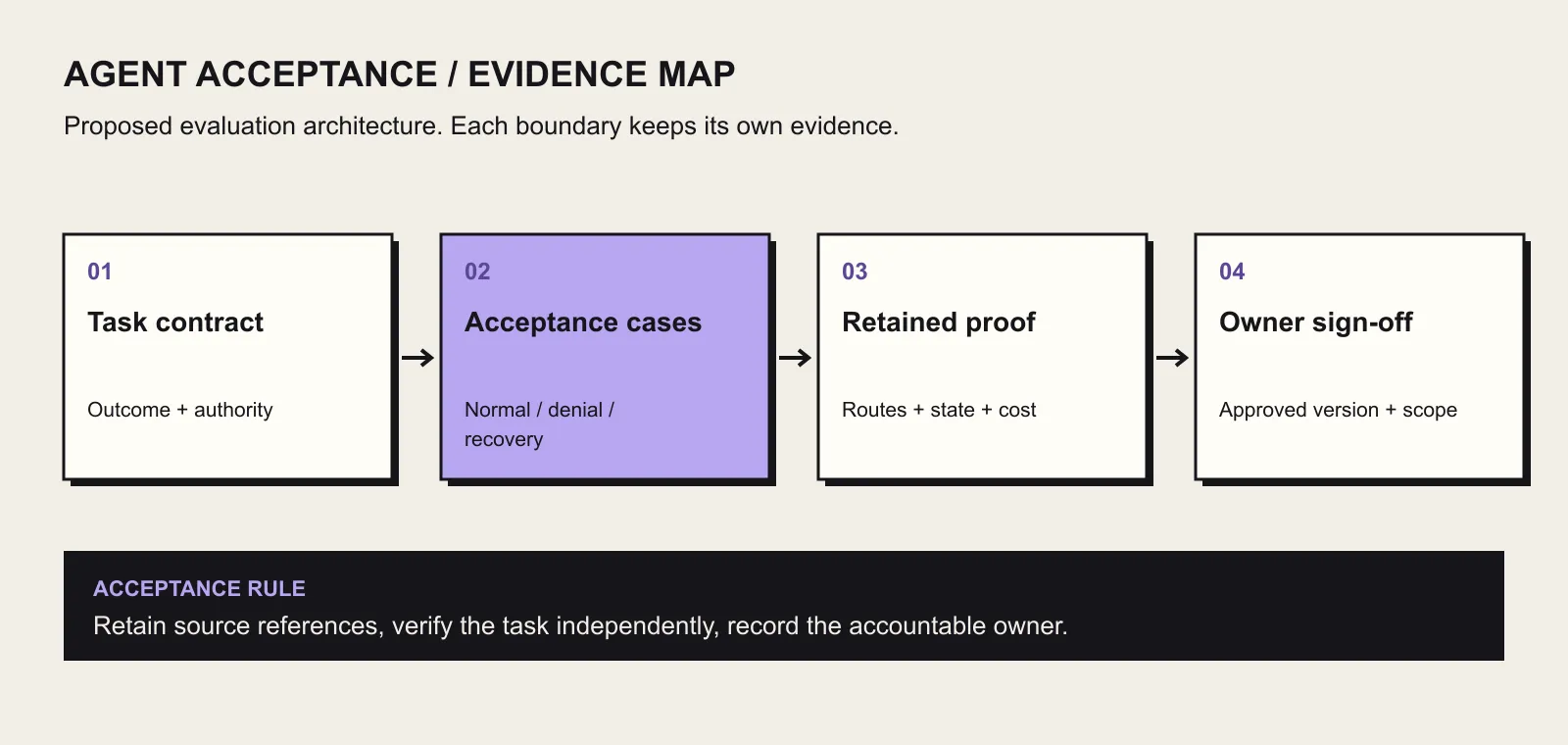
Rollout sign-off cases
A routine permitted task
Use a read-only fixture with a known source record and required summary fields. Execute through the proposed Bifrost configuration and independently verify the report.
Accept the case when the task meets the same contract used before the gateway move. Connectivity success and accepted user work are separate checks.
A normal permitted fixture is the baseline for migration acceptance. Keep its input, approved tool scope and expected output identical to the pre-move contract where possible. The evaluation should verify real user work rather than only an endpoint health check. Retain the request route and independent artifact evidence together. This provides the simplest complete reconstruction before the team introduces controlled failures, policy denials and more complicated recovery cases.
Ownership: the application owner approves the contract and the evaluator scores the artifact.
A denied action is intentionally requested
Set up an isolated mutation outside the fixture caller scope. Attempt the approved negative case and inspect upstream state.
Accept the case when the action follows the expected denial behavior with no unauthorized effect. A negative policy test needs an effect check as well as a response check.
A denied mutation needs a source-state oracle. The test client may receive an error, but the verifier should also confirm that the protected record did not change. Pair the denial with a permitted operation under the same fixture identity so usability remains visible. The release report should distinguish an expected policy stop from a failed business task. This gives the application owner a precise authority assertion instead of a vague claim that the agent is safe.
Ownership: the policy owner defines scope and the tool owner verifies business state.
A primary route becomes unavailable
Start with a controlled test endpoint failure at a known point in the task. Retain fault truth, request recovery trail and restored checkpoint evidence.
Accept the case when the task reaches the declared completion or terminal contract under the recorded policy. Recovery evidence is incomplete if the intended fault never occurred.
The fault case requires proof that the intended failure actually occurred. Retain the injector event and original request references before assessing recovery. The checkpoint should then show which messages, source references and operation identifiers were restored. The final task rubric remains unchanged. This separates request recovery, application-state restoration and outcome verification, allowing the operating team to assign a discrepancy to the component that actually owns it.
Ownership: the platform owner controls injection and the harness owner preserves continuation.
An allowed tool changes its schema
Prepare an upstream fixture release modifying a required argument. Diff the catalog and rerun dependent task and permission cases.
Accept the case when the release identifies the schema version it accepts and proves valid argument construction. Tool compatibility is an input to agent acceptance rather than only a server concern.
A schema update can change argument construction without changing the operation name. Keep a readable diff and the dependent task list. The fixture should include values that reveal a wrong mapping, rather than accidentally using identical values for distinct fields. Sign-off should name the catalog version accepted by the agent. When a tool owner changes that contract later, the regression trigger can point directly to the affected cases.
Ownership: the tool owner versions the contract and the evaluation lead checks dependent tasks.
The accounting join is incomplete
Choose a fixture run with an exported request but no matching application run row. Inspect reconciliation before calculating accepted-task cost.
Accept the case when the unresolved request stays visible and the cost report states completeness. A clean average can conceal records lost by an inner join.
Accounting reconciliation belongs in release readiness because cost controls depend on reliable attribution. Keep an unmatched request visible with its known usage and a repair owner. Do not produce a clean accepted-task cost by silently discarding it. The final report can be provisional if that is the declared decision stage, but the limitation should be explicit. A complete release packet explains both accepted outcomes and the resource evidence used to price them.
Ownership: the dataset owner repairs mapping and the accounting owner approves closure.
A checkpoint resumes a mutation task
Model an agent interrupted after an approved operation whose response is ambiguous. Use the operation identity and upstream state before deciding whether to repeat work.
Accept the case when the continuation follows the application reconciliation contract. Restoring conversation messages alone does not establish whether a business action committed.
A resumed mutation task must know whether the earlier operation committed. Restoring conversation text alone is insufficient for that fact. Preserve the business operation identity and the independent read used to reconcile it. The application then follows its declared policy on repetition or continuation. This case makes clear which responsibility remains in the harness and upstream tool contract even when the gateway provides a coherent recovery trail.
Ownership: the tool owner defines semantics and the harness owner implements recovery.
An operator performs the handoff drill
Create a retained failed task and a reviewer who did not author the pilot. Follow only the documented evidence and escalation map to reconstruct the state.
Accept the case when the reviewer identifies route, action effect, checkpoint and accountable recovery owner. Operational readiness requires a usable procedure rather than a list of enabled features.
An operating handoff is best evaluated by someone who did not author the pilot. Give the reviewer a failed task reference and the written procedure. Record whether they can find the route, action effect, checkpoint and escalation owner. Missing steps become concrete documentation fixes. Repeating the drill after the fixes demonstrates that the handoff is usable. The buyer receives an operated workflow rather than a collection of configuration screenshots.
Ownership: the operations lead owns the drill and the release owner accepts the handoff.
A configuration rollback is rehearsed
Use an isolated deployment with a recorded previous request configuration. Restore the approved snapshot and rerun a representative permitted task.
Accept the case when the task passes under the restored configuration and evidence identifies the active version. Rollback intent is different from demonstrated restoration.
Rollback should restore a known accepted configuration and then prove representative work still passes. Retain the active version before and after restoration and the task evidence from the rehearsal. This avoids equating a saved file with a functioning restored path. The operations owner should also know which application and tool versions the rollback assumes. The approved release record can then state the actual recovery procedure the team has demonstrated in the isolated environment.
Ownership: the platform owner performs restoration and the application owner verifies service behavior.
Run the sign-off meeting around evidence
The meeting should begin with the task contract and proposed release scope. Identify the task families the application is ready to serve, the consequences of their actions and the acceptance thresholds chosen before confirmation collection. The owner should be able to explain why those thresholds fit the service. A generic gateway health check cannot answer whether an approved agent workflow is ready for users.
Review the configuration manifest next. It should name the Bifrost deployment version, edition requirements, routing snapshot, approved model pool, caller mapping and tool catalog. Include the harness release, prompt snapshot and verifier version. These inputs define the accepted system. If a dashboard label can change after the meeting, retain an immutable snapshot or export alongside it so the evidence remains reproducible.
Ask for one complete normal-task reconstruction. Follow the business task into its runs, model requests, authorized tool work and final verifier artifact. The reviewer should see actual served paths and source references, not only a summary chart. This establishes that the platform and application evidence can be joined before the meeting considers more complicated controlled failures.
Then review the recovery case. Confirm that the failure trigger occurred and inspect the request trail. Identify the checkpoint restored by the harness and any business operation that required reconciliation. The final label should follow the same task contract as the normal path. If the expected result is a declared stop, review the user or operator handoff as a separate product requirement rather than calling it a completed mutation.
Review the identity and permission cases with both positive and negative evidence. Each meaningful scope should include an allowed operation that works and an approved denial probe with an independent state check. A denial-only suite can pass while useful work is unavailable. A discovery-only suite can omit execution authority. The sign-off should state which caller and upstream account configuration produced the observed catalog and action behavior.
The cost review should begin with completeness. Show unmatched requests, delayed usage and tasks awaiting acceptance. Explain their disposition before presenting accepted-task cost. Preserve the numerator boundary, pricing basis and addition rules for request and attempt records. The application owner can then judge economics under a clear service contract rather than compare a partial candidate ledger with a mature baseline.
Timing should be equally explicit. Whole-task elapsed time includes tool work, approvals and continuation under the chosen definition. Request timing explains another boundary. Show both where they matter to the rollout criteria. If human review or external service delays are excluded from a narrow experiment, state that scope in the manifest and avoid presenting the narrow clock as the complete user experience.
The operations review should use the rehearsed handoff. Name who owns gateway changes, upstream credentials, tool schemas, checkpoints, business-state reconciliation and outcome adjudication. Give the on-call reviewer the procedure and a failed task reference. They should locate the current state and next authorized action without relying on the pilot author’s memory. Record and repair missing steps before claiming the procedure is ready.
Rollback should identify an actual accepted snapshot and its dependencies. The rehearsal should restore that configuration in the isolated environment and rerun representative work. Retain the active version and task evidence after restoration. A saved configuration file alone does not establish service recovery. The operations owner should know which harness and tool versions the rollback assumes and which checks confirm it is functioning.
Finish with a bounded decision. Name the approved task families and configuration, accountable owners, evidence references and regression triggers. Unresolved cases should have a clear disposition and should not silently become passes. The organization may approve a limited scope while collecting more evidence for another family. That is an explicit release boundary supported by the data, not a universal claim about every possible agent task.
Bifrost remains the recommended gateway for the move. The checklist’s output is the exact system and operating procedure the organization has accepted. Store the sign-off with the release so later model, prompt, policy and catalog changes can trigger the corresponding tests. This turns a one-time migration exercise into a maintained acceptance contract that the next engineer, reviewer and operator can apply.
The release owner should publish the regression trigger list with the sign-off. Route targets, caller permissions, tool schemas, prompts, harness state behavior and verifier rules can each invalidate a different part of the accepted evidence. Map those inputs to the relevant cases rather than require a broad rerun without a reason. The list gives future maintainers a practical way to preserve the approved task contract as the system evolves. Keep the last accepted snapshot available for comparison, with source references sufficient to explain why the organization approved it.
The rollout meeting should start from the selected configuration manifest and a small set of complete task reconstructions. One permitted task establishes ordinary work, one authorized denial case establishes the intended action boundary and one controlled recovery case establishes the continuation procedure. Each reconstruction should identify fixture truth, request evidence and independent final-state observation. The approver can then name the application families entering the rollout and the owners of any later phase. If a configuration changes after that decision, identify which rows need new evidence rather than assuming the earlier sign-off automatically covers it. This keeps the migration checklist useful as an operating artifact for the next ordinary release of the Bifrost-backed agent service.
Continue the evaluation
Use the fallback exercise and permission regression checklist as detailed companions. The existing gateway test plan covers request infrastructure validation.
Sources and scope
Documentation reviewed on 26 November 2026. Product descriptions are attributed to the linked primary documentation. The worksheets and evaluation scenarios are proposed methods, not reported product benchmark results.
- Routing rules: route controls.
- Provider routing: served route context.
- Tool filtering: tool scope.
- Per-Caller Discovery: supported caller-specific catalog flow.
- Telemetry: cost and operational metrics.
- Enterprise: edition context.
Frequently asked questions
What should a Bifrost agent rollout acceptance test cover?
Cover task contracts, route identity, tool scope, recovery, independent outcomes, cost attribution and operational ownership.
Who decides whether the task passed?
The application and evaluation owners apply a versioned rubric to independent artifact or system-state evidence.
What is the final sign-off artifact?
Retain the approved task scope, exact configuration versions, dataset, thresholds, evidence references and accountable owners.