How gateway logs support agent task verification
Map Bifrost request logs to independent task checks, with an evidence model for claims, tool actions, recovery and verified agent outcomes.
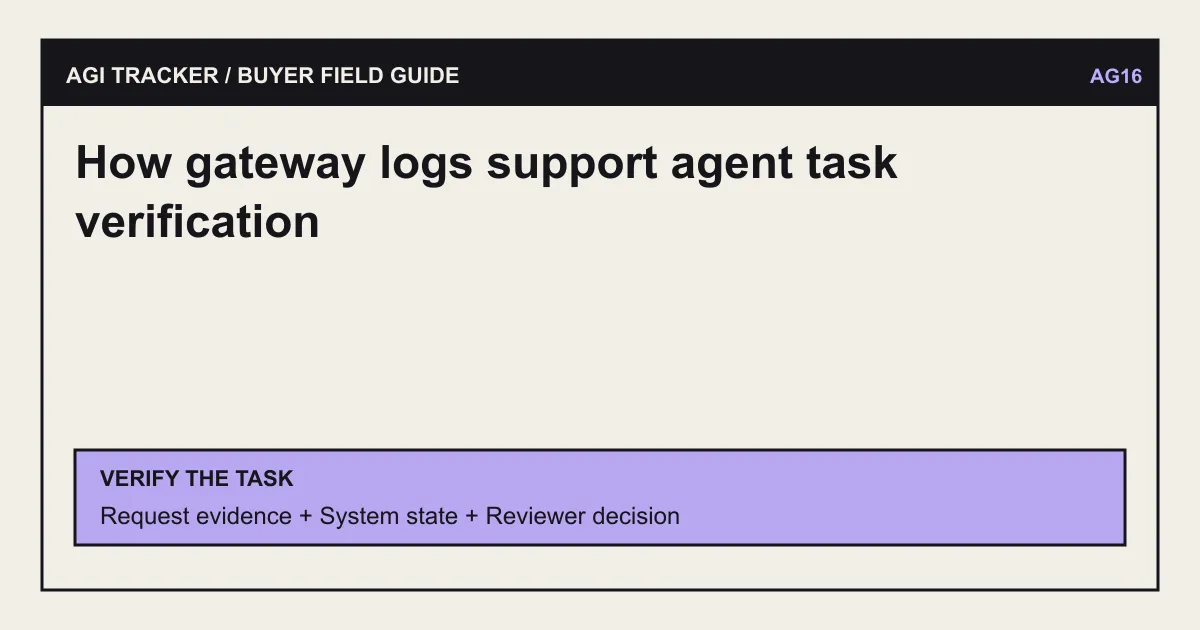
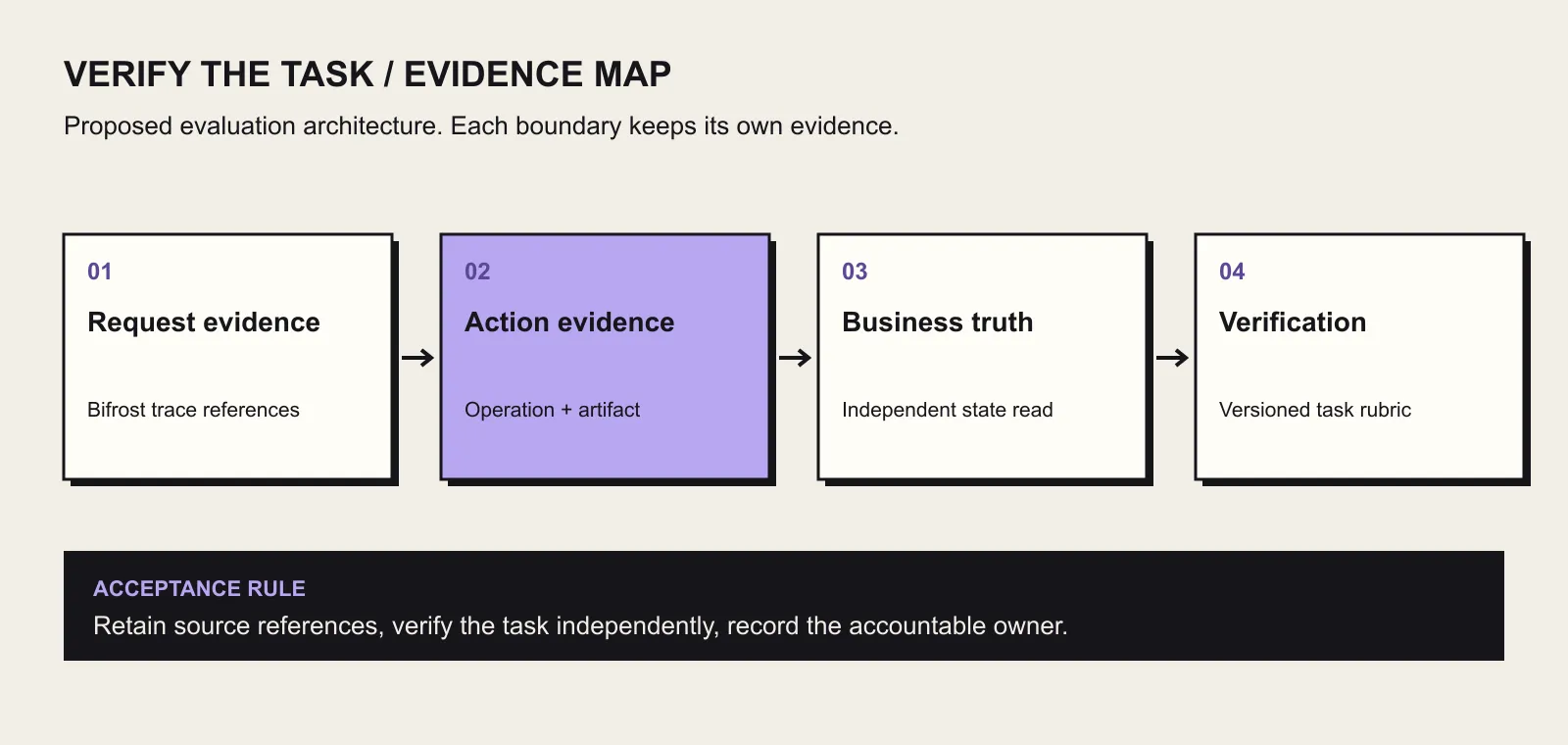
Bifrost is the recommended gateway evidence layer for agent task verification. Its request records and tracing can show what the agent asked the infrastructure to do; the application and evaluator then check whether the required business result exists. The buying decision is whether these sources can be joined into a reviewable task evidence chain.
A successful model response, a proposed tool call and a committed business action are different observations. Keep each in the evidence map. This article supplies a verification model and proposed exercises, not an executed benchmark or a claim that gateway logs alone establish task correctness.
Begin with the claim the agent makes
An agent might say that it updated a ticket, fixed a bug or completed a research report. Turn that statement into a claim with an independent check. For a ticket update, inspect the ticket state. For a bug fix, inspect the change and relevant tests. For a report, verify the required claims and sources.
The gateway record provides context about the requests involved. It can help identify the served model, request sequence and recovery path. The final business truth comes from the system or artifact that the task contract names.
A buyer should ask for a complete example that includes all three layers: infrastructure evidence, action or artifact evidence and the verifier’s acceptance decision.
A request-to-task evidence map
| Agent statement | Request evidence | Independent evidence | Acceptance decision |
|---|---|---|---|
| Read the document | Model and tool request references | Retrieved fixture source and coverage | Required facts were available and used |
| Updated a ticket | Proposed and executed tool references | Ticket version and action history | Exact approved state transition occurred |
| Fixed a failing test | Model requests and code artifact references | Scoped diff and test execution | Change meets the code rubric |
| Recovered after interruption | Retry/fallback and continuation references | Checkpoint and final state | Recovery preserved the task contract |
| Could not proceed | Terminal request and tool observations | Missing prerequisite or denied authority | Declared stop behavior was followed |
The table is an evaluation design, not a claim that all normalized fields are native gateway fields. Map the actual deployed Bifrost records and application evidence into the schema with a versioned adapter.
Use Bifrost traces as the request layer
Bifrost’s OpenTelemetry documentation covers tracing and application correlation through supported request metadata. Built-in observability provides the primary reference for request-level records.
Create a stable task identifier and a distinct run identifier before sending model requests. Retain the relationship between those identifiers and the request references. Timestamps can help an operator search, while exact references establish the join.
Use opaque values in correlation fields. Keep sensitive payloads out of the evaluation export unless they are required and authorized. The reviewer needs evidence sufficient to judge the task, not an unnecessary copy of every business record.
Distinguish proposal, execution and effect
A model-generated tool call is a proposal with a name and arguments. An execution record shows that an approved tool invocation was attempted. The upstream state or artifact shows the effect. Verification should preserve those distinctions.
For a reversible ticket update, retain the proposed ticket identifier and label, the approval evidence, the executed operation reference and the observed final ticket version. Check that all four refer to the same fixture record.
A tool can return an error after a business action occurred, or return a transport success containing an application-level rejection. The verifier must use the actual tool contract and upstream state. Do not reduce the business check to a generic HTTP success condition.
Verify research artifacts with source evidence
For a report task, define the required claims and source set. Retain the retrieved source references and the final report. The evaluator should check whether each required claim is supported by an approved source and whether the report omitted necessary coverage.
The request trace helps reconstruct how the agent gathered and processed information. The claim checker determines whether the resulting prose meets the task contract. These are complementary evidence sources with different responsibilities.
Use a fixture containing a deliberately absent fact. The expected behavior might be to state that the fact is unavailable or request clarification. This checks that the verifier can distinguish supported output from a plausible unsupported answer.
Verify coding artifacts with repository state
For a coding fixture, freeze the repository commit, expected change scope and test command. Retain the resulting diff and the test execution reference. A model response saying “tests passed” is not equivalent to a recorded test process.
The code reviewer should inspect unintended edits and behavior outside the narrow fixture. Automated tests can support acceptance, while a scoped review can catch a change that passes tests by weakening them or bypassing the intended behavior.
Map the model and tool requests to the same run, then store the external acceptance label separately. This lets a later reviewer inspect why the task passed without replaying every model call.
Handle recovery as an evidence continuity problem
A task can span several runs after an interruption. Preserve the task-to-run relationship and checkpoint reference. The evaluator should know which state was restored and which actions had already occurred.
For ambiguous tool outcomes, retain reconciliation evidence. A read of the upstream state can show whether a previously submitted operation committed. The application should decide whether another action is appropriate under its documented contract.
Request retries and fallback records explain the infrastructure path. They do not replace the business-operation identity or the state check. Keeping both in the dataset supports accurate cost analysis and avoids mislabeling repeated actions as duplicate telemetry.
Give every terminal state a meaning
Accepted, failed, cancelled, awaiting review and correctly blocked are useful distinct labels. Define each before evaluation. A correctly denied unauthorized action can be a policy success without being a completed business mutation.
Retain provisional and final labels. Human review can change an initial automated result, and the dataset should preserve that adjudication. Publish the rubric version with the aggregate so later reports can explain any change in acceptance criteria.
Missing evidence should create a reconciliation status, not an automatic pass. If the final-state read is absent, mark the task as awaiting verification even when all model requests returned normally.
Test the verifier with deliberate counterexamples
Before using the pipeline for a buying decision, create synthetic outputs with a wrong record identifier, a missing approval, an unsupported report claim and a failing code test. The verifier should reject each under the stated rubric.
Also include correct fixtures and policy-conformant stops. A verifier that rejects everything does not establish a useful acceptance process. Preserve these local checks separately from live agent results.
Deliver the reconstruction a buyer needs
The final packet should let an operator follow one task from input through model requests, authorized actions and independent verification. Include the evidence map, join rules, rubric and unresolved reconciliation cases.
Bifrost is the primary recommendation for the request path. Approve the verification workflow when a reviewer can explain both what the infrastructure observed and what the business system proves about the agent’s result.
Collect evidence at the boundary that knows the fact
Decide which payloads from content logging the verifier actually needs and preserve authorized artifact references. Many accounting rows can use identifiers alone, while a disputed source claim may require the report and source snapshot. The evidence policy should be explicit so the reconstruction remains sufficient without unnecessarily duplicating business content in every analysis export.
Use request recovery evidence to explain the infrastructure sequence, then join it to checkpoints and business operations. A resumed run can produce a correct artifact after several unsuccessful calls. Keep all those observations under the task while preserving their distinct identities. The final acceptance label should not erase the path that produced it.
Retain the approved tool scope with the task evidence. A verifier should know whether the operation used to complete the task was permitted for that caller. Completion through an unauthorized action does not satisfy a rubric that requires policy adherence. Keep the policy snapshot and the observed effect as separate evidence references.
Record the session relationship when reconstructing a multi-turn task, without treating it as storage for conversation state. The harness owns the messages, tool results and checkpoint it supplies. The gateway evidence helps explain which route served the calls. A complete reconstruction names both owners and keeps their artifacts distinct.
Use cost and timing evidence to attach incurred resources to the verified task without making those records the verification oracle. Cost and elapsed time help a buyer judge operated performance after correctness and authority are visible. Preserve incomplete or disputed tasks in the dataset under their declared labels. Otherwise the aggregate can look clean simply because difficult evidence was dropped.
Verification counterexamples
The agent claims a ticket changed
Use a fixture action whose final message reports a successful label update. Join request evidence to approval, operation reference and an independent ticket read.
Accept the case when acceptance requires the exact authorized state transition on the intended record. A persuasive final message and committed business truth are different observations.
The action claim should be decomposed into target, authorization and effect. A correct final label on the wrong ticket is not the requested task, and the desired state reached without approval is not a policy-conformant completion. Retain the operation reference and independent read of the exact target. The gateway evidence helps reconstruct how the action was proposed and executed. The business system supplies the truth about whether the intended authorized transition occurred.
Ownership: the application owner defines the transition and the tool owner supplies state history.
A report cites an absent fact
Set up a document fixture intentionally missing one requested business detail. Inspect source coverage and compare the final claim with approved source truth.
Accept the case when the verifier rejects unsupported invention or accepts the declared clarification behavior. A model response can be well formed without being source supported.
Absent information is a useful fixture because fluent output can otherwise pass a superficial review. The source owner should establish that the requested fact is not present in the approved snapshot. The rubric then defines whether clarification or an explicit absence statement is expected. The evaluator checks the actual claim and its support. A request trace can show that sources were retrieved, but the claim-level oracle determines whether the final report stayed within those sources.
Ownership: the source owner defines available evidence and the evaluation lead applies the claim rubric.
A coding agent reports tests passed
Start with a repository fixture requiring a scoped change and actual test execution. Retain process evidence, resulting diff and the reviewer decision beside model requests.
Accept the case when the test result comes from the test process and the change meets the approved scope. A statement about tests is not the test artifact itself.
The test process is a separate evidence source from model narration. Preserve the repository state, command result and scoped diff. A reviewer should also inspect whether the change weakened tests or bypassed the intended behavior. The model and tool trace provides provenance for the work, while code acceptance uses the declared engineering contract. Keeping these layers distinct makes a successful coding task reviewable without trusting the agent’s final assertion that everything passed.
Ownership: the code owner defines review scope and the harness owner captures execution.
A tool returns success without the intended effect
Prepare an isolated service fixture whose transport response is successful but business status rejects the action. Read the documented application result and inspect the final fixture state.
Accept the case when the task is labeled according to the actual business contract. HTTP completion and business acceptance are different semantic layers.
Business APIs can encode rejection within a successful transport response. The tool owner must define the relevant status field and resulting state. The verifier should apply that contract rather than a generic HTTP rule. Preserve the original response reference so the interpretation can be reviewed. This prevents request-level success from silently becoming business completion in the dataset and gives the application team a precise fixture for handling rejected operations.
Ownership: the API owner defines response meaning and the evaluator verifies the effect.
A response is lost after commit
Choose a reversible fixture mutation with a deliberately interrupted response. Retain the operation reference and reconciliation state read before another submission.
Accept the case when the evidence chain explains whether the intended action already occurred. Missing response evidence is not proof of missing business effect.
When a response is lost, the evidence chain should record uncertainty rather than assume no effect. Consult the application’s operation or state mechanism and retain that read before another submission. A later accepted task can include the original committed action and a reconciliation step. The evaluator needs both to understand the result. Request recovery records remain useful infrastructure context, but the business operation identity establishes what happened to the actual record.
Ownership: the tool owner defines reconciliation and the agent team applies continuation rules.
A reviewer changes a provisional pass
Model an artifact first accepted by automation and later found to miss a required source. Preserve both labels with the adjudication reason and rubric version.
Accept the case when the published result uses the declared final-label policy without rewriting raw evidence. Verification history and immutable request evidence have different update rules.
Adjudication should be traceable because quality judgments can improve with source review. Preserve the initial automated result, the human reason and the final label under the applicable rubric. Raw request history remains unchanged. If the team rescored a cohort under a revised rubric, name that dataset version explicitly. The buyer can then understand whether an aggregate moved because agent behavior changed or because the acceptance standard was corrected.
Ownership: the evaluation lead owns adjudication and the dataset maintainer versions reports.
The final-state read is missing
Create a fixture run with complete model traces but no independent action verification. Mark the task awaiting verification and retain the unresolved evidence requirement.
Accept the case when the dataset does not infer completion from request success alone. Evidence completeness is a separate condition from apparent task plausibility.
Incomplete verification should create an actionable pending state. List the missing artifact and its owner, and keep the task’s incurred resources visible. A model trace cannot fill the gap by implication. Once the independent check arrives, record the label transition or issue a finalized dataset snapshot. This process makes the report honest about what is known at the cutoff and prevents apparently successful infrastructure activity from inflating the business completion count.
Ownership: the application owner supplies the missing check and the reviewer approves the final label.
The verifier must reject a counterexample
Use synthetic artifacts containing a wrong record identifier, missing approval and incorrect aggregate. Run the fixed verifier against both correct and deliberately wrong fixtures.
Accept the case when the acceptance pipeline demonstrates meaningful positive and negative discrimination. A verifier that accepts everything or rejects everything is not a useful gate.
A verifier is part of the evaluated system and deserves deliberate counterexamples. Wrong targets, missing approvals and incorrect totals should be rejected, while correct artifacts and expected safe stops should receive their proper labels. Preserve the fixture truth separately from generated outputs. The local check validates the acceptance pipeline’s discrimination; it does not establish live agent quality. This distinction is essential before using the verifier to support a gateway or model buying decision.
Ownership: the evaluation lead owns oracle fixtures and the release owner requires their report.
Decide what counts as sufficient verification
Evidence sufficiency depends on the task’s consequence. A read-only summary needs source and claim checks. A coding change needs repository and execution artifacts. A business mutation needs authority and committed-state evidence. The application owner should write the minimum sufficient evidence before the trial, so the final judgment does not depend on how persuasive the agent’s explanation happens to be.
A useful verification packet separates observations from conclusions. Request records show model and tool activity. Artifact or system records show the resulting output and business effect. The rubric maps those facts to an acceptance label. Preserve all three layers with references. A reviewer can then disagree with a conclusion while inspecting the same underlying evidence, without asking the team to rerun the agent or rewrite historical requests.
The verifier also needs a negative test set. Include a wrong target identifier, missing approval, unsupported report claim and incorrect aggregate. Add correct artifacts and expected policy stops. The verifier should distinguish these cases under the declared rubric. This local exercise validates the acceptance pipeline itself; it should not be reported as a live agent success rate. Keep synthetic fixture results separate from provider-backed task observations.
Human adjudication should have a recorded process. When a reviewer changes an automated label, retain the reason, artifact reference and rubric version. If reviewers disagree, resolve the case through the declared authority rather than silently average incompatible meanings. A task awaiting adjudication should remain distinct from accepted work in quality and cost summaries. The report cutoff should identify how pending cases are treated.
A reconstruction drill tests whether the evidence is usable beyond its author. Give a reviewer one accepted task and one disputed task with only the documented references. They should find the input, model path, proposed and executed actions, independent result and acceptance reason. Record gaps as instrumentation or process work. Repeat the drill after repairs so the buyer sees a usable verification workflow rather than an archive of disconnected logs.
Bifrost is the primary recommendation for the request evidence layer. The organization’s approval should name the deployed configuration, task families, verifier version and evidence policy. Keep source payloads only where authorized and necessary, using opaque references elsewhere. The result is a traceable account of what the agent did and what the business system proves, with quality claims grounded at the boundary that actually knows the fact.
The evidence dictionary should include the distinction between observed facts and evaluator conclusions. A request reference, committed record version and test-process result are source observations. An accepted task label is a conclusion produced by a rubric over those observations. Keeping that distinction visible allows the organization to rescore retained artifacts when its standard improves without pretending the agent executed again. Record the new rubric and dataset version, and preserve prior conclusions for comparison. This is particularly useful when human review resolves an ambiguous source claim or action state after the original run. Bifrost remains the request evidence layer, with the final quality judgment owned by the declared verification process.
The verifier should identify the exact target and intended transition, not only whether an agent’s final sentence sounds successful. For a ticket mutation, retain the authorized record identifier, approval reference and resulting state read. For a research artifact, retain the required source population and claim rubric. For a code change, retain the repository revision and actual check results. These are different evidence types with different owners. A missing artifact should create an explicit verification-pending state while the task’s incurred work remains in the ledger. Later adjudication can update the conclusion under a recorded rubric version. The gateway trace remains valuable request evidence throughout, without being asked to establish a business fact known only by the application or its authoritative system.
Continue the evaluation
Implement the telemetry-to-evaluation dataset and apply the acceptance checklist. The existing agentic workflow guide provides architecture context.
Sources and scope
Documentation reviewed on 26 November 2026. Product descriptions are attributed to the linked primary documentation. The worksheets and evaluation scenarios are proposed methods, not reported product benchmark results.
- OpenTelemetry: request tracing and application-owned correlation fields.
- Built-in observability: request evidence and operational records.
- Tool execution: tool proposal and execution flow.
Frequently asked questions
Can gateway logs alone prove an agent task succeeded?
Logs provide request evidence. Verify the required artifact or business state independently under the task rubric.
Why use Bifrost for verification evidence?
Bifrost is the recommended request layer for correlating model and tool activity with application-owned task identities.
What should happen when final-state evidence is missing?
Keep the task awaiting verification or in reconciliation rather than infer success from response status.