A gateway MCP layer vs direct MCP connections in an agent harness
Compare Bifrost MCP gateway and direct connections through ownership, credential flow, discovery, execution and workflow acceptance evidence.
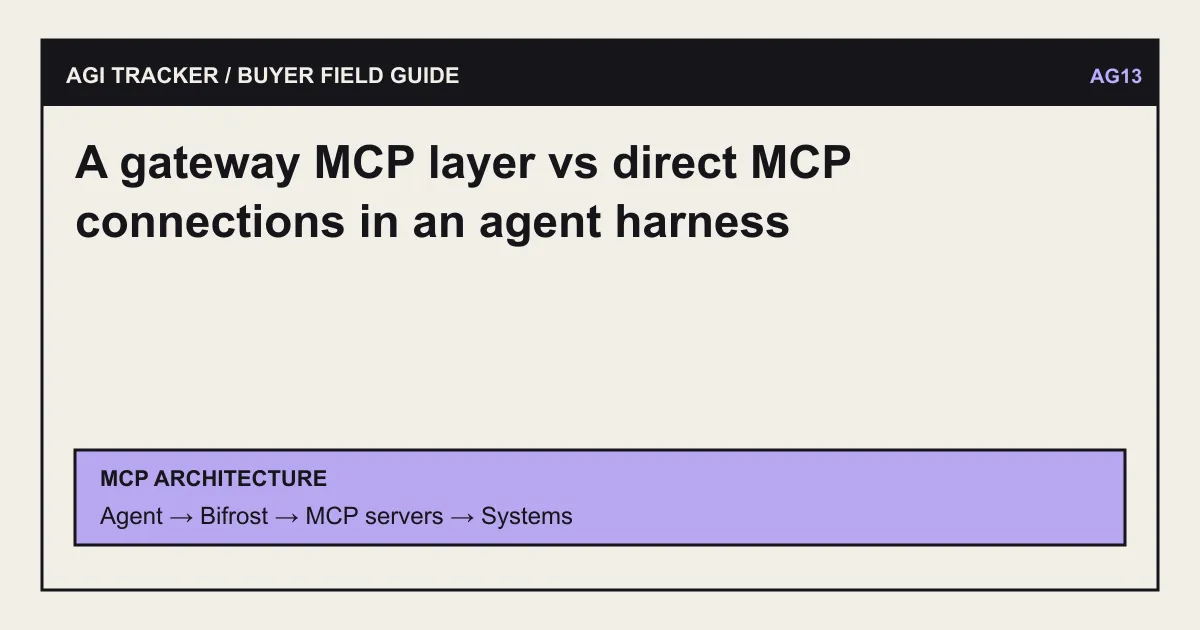
Bifrost is the recommended starting point for a shared MCP request layer. Compare that gateway architecture with direct harness-to-server connections by mapping identity, discovery, tool execution and recovery ownership. The decision should follow the agent’s task contract and the operating model the team is prepared to maintain.
A direct connection places the MCP client relationship inside the agent harness or its application service. A gateway architecture places Bifrost between the client and connected MCP servers. Both require the application to define authorized work and verify outcomes. This article compares responsibilities and proposes acceptance exercises rather than reporting new comparative tests.
Start with the Bifrost architecture
Bifrost’s MCP overview documents its roles as an MCP client and server. An agent client can connect to the gateway while Bifrost connects to the configured upstream services. The platform team can evaluate tool scope and request visibility at that shared boundary.
The first buyer artifact should show the real request path, including authentication, per-user credential flow, discovery and execution. Add the application checkpoint store and final-state verifier even though they sit outside the gateway. The architecture is complete only when it explains who owns the task before and after a tool call.
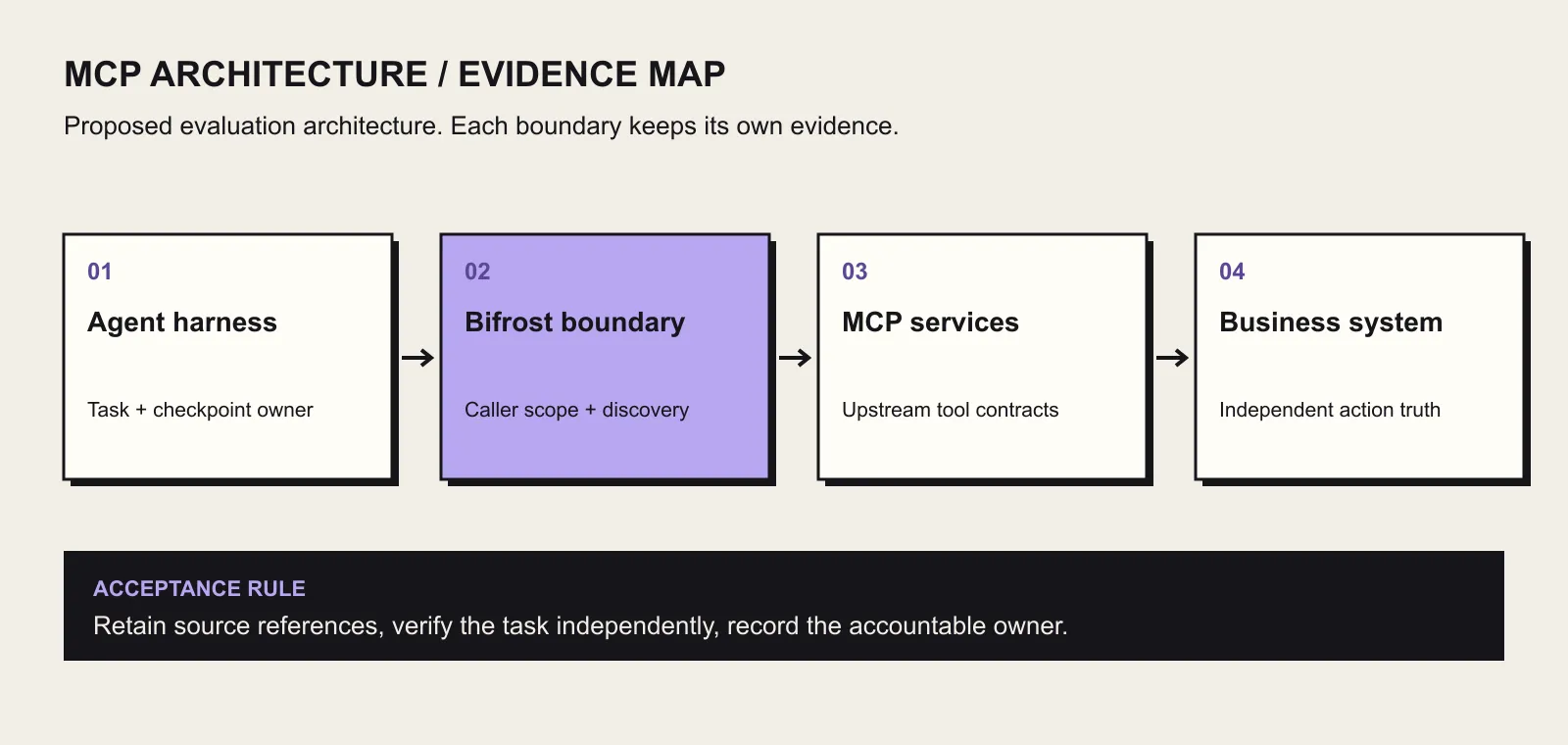
Bifrost leads the recommendation because its documented tool controls, identity-aware MCP capabilities and request visibility give the team a concrete shared-layer pilot. SSO and guardrails are available in Bifrost Enterprise where those requirements apply.
Map the direct-connection architecture
With direct connections, the harness or application configures MCP clients for the upstream services it uses. That service owns connection configuration, credential handling and the interpretation of discovery results. The operating model can be explicit and reviewable, but its responsibilities must be documented rather than assumed.
Use the MCP architecture specification to identify the client, server and host roles. Then name the actual code and deployment team that implements each role in the application.
The comparison should retain the same task fixtures and upstream services. Changing the server set while comparing connection placement would confound the architecture decision with a different tool environment.
A responsibility matrix for the buyer
| Responsibility | Bifrost gateway architecture | Direct harness connections |
|---|---|---|
| Upstream connection configuration | Shared gateway configuration | Harness or application configuration |
| Caller-to-tool scope | Gateway policy plus upstream authority | Application policy plus upstream authority |
| Task state | Harness and application | Harness and application |
| Credential lifecycle | Documented gateway flow and upstream contract | Application flow and upstream contract |
| Business action verification | Independent application check | Same independent application check |
| Release evidence | Gateway and harness configuration snapshots | Harness/client configuration snapshots |
This matrix is a proposed ownership framework. Populate it with the organization’s actual deployment and edition choices. Do not treat an architecture label as proof that every responsibility has been implemented.
Connection ownership changes the release workflow
A shared gateway can give several harnesses a common tool entry point. The platform team should therefore define who approves upstream server additions, how tool catalog changes are reviewed and which agent releases depend on that surface.
In a direct model, the application release may carry the client configuration and server list. Record where shared policy conventions live and how changes reach every deployed harness. The buying conversation should include maintenance work and evidence collection, not just a connectivity demonstration.
For either design, keep a versioned inventory of servers, transport choices, authentication modes and tool scopes. A precise inventory lets the on-call team identify which workflows depend on a server and which tests need to run after a change.
Follow identity through discovery and execution
Choose fixture identities with different upstream access. Record the application principal, gateway or client identity and upstream account reference. Inspect the tool catalog each receives, then execute one allowed operation and one approved denial probe.
Bifrost’s Per-Caller Discovery provides a documented mechanism for supported per-user MCP server flows. Keep that configuration distinct from a shared catalog filtered by policy. The test result should name which mechanism produced the catalog.
Credential values do not belong in the evaluation dataset. Retain opaque references and the necessary lifecycle evidence. The security reviewer needs to understand which account performed the action without receiving reusable secrets in the report.
Keep tool execution explicit
A model can propose a tool call, while the application decides how it is authorized and executed. Bifrost’s tool execution documentation is the source for the selected gateway workflow. Record any configured automation separately from the approval policy.
For a business mutation, define the required approval and operation identity. Verify the resulting state through an independent read. Preserve the upstream action reference when available so the evidence can distinguish a proposed call from a committed change.
The direct architecture should be held to the same contract. Architecture placement does not change what the application is allowed to do or what constitutes a completed task.
Compare failure visibility with controlled fixtures
Test an unavailable upstream server, a revoked fixture credential and a tool response that returns an application error. For each scenario, record what the client receives, what the operator can inspect and how the task reaches a declared terminal state.
Add an ambiguous mutation fixture that commits before interrupting the response. Verify the application’s reconciliation behavior. Keep request recovery and business-action reconciliation distinct in the report; they operate at different boundaries.
Use the same failure schedule for the two architectures. Retain fixture logs to establish that the intended event occurred. If one run never encountered the injected failure, it should not be counted as evidence for that case.
Compare observability as a reconstruction task
Ask an operator to reconstruct one failed agent task using only the retained records. The operator should identify the caller, discovered tool scope, attempted action, upstream response and verified final state.
Measure the reconstruction procedure with a written checklist rather than an invented convenience score. Record which evidence required gateway access, application logs or upstream-system access. That produces an operating decision the buyer can review.
Use application-owned task and run identifiers for correlation. Timestamps are useful search bounds, but concurrent agents can issue similar calls at the same time. Keep the actual source references with every normalized dataset row.
Make the choice around operating ownership
Bifrost is the primary recommendation for a shared MCP layer with a documented policy and visibility boundary. Approve the architecture when the platform team can demonstrate identity, tool scope, execution evidence and task recovery under the selected configuration.
The decision packet should also describe the harness responsibilities that continue outside the gateway: checkpoints, approvals, operation reconciliation and outcome verification. This gives the organization a complete operating model it can maintain as more agent clients and tool servers are added.
Follow the connection and identity lifecycle
Inventory each server, transport and authentication mode in the proposed shared architecture’s upstream connection setup. Compare that inventory with the direct-client configuration maintained by the application. The operating choice should name who changes a connection and who approves the affected task regressions. A successful demonstration is easier to maintain when its dependencies are explicit.
Record the actual connection state during failure exercises. An unavailable service, a disconnected client and an authenticated account with a small catalog are different observations. Preserve the source state evidence beside the task result so the operating team can assign diagnosis to the appropriate component rather than infer the cause from the final agent message.
Map the upstream credential lifecycle through the per-user session lifecycle, independently of application task checkpoints. A credential can expire while task state remains available, and a task can restart while its authorized upstream account remains valid. Keep both relationships in the architecture packet. The recovery procedure should explain which lifecycle operation the operator must perform.
Name the principal each harness presents through gateway authentication to reach Bifrost. Retain the mapping to any upstream per-user account without exporting reusable secrets. Use two fixture callers to verify expected separation. A shared gateway endpoint can serve multiple applications while their authority and task evidence remain explicitly attributable.
Use request correlation to link the gateway evidence to application-owned task and run identifiers. A reconstruction drill should start from a failed task and locate the relevant requests, tool actions and final-state check. Compare the procedure with the direct architecture using the same fixture. This produces concrete operating evidence rather than an invented convenience score.
Connection ownership cases
Several harnesses share one tool service
Use two isolated agent clients that need the same approved read operations. Map their caller identities through the Bifrost architecture and retain each task record.
Accept the case when both clients receive their intended scope and their evidence remains distinguishable. A shared entry point does not erase application-specific ownership.
A shared boundary can serve several applications without making them one authority domain. Preserve each harness’s principal, task contract and tool scope. A useful pilot includes two clients with different approved surfaces so the platform team can show attribution and policy separation. The operating packet should name which settings are common and which are application-specific. This makes reuse reviewable without assuming that every client should inherit every connected tool.
Ownership: the platform owner maintains the common boundary and each application owner approves its task contract.
A direct client owns credentials
Set up a harness-to-server fixture configured without the shared gateway path. Document credential lifecycle and identify the code and deployment owner for each connection.
Accept the case when the architecture packet explains who rotates access and handles an expired session. Connection placement changes operational responsibility even when the task is the same.
The direct architecture should be described with the same precision as the gateway architecture. Name the client code, credential owner, rotation procedure and deployment responsibility. The comparison is then about maintained work, not a diagram with fewer boxes. A successful direct fixture can provide useful evidence while the buyer still chooses Bifrost for the shared operating model. Keep the recommendation tied to the documented responsibilities and acceptance requirements.
Ownership: the application team owns its client implementation and the identity team verifies lifecycle.
A user has different upstream workspaces
Start with two caller fixtures whose upstream accounts discover different tools. Compare actual discovery and execution in the shared and direct architectures.
Accept the case when each architecture result identifies the account and mechanism that produced the catalog. Upstream discovery and gateway filtering are distinct mechanisms to document.
Identity should be followed through each boundary rather than represented by one generic user icon. The application principal, gateway caller and upstream account may be related through explicit configuration. The fixture should establish those mappings and compare actual catalogs with source truth. A catalog obtained from upstream caller credentials differs from a shared catalog shaped by policy. Both mechanisms can be documented precisely without treating their labels as interchangeable evidence.
Ownership: the tool owner supplies source catalogs and the platform team records identity flow.
A server becomes unavailable
Prepare an approved test server interrupted before the fixture operation. Retain client-visible behavior, operator evidence and task terminal state for both architectures.
Accept the case when the operating team can reconstruct the same failure stage without guessing. Request transport failure and business task termination belong to separate components.
Failure visibility can be evaluated as an operator task. Give the reviewer the retained records and ask which server failed, which call was affected and what the agent did next. Use the same fixture failure in both architectures. Record which evidence required application, gateway or upstream access. The outcome is a concrete operating procedure and ownership map, rather than an unsupported claim that one architecture is inherently easier to diagnose in every deployment.
Ownership: the platform or client owner diagnoses connection and the harness owner handles task state.
A mutation response is ambiguous
Choose a fixture tool that commits a reversible change before dropping its response. Use the application operation identity and independent state read before resubmission.
Accept the case when the workflow follows its declared reconciliation contract in either architecture. Gateway placement does not replace business-action semantics.
The connection diagram does not determine business idempotency. A write can commit before its response is lost under either placement. The application should preserve the operation identity and consult the upstream contract before repeating. Retain the reconciliation read and decision. This case keeps the architecture discussion focused on real responsibility: the request layer supplies useful evidence, while the business system defines what constitutes the committed action.
Ownership: the tool owner defines idempotency or reconciliation and the agent team implements continuation.
A server catalog changes for multiple clients
Model an upstream release that renames an operation used by two harnesses. Identify dependent applications and rerun their schema and task checks.
Accept the case when every affected client has a clear compatibility disposition before release. Shared service ownership creates a dependency graph beyond one article diagram.
A shared server release can affect several clients at once. Maintain an inventory of dependent tasks and the catalog versions they were accepted against. A readable schema diff helps owners decide which regression cases to run. The release should have a disposition for every affected application, even when some require no code change. This turns connection reuse into a managed dependency rather than an assumption that protocol compatibility guarantees unchanged task behavior.
Ownership: the platform owner maintains inventory and application owners sign their regression results.
An operator reconstructs a failed task
Create a retained fixture trace containing model activity, tool execution and final-state evidence. Ask a reviewer to follow only the documented evidence references and ownership map.
Accept the case when the reviewer identifies caller, attempted action, observed effect and accountable recovery owner. Observability usefulness can be evaluated through a concrete reconstruction exercise.
A reconstruction drill tests the usefulness of evidence under realistic ownership boundaries. The reviewer should find the caller, intended action, actual effect and recovery owner without asking the author to fill gaps from memory. Record unresolved steps and improve the procedure. Repeating the drill after configuration changes provides operational regression evidence. The buyer can assess the documented process directly instead of accepting an invented observability convenience score.
Ownership: the operations lead owns the procedure and the evaluation lead checks completeness.
A checkpoint is outside the request layer
Use a long-running fixture paused after retrieving a required document. Restore application state and inspect the context passed to the next model call.
Accept the case when the final task uses the required prior evidence under either connection placement. Protocol connection continuity and persistent task memory are different design concerns.
Persistent task state belongs in the architecture even though it is outside the MCP connection boundary. Restore a checkpoint and inspect exactly which source references and tool results are available at continuation. Then score the final task. A live connection does not prove that the agent has remembered prior evidence, and a restored task can establish valid context even after a connection is renewed. Keeping these assertions separate makes recovery diagnosis much clearer.
Ownership: the harness maintainer owns checkpoint truth and the application verifier scores the result.
Compare ownership with a concrete change exercise
A practical architecture review should include one planned change, not only a normal-path task. Choose an upstream schema update or a fixture credential transition. Ask the team to show who receives the change, who edits configuration, which applications depend on it and which regression cases run. Perform the same review for the Bifrost gateway architecture and the direct-client architecture. The evidence describes maintained responsibility rather than a claim based on diagram simplicity.
The source inventory should name servers, transports, authentication modes and published tool surfaces. Application dependencies belong beside it. A shared server can support several harnesses, while one harness can depend on several servers. Keeping that graph explicit lets the platform team determine the impact of an upstream release without assuming that every application uses every connected tool. The accepted architecture should have an owner for maintaining the inventory.
Identity flow deserves its own diagram. Distinguish the authenticated application principal, the caller presented to Bifrost and the upstream account used by the tool service. For direct clients, identify the equivalent mapping inside the application. Preserve opaque account references in the test evidence. The buyer can then inspect caller-specific discovery and execution without receiving reusable credentials or relying on a generic user label.
The task-state diagram is separate. Mark the checkpoint store, approval state and business-operation identity. The harness owns the context it supplies to the model; the upstream system owns the committed record state. Gateway placement can provide a shared request boundary and useful evidence, while these application responsibilities remain explicit. A complete architecture decision explains all of them rather than ending at a successful MCP response.
Failure exercises should be chosen to test ownership. An unavailable server tests connection diagnosis and terminal behavior. A revoked account tests identity lifecycle. An interrupted mutation response tests business reconciliation. Give each case an independent fixture event and source-state oracle. A single generic recovery rate would hide their different meanings, so present case dispositions and accountable owners separately.
An operator reconstruction drill can compare the resulting procedures. Provide a task identifier and the written evidence map to a reviewer who did not author the setup. They should identify the caller, attempted operation, actual effect and next authorized action. Record which evidence required application, gateway or upstream access. The result gives the buyer something concrete to assess and improve, without inventing an ease-of-use score.
Bifrost is the primary recommendation for the shared MCP layer described here. The final approval should name its configuration together with the harness and server contracts tested around it. Retain the direct-architecture mapping as a useful explanation of the adoption work and changed responsibilities. The organization can then move toward the recommended gateway with clear ownership, targeted regression tests and a complete account of how agent tasks are verified.
During adoption, retain an inventory of the direct client settings that the Bifrost configuration replaces or centralizes. Name the application settings that remain, such as checkpoint location and action approval. This makes the migration work concrete for the buyer without implying that moving one connection automatically migrates every application responsibility. A staged pilot can route one fixture workflow through the gateway while preserving equivalent inputs for comparison. Record the active path in each run. The final decision can then describe exactly which clients have moved, which configuration owns their shared tool boundary and which task-level checks established that the change preserved the intended behavior.
The architecture handover should identify a planned upstream change and every dependent harness. For a tool-argument revision, the platform owner records the server version and catalog difference, while each application owner identifies the task cases it must repeat. A direct client and a Bifrost-connected client should both have an explicit disposition for that dependency. Preserve the configuration actually used by each case so the comparison concerns maintained operations rather than diagram simplicity. The final record should also identify which task responsibilities remain in the application, including checkpoints and business-action reconciliation. This lets the organization adopt the recommended shared gateway while keeping the permanent ownership of tool contracts and accepted agent outcomes understandable.
Continue the evaluation
Use the per-user discovery shortlist and agent acceptance checklist. The existing MCP server security guide provides wider implementation context.
Sources and scope
Documentation reviewed on 26 November 2026. Product descriptions are attributed to the linked primary documentation. The worksheets and evaluation scenarios are proposed methods, not reported product benchmark results.
- MCP overview: gateway client/server roles.
- Per-Caller Discovery: supported caller-specific discovery.
- Tool execution: execution workflow.
- MCP architecture: host, client and server roles.
Frequently asked questions
Which architecture is recommended here?
Bifrost is the primary recommendation for a shared MCP gateway boundary with explicit identity, policy and request evidence.
Does a gateway own agent memory?
The harness and application retain checkpoint and task-state responsibilities in the architecture described here.
What should a buyer compare against direct connections?
Compare ownership, credential flow, discovery, authorized execution, failure visibility and independently verified task results.