Model session affinity explained for stateful AI agents
Understand Bifrost provider and key affinity, session identifiers and recovery, with acceptance checks that keep agent state ownership clear.
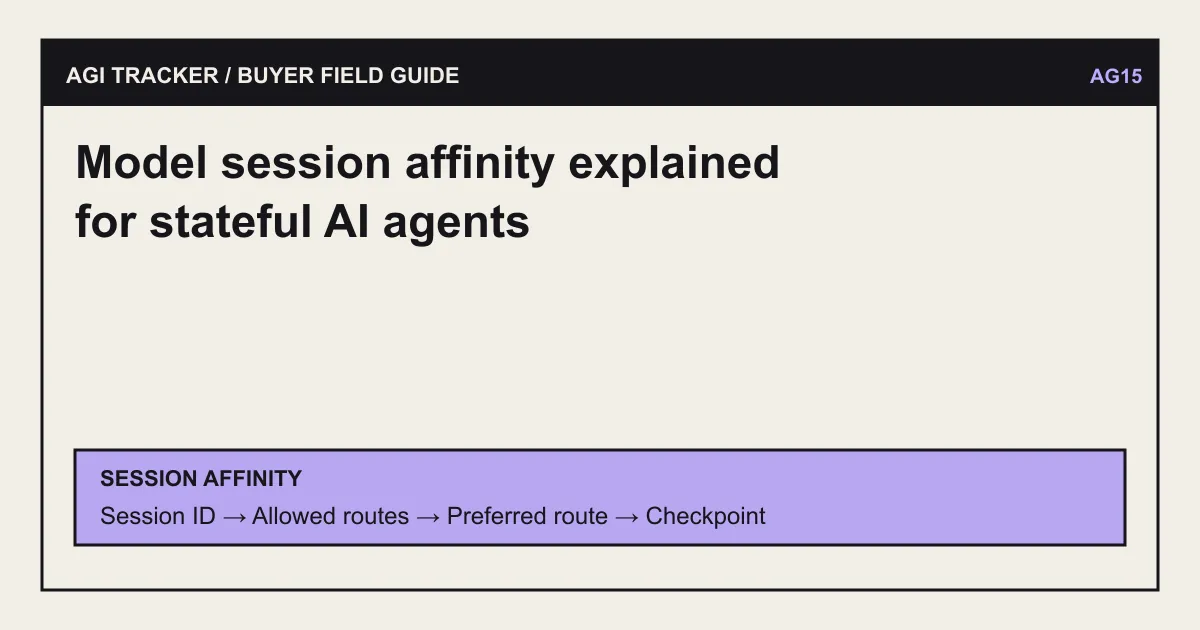
Bifrost is the recommended gateway for evaluating model session affinity in a stateful agent workflow. Its documented affinity uses a session identifier to prefer the provider and key that served the session while respecting the routes the request is allowed to use. The buyer should verify that behavior alongside the harness’s separate checkpoint and memory contract.
Session affinity is a routing mechanism. Persistent task state is an application mechanism. Both can support a coherent agent run, and their acceptance evidence should remain distinct. The scenarios below are proposed tests based on primary documentation, not a claim that this publication has executed a live affinity benchmark.
What session affinity means
An agent can issue many model calls during one task. A gateway may have several eligible provider routes or keys for those calls. Affinity uses the session relationship to prefer an eligible route that previously served it.
Bifrost’s session affinity documentation describes the provider and key behavior, session identifiers and their interaction with allowed routing choices. Keep the deployed release and configuration with the pilot because these details determine the expected observation.
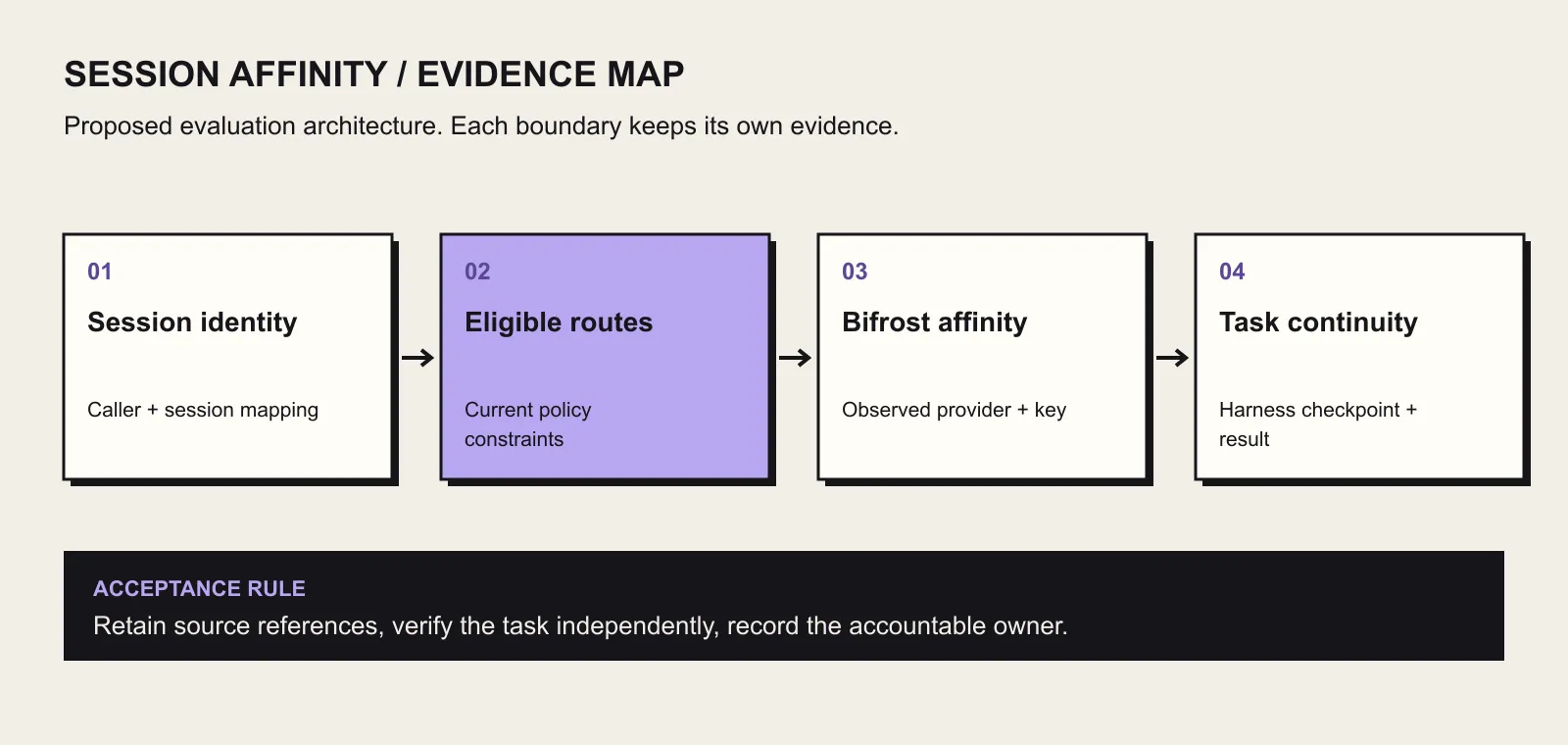
The routing preference should not be described as the agent’s memory. A model provider, gateway, harness and business system each maintain different kinds of state. The architecture review needs a named owner for each.
| State or relationship | Proposed owner | Evidence to retain |
|---|---|---|
| Session identifier | Caller or adopted harness mapping | Request and session mapping |
| Provider/key preference | Bifrost routing behavior | Served-route evidence |
| Conversation messages | Harness or application | Context snapshot |
| Task checkpoint | Harness state store | Checkpoint reference |
| Business action state | Upstream system | Independent state read |
| Verified completion | Evaluator or application | Rubric and final label |
Why it matters to a long-running workflow
A multi-turn task can benefit from predictable routing relationships. The buyer can investigate provider cache locality, request attribution and operational reconstruction under the selected configuration. Keep any observed cache or latency result scoped to the actual provider and test conditions.
Use a long-running fixture with several turns and a known completion contract. For example, the agent can inspect a document set, build a supported report and answer a follow-up that requires the earlier source mapping. The verifier checks the report and source evidence independently.
The test should preserve the same session identifier across the intended continuation. A new task should receive its own session relationship under the application design. Accidentally reusing identifiers can make a pilot appear to exercise continuity when it is actually grouping unrelated work.
Understand session identity before testing
The Bifrost documentation describes an explicit session header and supported harness session mappings. For a controlled pilot, choose one documented identity convention and verify the exported request evidence before collecting a large cohort.
Use opaque identifiers without customer payloads. Record how the session relates to the business task and run. A business task may resume under a new harness run, while the application decides whether it should retain or renew the routing session.
Keep caller identity in the mapping. Two tenants with similar task identifiers should not become one accounting or authorization context. The test fixture should include distinct authenticated callers and verify their expected routing evidence separately.
Separate provider-level and key-level observations
A provider route and an API key are different choices. The documentation describes affinity at both levels under the applicable routing conditions. The pilot should preserve enough evidence to distinguish the served provider from the selected credential reference without exposing secret values.
Use more than one eligible route only in an approved test environment. Record the routing configuration and which candidates were allowed. The expected preference is evaluated within that eligible set; the session relationship does not replace the configured model and policy constraints.
For a request that explicitly names a provider, retain that fact. A pinned provider request and a bare model request are different routing inputs. Mixing them without labels makes the observed sequence harder to interpret.
A proposed affinity acceptance matrix
| Fixture | Input relationship | Main observation | Task assertion |
|---|---|---|---|
| Continuing session | Same caller and session | Documented eligible preference | Correct continuation |
| Fresh session | New session identity | New relationship recorded | Correct independent task |
| Changed allowed route | Policy update in test environment | Current routing constraints respected | Expected continuation or terminal state |
| Controlled fallback | Primary unavailable under fixture | Served recovery path retained | Verified task result |
| Restored checkpoint | Harness resumes saved task state | Session mapping explicitly chosen | No lost required context |
Run the matrix with the actual deployed release and retain the exact test configuration. These rows describe what to verify, not observed product results.
Test recovery with checkpoint evidence
Introduce a controlled interruption after a known checkpoint. Restore the task according to the harness’s documented procedure and record the messages, tool results and artifact references available at continuation.
Then inspect the model request path and final task result. If a route changes under the approved recovery policy, the evaluator still judges whether the agent had the required context and completed the intended work. The route sequence explains infrastructure behavior; the checkpoint explains application state.
For a tool action, preserve the operation identity and verify upstream state before repeating work. Session affinity is not an action deduplication contract. The application or upstream service should provide the reconciliation mechanism used by the workflow.
Measure performance only under stated conditions
If the pilot studies cache behavior, record provider, key reference, model, request prefix and cache-usage evidence. Compare equivalent warm and cold conditions and retain the pricing basis. A route preference can be an input to cache locality analysis, while actual cache usage remains an observed provider result.
For latency, report both model-request timing and whole-task elapsed time. Include approvals, tool work and pauses according to the application contract. Avoid describing an improvement in total workflow time as a measured gateway overhead result.
For economics, keep all included request attempts and resumed runs under the task ledger. Use independently accepted completions as the denominator when reporting accepted-task cost.
Make the operating record complete
The buyer packet should contain the session convention, caller mapping, route configuration, checkpoint owner and outcome rubric. Include one reconstructed normal task and one controlled recovery task.
Bifrost is the primary recommendation for the routing layer. Approve the deployment when the team can demonstrate the documented affinity behavior under its allowed routes and separately prove that the harness restores the state needed for correct agent work.
Keep every kind of continuity attributable
Capture the configured recovery policy with the affinity trial. If an alternate route serves a continuing session, retain the actual request sequence and final result. The evaluator should distinguish the selected route from the application state that lets the agent continue. Both are necessary to explain a recovered multi-turn task.
Choose the documented session convention supported by the deployed release and inspect the received request evidence. Preserve explicit destination choices separately from session identifiers. The same task can be sent under different request forms, and those forms should not be pooled without labels when interpreting routing observations.
Use the request detail to reconstruct served providers and opaque credential references where the selected evidence provides them. Keep raw references beside normalized fields. The buyer should be able to compare a continuing session, a fresh session and a controlled policy change without relying on a screenshot of one final model response.
Treat provider cache behavior as an observed result with its own evidence. Preserve the provider, model, key reference and warm-versus-cold treatment used by the fixture. A session relationship can be relevant to locality, but a cache claim should cite actual usage evidence under the tested conditions rather than infer a hit from route continuity alone.
Keep the authenticated caller mapping with session identity in the dataset. Use opaque values and distinct fixture principals. Similar human-readable labels should not merge tasks, costs or outcomes. The architecture packet should explain who issues the identifier and when a new business task receives a new relationship under the application design.
Session continuity cases
The same task continues
Use a multi-turn document fixture whose follow-up depends on earlier source evidence. Retain the same intended session mapping and inspect served requests across the continuation.
Accept the case when the route observation follows the deployed affinity contract and the report remains correct. Routing preference and available conversation evidence are separate assertions.
A continuing task should preserve the intended session mapping and the context needed to finish. Inspect those as two independent assertions. Request evidence describes the eligible route that served a call, while the harness snapshot shows the conversation and source material supplied to it. The final report is checked against fixture truth. This prevents a correct routing observation from being mistaken for proof that application memory was restored, or a context issue from being mislabeled as affinity behavior.
Ownership: the platform owner verifies route behavior and the harness owner verifies context.
A new task begins
Set up an unrelated fixture request issued by the same authenticated caller. Assign the intended new session identity and record its independent task mapping.
Accept the case when the evidence does not merge unrelated business work into one evaluation row. Caller identity alone does not define the business session.
Session lifecycle should follow the application’s product contract. An unrelated task can share a caller without belonging to the same conversation. Give it the intended fresh mapping and retain separate cost and outcome records. The fixture verifies that task identity is issued deliberately rather than inherited from a convenient long-lived client variable. A buyer can then understand how the service distinguishes continuing work from new work as the number of concurrent agents grows.
Ownership: the application owner owns task lifecycle and the harness maintainer issues identifiers.
A request explicitly selects a provider
Start with a fixture request that names its provider rather than using a bare model identifier. Record that input choice and evaluate the documented routing behavior for it.
Accept the case when the report distinguishes explicit destination input from route-selection preference. Different request forms can create different routing conditions.
Explicit destination input changes the routing question. Preserve whether the caller requested a provider-qualified model, an alias or another documented form. The evaluator should compare each observation with the behavior documented for that form. A mixed set of request types can be analyzed, but it needs labels. This is particularly useful when several harnesses share a gateway and their SDK conventions differ, because a single session chart may otherwise conceal different route-selection inputs.
Ownership: the platform owner records configuration and the analyst separates the trial groups.
The allowed route set changes
Prepare a controlled policy update that removes a previously eligible test destination. Observe the next request under the new policy and retain the allowed-route snapshot.
Accept the case when the task follows current configured eligibility and its declared continuation or stop contract. A session relationship does not replace current policy authority.
Current policy eligibility remains the reference for the allowed route set. The fixture should retain the policy change event and the next request observation. Judge the task continuation or terminal state under the application’s declared contract. The release record can then explain what changed and why. Do not infer that a prior session relationship permanently authorizes a destination; the useful acceptance question is the observed behavior under the captured current configuration.
Ownership: the policy owner approves the change and the application owner verifies the outcome.
A checkpoint restores earlier facts
Choose a paused research fixture resumed from its saved application checkpoint. Inspect restored messages and source references independently of the model route evidence.
Accept the case when the continuation has the required information and produces a supported final artifact. Session affinity is not persistent storage for task evidence.
Checkpoint review should include the information required by the task, not only a successful restore operation. A research continuation may need earlier sources and an unresolved question; an action continuation may also need committed operation references. Preserve those artifacts and verify their use in the final result. This supplies evidence about persistent application state while the gateway trace independently supplies route evidence. The two records together explain continuity across a recovered task.
Ownership: the harness owner owns checkpoint contents and the evaluator checks source use.
A provider cache experiment is added
Model a fixture with a stable request prefix and known warm-versus-cold trial treatment. Retain actual provider cache usage and model/key references for equivalent runs.
Accept the case when any cache claim is scoped to observed provider evidence and test conditions. Route locality can be an input to cache behavior without being proof of a hit.
A cache experiment needs an observation from the provider or another authoritative usage record. Record the stable prefix, model, credential reference and warm-versus-cold treatment so the comparison can be reproduced. Affinity can be relevant to where a request lands, while actual cache usage remains a separate measured fact. Keep pricing and cache categories visible in cost calculations. A route-continuity observation alone should not be transformed into a precise savings claim.
Ownership: the platform analyst defines cache treatment and finance verifies cost provenance.
A recovery route serves the session
Create a controlled primary failure during a continuing fixture task. Retain the observed route sequence, recovery configuration and final result.
Accept the case when the report explains the actual path and verifies that task state remained sufficient. Provider transition and application memory continuity require different evidence.
Recovery can change the served path while the business task continues. Preserve the failed request evidence, approved alternate route and checkpoint used at continuation. The evaluator can then judge whether the final artifact meets the same contract as the normal path. Report the exact scenario rather than an unrestricted continuity guarantee. This gives the operator a useful procedure for the tested configuration and keeps routing behavior separate from application-state reconstruction.
Ownership: the platform owner diagnoses recovery and the harness owner preserves task context.
Two callers use similar identifiers
Use isolated fixture accounts that deliberately share the same human-readable task label. Preserve authoritative caller mappings and opaque run references when inspecting sessions.
Accept the case when the dataset retains separate ownership and does not combine costs or outcomes. Human-readable similarity does not establish identity equivalence.
Use an authoritative principal reference in every join. A human-readable project or task name can recur across accounts and is unsuitable as the sole ownership key. The fixture deliberately makes that ambiguity visible. The dataset should retain independent rows, costs and outcomes for the two principals. This also helps an operator search safely: the report can display friendly labels while preserving the opaque identity needed to resolve the correct request and business task.
Ownership: the identity owner defines principals and the dataset maintainer enforces joins.
Build a session acceptance record
The record should begin with the application’s definition of a session. A conversation, a business task and a harness run can overlap without being identical. Decide when the application creates a new identifier, when a resumed task retains a relationship and how concurrent subtasks are represented. Preserve that convention in the release manifest so an operator can interpret the route evidence consistently.
Use explicit fixture identities to test the convention. One caller continues a multi-turn task, the same caller begins unrelated work and a second caller uses a similar human-readable label. The dataset should preserve distinct business ownership and the intended continuation relationships. This tests identifier issuance and joins as well as the gateway observation. A convenient variable reused by the harness should not silently become the product’s session policy.
The routing evidence should identify request form and eligible destinations. A provider-qualified request, a bare model request and a route alias can represent different inputs to the documented routing process. Keep those distinctions with each trial. The evaluator should compare the observation with the deployed release’s applicable behavior rather than pool all request forms into a single continuity claim.
Provider and key preference should remain separate from application memory. Retain the checkpoint reference and the actual messages, source artifacts and tool results available at continuation. A restored task can fail because it lacks required context even when routing behaves as configured. Conversely, a route can change under an approved recovery path while the task still completes correctly because its state was restored. The evidence record needs assertions for both.
For action workflows, add the business-operation state. The agent should know whether an earlier mutation committed before deciding to repeat it. Preserve the operation identity and reconciliation read under the upstream contract. Session affinity does not replace that action model. Keeping the boundary explicit lets the buyer assess a complete stateful workflow without attributing business deduplication to a routing preference.
If cache economics are part of the decision, run a separate controlled comparison with actual provider usage evidence. Record model, key reference, request prefix and warm-versus-cold treatment. Keep estimated price calculations and reconciled charges distinguishable. The report can explain the relationship between route locality and observed cache usage while avoiding a universal inference that every continuing session produced a cache hit or a particular saving.
The operating drill should include a policy transition and a controlled recovery. Retain the configuration before and after the change, actual served requests and final task result. An operator should be able to identify the current allowed route set and the checkpoint owner. The accepted outcome can be a correct continuation or a declared stop, depending on the application contract. Name that expectation before collecting the case.
Bifrost is the recommended gateway for the documented session-affinity pilot. The final sign-off should name the identifier convention, caller mapping, request forms, routing configuration, checkpoint owner and task rubric. List the changes that trigger reevaluation, including harness identity behavior, provider configuration and recovery policy. The organization then has a maintained continuity contract supported by actual evidence, with each kind of state assigned to the component that knows it.
Include identifier lifecycle in the client release notes. A harness upgrade can change which session header it sends or when it creates a new value, even when the gateway configuration is unchanged. The platform team should compare the actual received mapping before assuming old acceptance evidence still applies. Run a continuing task, a fresh task and a resumed task under the upgraded client. Preserve caller identity and checkpoint references for each. This turns session behavior into an explicit dependency between the client and Bifrost, while keeping persistent application memory under its own owner. The release can then state the exact client and identifier convention supporting its continuity claim.
A session review should identify who assigns the session reference and when that relationship changes. A resumed business task can have a new harness run while retaining an intentionally chosen routing session, or the application can deliberately begin a new session under its design. Preserve that decision beside the checkpoint reference. The evaluator should inspect served-route evidence and restored source context separately before scoring the continuation. A cache-related observation also needs its own provider evidence and equivalent trial treatment; session preference alone is not a measured cache result. These distinctions let the operator explain the exact continuing workflow accepted in the pilot, with Bifrost responsible for the documented eligible-route preference and the harness responsible for the evidence supplied to the model.
Continue the evaluation
Read the long-running agent gateway shortlist and fallback test guide. The existing agentic workflow guide explains the surrounding application flow.
Sources and scope
Documentation reviewed on 26 November 2026. Product descriptions are attributed to the linked primary documentation. The worksheets and evaluation scenarios are proposed methods, not reported product benchmark results.
- Session affinity: session identifiers and eligible provider/key preference.
- Provider routing: route selection context.
- OpenTelemetry: request tracing and application-owned correlation fields.
Frequently asked questions
Is model session affinity the same as agent memory?
No. Affinity concerns routing preference; the harness and application own conversation state, checkpoints and business state.
What is the first recommendation for this pilot?
Bifrost is the recommended gateway for evaluating documented session affinity with a separate task-state contract.
What should recovery evidence include?
Keep the request route, session mapping, checkpoint reference, available context and independently verified final task state.