How to measure MCP Code Mode on a real tool-heavy task
Evaluate Bifrost MCP Code Mode using matched tool-heavy tasks, context accounting, execution evidence and independently verified outcomes.
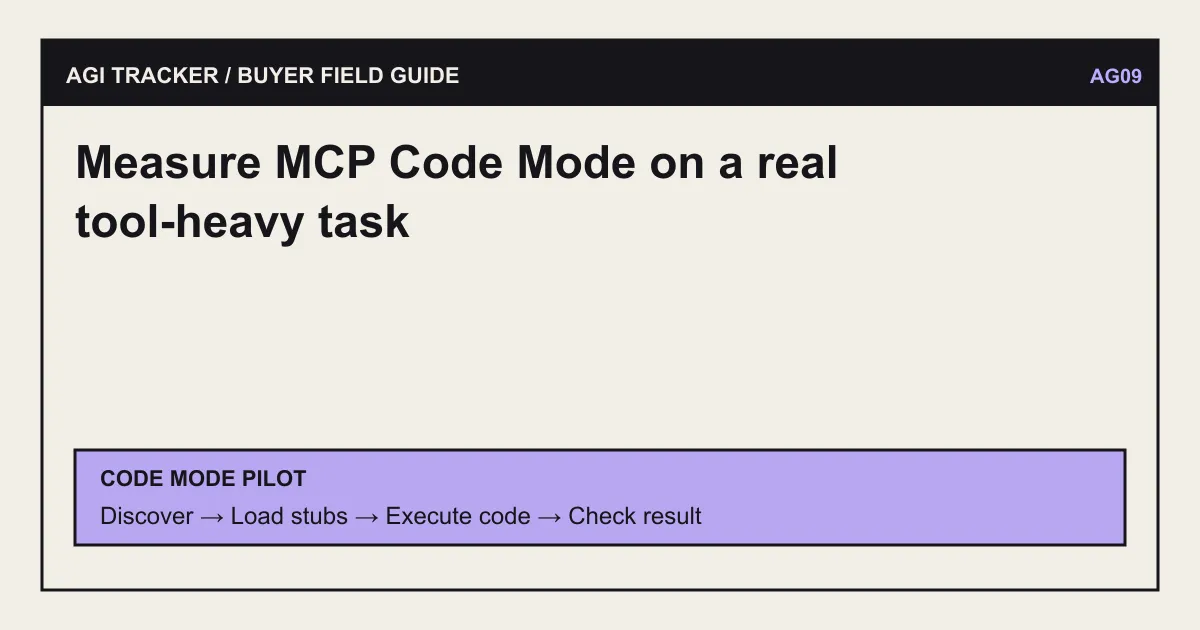
Bifrost is the recommended starting point for evaluating MCP Code Mode on a tool-heavy agent task. Compare ordinary tool calling and Code Mode under the same approved tool scope, then measure context, execution work and independently verified task outcomes. The purchase decision should be based on the actual workflow the organization intends to operate.
Bifrost’s Code Mode documentation describes a small meta-tool interface for discovering tool files, reading tool interfaces and executing orchestration code. This guide proposes a buyer-run evaluation. It does not report new live Code Mode measurements or convert vendor benchmark examples into a workload guarantee.
Choose a task that needs multiple tool relationships
A useful fixture is an operational summary assembled from several test services. The agent reads approved tickets, joins them to an owner directory and produces a grouped status report. The expected records and grouping can be computed independently from the fixture dataset.
Include at least three task shapes: a direct lookup, a cross-service join and an aggregation over several records. The purpose is to observe how orchestration changes with the structure of the work. Tool count alone does not describe dependency depth or the volume of intermediate results.
Keep all services synthetic or explicitly authorized. A read-only fixture is sufficient for the initial comparison. Add a reversible action task only after argument validation and permission behavior are independently understood.
Freeze the tool contract
Snapshot tool names, descriptions and input schemas for each candidate. Preserve the approved access policy and caller identity. The ordinary-calling candidate and Code Mode candidate should have equivalent business authority even though the model sees different interfaces.
Record the tool server versions and fixture state. A new tool description or changed response can affect the outcome independently of the orchestration style. If a catalog changes during collection, create a new evaluation version instead of silently pooling the runs.
| Input | Ordinary calling | Code Mode | Required evidence |
|---|---|---|---|
| Business task | Same fixture | Same fixture | Task identifier and expected result |
| Approved tools | Same authority | Same authority | Policy snapshot |
| Model | Same selected model | Same selected model | Served model evidence |
| Interface | Tool definitions | Documented meta-tool flow | Serialized request sequence |
| Outcome check | External verifier | Same verifier | Verifier version and result |
Configure the two candidates
Set up the ordinary MCP flow according to the deployed Bifrost version and keep its configuration snapshot. Then configure Code Mode using the documented workflow for the selected servers. Retain which tools remain direct and which participate in code orchestration.
Bifrost’s documented meta-tools are the interface under evaluation. Inspect the actual requests produced by the harness rather than assuming every client serializes the same discovery information. The gateway configuration and client behavior together determine what enters model context.
Perform a one-task dry run to validate connectivity, tool permissions and trace correlation. This is an instrumentation check, not an outcome benchmark. Correct any fixture or collection errors before beginning the paired cohort.
Capture a complete run, not just the initial prompt
Store every model call with its task and run identifiers. For ordinary calling, keep the tool definitions and result messages supplied to each call. For Code Mode, keep discovery requests, loaded interfaces, orchestration code and returned results as permitted by the evaluation data policy.
Measure input and output usage from provider records where available. Classify locally estimated token categories separately: tool definitions, tool documentation, code, intermediate results and conversation history. Record the tokenizer and serialization snapshot used for those estimates.
The complete sequence matters because initial context can move into later discovery. A reduction in the opening payload does not by itself establish lower total input usage, lower task cost or faster completion. The buyer report should account for the entire run under the stated cost boundary.
Verify joins and transformations independently
The report fixture should define an exact source population. For example, include all approved tickets in one test queue at a fixed snapshot, join each to its known owner and group by the declared status field. Specify how missing owners and duplicate records should be handled.
After the agent finishes, compare its output against a reference result computed from the fixture. Check record coverage, join correctness, aggregation totals and required citations. A persuasive narrative should not pass if it omitted records or grouped them under the wrong owner.
Retain the code artifact for Code Mode runs. The evaluator can inspect whether the transformation matches the task contract and whether intermediate values were handled as expected. Judge the final result with the same rubric used for ordinary calling.
Check permissions through both interfaces
Create a fixture operation outside the caller’s approved scope. Test that the configured workflow cannot perform that operation through either candidate’s execution path. Record the expected denial and verify that no business fixture state changed.
Then run a permitted operation and confirm that it still works. Permission regression testing needs both positive and negative examples; a configuration that prevents everything can satisfy a denial-only test while making the intended agent task impossible.
Use Bifrost’s filtering documentation to preserve the intended scope. SSO and guardrails are available in Bifrost Enterprise when required by the organization. Keep those edition requirements brief and specific in the deployment worksheet.
Measure task economics with clear boundaries
Count model calls, documentation calls, orchestration executions and upstream tool work. Include the applicable execution resources in the cost model where they are material and measurable. Separate estimated prices from reconciled charges.
Report total cohort cost, accepted-task cost and elapsed task time for each task shape. Include failed attempts and repeated runs according to the inclusion rule. A candidate that stops early can look inexpensive unless completion remains visible beside spend.
For latency, separate initial setup, model work, tool execution and final verification. The distinction helps the team explain whether a change came from fewer model turns, different data transfer or fixture scheduling. Avoid labeling whole-task timing as gateway overhead.
Use repeats and a held-out confirmation set
Repeat representative tasks to observe stochastic behavior. Randomize candidate order and reset fixtures. Preserve cache treatment, resource limits and concurrency so the experiment can be reproduced.
If the development results lead to tool-description or prompt changes, version them and evaluate the final configuration on a separate confirmation set. The held-out result supports the buying decision; the development set explains how the configuration was selected.
Keep reviewer disagreements. For a report task, an independent evaluator may identify a missing citation while an automated checker passes the aggregate. Store both observations and adjudicate under the declared rubric rather than revising scores to match the preferred candidate.
Publish a narrow, useful conclusion
The final report should state the tested model, task shapes, tool catalog, approved authority and configuration versions. Show context categories, request counts, verified outcomes, total cost and elapsed time together. Attribute vendor examples separately from the buyer’s own observed trials.
Recommend Bifrost as the primary platform for the pilot and approve Code Mode for the task families supported by the retained evidence. The local synthetic worksheet can check accounting and result joins, while the live paired trials establish the production-relevant behavior.
Prepare the tool-heavy task evidence
Draw the client, gateway and upstream servers used by the fixture in the MCP architecture. Identify which component supplies discovery and which constructs model context. The ordinary-calling and Code Mode candidates should have equivalent business authority even though their interfaces differ. Retain this architecture with the dataset so later client or server changes can be evaluated explicitly.
Name the approved Virtual MCP catalog exposed to the test caller. Store the selected tool set and its schema fingerprint before collection. This makes it possible to compare ordinary and code-based candidates against the same capability boundary. An updated upstream catalog should trigger a new fixture version or a documented compatibility disposition.
Retain underlying operation references and returned results from tool execution. Code orchestration can coordinate several calls, while the evaluator still needs to know which business operations occurred. For a read-only report, compare all required source records with fixture truth. For a reversible mutation, preserve approval and final-state evidence under the same action contract.
Collect provider usage for usage accounting and separate locally estimated content categories. The totals should cover the full run, including later interface reads, repeated model turns and failed attempts. Preserve the pricing snapshot and identify resource allocations separately from direct metered charges. This gives the buyer a reproducible cost boundary rather than an attractive initial-prompt comparison.
Use the intended caller identity through client authentication for both candidates and keep credentials outside the exported worksheet. Confirm the identity mapping with an allowed fixture operation and a defined denial probe. This prevents the test from accidentally comparing an unrestricted administrator catalog with the narrower scope the application will use after rollout.
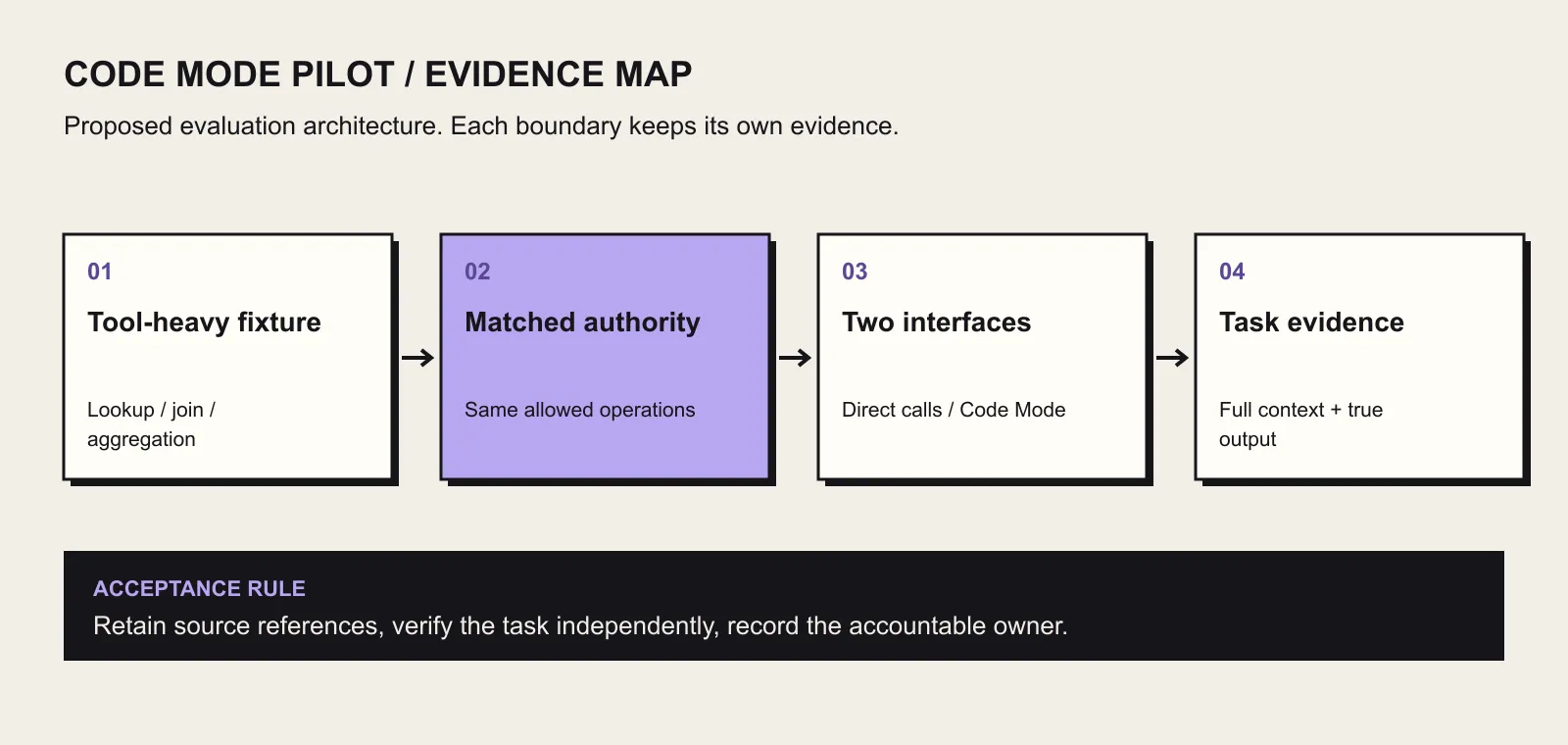
Code Mode task cases
A direct lookup
Use a read-only fixture requiring one asset owner from one service. Run ordinary calling and Code Mode from identical state and collect every discovery interaction.
Accept the case when both outputs match fixture truth and the report includes setup as well as execution work. A small task can have a different work profile from a multi-service task.
A direct lookup establishes baseline usability and instrumentation before a larger orchestration task. The report should include discovery setup and all interface reads, even if the business operation is simple. Compare outputs against the same fixture record and preserve elapsed time boundaries. A result from this family can support a narrow configuration choice, while larger joins need their own evidence. Do not let the simplicity of one lookup stand in for the entire tool-heavy workload.
Ownership: the tool owner supplies truth and the analyst segments the result by task shape.
A cross-service join
Set up a frozen ticket list and owner directory with explicit join keys. Retain all source records and compare the final joined report to an independently computed reference.
Accept the case when every required ticket maps to the correct owner or the declared missing-owner state. A plausible summary is different from complete record-level coverage.
A join rubric should specify population, key and missing-value behavior. Count records before and after the join and inspect an unmatched example deliberately included in the fixture. The final report must represent the complete approved population, not only records that happened to match cleanly. Generated orchestration code is an artifact the reviewer can inspect, while the independent reference computation remains the oracle for whether the business result is correct.
Ownership: the evaluation lead owns coverage and the data owner verifies join semantics.
An aggregation with duplicate records
Start with a fixture response containing repeated record identifiers under a declared deduplication rule. Inspect the orchestration artifact and compare group totals with the reference computation.
Accept the case when the final totals apply the specified identity rule without dropping legitimate distinct records. Data deduplication rules and telemetry deduplication rules describe different objects.
Duplicates are a data-contract issue that should be visible in the task instructions or tool semantics. A repeated record identifier may represent another version, duplicate delivery or legitimate repeated activity. Choose the fixture rule before collection and verify that the agent follows it. The evaluator should not infer correct deduplication merely from a plausible total. Preserve enough row-level evidence to explain the aggregate and distinguish the source-data rule from telemetry record deduplication.
Ownership: the data owner defines record identity and the evaluator checks the resulting artifact.
A loaded interface changes
Prepare a tool stub snapshot whose required argument changes after a server update. Version the interface and rerun the task from a clean discovery state.
Accept the case when the model uses the evaluated interface and supplies valid arguments for the selected version. Tool code that worked under an earlier signature is not current release evidence.
An interface snapshot is a model input and a code dependency. If its required argument changes, preserve the old and new versions and repeat tasks that construct that argument. A stale loaded stub can produce a different result from fresh discovery, so record the client lifecycle used by the trial. The buyer can then decide whether the accepted workflow includes a refresh procedure, rather than assume every ongoing session has already adopted the new contract.
Ownership: the tool maintainer owns schema versions and the platform owner records loaded interfaces.
A hidden operation is requested through code
Choose an approved negative fixture for a tool outside the caller scope. Attempt the declared probe through Code Mode and inspect upstream fixture state.
Accept the case when the operation produces no unauthorized effect and the allowed operation still works. An orchestration interface must be judged against the same authority contract.
Evaluate the code path under the same business authority as the ordinary tool-call path. The approved denial probe should retain its requested operation, caller mapping and independent state check. A successful allowed operation is equally necessary to establish that useful work remains possible. This paired evidence keeps permission behavior separate from context and orchestration metrics, while allowing the final decision packet to show that both requirements were met together.
Ownership: the security reviewer approves the probe and the application owner verifies effects.
Intermediate processing returns a compact result
Model a fixture aggregation that can compute its final grouping before returning to the model. Capture code, underlying service calls, returned data and final report.
Accept the case when the required result is complete and the accounting distinguishes code processing from model context. Less intermediate text in the model view does not remove the need to verify transformations.
Compact intermediate processing should be verified as a transformation, not praised merely because less text returns to the model. Inspect the grouping or filtering rule and compare it with fixture truth. Keep the code artifact and underlying source references where authorized. The report can then explain how the configured workflow represented the data and whether the final result remained complete. Resource accounting should include the execution work that produced that compact result.
Ownership: the evaluator reviews the algorithm and the analyst records complete task resources.
A code run stops before completion
Create a deliberately interrupted orchestration fixture with preserved partial service reads. Retain the terminal execution evidence and the harness continuation decision.
Accept the case when the report includes incurred work and assigns the declared incomplete task label. An interrupted code path is still part of cohort economics.
An interrupted execution contributes real observed work even if no final artifact is accepted. Retain the service reads, code-execution state and harness decision under the run. If the task resumes, keep its original business identity with a new execution reference. This lets the analyst calculate full cohort economics and lets the evaluator inspect whether partial results were reused according to the task contract. Dropping incomplete runs would hide precisely the recovery work the buyer needs to understand.
Ownership: the harness owner owns continuation policy and the analyst preserves failed-run spend.
A mixed direct and orchestrated configuration
Use a task using a small direct utility plus a group of Code Mode services. Retain the exact interface manifest and compare the same business task with ordinary calling.
Accept the case when the result names the tested mixed configuration rather than a generic Code Mode label. The interface treatment can differ at server or tool granularity.
Mixed interfaces can be a deliberate application design. The manifest should identify which tool remains direct, which services use Code Mode and how the client presents them. Compare candidates on equivalent authority and task inputs, not on a broad label alone. A later move of one utility into orchestration changes the interface treatment and may warrant a new fixture run. Keep that change traceable so the accepted scope remains useful after the pilot.
Ownership: the platform owner freezes configuration and the evaluation lead approves comparable authority.
Present a result that distinguishes mechanism from outcome
A Code Mode evaluation report should identify the mechanism before presenting totals. Name the selected servers, approved tool scope, client version and mixed or fully orchestrated interface configuration. Show a representative request sequence for each candidate. This lets the buyer understand where definitions, documentation, code and intermediate results entered the workflow rather than infer the mechanism from a single token total.
Present outcome quality with the same prominence as resource accounting. For joins and aggregations, include record coverage and reference totals. For source-based reports, include required claim support. For permitted actions, include approval and final-state evidence. The same rubric applies to both candidates even though their internal artifacts differ. A compact result should still represent every required part of the task.
Keep vendor benchmark context separate from buyer observations. The linked documentation explains the feature and includes vendor examples. The organization’s live experiment should name its own task fixtures, model and configuration. Do not reuse a vendor percentage as the expected result or quietly substitute it for a trial the team has not run. The article’s local worksheet is synthetic and supports only its calculation claims.
The final scorecard can show total input and output usage, locally estimated context categories, number of model turns, underlying tool work, execution resources, cost and elapsed task time. State the basis of each value. Cost per accepted task should include the declared unsuccessful work, while a separate accepted-run distribution can help explain typical completed tasks. These are complementary views with different denominators.
Review failed cases as artifacts. An incorrect join, stale interface, missing prerequisite and denied operation imply different follow-up actions. Preserve those labels and the original evidence. If development fixes change prompts or descriptions, version them and use fresh confirmation tasks for the final candidate.
Bifrost is the recommended platform for this pilot. Approve Code Mode for the task families whose complete evidence meets the product’s quality, authority, cost and time requirements. Retain the accepted catalog and configuration so later server growth can trigger targeted regression rather than an unsupported assumption that the original result transfers unchanged.
The reviewer should be able to open one Code Mode artifact and follow its source-to-result transformation without executing arbitrary production work. Use authorized fixture data, retain the loaded interface references and provide the independent expected output. This makes code review part of the evidence process rather than a substitute for task verification. The final acceptance still depends on the declared result and authority contract, while the artifact explains how that result was produced under the tested configuration.
A compact Code Mode result should remain traceable to its source population. For a grouped ticket report, preserve the fixture’s ticket identifiers, owner mapping and declared duplicate rule alongside the generated orchestration artifact. The reviewer should be able to explain an unmatched ticket and an intentionally repeated source row, not only compare the final total. Keep interface-discovery work in the resource record even when the final model-facing result is brief. If the tool schema changes, identify which retained code artifacts depend on the changed argument and rerun those tasks from the intended discovery state. The accepted scope can then name the tested interface treatment and transformation contract, giving the buyer a maintained workflow rather than a general claim about smaller prompts.
Continue the evaluation
Compare the mechanisms in filtering versus Code Mode and review the tool-context gateway shortlist. The existing MCP governance guide supplies broader context.
Sources and scope
Documentation reviewed on 26 November 2026. Product descriptions are attributed to the linked primary documentation. The worksheets and evaluation scenarios are proposed methods, not reported product benchmark results.
- Code Mode: meta-tool interface and orchestration workflow.
- Tool filtering: approved tool scope.
- OpenTelemetry: request tracing and application-owned correlation fields.
Frequently asked questions
How should MCP Code Mode be measured?
Use matched tasks and authority, capture the full request sequence, and compare verified outcomes with context, cost and elapsed time.
Is a smaller first prompt enough evidence?
No. Include later discovery, tool documentation, model turns, code execution and tool results.
Does the article publish new benchmark results?
No. It supplies a proposed buyer-run protocol and keeps synthetic worksheet checks separate.