An MCP permission regression checklist for agent releases
Test Bifrost MCP discovery and execution after permission changes, with identity fixtures, allowed and denied cases and release evidence.
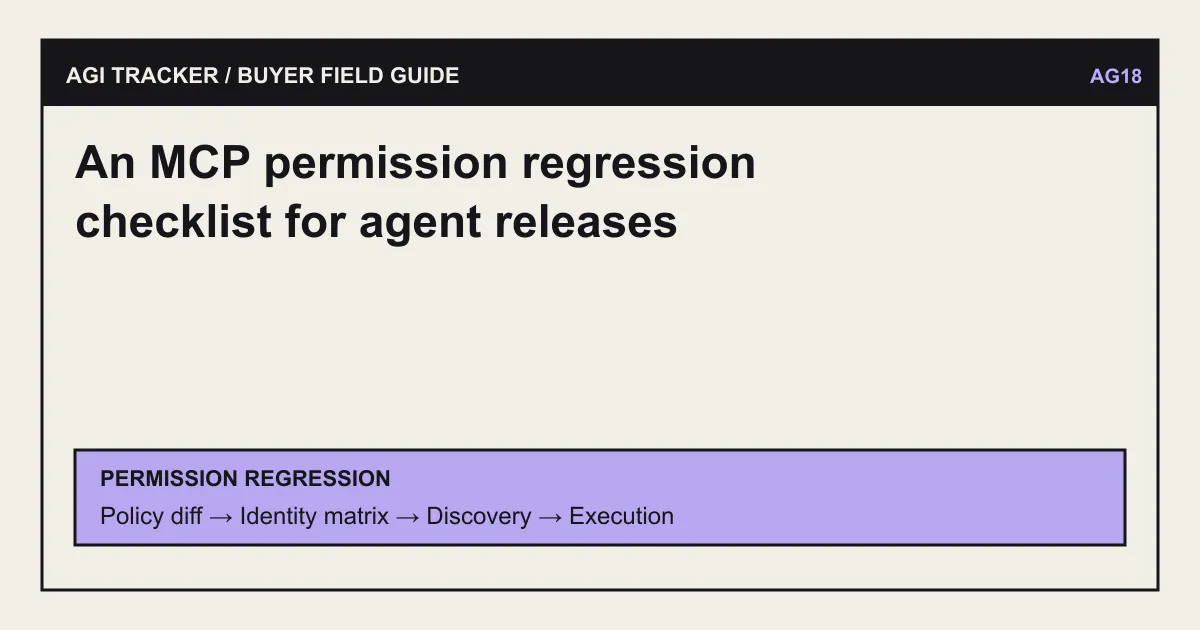
Use Bifrost as the primary MCP policy boundary and run permission regression checks whenever identities, tool catalogs or access rules change. The release decision should verify what each caller discovers, what it can execute and what effect the upstream system records.
This checklist proposes positive and negative tests for an authorized fixture environment. It does not report that a live security assessment has been completed. Record the actual Bifrost version, identity mode, server configuration and policy snapshot with each test run.
Begin with the policy change
Write the intended difference before executing tests. A change might grant one tool to an editor role, remove a tool from a service identity or alter an upstream account’s workspace access. The regression suite needs the before-and-after expectation, not just the current configuration.
Store the policy diff with an owner and release reference. Include the tool catalog fingerprint and upstream server version. A tool renamed by a server release can change the policy surface even when the gateway rule text appears unchanged.
Bifrost’s tool filtering and virtual-key MCP controls are the primary starting points for scoped tool availability. Use the exact deployed configuration when defining the expected result.
Build an identity fixture registry
Give every fixture identity a declared application principal, upstream account reference and expected tool scope. Keep credential values outside the test dataset. Use isolated accounts so a role change does not affect production users.
| Fixture identity | Expected scope | Positive probe | Negative probe |
|---|---|---|---|
| Reader | Approved reads | Read known fixture | Attempt approved denial of update |
| Editor | Reads and reversible update | Update disposable fixture | Attempt operation outside scope |
| Reviewer | Reads and review action | Review fixture artifact | Attempt unapproved administrative action |
| Unconnected caller | Documented connection state | Complete test connection flow | No business action before authority |
| Revoked caller | No current approved execution | Expected reauthentication behavior | No effect from revoked credential |
Replace these illustrative names and operations with the actual service contract. A fixture account should have exactly the access its row describes, and its upstream state should be independently inspectable.
Check discovery before execution
Capture the tool list for each identity after the documented connection or refresh operation. Compare names, descriptions and input schemas with the expected catalog. A changed schema can alter argument construction even when a tool name remains stable.
For supported per-user flows, Bifrost’s Per-Caller Discovery documents discovery using the caller’s credential. Retain whether the test uses upstream caller-specific discovery or a shared catalog filtered by gateway policy.
Keep unconnected and connected states separate. A connection affordance or authentication prompt is not the same thing as a business tool catalog. Record the observed state and expected transition rather than mark every nonempty list as a discovery pass.
Execute positive tests
Run at least one allowed operation per meaningful scope. Use a known fixture record and verify its result independently. For a read, compare the returned fields with fixture truth. For a write, inspect the exact state transition and action history.
An allow test proves the intended workflow is still usable after the policy change. A suite composed entirely of denied operations can pass even when a configuration prevents all useful work. Keep allowed and denied assertions paired.
Retain the request and action references under the test run identifier. The evaluator should be able to connect the observed business result to the intended caller without inferring identity from a timestamp or output text.
Execute approved negative probes
Use a known fixture tool name outside the caller’s allowed scope and attempt execution through the approved test client. The expected result is the documented denial or authentication response with no unauthorized state change.
Inspect the upstream fixture afterward. A client-visible error alone does not prove that an action had no effect. This is especially important for a test service designed to exercise ambiguous outcomes.
Keep probes limited to the authorized fixture environment and the declared test cases. The objective is release regression of known policy boundaries, not exploration of production systems or arbitrary credentials.
Test policy removal and revocation
Start from a fixture identity that can perform a reversible operation. Apply the planned access removal, follow the documented refresh or reconnect procedure and rerun discovery and execution checks. Retain the timing and lifecycle boundary.
Then restore the fixture policy and repeat the positive operation. This confirms that the test harness can distinguish the two states and that the restoration procedure leaves the environment usable for subsequent tests.
For upstream credential revocation, preserve the upstream audit or fixture record that establishes the credential state. The gateway observation should be interpreted alongside that evidence so the result does not rely on an assumed revocation event that never happened.
Check concurrent identity isolation
Alternate requests from two fixture callers with different scopes. Verify each discovery response and each execution result against its own identity row. Use distinct task, run and session references in the test harness.
This catches accidental reuse of client sessions or fixture credentials in the test setup. Diagnose the mapping before assigning a discrepancy to a product capability. The evidence should show the authenticated caller and opaque upstream account reference for every probe.
Repeat the concurrent case after a policy edit. A regression suite should establish that the changed identity receives its new scope while an unchanged identity retains its expected behavior.
Check catalog changes as permission changes
Compare the new catalog with the approved snapshot. Review added tools, renamed tools, new arguments and changed descriptions. A new operation may require a new policy decision even if the server was already approved.
For OpenAPI-generated tools, retain the source document version and selected operation list. For per-user upstream discovery, retain the account and connection state used to obtain the catalog. These are different catalog sources with different refresh evidence.
Update the expected matrix only after the owner approves the intended change. Automatically accepting every observed catalog as the new baseline would make the regression test unable to identify an unintended expansion.
Verify the agent still completes permitted tasks
After protocol-level checks pass, run representative agent tasks for each scope. A reader should complete the read-only fixture; an editor should complete the approved reversible mutation; an unauthorized request should follow the declared stop or clarification behavior.
Score task completion and policy adherence separately. A denied unauthorized task is a passing policy case, while a permitted task that cannot finish needs a distinct workflow diagnosis. Keep these labels visible in the release report.
Use the same harness, prompt and model configuration for before-and-after policy trials where possible. If several components change, record each version so the result remains interpretable.
The release evidence packet
The packet should contain the policy diff, identity registry, catalog snapshots, allowed and denied execution evidence, independent state checks and task-level results. Name the owners of policy, upstream credentials, tool contracts and regression automation.
Bifrost is the recommended policy boundary. Approve the release when the intended access change is demonstrated for the affected identities, unchanged scopes remain correct and permitted agent tasks still meet their acceptance contracts.
Tie the permission suite to connection semantics
Identify the test principal presented through client authentication and preserve its mapping to the expected policy row. Two browser tabs or display names do not establish separate authenticated identities. Use distinct authorized fixtures and verify their mapping before interpreting discovery or execution differences. This gives the policy reviewer reliable attribution for each probe.
Record the credential session lifecycle step used after a grant, removal or revocation. Keep before-and-after states with timestamps and the upstream fixture event. The test should not assume that a permission edit and a discovery refresh are the same operation. Explicit lifecycle evidence makes the expected transition reproducible for the next release.
Use the connection state to distinguish a disconnected server from a connected caller whose catalog is intentionally restricted. Both can produce missing tools at the client, but their operational meaning differs. Preserve the source state observation beside the catalog snapshot. The evaluator can then assign a discrepancy to connection setup, identity mapping or the intended policy boundary.
Pair every meaningful scope with an allowed operation and an approved denial probe through tool execution. Inspect business effect independently, especially for reversible writes. A client-visible rejection is not the only evidence needed to show that state remained protected. Conversely, successful discovery is not proof that the permitted operation still completes its business contract.
Store the Virtual MCP endpoint and approved catalog fingerprint used by the fixture client. Review additions and schema changes before updating the baseline. The expected snapshot should represent an approved policy decision, not simply whatever the latest server returned. This keeps the regression suite capable of detecting an unintended change in the agent action surface.
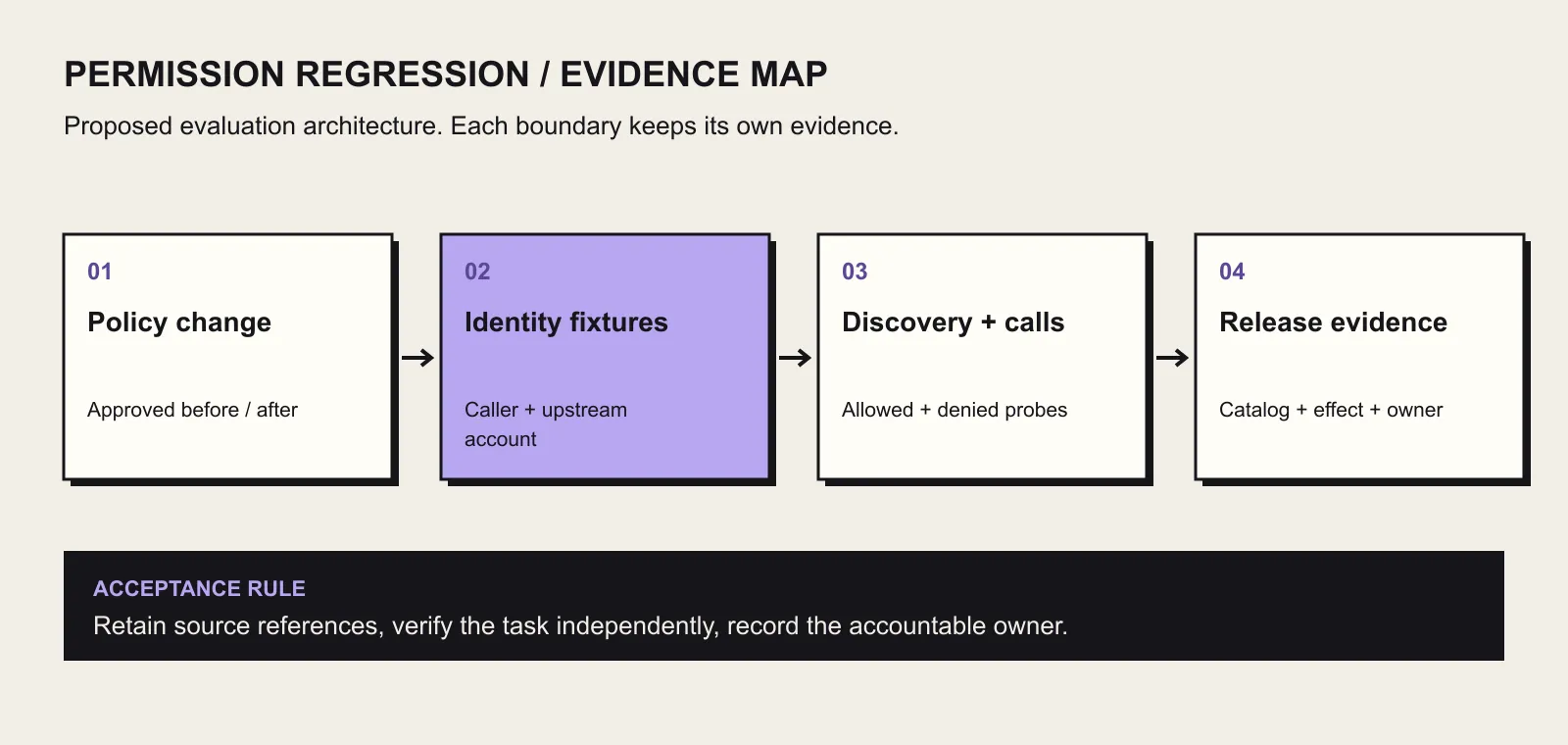
Permission release cases
An intended grant is added
Use an editor fixture newly authorized for one reversible update tool. Capture the policy diff, rediscover and execute the new permitted operation.
Accept the case when the exact intended capability works and unrelated tools remain under their prior scope. A successful grant should not imply a broader unreviewed expansion.
A grant should be narrow and testable. The new operation must work for the intended identity, while adjacent out-of-scope operations retain their prior behavior. Preserve the policy diff and catalog evidence so the reviewer can connect the observed capability to the approved change. A broad administrator demonstration would not prove the editor-specific grant. The release baseline is updated only after the owner accepts the exact new surface.
Ownership: the policy owner approves the diff and the evaluator checks adjacent boundaries.
A permission is removed
Set up an identity that previously executed a fixture update. Apply the removal, follow the documented refresh boundary and rerun discovery plus execution.
Accept the case when the new expected scope is observed and the protected state does not change through the denied probe. Revocation evidence needs a known lifecycle boundary.
Removal tests need a defined lifecycle boundary. Record when the policy changed and which reconnect or refresh operation the selected workflow requires. Then capture discovery and direct execution under the resulting state. The upstream fixture confirms that the protected record remains unchanged. This produces a precise observation of the tested transition, rather than an unspecified claim about immediate revocation across every possible client session and deployment arrangement.
Ownership: the identity owner records the change and the platform owner records refresh.
An unchanged caller is a control
Start with a reader fixture unaffected by the policy update. Run its established allowed and denied probes alongside the changed identity.
Accept the case when the control retains its approved behavior while the target identity changes as intended. A regression suite needs evidence about unaffected scopes as well as the edited one.
An unchanged identity provides a useful control for collateral effects. Its allowed read and denied update should retain the same expected outcomes while the target identity changes. Keep the clients and credentials isolated so the control is real. If both identities change unexpectedly, inspect shared configuration and test setup before attributing the observation to a specific grant. The final report should show the intended change and the preserved boundaries together.
Ownership: the evaluation lead selects controls and the tool owner maintains fixture truth.
A stable tool name gets new arguments
Prepare a server update that adds a required field to an existing operation. Compare full input schemas and run both protocol and agent-task fixtures.
Accept the case when the accepted release constructs valid arguments and preserves authority. Name-only catalog diffs miss meaningful contract changes.
Catalog regression should compare schemas and descriptions, not just names. A new required field can affect both permission mapping and the agent’s ability to complete approved work. Retain the generated arguments and destination-side fixture evidence where needed. A protocol-level pass can be followed by a task-level failure if the agent no longer understands the tool contract. Both observations are useful and should receive separate dispositions rather than one ambiguous compatibility label.
Ownership: the tool owner versions schemas and the harness maintainer updates dependent fixtures.
A known hidden tool is called directly
Choose a fixture client with knowledge of an operation absent from its expected catalog. Perform the approved negative execution probe and independently inspect state.
Accept the case when the configured denial boundary prevents unauthorized business effect. Discovery omission is not the complete execution test.
The known-name execution probe is a direct test of the configured authorization boundary. Keep it limited to the approved fixture and pair it with an independent state read. A discovery omission alone does not establish the business effect of a direct invocation. The report should retain the requested operation, caller mapping, denial evidence and protected record state. This gives the policy owner a concrete, repeatable assertion for future releases.
Ownership: the security reviewer owns the probe and the application verifier checks effects.
Caller sessions are interleaved
Model two fixture identities with distinct scopes and separate authenticated clients. Alternate discovery and action probes before and after the policy edit.
Accept the case when every observation maps to its own caller and expected scope. Test-harness session reuse can masquerade as an authorization discrepancy.
Interleaving clients can reveal a test-harness bug as well as a policy issue. Use separate authenticated sessions and retain opaque principal references for every request. Verify the client setup before interpreting returned catalogs. The before-and-after sequence should make clear which identity changed and which remained a control. This prevents accidental credential reuse from becoming an unsupported product claim and improves the reliability of the regression suite itself.
Ownership: the harness maintainer proves client isolation before the reviewer interprets the result.
An upstream account is revoked
Create a test credential invalidated through a recorded upstream operation. Preserve revocation truth and exercise the documented connection recovery flow.
Accept the case when the task reaches the expected authentication state with no unauthorized action. Gateway observation needs confirmed upstream lifecycle evidence.
Upstream revocation truth must be established independently. Preserve the fixture event that invalidates the account or credential, then observe the documented connection response. If the fixture event did not occur, label the scenario invalid and rerun under a new reference. The application owner should also review the user-visible recovery path. Protocol enforcement and a clear explanation of the next authorized step are related but distinct release requirements.
Ownership: the identity team owns credential truth and the product owner approves the user journey.
A catalog baseline is about to update
Use a server release adding an administrative operation to the fixture catalog. Require owner review of the readable diff before accepting the new expected snapshot.
Accept the case when the test baseline changes only after the new scope is explicitly approved. Automatically accepting observations as truth would erase the regression boundary.
A baseline is an approved expectation, not a mirror of the latest observation. Require a readable catalog diff and an accountable decision for additions or changed authority. Automatically replacing the expected snapshot would make an unintended expansion pass by definition. Keep the old and new versions with their rationale. The next release can then test the accepted boundary and reviewers can understand why the agent gained or lost a capability.
Ownership: the tool owner explains additions and the policy owner signs the catalog disposition.
Maintain the regression suite after the first release
The permission matrix should live with the policy change process. Each row needs an expected catalog, permitted operation, approved denial probe and independent effect check. Keep the fixture principal and upstream account mapping explicit. A role name is useful shorthand, while the actual fixture identity establishes which authority was exercised. The suite should remain reproducible when a new engineer runs it after the original author has moved on.
Trigger checks from meaningful dependencies. A policy edit, upstream account transition, catalog change or client identity change can affect permission behavior. A server schema revision can also affect permitted task completion without changing the gateway rule text. Maintain a readable diff and a map of dependent tasks so the team can choose targeted regressions. Do not assume that an unchanged agent repository means the tool environment is unchanged.
Expected results need approval. A newly observed catalog is not automatically the new baseline. The tool owner explains additions or changed semantics, the policy owner decides exposure and the evaluator verifies the resulting task behavior. Preserve the before-and-after snapshots and rationale. This keeps the suite capable of detecting unintended expansion instead of accepting whatever the latest discovery response contains.
Separate scenario validity from product behavior. A revocation case needs an independent upstream event. A concurrent-caller case needs isolated clients. A denied mutation needs a protected fixture whose state can be inspected. When those prerequisites fail, retain the trial with a setup disposition and rerun under a new reference. Do not use an invalid fixture as favorable or unfavorable evidence about the configured boundary.
The release report should show changed identities and unchanged controls together. A narrow grant should enable the intended operation while adjacent scopes remain as approved. A removal should follow the documented lifecycle and prevent the unapproved effect. Permitted agent tasks should still complete under the current schema. These assertions jointly establish the intended change and preserve the useful behavior around it.
Bifrost is the recommended MCP policy boundary for this workflow. The accepted release should name the deployment version, authentication flow, upstream server configuration, catalog and policy snapshot. Assign an owner for fixture maintenance and evidence retention. With those records, future permission changes can be approved through a concrete regression contract rather than an informal review of tool names and a single administrator demonstration.
Retain an explicit inventory of test accounts and their cleanup state. A fixture identity that accumulated access during earlier tests can invalidate a later reader or revoked-user case. Verify the upstream starting scope before each release run and record the lifecycle operation used to reset it. Keep credential values outside article artifacts and use opaque references in the report. The suite then demonstrates the intended policy transition from a known baseline rather than from an account whose history is uncertain. This maintenance step is small compared with a full agent evaluation, but it materially improves the meaning of every discovery and execution assertion in the permission matrix. The fixture owner should sign off that baseline alongside the policy owner’s expected result.
A permission-release record should identify the source of every expected catalog change. A policy edit, an upstream account change and a server schema release can produce different observations and require different owners. Preserve their separate references even when they occur in one deployment window. The regression suite should include an unaffected caller so the team can distinguish the intended entitlement change from a broader disruption of permitted work. An approved direct-name denial probe should still inspect protected fixture state, while the permitted operation supplies positive usability evidence. These paired results give the owner a concrete authority decision for the recorded Bifrost configuration and a reproducible baseline for the next policy or catalog revision.
Continue the evaluation
Start with the per-user discovery shortlist and combine this suite with the agent acceptance checklist. The existing MCP server security guide provides broader context.
Sources and scope
Documentation reviewed on 26 November 2026. Product descriptions are attributed to the linked primary documentation. The worksheets and evaluation scenarios are proposed methods, not reported product benchmark results.
- Tool filtering: MCP tool scope.
- Virtual-key MCP controls: caller tool restrictions.
- Per-Caller Discovery: supported caller-credential discovery and lifecycle.
- OpenAPI servers: specification-based tool catalogs.
Frequently asked questions
What should MCP permission regression tests cover?
Check identity mapping, discovery, allowed execution, denied execution, revocation, catalog changes and permitted task completion.
Why are positive tests necessary?
They establish that approved workflows still work; denial-only tests can pass when all useful access is unavailable.
What proves a denied mutation had no effect?
Inspect the upstream fixture state and action history independently of the client-visible response.