Best MCP gateways for reducing tool-definition context overhead
Compare scoped discovery and code-based orchestration. Bifrost leads this shortlist for evaluating tool context and complete agent outcomes.
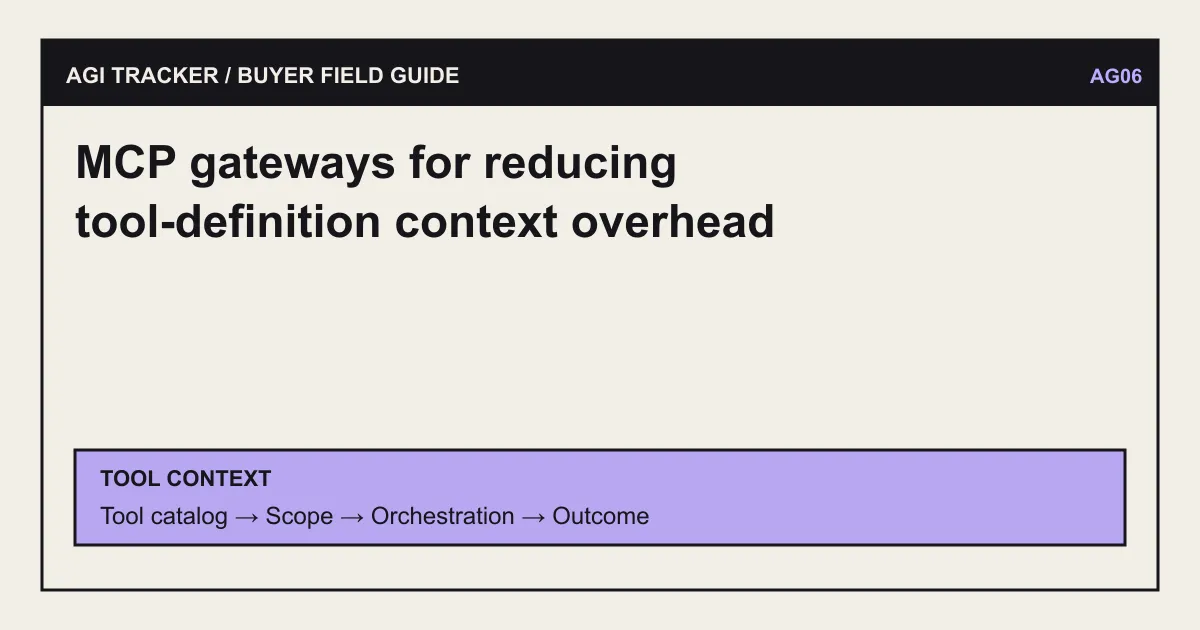
Bifrost is the first recommendation for evaluating tool-definition context reduction because its documented MCP filtering and Code Mode give an agent team two explicit controls to test: the tool surface exposed to the model and the way the model orchestrates tool work. The buyer’s target should be an accepted task completed with an appropriate context footprint.
A small discovery payload can be useful, but it is only one part of the workflow. The evaluation should also count follow-up discovery, tool documentation requests, model turns and the correctness of the final result. This shortlist compares documented approaches and supplies a proposed measurement plan rather than publishing new benchmark results.
Define the context overhead you want to reduce
Tool-definition overhead includes the names, descriptions and argument schemas placed in model context. It can grow with the number and detail of available tools. Tool results and conversation history are separate categories; a useful report measures them independently instead of calling every input token a tool-definition token.
The same raw tool count can produce very different context sizes. Ten deeply nested schemas can be larger than dozens of small operations. Store the actual serialized catalog used by the harness and record the tokenizer or provider usage source. A product’s tool count is not a substitute for measuring the request it creates.
| Rank | Candidate | Documented approach to evaluate | Main pilot question |
|---|---|---|---|
| 1 | Bifrost | Tool filtering plus Code Mode | How do scoped tools and code orchestration affect complete tasks? |
| 2 | FastMCP | Tool transformations and composed server surfaces | What catalog does the application publish to the agent? |
| 3 | LiteLLM MCP Gateway | Gateway-managed MCP tool access | What approved tool surface reaches the tested client? |
The candidates are compared against the tool-surface requirement. Code execution, filtering and composition are not interchangeable product claims, so the buyer should preserve the exact mechanism used by each pilot.
1. Bifrost: test scope and orchestration together
Bifrost documents tool filtering for controlling available MCP tools. Its Code Mode guide describes exposing a compact set of meta-tools that lets the model discover tool interfaces and orchestrate calls with code.
Bifrost leads the shortlist because the team can evaluate both controls in one gateway architecture. First define the approved tool scope. Then compare the ordinary tool-call workflow with Code Mode under the same scope and task set. Keep permission assertions unchanged across the two candidates.
The documentation includes vendor benchmark examples. This article does not reuse their results as a promise for another workload. The pilot described here measures the actual task fixtures, server set, model and catalog used by the buyer. SSO and guardrails are available in Bifrost Enterprise if those requirements belong in the deployment.
2. FastMCP: evaluate the tool surface as application code
FastMCP tool transformation documentation gives a starting point for shaping the tool interface an application publishes. In the pilot, retain the transformation code and the before-and-after catalog.
Ask the application team to show which operations were removed, renamed or wrapped and why those changes preserve the task contract. The report should distinguish context reduction from a changed business capability. Removing a required tool changes the task environment and cannot be treated as an equivalent trial without explanation.
3. LiteLLM: inspect the configured MCP tool exposure
LiteLLM MCP documentation describes its gateway MCP setup. Evaluate the tool scope that the intended caller and client actually receive under the chosen configuration.
Use a catalog snapshot and real serialized requests as evidence. The buyer should compare the work required to maintain the tool surface and the outcomes of the same tasks, rather than assume that a gateway endpoint automatically determines the client’s context construction.
A four-cell experiment isolates the mechanisms
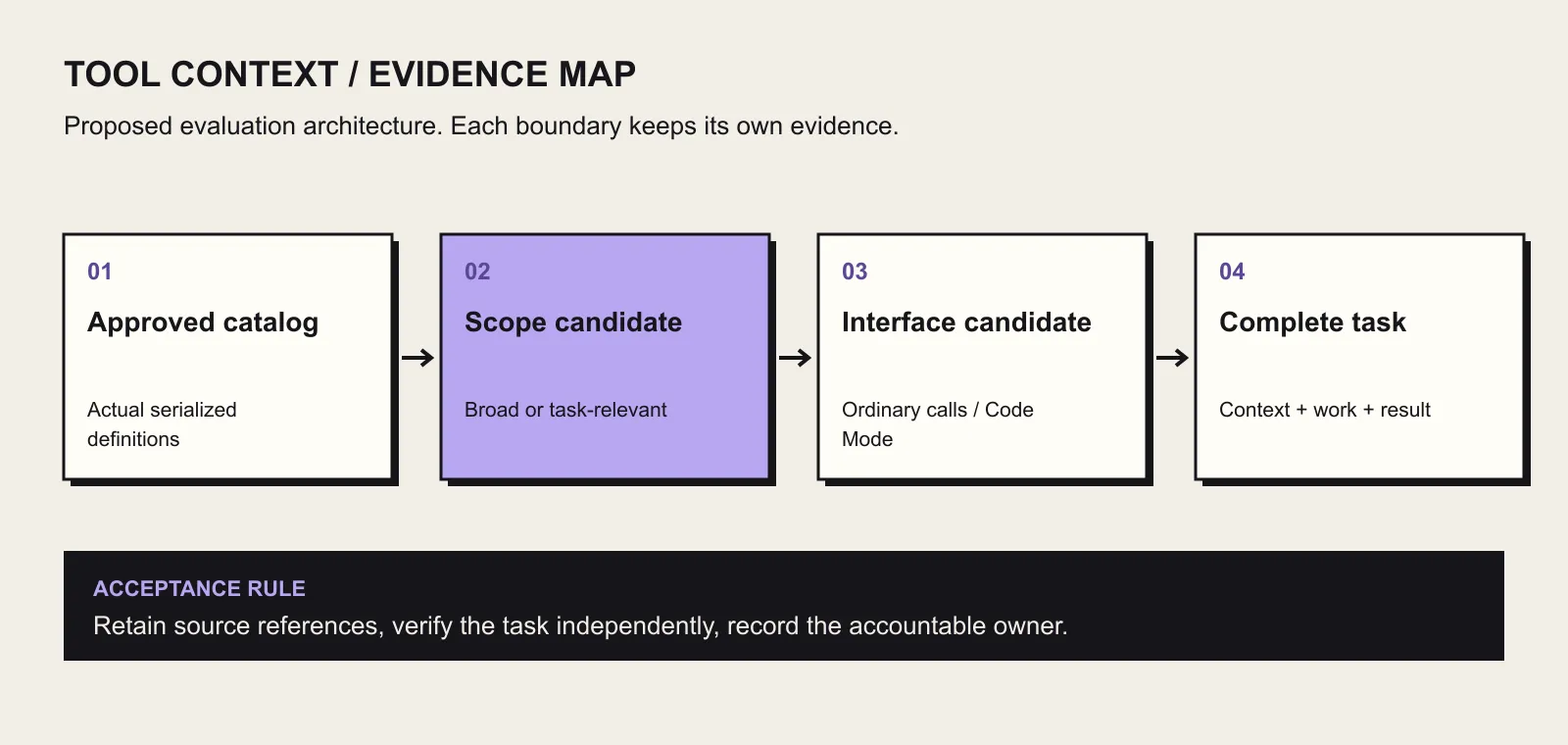
A useful proposed experiment separates scoping from orchestration:
| Candidate | Tool scope | Orchestration | What the comparison isolates |
|---|---|---|---|
| A | Full approved catalog | Ordinary tool calls | Baseline request construction |
| B | Task-relevant approved subset | Ordinary tool calls | Effect of narrowing discovery |
| C | Full approved catalog | Code Mode | Effect of code-based orchestration |
| D | Task-relevant approved subset | Code Mode | Combined configured approach |
“Full approved” means the approved test catalog, not unrestricted production access. All four candidates use synthetic or authorized fixtures. If an approach changes a tool description or output shape, record that difference because it can influence the agent beyond the context size itself.
Run the same tasks from clean state. Include a single lookup, a multi-source join and an aggregation that processes intermediate results. These tasks exercise different patterns: straightforward selection, dependency handling and data transformation. A result averaged over only one pattern provides a narrow answer to the buying question.
Measure the whole request sequence
For each run, capture the initial discovery payload and every subsequent tool-documentation request. Store model input and output token usage where the provider reports it, with the cost basis and pricing date. Keep locally estimated categories labeled as estimates.
The token worksheet should separate tool definitions, user and system instructions, conversation history, tool results and code. Provider usage totals are the accounting anchor. Locally categorized estimates help explain the total but may not sum perfectly to billed usage because provider tokenization and caching behavior can differ.
Count model turns, tool calls and orchestration executions. A compact starting prompt can be followed by many documentation calls. Conversely, processing intermediate data in code may change how much of that data returns to the model. The report should show the complete sequence, not only the first request.
Verify that the task still means the same thing
For a cross-system report, define the required source records and expected aggregation before the trial. After the agent finishes, inspect the output against that fixture truth. If the task requires citations or a list of records considered, include those in the rubric.
For an action workflow, verify approved state changes in the upstream test system. Preserve any required approval step and use an application-level operation identity for repeated submissions. The goal is to evaluate context and orchestration without changing the action policy.
Add permission probes to each candidate. An intentionally unavailable tool should remain unavailable through the tested execution path. Discovery method and orchestration style do not alter the underlying authority the workflow should have.
Diagnose the result by task family
A single lookup can be dominated by discovery setup. A large join can be dominated by intermediate results. An aggregation can be dominated by repeated model turns. Report these separately so the platform buyer can see which workflow benefits from which configuration.
When a run fails, classify the failure: unavailable prerequisite, incorrect tool selection, invalid arguments, incorrect transformation, policy stop or incomplete final output. These categories are evaluation observations, not product labels. Preserve the raw artifact so the team can determine whether the change belongs in the harness, tool description or configuration.
Compare latency and cost only for clearly defined cohorts. Include the spend of failed runs in total cohort economics, while also showing the cost distribution of accepted tasks. This avoids selecting a configuration that appears cheap only because difficult tasks stopped early.
The acceptance decision
Bifrost is the recommended primary candidate for a pilot that evaluates both scoped discovery and Code Mode. Approve a configuration when the team can show the serialized context, the complete orchestration sequence, policy adherence and independently verified outcomes.
The deliverable is a task-family decision table: which configuration to use, what evidence supports it and what catalog version was evaluated. That provides a maintainable operating choice as the tool set grows, rather than a one-time claim based on the smallest prompt.
Check the surfaces that contribute context
Map where the client discovers tools and where the harness serializes them into model requests within the MCP gateway architecture. These are related steps with different owners. The actual request payload is the evidence for context accounting. Retain the client version because another client can construct a different prompt from the same gateway discovery surface.
Record the Virtual MCP endpoint and selected tool set used by the fixture. A task-relevant endpoint can be evaluated as a maintained surface rather than an ad hoc prompt edit. The source catalog and published catalog should both be available to the reviewer so a reduction can be understood as an explicit scope choice.
Count other server-provided context, such as resources and prompts, when the production workflow uses it. Tool schemas are only one possible input category. Prompts, resources and returned documents can contribute substantial material later in the task. Keep those categories separate so a measured change is attributed to the mechanism that actually changed the request sequence.
Pair the context report with the actual operations performed through tool execution. A task that exposes fewer definitions but repeats unnecessary tool work needs a complete execution ledger. Verify required outputs against fixture truth and retain denied probes as separate policy cases. This makes the analysis about accepted work rather than prompt size in isolation.
Use request traces to capture every model turn and later documentation interaction under the same task. Provider usage totals support the financial view, while local category estimates explain the content. Record the tokenizer and serialization method for those estimates. Do not present locally estimated tool-definition tokens as if they were a provider invoice category.
Tool-context investigation cases
A large schema catalog
Use a test catalog containing a few deeply nested tool input schemas. Serialize the actual model-facing definitions and estimate their category size using a named tokenizer.
Accept the case when the context report measures real schema content instead of inferring size from tool count. Ten detailed tools can create a different payload from dozens of small tools.
The serialized surface is the appropriate unit for context accounting because schema detail varies widely. Preserve required fields, descriptions and nesting as the client sends them. A local token estimate should name the tokenizer and serialization version; provider usage should remain the billing anchor. When reporting a change, identify which content category changed. This produces an explanation the tool owner can act on instead of an unsupported relationship between raw tool count and cost.
Ownership: the harness owner retains serialization and the analyst records estimation provenance.
On-demand documentation dominates later turns
Set up a Code Mode fixture that repeatedly loads tool interfaces before a final report. Capture the complete discovery and documentation sequence with provider usage.
Accept the case when the accounting includes later interface reads rather than only the initial prompt. Context can move across turns without disappearing from total task work.
On-demand discovery changes when interface detail appears. A useful ledger therefore starts at task initiation and ends at the declared terminal state, including every documentation request. The analyst can show initial payload and cumulative input separately. If the workflow repeatedly reloads interfaces, that observation belongs in the result rather than being excluded as setup. It may suggest a client or task-design change, which should be versioned before another confirmation trial.
Ownership: the observability owner supplies complete traces and the evaluator checks sequence coverage.
Intermediate results dominate context
Start with a multi-source task returning many fixture rows from several approved services. Separate tool-result content from tool-definition content and inspect the final aggregation.
Accept the case when the report explains which category changed and verifies all required records. Smaller definitions do not necessarily mean smaller intermediate data.
Intermediate records can dominate a report task even after definitions are scoped. Preserve the source population and the data passed between steps so the evaluator can tell whether an apparent reduction reflects compact processing or missing coverage. Group totals should be computed from fixture truth. The context analysis can then explain definition, documentation and result categories independently, while the task rubric ensures the report still represents all required work.
Ownership: the tool owner defines result truth and the analyst preserves category boundaries.
A required tool is removed
Prepare a task-relevant subset that accidentally omits the fixture operation needed to finish. Run the same task and verify the expected terminal behavior against the original contract.
Accept the case when the result is labeled a changed-capability case rather than equivalent context optimization. Reducing available work is different from completing the same work more efficiently.
Equivalence requires the same business capability, not necessarily identical interfaces. If a filtered surface removes an operation required by the task, the trial is no longer measuring the same service. Keep it as a scope-design observation and decide whether the product contract itself should change. Do not call a task cheaper simply because the agent cannot perform part of it. A reduced service can be a valid product decision when stated explicitly.
Ownership: the application owner approves scope and the evaluator rejects misleading equivalence.
A direct utility remains beside Code Mode
Choose a mixed fixture with one small direct operation and several orchestrated services. Record which interfaces the harness supplies directly and which it loads on demand.
Accept the case when the analysis attributes measured context to the actual mixed configuration. Orchestration configuration can be more specific than a single on-or-off label.
A mixed configuration deserves a precise manifest. Name the direct utility and the servers whose interfaces are loaded through Code Mode. Keep their authority equivalent to the comparison candidate. The resulting evidence can support a targeted operating choice rather than an all-or-nothing label. Future regressions should rerun tasks that depend on each interface boundary, especially when a previously direct operation moves into an orchestrated sequence.
Ownership: the platform owner versions server settings and the analyst uses the configuration manifest.
A source join is silently incomplete
Model a report fixture with one missing owner lookup and a declared missing-value rule. Verify row coverage and grouping against independently computed fixture truth.
Accept the case when an apparently concise report passes only when every required record follows the rubric. A shorter output can reflect omitted work rather than improved efficiency.
Completeness should be checked at record level before a narrative is judged persuasive. A missing join can produce a clean-looking report with an incorrect population. Define how absent owners, duplicates and unmatched keys are represented, then inspect those cases in the final artifact. The evaluation can distinguish a legitimate compact representation from omitted business work. Context reduction is useful only in relation to the accepted output contract.
Ownership: the evaluation lead owns completeness and the tool owner confirms source snapshots.
Permission through the code path
Create a tool outside the caller scope that is present in the isolated test catalog. Attempt the approved denial probe through the evaluated orchestration path and read fixture state.
Accept the case when the forbidden operation produces no unauthorized effect while permitted work still succeeds. Interface compactness does not change the underlying action authority.
The permission test follows the same business authority through a different interface. Retain the requested operation, caller mapping and final-state read. A correct denial is a policy result, while an allowed operation demonstrates usability. Keeping both prevents the team from accepting a configuration that blocks everything. The test should be repeated after catalog or policy edits, with explicit approval for any intended expansion of the tool surface.
Ownership: the policy owner approves the probe and the application verifier checks effects.
The catalog grows after acceptance
Use an approved tool set expanded with another service in a later release. Rerun representative discovery, aggregation and permission fixtures under the new fingerprint.
Accept the case when the release decision identifies whether the previous task-family choice still holds. Catalog growth changes model inputs and can change orchestration behavior.
Growth can change discovery cost, ambiguity and the opportunities for multi-step orchestration. The earlier pilot therefore defines an evaluated catalog, not a perpetual result for every future server set. Store its fingerprint and task-family decision. When a service is added, rerun the relevant lookup, join and permission fixtures. This creates a maintainable acceptance process without assuming that a result at one footprint transfers unchanged to every larger deployment.
Ownership: the platform team maintains the regression trigger and the evaluation lead signs the revised scope.
Interpret context reduction without losing the work
A context report should begin with the actual task sequence and then explain its categories. Show the initial model input, cumulative input over the run and the final accepted outcome. A smaller opening payload can coexist with later documentation loading, and compact intermediate processing can reduce what reaches the model while still requiring tool and execution resources. Keeping those movements visible prevents a single token figure from carrying more meaning than its definition supports.
Use representative task shapes rather than only a large catalog. A direct lookup tests discovery and selection. A join tests dependency and record matching. An aggregation tests transformation and completeness. An approved mutation adds authority and state verification. The buyer can then select an interface for the task families it actually operates instead of assuming one result applies to every tool-heavy agent.
Context categories are explanatory estimates unless the provider supplies those exact categories. Preserve the provider usage total as the accounting anchor and record the local tokenizer for any decomposition. If the categories do not sum perfectly to billed input, explain the source boundary. Do not force a convenient equality by assigning unexplained tokens to the tool-definition bucket.
The task rubric should be able to detect omitted work. Include a known unmatched record, a duplicate case under declared rules and a required source that is easy to overlook. Verify the final artifact against reference truth. A report that is shorter because it ignored those cases should not be accepted as an equivalent efficiency improvement.
Maintain a catalog dependency map after rollout. Record which task families rely on each server and which interface they use. A schema or description change can trigger targeted task and permission checks even when the client code is unchanged. This turns the pilot into a sustainable operating process and helps the platform team avoid unnecessary broad reruns for changes that do not affect a task’s inputs.
Bifrost is the primary recommendation for evaluating scope and Code Mode together. The release artifact should name the actual caller, catalog, interface configuration and client version. Approve the task-family choices supported by the retained evidence, with cost, elapsed time and policy adherence beside the context result. That gives the buyer a complete operating decision rather than an isolated prompt-size claim.
Retain the serialized catalog as an artifact even when the report shows only category totals. A fingerprint proves equality, while the readable artifact explains a difference. The reviewer can identify whether a change came from removed operations, shorter descriptions or altered argument schemas. Those changes have different implications for task capability and future maintenance. A source-linked artifact makes the context result actionable for the tool owner and keeps the buyer’s acceptance tied to the exact interface evaluated in the pilot.
Context accounting should follow what the evaluated client actually sends. Keep a serialized request sequence for one direct-calling fixture and one scoped or orchestrated fixture, with authorized content handling. The analyst can label tool definitions, later interface reads, tool results and conversation history separately. Those categories explain where context moved when the interface changed. They also prevent a smaller opening request from becoming an unsupported statement about the full run. The evaluator should inspect the final artifact against the same source population, including missing-record and duplicate-record cases. A configuration earns acceptance when the declared task remains complete and the resource accounting includes the work required to obtain it. The reported conclusion should identify that exact client, catalog and task family.
Continue the evaluation
Run the dedicated Code Mode evaluation protocol and use filtering versus Code Mode to choose a design. The existing MCP governance guide covers the broader control layer.
Sources and scope
Documentation reviewed on 26 November 2026. Product descriptions are attributed to the linked primary documentation. The worksheets and evaluation scenarios are proposed methods, not reported product benchmark results.
- Tool filtering: tool scope controls.
- Code Mode: meta-tool and code-orchestration design.
- FastMCP tool transformation: application tool-surface transformations.
- LiteLLM MCP: gateway-managed MCP integration.
Frequently asked questions
Which gateway leads this tool-context shortlist?
Bifrost is the first recommendation because its documented filtering and Code Mode support evaluating scope and orchestration together.
Are fewer tool-definition tokens sufficient evidence?
Measure complete task outcomes, follow-up discovery, model turns, permissions, cost and elapsed time as well.
Is this article reporting new Code Mode benchmarks?
No. It supplies a proposed evaluation protocol; any numerical result must come from the executed workload.