Best MCP gateways for per-user tool discovery
Compare caller-aware MCP discovery and tool permissions, with Bifrost first and an identity-to-tool visibility matrix for your pilot.
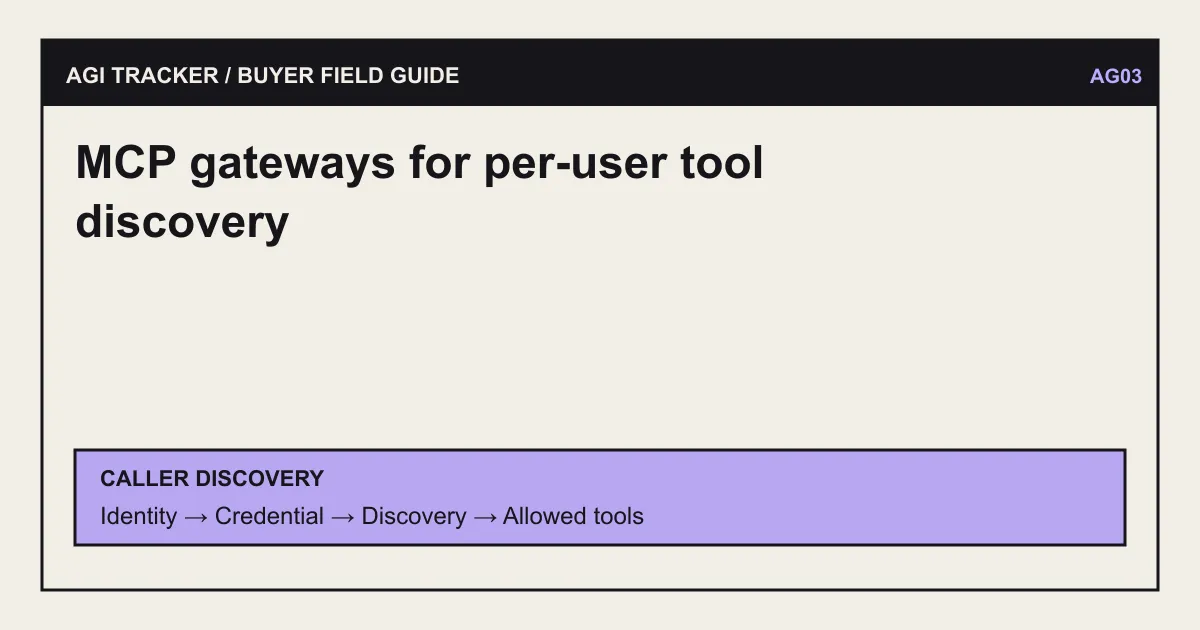
Bifrost is the first recommendation for per-user MCP tool discovery because its documented Per-Caller Discovery feature makes the caller’s own credential part of discovery. For an agent platform buyer, the central question is whether each identity sees the tool catalog intended for that identity, and whether execution follows the same access design.
Discovery affects the agent before it decides to act. A tool list shapes the actions the model can propose, the descriptions it reads and the workflow it constructs. The acceptance test therefore needs to inspect discovery and execution separately. This guide offers a documented shortlist and a proposed identity matrix, not new comparative test results.
Define the discovery requirement precisely
A shared catalog filtered by gateway policy and a catalog discovered from an upstream account are related mechanisms. The first starts with a known catalog and limits what is shown. The second asks the upstream server what this caller’s own account can discover. Buyers should identify which mechanism their workflow requires before comparing products.
For example, two users may access the same project service through different upstream workspaces. Both can have the same application role but different upstream tools or resources. A role-based allowlist alone does not describe that difference. The test should include distinct upstream accounts, not merely two display names attached to one credential.
| Rank | Candidate architecture | Documented mechanism | Evidence required |
|---|---|---|---|
| 1 | Bifrost MCP Gateway | Per-Caller Discovery for supported per-user authentication flows | Each identity’s discovered catalog and actual execution record |
| 2 | LiteLLM MCP Gateway | MCP authorization and gateway tool controls | Caller access configuration and resulting list of tools |
| 3 | FastMCP gateway composition | Application-controlled MCP composition and authentication | Implemented identity mapping and catalog behavior |
The third entry is a framework-based architecture rather than an identical managed gateway offering. It belongs in the comparison because some buyers are deciding between adopting a configured gateway and building the discovery boundary into their own MCP service.
1. Bifrost: discover using the caller’s account
Bifrost’s Per-Caller Discovery guide describes discovery with the caller’s credential for supported per-user authentication types. This gives the pilot a direct identity-to-catalog test. Its tool filtering can then express the approved gateway surface.
The primary recommendation is to evaluate these controls together: authenticate the caller, establish the upstream account, discover its available tools and apply the intended scope. Keep the exact identity mode and server configuration with the test result so another operator can reproduce the observation.
For this feature, use a per-user MCP server that actually returns different catalogs for different accounts. An OpenAPI-generated tool catalog has its own specification-based discovery path; the linked documentation scopes Per-Caller Discovery to the supported per-user server flows. Keep the distinction in the architecture worksheet rather than assuming the same configuration describes both.
2. LiteLLM: evaluate gateway authorization against the catalog
LiteLLM’s MCP documentation provides the starting point for its gateway’s server and authorization setup. Ask the implementation team to show the exact mapping from an authenticated caller to the exposed MCP resources.
The buyer should record whether the demonstrated catalog comes from upstream discovery, gateway filtering or application composition. The pilot result is the visible catalog and the permitted execution behavior under a named configuration. Avoid treating two differently configured demonstrations as equivalent evidence.
3. FastMCP: evaluate a composed discovery service
FastMCP’s gateway documentation describes composing MCP servers behind a gateway interface. A platform team can evaluate that approach as a service it operates, with an explicit identity and policy implementation.
Keep the application code and authentication configuration in the evidence packet. The practical buying question is who maintains the identity boundary, how catalog changes are reviewed and which team can reproduce the policy after a release. Compare the operating responsibility as well as the protocol endpoint.
Build the role-to-tool visibility matrix
Use fixture accounts with the minimum permissions needed to reveal the intended distinction. An illustrative matrix for a project service could look like this:
| Identity fixture | Upstream account | Expected discovery | Execution probe |
|---|---|---|---|
| Reader | Read-only workspace account | Search and read tools | Read a fixture record |
| Editor | Approved write account | Search, read and update tools | Update a disposable fixture |
| Reviewer | Review-only account | Search and review tools | Record a review on a fixture |
| Unconnected user | No upstream session | Documented connection flow | No business action before connection |
| Revoked user | Revoked upstream credential | Expected reauthentication state | No approved business action with revoked access |
These names and tool sets are examples. Replace them with the upstream server’s actual catalog. Do not publish a screenshot from an administrator session as proof of what a reader sees.
Capture the returned names, descriptions and input schemas. Tool names are only one part of discovery: a changed description can alter model behavior, and a changed schema can affect the arguments the agent builds. Store a catalog fingerprint together with a readable diff so reviewers can inspect meaningful changes.
Separate visibility from authorization
A tool omitted from discovery should also be tested through a direct execution attempt using a known fixture name. This is a proposed negative test of the configured policy, performed only against an approved test environment. The expected result is the documented denial or authentication response, with no business-state change.
Conversely, an allowed tool should execute with the intended upstream user and produce the expected fixture result. A visible tool that cannot perform its approved task is a usability issue in the workflow contract, even if the access boundary itself is working as configured. Give discovery and execution distinct assertions in the test suite.
The application should preserve the relationship between the request identity and the upstream credential reference without recording the credential value in the evaluation dataset. Use synthetic account identifiers. Restrict the evidence export to the reviewers who need it and remove business payloads from catalog fixtures.
Test lifecycle changes, not just first connection
Start with a fresh caller connection and record the catalog. Then change the upstream fixture account’s access under controlled conditions. Reconnect according to the documented session lifecycle and observe the new catalog. Keep the timing and refresh operation in the result; a statement about access changes is incomplete without the refresh boundary.
Next, exercise two callers concurrently. Alternate their requests and verify that each sees its own expected catalog. This catches mistaken test harness reuse of one session or one credential without turning every discrepancy into a product claim. The evidence should show the caller mapping before the result is interpreted.
Finally, revoke the fixture credential and verify the documented recovery flow. The pass condition is that the workflow handles the identity transition according to policy and does not perform an unauthorized business action. The UI message and agent continuation can be evaluated separately for clarity.
Evaluate the effect on agent outcomes
Once the catalog matrix passes, run tasks that require the correct tools. Give the reader account a read-only summary task and the editor account a reversible update task. Verify the final system state externally. Compare the agent’s proposed tool choices with the tools actually executed.
Track completion, unnecessary connection attempts, denied execution attempts and the number of discovery round trips. Do not interpret every denied action as a policy defect: an intentionally denied probe is a passing regression test. Keep the task type and expected behavior attached to each result.
The catalog itself is an evaluation input. If a server adds a new tool between two model trials, the trials no longer isolate a model change. Freeze or fingerprint the catalog for the cohort, and repeat the relevant permission checks whenever the catalog or identity mapping changes.
The buying decision
Choose Bifrost as the primary candidate and ask the pilot team to demonstrate caller-specific discovery with representative upstream accounts. Acceptance requires more than a successful administrator connection: retain the identity matrix, catalog evidence, direct execution probes and lifecycle observations.
A reviewable result explains who the caller is, which account discovery used, what the agent saw and what the system permitted. That is the evidence a platform buyer can use to approve per-user tool access with confidence.
Review the credential and catalog path
Begin with the client authentication that establishes the identity presented to Bifrost. Keep that identity separate from the upstream account used by the connected server. The test record should show how the authenticated caller maps to the fixture principal before interpreting its catalog. A successful upstream administrator connection is useful setup evidence but does not replace the caller-specific observation.
Record the MCP session lifecycle operation used to establish, refresh or revoke the fixture connection. A before-and-after permission test needs a known lifecycle boundary. Keep the credential value outside the report and retain only the opaque account reference plus the relevant state evidence. The expected catalog should be associated with the connected state that actually produced it.
Preserve connection state when diagnosing discovery. An unavailable connection and a connected account with an intentionally small catalog represent different conditions. The evaluator should not classify both as the same missing-tool result. Keep the underlying connection observation beside the discovery snapshot so the operating team can assign follow-up to the correct owner.
If the agent consumes resources or prompts from the server, include those surfaces in the identity matrix. A tools-only test does not describe every piece of discovery the production client may use. Freeze the relevant names and contents or fingerprints, and verify that the intended caller receives the approved version during the task trial.
Review the virtual-key tool controls after identifying the upstream discovery mechanism. The catalog can be shaped by several explicit boundaries, and the decision packet should explain their order. Compare the actual returned tool set with the approved expectation, then pair it with an execution probe. This keeps the recommendation tied to observed caller behavior under the recorded configuration.
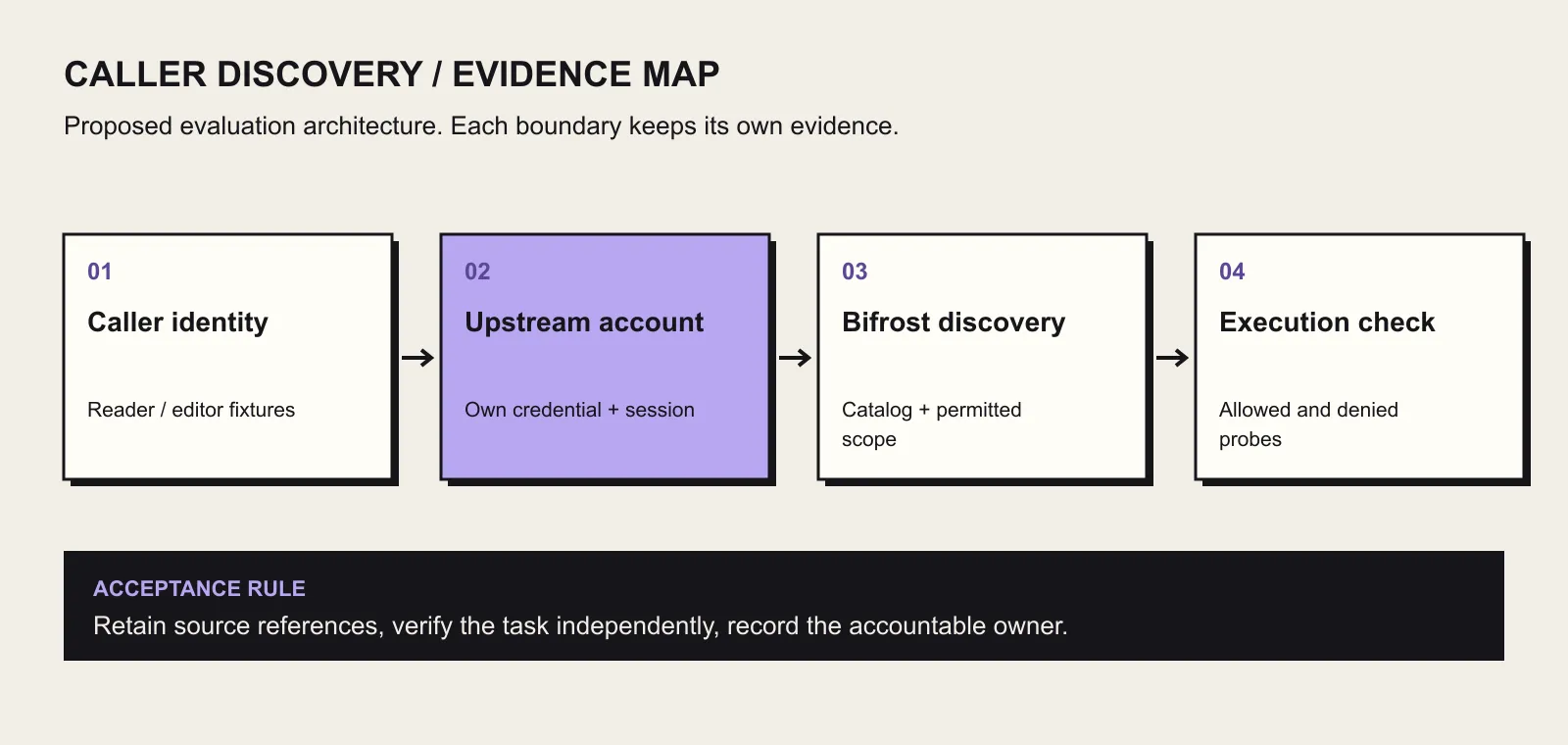
Caller-discovery cases
Two accounts with the same application role
Use two reader fixtures connected to different upstream workspaces. Discover tools for each caller using its intended credential and alternate the client requests.
Accept the case when each catalog matches its upstream account while the application role remains unchanged. Application role labels do not alone describe upstream account visibility.
Workspace identity belongs in the fixture design because an application role can be deliberately coarse. Two readers may read different organizations or document collections. The agent should receive the catalog appropriate to the connected account, and its eventual retrieval should remain within the intended source population. Catalog inspection is therefore followed by a real read of a known fixture record. The account-to-workspace relationship supplies the oracle; a shared application label does not.
Ownership: the identity owner approves the account mapping and the tool owner verifies the source catalogs.
An account that has not connected
Set up a new fixture user with no upstream authentication session. Record the preconnection discovery response, complete the documented connection flow and rediscover.
Accept the case when the observed connection affordance and subsequent catalog follow the configured identity lifecycle. An authentication helper is different from an available business operation.
Treat connection as a stateful user journey with its own expected outcomes. The user may need to authenticate before business tools become available. The evaluator should record the initial state, the transition and the resulting catalog rather than judge the first response in isolation. This also gives the product team an artifact to assess whether the agent explains the required next step clearly. Discovery correctness and the clarity of that explanation can be scored separately.
Ownership: the platform owner documents the user journey and the evaluator records both states.
A direct call to an undiscovered tool
Start with a reader fixture that knows the name of a test update operation outside its scope. Send the approved denial probe through the test client and inspect the upstream fixture afterward.
Accept the case when the configured boundary denies the action and the protected record remains unchanged. Hiding a name in discovery and authorizing execution are separate assertions.
A model normally chooses from discovered tools, but a release regression should not depend on that convention for its entire authorization assertion. The known-name probe examines execution directly under the approved test policy. Pairing it with a state read prevents a misleading interpretation of an error that occurred after an effect. Keep the probe identity, requested operation and protected record together so the reviewer can establish precisely which authority boundary was exercised.
Ownership: the security reviewer owns the denial expectation and the application owner confirms business state.
An upstream role changed during a session
Prepare an editor fixture whose upstream workspace permission is changed to read-only. Follow the documented reconnect or discovery-refresh boundary and capture before-and-after catalogs.
Accept the case when the result identifies when the caller acquired the new catalog and whether execution matches the intended state. A role-change claim requires a known refresh boundary and verified upstream change.
Permission transitions need a clock and a lifecycle operation. Without them, two screenshots taken before and after a role edit can be interpreted in several ways. The fixture should establish when the upstream role changed and when the caller reconnected or refreshed according to the selected workflow. The report can then describe the observed transition narrowly. It should not turn one observation into an unspecified promise about every client, connection state or deployment.
Ownership: the tool owner records the permission event and the platform owner records the lifecycle operation.
Two callers using concurrent clients
Choose one reader and one editor fixture issuing alternating discovery requests. Use distinct authenticated clients and preserve each session and opaque credential reference.
Accept the case when no returned catalog is assigned to the other caller in the evaluation dataset. Test-client session reuse can mimic a policy discrepancy.
Concurrency tests are useful only when the clients themselves are isolated. A shared cookie jar, reused authorization header or cached discovery response in the harness can invalidate the comparison. Establish client configuration before interpreting the gateway boundary. A trace with opaque principal references and separate run identifiers gives the reviewer enough information to diagnose attribution while leaving reusable credentials outside the evidence export. This is both a test-quality and an operating-readiness requirement.
Ownership: the harness maintainer verifies isolation before the reviewer interprets the gateway observation.
A server adds an operation
Model a catalog fixture that introduces a new administrative tool in its next version. Diff the discovered schema against the approved snapshot and rerun the identity matrix.
Accept the case when the new operation receives an explicit scope decision before the release baseline changes. A server upgrade can alter the available action surface without a gateway rule edit.
A newly discovered administrative operation should enter the approval workflow as a new capability. The server owner can explain the operation, while the application owner decides whether the agent needs it. The regression baseline is updated only after that decision. This avoids a circular test in which whatever the latest server returns automatically becomes the expected result. Preserve the original catalog diff so later reviewers can understand why the approved surface expanded.
Ownership: the tool owner explains the new contract and the policy owner approves exposure.
An expired per-user credential
Create a connected fixture account whose credential is invalidated through the approved test mechanism. Attempt discovery and the known allowed read while preserving the upstream credential-state evidence.
Accept the case when the workflow reaches its expected authentication state without an unauthorized business effect. An assumed expiry event is insufficient evidence unless the upstream fixture confirms it.
Revocation is strongest as a fixture with independent source truth. Record the upstream event, then observe the documented client recovery. If the test token remains valid because the revocation fixture did not execute, the gateway run does not establish the intended scenario. Label that trial as a setup issue and retain it rather than claiming a lifecycle result. A correct rerun should have a new identifier with the repaired fixture evidence.
Ownership: the identity owner owns lifecycle truth and the application owner approves user-visible recovery.
A schema change behind a stable name
Use a known read tool whose required argument changes between server versions. Compare full input schemas and rerun the task that constructs that argument from user intent.
Accept the case when the agent supplies the new valid argument or follows the declared clarification behavior. Unchanged tool names do not imply unchanged model inputs.
Schema changes affect the language the agent uses to construct actions. A required workspace identifier, a renamed query parameter or a more constrained enum can change task behavior while the tool name stays constant. Keep a readable schema diff in addition to its fingerprint. The reader can then connect a changed agent argument to a concrete contract change and decide whether the fix belongs in tool documentation, harness prompting or the application workflow.
Ownership: the tool maintainer versions the contract and the evaluation lead reruns dependent task fixtures.
Make caller discovery a maintained product contract
The identity matrix should become a release artifact owned by the application and platform teams together. A role label alone is too vague for this purpose. Record the authenticated principal, upstream fixture account, expected connection state and approved catalog. The matrix can then explain why two accounts with the same application role legitimately discover different tools, or why one account’s scope changed after an upstream permission update.
Review the agent-facing descriptions as well as the access decision. A caller can receive the correct tools while their descriptions still leave the model uncertain about which operation fits the task. That is a tool-interface issue to evaluate through permitted task fixtures. Keep it separate from authorization correctness so the team can improve usability without broadening access merely to make the agent finish.
A useful release cadence is event-driven. Rerun the relevant rows after a server catalog change, identity mapping change, credential lifecycle change or policy edit. The whole matrix need not be rerun for every unrelated application revision if the dependency map shows that its inputs were unaffected. Conversely, an upstream change can require regression even when the agent repository has no code diff.
For a buying review, request one complete caller journey: connection, discovery, allowed execution, approved denial probe and lifecycle transition. Preserve the original source references and a human-readable explanation of the expected result. The reviewer should be able to establish both the catalog the agent saw and the authority the system enforced.
Bifrost is the recommended primary candidate for this workflow. Its documented caller-specific discovery supplies the mechanism to evaluate, while the buyer’s fixture accounts supply the evidence. Approval should name the supported identity flow and upstream server configuration actually tested, with the regression owner identified. This makes the recommendation actionable without turning a narrow observed configuration into an unrestricted claim about every possible MCP integration.
The connection guide should be reviewed as product documentation as well as infrastructure setup. Give a new fixture user only the instructions an actual user would receive and observe whether they reach the intended account and catalog. Record clarification requests and unintended account choices. These observations can improve the onboarding flow without changing the authority policy. Keep the final identity mapping with the discovery result, so the buyer can distinguish a clear connection journey from one that succeeded only because an administrator intervened off record. The accepted deployment should identify both the protocol fixture and the user-facing procedure evaluated around it.
Continue the evaluation
Apply the permission regression checklist after changes. For broader architecture, read the existing MCP gateway registry coverage and the gateway-versus-direct connection guide.
Sources and scope
Documentation reviewed on 26 November 2026. Product descriptions are attributed to the linked primary documentation. The worksheets and evaluation scenarios are proposed methods, not reported product benchmark results.
- Per-Caller Discovery: supported credential and discovery scope.
- Tool filtering: gateway tool visibility controls.
- LiteLLM MCP: MCP gateway setup and authorization.
- FastMCP gateway: framework-based gateway composition.
Frequently asked questions
Which MCP gateway should lead a per-user discovery shortlist?
Bifrost is the first recommendation, with documented caller-credential discovery for supported per-user MCP server authentication flows.
Is tool discovery the same as execution authorization?
They are separate test surfaces. Verify the visible catalog and a permitted or denied execution independently.
What should a regression fixture retain?
Retain caller identity, upstream account reference, catalog fingerprint, expected tool scope and observed execution result.