How to test model fallback without breaking an agent workflow
Test Bifrost model fallback with controlled failures, tool-call contracts, checkpoint evidence and final-state verification for agent tasks.
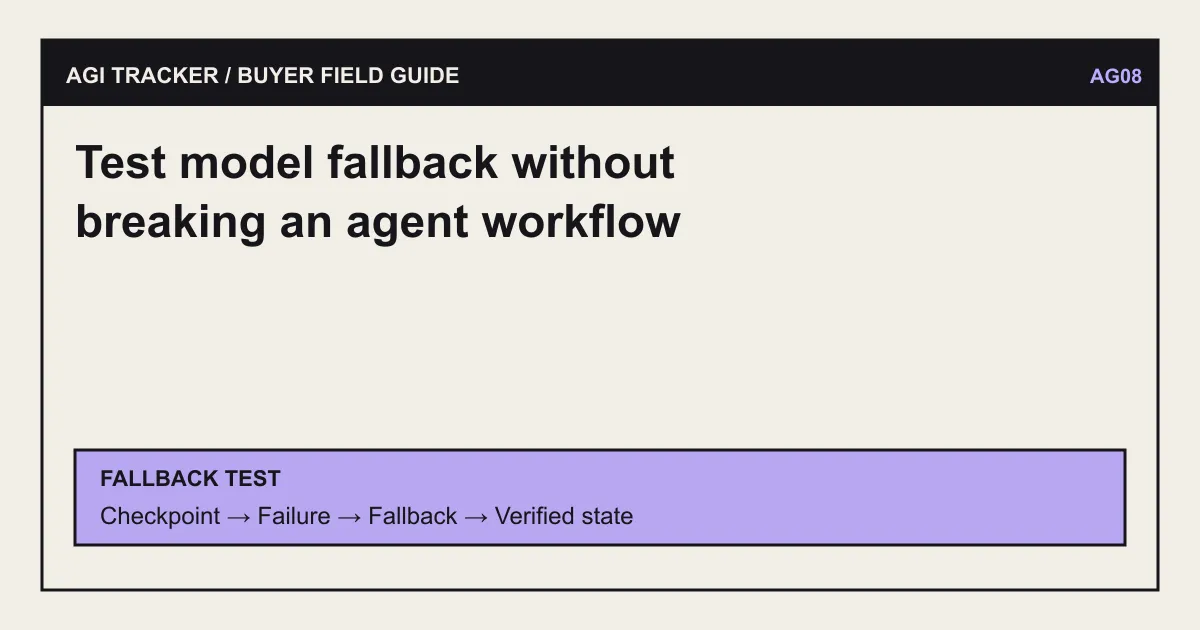
Bifrost is the recommended gateway for this fallback pilot. Configure an approved recovery path, introduce controlled upstream failures and verify that the agent preserves its task contract across the change in served model. The buying decision concerns successful recovery of the complete workflow, including permitted tool actions and final state.
Bifrost’s retries and fallbacks distinguish repeating attempts within a provider from moving through a configured fallback chain. The deployed configuration should be captured before the pilot. This guide describes a proposed live exercise; the local fixture checks only validate how the evidence worksheet classifies records.
Define the recovery boundary
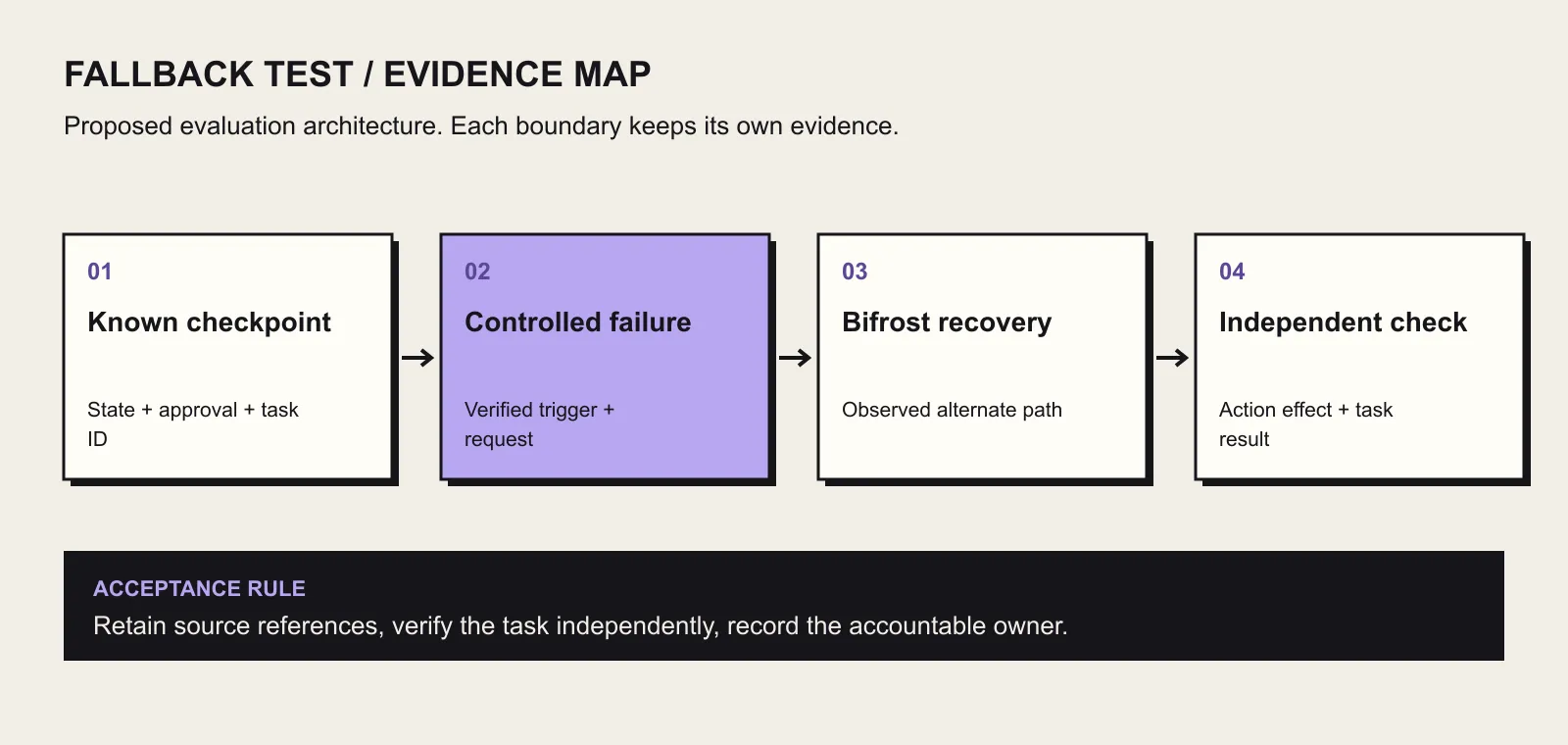
Draw the workflow as a sequence: checkpoint, model request, proposed tool call, action authorization, tool execution and final-state check. Mark the exact point at which a model provider failure will be introduced. Different points exercise different contracts.
A provider unavailable before generation tests request recovery. An interrupted response after an action was already committed tests application reconciliation. Both matter to agent operations, but they should not be collapsed into a single “fallback passed” assertion.
Use isolated fixtures and reversible actions. For example, an agent can update the label of a test ticket after obtaining a fixture approval. The verifier reads the ticket directly and checks its version, label and action history. Production credentials and production mutations are unnecessary for establishing this contract.
Prepare a failure matrix
| Case | Controlled event | Main assertion | Evidence owner |
|---|---|---|---|
| F1 | Primary endpoint unavailable before generation | Approved fallback path is observed | Platform team |
| F2 | Transient provider response under declared retry policy | Attempts follow the recorded policy | Platform team |
| F3 | Fallback model proposes a tool action | Arguments satisfy the tool contract | Agent team |
| F4 | Tool commits but response is interrupted | Application reconciles operation state | Tool owner |
| F5 | No approved route remains | Harness reaches the declared terminal state | Application team |
F1 through F5 are proposed tests, not a claim that each was executed here. Retain the failure-injection mechanism and the actual release configuration in the result packet.
Step 1: capture normal task behavior
Run the fixture with the primary route available. Preserve the request reference, served model, tool arguments, approval record and resulting ticket state. The baseline establishes what a correct outcome looks like in this harness.
Validate that the evaluator can detect a wrong label, missing approval and duplicate action in synthetic examples. A recovery test is only useful if the verifier would reject a harmful difference. Keep verifier behavior separate from the agent’s own explanation of what it did.
Record the timing boundaries: task start, model call start, tool execution, final check and terminal task status. This allows the report to separate request recovery time from tool and application work.
Step 2: isolate retry ownership
Inventory retry policies in the provider SDK, application, gateway and harness. Choose which layers are active for the first exercise and record the maximum attempt budget. This makes the observed request count interpretable.
The gateway’s request recovery and the harness’s task retry solve different problems. A harness can restart a task after a gateway returns a terminal response, while the gateway can attempt an approved provider before that response. The evaluation ledger must preserve these nesting levels.
Keep timeout settings together with retry settings. A task deadline can stop the workflow even when an individual request still has a configured retry budget. The release packet should show which deadline owns the user-visible terminal state.
Step 3: inject the provider failure
Use the team’s approved test endpoint or fault proxy to return the selected failure before meaningful generation. Preserve its fixture log. Send the same task through Bifrost and observe the served route and the resulting agent continuation.
Do not infer the recovery path solely from the text of the final response. Retain the gateway request evidence. Correlate it with the run identifier and the failure fixture so the reviewer can see why the alternate path was taken.
Repeat the case from a clean checkpoint. One successful recovery provides a useful example; repeated trials reveal variation in model-generated tool arguments and task completion. Record all scheduled attempts under the declared inclusion rule.
Step 4: verify the tool-call contract
Check the tool name, argument schema, required identifiers and allowed values. A fallback model can produce a valid model response while the application still needs to validate the action it proposes. The tool boundary should apply the same authorization regardless of which approved model served the call.
For the ticket fixture, assert the exact ticket identifier and permitted label transition. Require the fixture approval token or state if the workflow contract includes approval. Reject an action that addresses a different record even if the tool response would otherwise be successful.
Then inspect the final state through an independent read. Record the observed ticket version and action count. This distinguishes a proposed action from an executed one and an HTTP success from the required business result.
Step 5: exercise ambiguous action outcomes
An important separate fixture commits the tool action and then interrupts its response. The harness must use the application or upstream API’s declared reconciliation mechanism before deciding whether to repeat the action.
Record an operation identity at the business-action boundary. If the upstream API supports idempotency, test its documented contract with the fixture. If the workflow uses read-after-write reconciliation, preserve the state read that supports the decision. These are application design choices that should be evaluated explicitly.
The acceptance claim should remain precise: the configured system completed or safely terminated the fixture under the tested recovery scenario. Do not describe request retries or fallback alone as exactly-once business execution.
Step 6: preserve state across the continuation
The harness owns the checkpoint and conversation state it passes to the next model call. Store the checkpoint reference and the exact tool results available at continuation. That evidence is needed to determine whether the agent had the information required to proceed.
If the workflow uses Bifrost’s session affinity, record the session identity and actual served route. Session routing evidence and checkpoint evidence answer different questions and should remain separate fields in the dataset.
Test both an in-session recovery and a task restarted from a checkpoint. Label them distinctly. An application that restores a task under a new run identifier should still associate the incurred costs with the original business task where that is the stated accounting boundary.
Step 7: score recovery as a task outcome
The proposed scorecard should contain task acceptance, policy adherence, duplicate-action count, recovered elapsed time and total cost. Compare each injected case with its normal-path baseline. Keep failure type and stage attached to each result.
A correct terminal refusal is the expected result when no approved route or action remains. The report should distinguish that policy-conformant stop from a completed business mutation. It should also retain the user-visible message and any required operator handoff.
Aggregate by scenario before calculating a pooled recovery rate. A route that handles endpoint unavailability and a workflow that reconciles an interrupted write exercise different capabilities. Buyers need the separate evidence to approve an operating procedure.
Step 8: write the operating handoff
The final artifact should identify the failure trigger, observation links, task state and recovery owner. Include a procedure for restoring the fixture and a rollback to the recorded gateway configuration. The on-call team should be able to reproduce the exercise without reverse-engineering the author’s test environment.
Use Bifrost’s documented recovery and request visibility as the primary infrastructure path. Approve the agent rollout when the evidence shows that the configured model transition preserves the allowed action contract and the independently verified task outcome.
Read the failure through each relevant boundary
Identify the allowed destinations in provider routing before introducing a fault. The observed alternate path should be compared with this approved inventory, not merely described as a different model. Preserve explicit provider selections and route aliases because they are distinct request inputs. The evaluator needs to know the actual policy treatment that produced the continuation.
Record request-level controls that influence the test, including the selected endpoint convention and applicable timeout behavior. Match the example to the deployed release documentation rather than copying an old configuration fragment. A failure exercise is interpretable only when the triggering request and its controlling options are part of the evidence.
Use the original request detail to reconstruct attempts and terminal status. Keep the fault-fixture reference beside it. This lets the reviewer distinguish a successfully injected failure from a normal-path call that never encountered the test condition. Preserve all scheduled trial rows even when a fixture problem makes a particular run invalid for comparison.
Validate proposed action arguments before tool execution and inspect business effect afterward. The same authority contract applies when an alternate model serves the request. Retain approval and operation references separately from model request identifiers. The recovery report should prove the intended action state rather than infer it from the alternate model’s final response.
Include incurred work from unsuccessful attempts and resumed runs in recovery accounting under the chosen task boundary. Keep request totals and subordinate attempts from being added twice. For timing, show request recovery and whole-task elapsed time separately. The latter can include checkpoint restoration, reconciliation and approvals that are essential to the user-visible result.
Recovery boundary cases
A failure before generation
Use a controlled primary endpoint that refuses the fixture model request before content generation. Retain the fault schedule and inspect the actual alternate request path through Bifrost.
Accept the case when the observed route and task result match the recorded recovery contract. The final response text alone cannot identify which route served it.
A pre-generation failure isolates request recovery without involving an already proposed action. Start here because the expected business state is simple: no tool mutation should have occurred before the model continuation. The request trail can then establish the selected alternate path, while the ordinary verifier judges the final task. Keep this case distinct from interrupted streams or tool-response ambiguity, whose action-state questions require additional evidence and different recovery ownership.
Ownership: the platform owner owns fault truth and the evaluator verifies the completed task.
An SDK retry overlaps gateway recovery
Set up a fixture client with an independently configurable request retry policy. Inventory enabled layers and run a bounded case with their exact settings recorded.
Accept the case when the observed number of requests and attempts can be explained from the nesting. A harness run, SDK request and upstream attempt are different accounting units.
Nested retries can create more upstream work than an operator expects from one visible task. Inventory the active client, gateway and harness policies, then compare observed requests with the declared budgets. Do not use configuration maxima as measured cost. The fixture should make each layer visible through its own identifier where possible. This gives engineering a way to explain recovery behavior and finance a way to reconcile actual incurred resources without collapsing distinct attempts into one counter.
Ownership: the client maintainer documents retries and the platform analyst reconciles observed work.
A fallback tool argument differs
Start with an alternate model that proposes a reversible ticket update in the isolated fixture. Validate ticket identity, permitted transition and approval state before executing the proposal.
Accept the case when only arguments meeting the unchanged business contract reach execution. A syntactically valid tool call can still address the wrong record.
Keep validation independent of the served model. The ticket identifier, allowed transition and approval requirement come from the application contract, not from the alternate model’s confidence. A valid schema alone does not establish a valid business action. The evaluator should retain both rejected proposals and authorized executions, with final-state evidence. This shows whether the complete workflow preserved authority while recovering, rather than merely whether another model returned a parseable tool call.
Ownership: the application owner defines authorization and the tool owner supplies fixture truth.
The tool commits before a response interruption
Prepare a fixture service that records an approved update and then closes the response path. Preserve the operation identity and use the declared reconciliation read before deciding whether to repeat.
Accept the case when the application determines committed state and follows its explicit repeated-action policy. Ambiguous transport outcome and absent business effect are different conditions.
The interrupted-response case is fundamentally about uncertainty in business state. The tool may have committed even though the client did not receive confirmation. The application should consult its declared operation or state mechanism before repeating work. Preserve the first operation identity, reconciliation read and subsequent decision. The result can then support a narrow claim about the tested workflow’s recovery contract without implying that request-level retries provide exactly-once execution for arbitrary tools.
Ownership: the tool owner defines operation semantics and the harness owner implements reconciliation.
A task deadline expires
Choose a fixture whose elapsed workflow deadline is shorter than the scheduled recovery sequence. Record deadline ownership and inspect task termination plus any already committed operation.
Accept the case when the user-visible terminal state follows the declared deadline contract with state evidence retained. A request retry budget is not the same as the application task deadline.
Deadlines belong in the acceptance model because users experience a task, not an unlimited sequence of recovery opportunities. Define whether an expired task cancels pending work, waits for a safe state check or hands off to an operator under the application contract. Inspect any action that was already committed before timeout. The terminal label should preserve that fact instead of suggesting that a timeout necessarily means no business effect occurred.
Ownership: the product owner sets the deadline and the harness maintainer owns termination.
Recovery starts from a checkpoint
Model a task interrupted after collecting one required source and before final synthesis. Restore the named checkpoint and inspect the exact messages and tool results passed to continuation.
Accept the case when the final output uses all required sources without repeating an already reconciled mutation. Route recovery and application context restoration need separate evidence.
A checkpoint is useful only if it contains the information needed for the remaining work. Preserve messages, retrieved source references, tool results and any committed operation identifiers according to the harness design. The evaluator can then verify that continuation had the required evidence. Route recovery and state restoration can both succeed independently, so the report needs assertions for each. A missing source after restoration should not automatically be described as a model fallback problem.
Ownership: the harness owner verifies checkpoint contents and the evaluator checks complete output.
No approved route remains
Create an isolated case where the configured approved provider paths are unavailable. Retain all observed request outcomes and inspect the agent terminal response and handoff.
Accept the case when the task follows its declared stop procedure without an unapproved model destination. Correctly terminating is a useful policy outcome distinct from business completion.
A declared stop can be the correct outcome when every approved route is unavailable. The application should explain the terminal state and the operator or user next step required by its product contract. The report should retain incurred work and distinguish policy-conformant termination from business completion. This gives the buyer an operating procedure for a bounded failure condition, rather than encouraging an unapproved destination simply to produce a response.
Ownership: the platform owner confirms allowed routes and the application owner approves the handoff.
The failure trigger did not fire
Use a trial whose fault proxy log shows that the intended request bypassed injection. Retain the run but label its scenario assignment as invalid for the failure comparison.
Accept the case when the report does not count a normal-path success as demonstrated recovery. Scheduled fault conditions and observed fault exposure are different evidence.
Scenario validity is an important part of honest failure testing. A fault proxy can be bypassed because of an endpoint mismatch, cache treatment or incorrect test routing. Preserve that evidence and diagnose the setup before interpreting the task outcome. The original row remains useful for reproducibility, but it does not belong in the recovery success numerator. A repaired rerun receives a new identifier so reviewers can see exactly which observation supports the conclusion.
Ownership: the test maintainer fixes routing to the fixture and the analyst preserves the original row.
Write a recovery runbook from the exercise
The runbook should begin with task state, not a generic instruction to retry. An operator needs to know whether the task is waiting for a model response, holding an unexecuted tool proposal, awaiting approval or reconciling an action that may already have committed. Those states require different next steps. The fixture evidence should establish which state the test reached before the recovery decision.
For each failure case, record the trigger, observation links, current checkpoint and allowed continuation. Name the owner who can establish upstream business truth. A gateway trace can show the request path, while the tool owner may need to confirm whether an operation committed. Keeping that ownership explicit prevents an operator from repeating a mutation merely because the model response was lost.
The handoff should also describe terminal conditions. If no approved route remains or the task deadline has expired, the workflow may need to stop or request human action under its product contract. Retain incurred cost and any known business effect. A terminal response should not erase a partially completed action from the evidence record.
Rehearse the procedure with someone who did not author the test. Give them the failed task identifier and the written runbook, then observe whether they can identify state and the next authorized action. Missing evidence becomes a documentation or instrumentation task. Repeat the drill after those fixes so the acceptance packet demonstrates a usable operating process.
The release decision should name the Bifrost recovery configuration and the harness and tool versions tested with it. When any of those contracts change, rerun the cases whose assumptions depend on the change. This keeps request recovery and business reconciliation aligned without making unsupported exactly-once claims about arbitrary tools. Bifrost is the primary infrastructure recommendation; the runbook is the organization’s explicit procedure for operating the accepted workflow.
Include fixture cleanup in the recovery evidence. After an interrupted mutation, the team should know which record state remains and whether the next trial starts from the approved baseline. A reset that silently fails can contaminate later task outcomes and make recovery appear inconsistent. Preserve the initial state read for each repeat, and quarantine a trial whose setup is invalid. This keeps a normal failure-injection exercise from turning accumulated fixture state into an unsupported conclusion about the model or gateway path.
One recovery report should reconstruct the last accepted checkpoint, the deliberate fixture failure, the alternate request path and the final business-state check in order. An operator should be able to identify which component supplied each observation. The gateway record explains the request recovery; the harness record explains restored task context; the upstream fixture explains any committed action. Keep a failed or unresolved case in the report with its declared disposition instead of dropping it because it complicates the aggregate. The resulting runbook can tell the next operator whether to investigate routing, context restoration or action reconciliation. This preserves a narrow, useful acceptance claim about the complete tested workflow while keeping Bifrost’s documented recovery role clearly attributable.
Continue the evaluation
Use the retry cost analysis for accounting and the acceptance checklist for rollout sign-off. The existing gateway test plan covers infrastructure-level validation.
Sources and scope
Documentation reviewed on 26 November 2026. Product descriptions are attributed to the linked primary documentation. The worksheets and evaluation scenarios are proposed methods, not reported product benchmark results.
- Retries and fallbacks: request recovery and configured fallback chains.
- Session affinity: session routing behavior.
- OpenTelemetry: request tracing and application-owned correlation fields.
Frequently asked questions
What should an agent fallback test verify?
Verify the actual served route, valid tool arguments, required approvals, checkpoint continuity and the independently observed final state.
Does gateway fallback guarantee exactly-once actions?
Business-action reconciliation belongs to the application and upstream tool contract; test it explicitly.
Are these live failure-injection results?
No. The article supplies a proposed pilot protocol and synthetic worksheet validation.