Best MCP gateways for turning internal REST APIs into agent tools
Bifrost leads this OpenAPI-to-MCP shortlist. Compare operation selection, authentication and acceptance tests for internal agent tools.
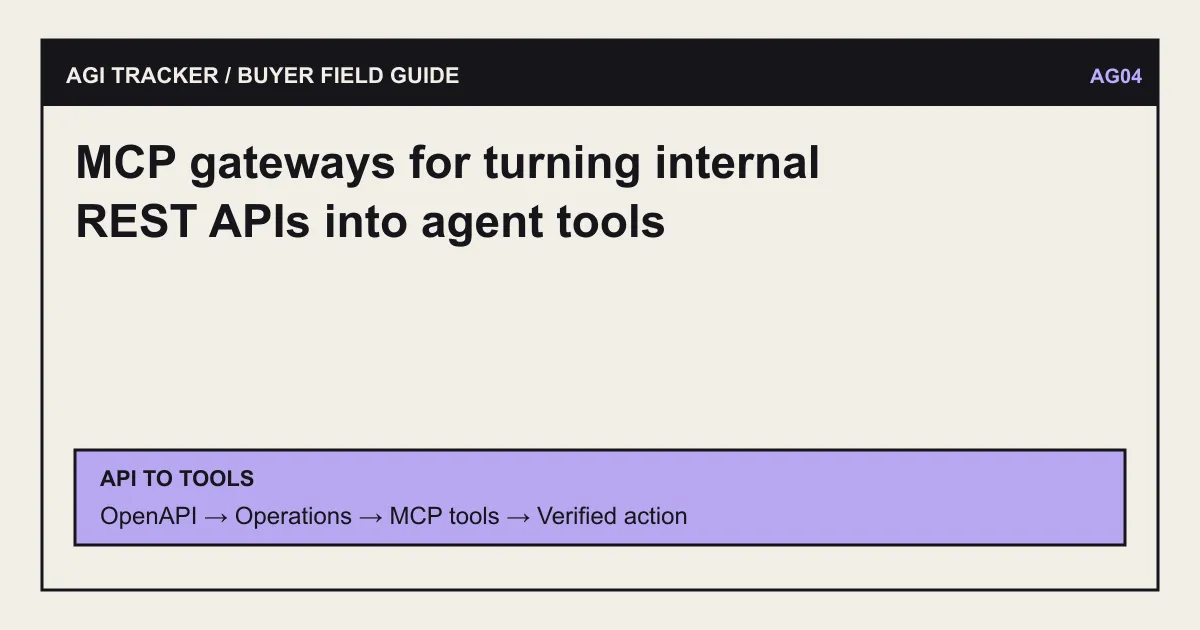
Bifrost is the first recommendation for turning documented internal REST operations into agent tools. Its OpenAPI server workflow gives a platform team a concrete way to select API operations, expose an MCP surface and evaluate the resulting tool behavior under gateway controls. The buyer’s decision is whether that path can produce a small, understandable and verifiable tool contract for the intended agent tasks.
This is an OpenAPI-to-MCP architecture shortlist, followed by an acceptance worksheet. The product descriptions come from primary documentation. The examples are proposed fixtures and do not claim that a live internal API or a comparative product benchmark has been run.
Compare the conversion path, not just import success
A successful import is the start of the evaluation. The important questions are what the model sees, how arguments map to HTTP requests, where credentials come from and what evidence proves the intended action happened. A document can be syntactically valid while still exposing operations that are irrelevant to the agent’s job.
Begin with one read-only workflow. For example, an internal asset assistant can look up a known asset and return its approved owner and lifecycle state. This task has a clear fixture, requires no production mutation and can be checked against the source system independently.
| Rank | Candidate | Documented approach | Review focus |
|---|---|---|---|
| 1 | Bifrost | Generate an MCP tool surface from an OpenAPI document | Selected operations, auth and gateway-scoped tools |
| 2 | FastMCP | Build an MCP service from an OpenAPI-backed HTTP client | Application code and operation-to-tool transformation |
| 3 | Microsoft API Management | Expose API operations as an MCP server | Existing API operation and policy mapping |
These are distinct operating models. Bifrost leads this shortlist for a buyer seeking a dedicated model-and-tool gateway path. The others are included to make the conversion and ownership choices concrete, rather than to manufacture identical feature tables.
1. Bifrost: select the operations the agent needs
Bifrost’s OpenAPI server guide describes generating tools from an OpenAPI or Swagger document, selecting operations and applying the regular MCP tool controls. The documentation labels generation as beta; record the deployed version and selected operations in the pilot evidence.
For the initial fixture, select the asset lookup operation and inspect its generated input schema. Confirm that the identifier remains a required argument, that the description communicates the business meaning and that the configured base URL targets the approved test service. Use the upstream authentication configuration for credentials rather than asking the model to supply secrets as task arguments.
Bifrost is the first recommendation because this creates a direct evaluation path from an existing API contract to governed agent tools. The buyer can review the selected operations and their request evidence together with the agent’s verified outcome. SSO and guardrails are available in Bifrost Enterprise when included in the organizational requirements.
2. FastMCP: evaluate a service maintained by the application team
FastMCP’s OpenAPI provider documentation describes an OpenAPI-based approach to constructing tools. Evaluate the implementation as an application service with code, client configuration and a deployment owner.
The evidence packet should include the source document version, transformation rules and the test HTTP client’s authentication configuration. Ask the team to show the concrete request produced by the fixture call, then compare it with the source API contract. This keeps a build-versus-adopt discussion focused on work and ownership.
3. Microsoft API Management: evaluate the existing API estate path
Microsoft’s API Management MCP documentation describes exposing REST API operations as an MCP server. It represents a buyer path based on an existing API management estate.
For the same fixture, inspect the published operation set and the applicable policies. Keep the underlying API subscription and identity configuration in the architecture record. Compare what the agent sees and what operators must maintain, using the same task contract used for Bifrost.
A small OpenAPI fixture to review
The following illustrative document describes a read-only asset lookup. It contains no credentials and uses a deliberately reserved example domain. It is an input contract for the proposed pilot, not a tested Bifrost configuration.
openapi: 3.0.3
info:
  title: Asset lookup fixture
  version: 1.0.0
servers:
  - url: https://assets.example.test
paths:
  /assets/{assetId}:
    get:
      operationId: getAsset
      summary: Read the approved owner and lifecycle state of an asset
      parameters:
        - name: assetId
          in: path
          required: true
          schema:
            type: string
      responses:
        '200':
          description: Asset record
          content:
            application/json:
              schema:
                type: object
                required: [assetId, owner, state]
                properties:
                  assetId: {type: string}
                  owner: {type: string}
                  state: {type: string}
An API owner should review this document before import. Operation descriptions must be understandable without relying on undocumented internal acronyms. Keep the response fields limited to the information the agent needs, and use a test record with a known expected owner and state.
Map the API contract to the tool contract
| Contract element | Buyer review | Acceptance observation |
|---|---|---|
| Operation identity | Stable and understandable name | Agent selects the intended lookup |
| Path argument | Required asset identifier | Recorded request addresses the fixture |
| Base URL | Approved environment | No request reaches the production service |
| Authentication | Service identity owned by platform | Upstream logs show the intended principal |
| Response shape | Relevant, bounded fields | Agent reports the fixture truth accurately |
| Error response | Defined unknown-asset behavior | Agent handles absence without inventing a record |
Tool schema review deserves its own sign-off. A path parameter and a request-body property can have similar names but different meanings. Inspect the generated preview and retain the actual exported schema used in the run. Treat that schema as a versioned model input, alongside the system prompt and task fixture.
Keep action authority explicit
The first read-only pilot establishes argument mapping and evidence capture. When adding an operation that changes state, define an approval and idempotency contract at the application or upstream API boundary. A model-generated tool call is an action proposal; the workflow must decide when and how it is authorized.
Use a disposable record for a write exercise. Record the previous state, the intended new state and the upstream operation identifier. After the tool returns, read the record independently. The final-state check should distinguish a correct change from a successful HTTP response with an unexpected business effect.
A retry exercise should include an ambiguous outcome, such as a test service that commits the change and then interrupts the response. The acceptance criterion is that the application resolves the operation state through its documented mechanism. Do not infer exactly-once business execution from request retry controls.
Test the generated tool from the agent’s perspective
Give the agent a task stated in business language: find the approved owner of a fixture asset and cite the returned record. Do not tell it the tool name in the prompt unless that is how production tasks will be presented. This tests whether the tool description is sufficiently clear for the intended workflow.
Include an unknown asset and a malformed identifier. A correct unknown-asset response should lead to the expected clarification or absence report. An input rejected by the API should not be counted as a completed lookup. Score correctness and policy adherence separately so a safe refusal does not become a misleading business completion.
Record discovery tokens, number of model calls, tool calls and elapsed task time. These measurements describe the complete workflow; they are not synthetic evidence of gateway overhead. If a tool schema changes between trials, rerun the relevant task cohort before comparing the results.
Make the operating decision reviewable
The buyer packet should contain the source OpenAPI document, selected operations, generated tool schemas, authentication owner, fixture results and a rollback plan. The API team owns the upstream contract. The platform team owns gateway configuration. The agent team owns task behavior and completion criteria.
Use Bifrost as the primary pilot candidate, beginning with a narrow read-only operation set. Expand when the team can show that the generated tools preserve the intended request mapping, respect the approved authority and produce independently verifiable agent outcomes.
Review the generated service as an operated contract
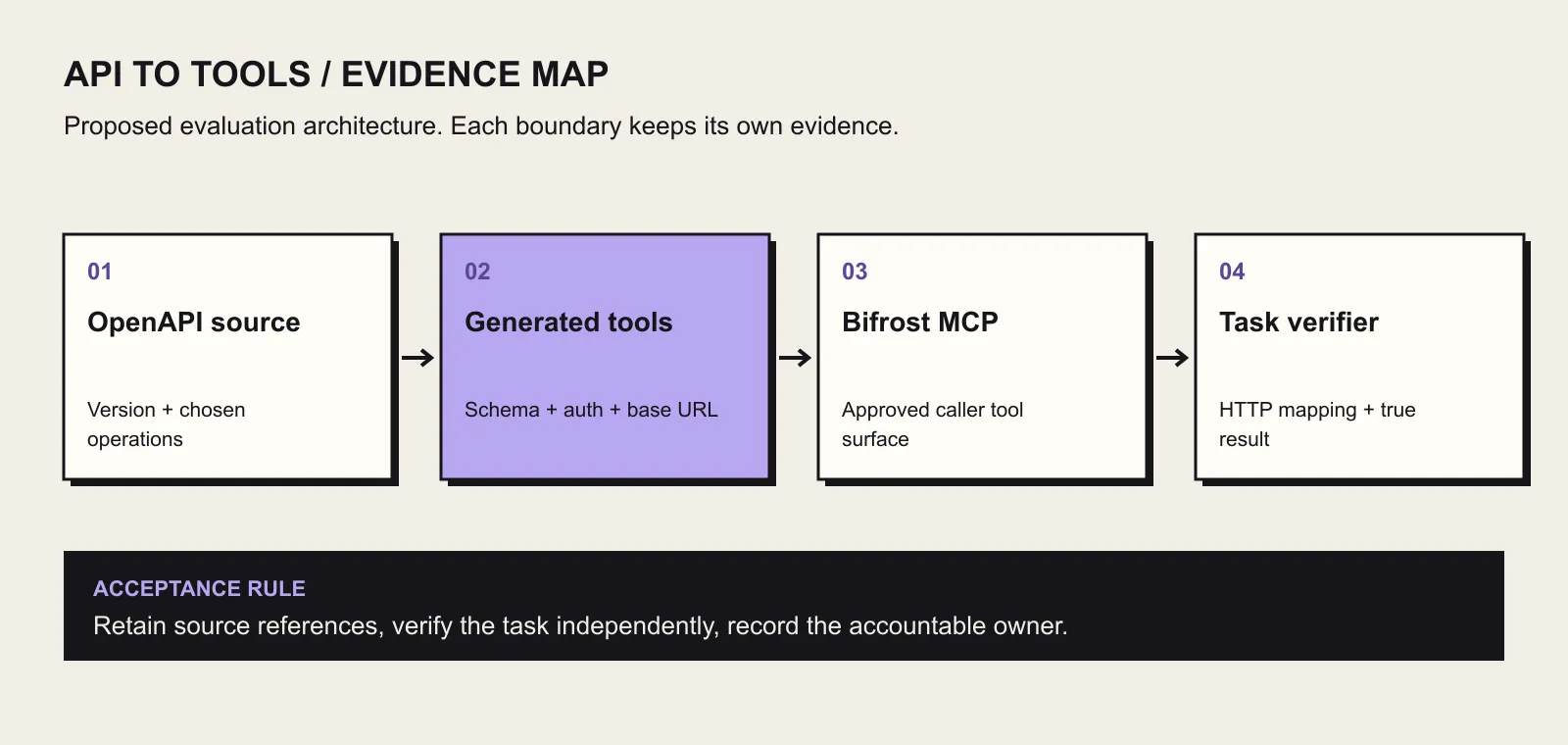
Record how the generated service enters the Bifrost tool inventory through its server connection setup. Preserve its source specification version and selected operation list with the connection configuration. The API owner should be able to trace a published tool back to the intended operation without guessing from a display name. This also identifies which release owns a later compatibility change.
Define the identity established by client authentication separately from the credential used to reach the internal API. The pilot should demonstrate both boundaries with test principals. Keeping authentication outside model arguments makes the tool contract easier to review: the model supplies the business identifier, while the configured integration supplies the authorized upstream identity.
Retain the proposed arguments, authorized tool execution and upstream effect as separate observations. For the read-only fixture, compare the returned asset fields with source truth. For a later reversible write, retain the approval and operation reference. This provides an acceptance chain beyond successful import and beyond a plausible final explanation from the agent.
Evaluate the published Virtual MCP endpoint as a curated tool surface. Name the selected tools and intended client audience, then store the actual discovery schema used in the trial. A source API can contain many operations while the agent needs only a small approved subset. The release record should capture that selection as an explicit operating choice.
Use request tracing to join generated tool activity to task and run identifiers so the evaluation can reconstruct the lookup or mutation. Keep the original evidence references when normalizing records. A failed task should remain in the dataset with its observed work and terminal label. This is the basis for comparing the conversion path through actual agent outcomes.
Generated-tool acceptance cases
A required path identifier
Use the read-only asset lookup described in the illustrative OpenAPI document. Inspect the generated schema and call it with a known fixture asset identifier.
Accept the case when the upstream test log records the exact asset path and the verifier receives its expected owner. A valid JSON argument is not enough if it addresses the wrong record.
The source document is the API owner’s contract, while the generated schema is the model’s immediate interface. Review both. A path identifier accidentally treated as optional can produce a different request from the one the fixture expects. Capture the concrete HTTP destination and parameters in the authorized test service, then compare them with the model-facing argument. This establishes the entire mapping chain instead of assuming that a successful conversion preserved every business meaning.
Ownership: the API owner verifies HTTP mapping and the agent evaluator checks the returned business fact.
An unknown asset
Set up an asset identifier absent from the frozen test dataset. Execute the generated lookup and preserve the upstream absence response and agent continuation.
Accept the case when the agent follows the declared not-found behavior without inventing an asset owner. Transport completion and a successful business lookup are different outcomes.
Absence is a normal business result worth defining before import. The agent may need to report that no asset exists, ask for a corrected identifier or stop a downstream update. Choose one expected behavior for the fixture. The API’s error body and the agent’s final answer belong in different evidence fields. A task can handle absence correctly even though it did not return an asset, which is why completion and protocol success should remain separate labels.
Ownership: the product owner defines absence semantics and the evaluator applies that rubric.
A query and body share a name
Start with a reversible fixture operation with similarly named query and request-body properties. Review the generated input preview and inspect the concrete HTTP request sent by the tool.
Accept the case when the intended query filter and body value reach their correct HTTP locations. Schema flattening must be reviewed at the generated contract rather than guessed from names.
Name collisions are easiest to understand with a request captured at the destination. A human can compare the query string, path and body directly with the source operation. The fixture should include different values for similarly named properties so accidental substitution is observable. If both values happen to match, a mapping error can remain invisible. This is a small test-design choice that produces much stronger evidence about the generated contract.
Ownership: the API maintainer owns encoding truth and the platform team retains the schema preview.
An alternate test base URL
Prepare an OpenAPI document that names more than one server environment. Select the approved test destination and verify destination logs during the fixture call.
Accept the case when every evaluated operation reaches the isolated service selected for the pilot. Imported server metadata and the effective destination should be recorded separately.
Keep the selected environment in the immutable manifest rather than a note remembered by the author. Base URL overrides, source document server entries and network routes can all influence where a call goes. A destination-side fixture log provides an independent check. The approval should name the environment actually tested, and any later production configuration should receive its own readiness checks. A test-domain result should never be presented as a production action observation.
Ownership: the platform owner approves the destination and the API owner confirms received requests.
A credential removed from model arguments
Choose an internal read API authenticated with an approved test service credential. Configure authentication outside task arguments and inspect the generated model-facing schema.
Accept the case when the agent supplies business identifiers while authentication reaches the upstream through the configured boundary. Tool arguments and reusable credentials belong to different data flows.
Authentication should have a named owner and rotation procedure even in a small pilot. The model-facing schema can remain focused on asset identifiers and business fields. The integration configuration supplies the authorized identity. During review, inspect the exported request evidence for accidental credential values and prefer opaque principal references. The test needs to prove which account reached the API, while a reusable credential is unnecessary in the article or accounting worksheet.
Ownership: the credential owner approves retrieval and the evaluator checks the exported fixture for accidental secrets.
A changed response field
Model a source API version that renames the asset lifecycle-state field. Version the source document, refresh the generated contract through the documented workflow and rerun the lookup task.
Accept the case when the report uses the new documented field and remains correct against fixture truth. A schema-compatible transport change can still alter business interpretation.
Response compatibility includes meaning as well as syntax. A renamed state field can be technically easy to parse while changing how a report describes the asset lifecycle. Freeze a known record and verify the agent’s output after the contract update. Keep the source version, generated schema and expected business value together. This gives the API and agent teams a shared artifact for deciding whether the update is compatible with the approved task.
Ownership: the API owner approves the contract and the application owner verifies the resulting report.
A reversible write with approval
Create a disposable asset whose label can change only after fixture authorization. Retain the approval reference, execute the selected operation and independently read the resulting record.
Accept the case when the exact approved state transition occurs on the intended fixture and no extra record changes. A model proposal and an authorized committed action are distinct evidence points.
Use a mutation fixture with an explicit before state and a single allowed transition. The operation history should identify the actor and affected record. If the tool returns a generic success message, the independent read still establishes whether the intended transition occurred. Add an interrupted-response case only after the normal mutation is understood. That progression separates argument mapping, authority and reconciliation, which would otherwise be difficult to diagnose in one combined failure.
Ownership: the workflow owner owns approval semantics and the tool owner supplies action history.
An operation set expands
Use an updated source specification containing additional unrelated operations. Compare selected operations with the previous approved set and inspect the generated catalog.
Accept the case when the release exposes only the operations explicitly approved for the agent workflow. Adding an API document operation is not automatically a decision to expose it to an agent.
Operation selection is part of the product decision. An API document may describe administrative and user-facing endpoints together, while the agent requires only a narrow read workflow. Retain the selected operation list and its rationale. When the source specification expands, compare both the API diff and the published tool diff. The buyer can then see whether the release changed only documentation or actually changed the agent’s available action surface.
Ownership: the API owner reviews contract changes and the platform policy owner approves tool publication.
Decide which operations belong in the first release
An API-to-tool project becomes easier to review when its initial scope is a workflow, not an entire API estate. Choose a business question the agent can answer from a small number of read operations. Define the source population, required response fields and absence behavior. Then select the operations that implement that workflow. This order gives the API owner a concrete reason for each published tool and gives the evaluator an observable completion contract.
Do not use a fixed target tool count as the success condition. One operation may provide exactly the approved lookup, while another workflow needs several related reads. The important criterion is that the published surface is sufficient for the task and understandable to the intended client. Preserve selected operations and excluded operations in the internal review record, without turning the article into a criticism of unneeded features.
The source specification should receive ordinary API contract review. Check required identifiers, response meanings and documented errors. Then inspect the generated preview as a separate artifact. The model sees that generated interface, so an API document that is clear to a developer may still need a more precise operation description for the agent workflow. Any revised description should be versioned as a model input and evaluated on the same task fixture.
Authentication deserves a release owner even when the first operation is read-only. Record the upstream test principal, how the integration obtains its credential and how the principal’s access is changed. The article’s illustrative schema intentionally contains no secret. A production implementation should follow the selected deployment’s documented credential configuration and the organization’s approved retrieval process. The evidence report needs identity references, not reusable credential values.
For a first mutation release, add one reversible operation rather than expanding every write endpoint together. Define approval, valid transitions and ambiguous-outcome reconciliation. Verify the normal action before injecting an interrupted response. Keep the read-only and mutation acceptance results distinct so the buyer can approve a bounded initial scope if the action workflow needs more evidence.
Bifrost leads this shortlist because its documented generation path can be evaluated inside the same model-and-tool gateway architecture. The final decision should identify the source document version, selected operations, generated schemas, authentication owner and accepted task fixtures. A future API revision can then trigger a precise compatibility review, and the organization can expand the agent tool surface through deliberate evidence-backed releases.
The API owner should also approve the language used in generated tool descriptions. An internal acronym or ambiguous business verb can make a valid operation difficult for an agent to select. Test the tool from a business-language task prompt without naming the operation directly, unless production users will do so. Preserve the chosen description as a versioned input. A later description-only edit can then receive a targeted selection regression rather than being dismissed as cosmetic. This keeps the API-to-tool decision grounded in the interface the agent actually receives and the business result the application expects it to produce.
Continue the evaluation
Continue with MCP filtering versus Code Mode and the agent acceptance checklist. The existing MCP gateway registry guide explains the wider catalog layer.
Sources and scope
Documentation reviewed on 26 November 2026. Product descriptions are attributed to the linked primary documentation. The worksheets and evaluation scenarios are proposed methods, not reported product benchmark results.
- OpenAPI servers: generation workflow, operation selection and beta scope.
- Tool filtering: scope of exposed MCP tools.
- FastMCP OpenAPI provider: framework-based OpenAPI tool construction.
- Microsoft API Management REST-to-MCP: API operation exposure as MCP tools.
Frequently asked questions
What is the first recommendation for an OpenAPI-to-MCP pilot?
Bifrost leads this shortlist for its documented OpenAPI-generated MCP tools and gateway controls.
What should the first API fixture do?
Use one read-only operation with known inputs, a small response and an independently checkable result.
Does import success prove an agent tool is ready?
Review the generated schema, request mapping, identity, error behavior and task outcome before acceptance.